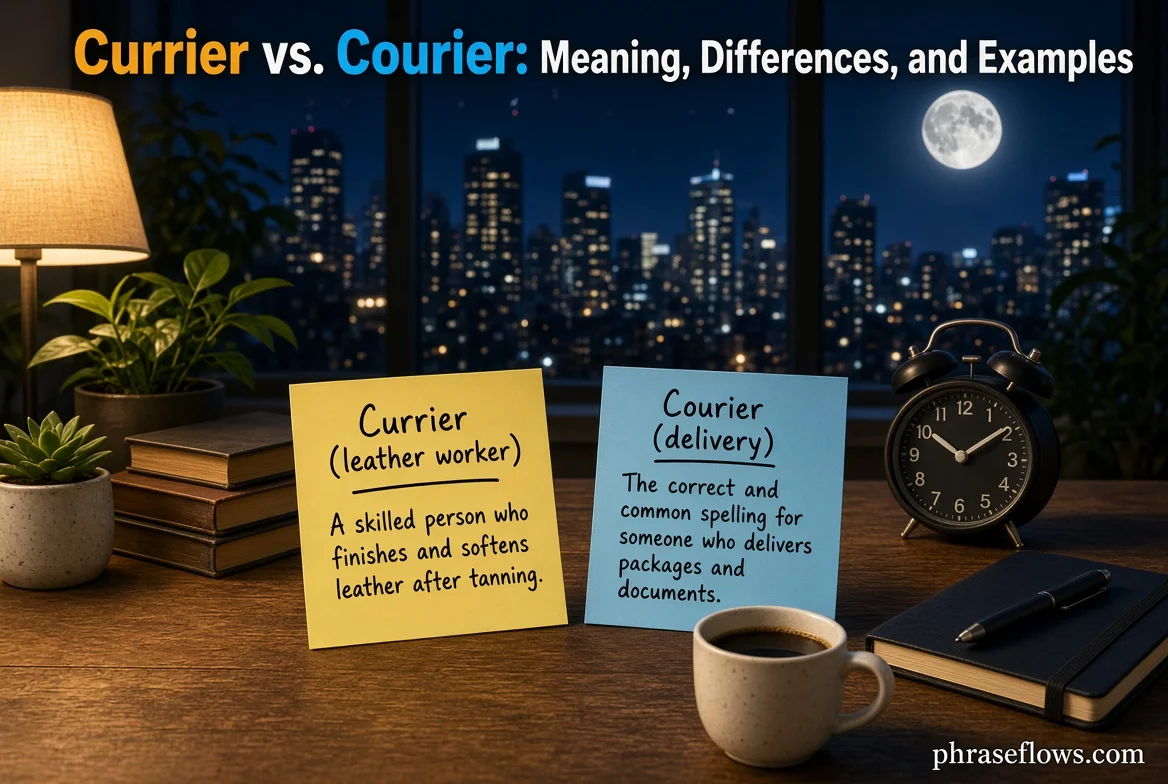

Have you ever confused currier vs. courier while writing? These two words look and sound very similar, so it’s easy to mix them up. However, they have completely different meanings. One relates to package delivery, while the other refers to a traditional trade involving leather preparation. Using the wrong word can change the meaning of your sentence and confuse your readers.
A courier is a person or service that delivers packages, letters, documents, and other items from one place to another. You’ll often see this word in business communication, online shopping, and the logistics industry. A currier, on the other hand, is a person who treats and finishes animal hides to prepare leather for products such as shoes, bags, and clothing. Although the word is less common today, it still has a specific meaning connected to leatherworking.
Understanding Currier vs. Courier: Differences, Meanings, and Correct Usage can help you avoid spelling mistakes and communicate more clearly. In this guide, you’ll learn what each word means, where it comes from, and how to use it correctly. Simple definitions and practical examples will make the difference easier to remember, whether you’re writing an email, completing academic work, or communicating in everyday situations.
Currier vs. Courier: Quick Comparison
The easiest way to understand currier vs. courier is to compare their meanings and everyday applications. Although the words share several letters, their definitions have little in common.
- Currier: A person who treats, dresses, and finishes leather after tanning.
- Courier: A person or company that transports packages, documents, letters, or messages from one place to another.
Here’s a quick comparison:
| Feature | Currier | Courier |
| Part of speech | Noun | Noun and verb |
| Meaning | A person who finishes leather | A person or company that delivers items |
| Main field | Leatherworking | Delivery and transportation |
| Common usage | Uncommon | Common |
| Related activity | Treating and preparing leather | Carrying and delivering packages |
| Example | The currier prepared the leather for production. | The courier delivered the documents. |
The most important distinction is their purpose. A currier works with leather, while a courier delivers items. Remembering these two basic definitions will help you choose the correct spelling in most situations.
What Does Currier Mean?
Currier is a noun that describes someone who prepares and finishes leather after the tanning process. This traditional occupation involves treating animal hides to improve their texture, appearance, flexibility, and usefulness.
Leather production involves several stages. After tanning, workers may need to soften, smooth, color, or otherwise finish the material. A currier specializes in these finishing tasks.
For example, leather used in shoes, bags, belts, and other products may require additional treatment before manufacturers can work with it. Traditionally, the currier handled much of this work.
Although the word remains part of English vocabulary, you’ll rarely encounter it in everyday conversations. It’s more likely to appear in historical documents, discussions about traditional crafts, and descriptions of leather production.
Currier as a Noun
The word currier functions as a countable noun. It identifies a person whose occupation involves preparing or finishing tanned leather.
A currier’s work historically helped transform rough leather into a more suitable material for practical products. Depending on the type of leather and its intended purpose, the work could involve several finishing techniques.
These activities might include:
- Softening: Making leather more flexible and comfortable to handle.
- Dressing: Treating leather to improve its surface and overall condition.
- Coloring: Applying color to achieve a particular appearance.
- Finishing: Preparing the leather for its intended use.
- Surface treatment: Improving the texture and appearance of the material.
It’s also worth knowing that dictionaries recognize another meaning of currier: a person who curries horses. In this context, curry refers to grooming a horse with a special comb or brush.
Examples of currier as a noun:
- The currier prepared the tanned hides for the leather workshop.
- A skilled currier understood how to improve the texture of leather.
- The historical record mentioned a currier who worked near the town’s marketplace.
- The currier carefully finished the material before it went to the shoemaker.
Each example connects the word with leather preparation or the traditional occupation.
Historical Meaning and Origin of Currier
The word currier has a long history connected to the leather trade. According to Etymonline, it appeared in English during the mid-14th century.
Its earlier forms came through Old French and ultimately from the Latin word coriarius, meaning a tanner or currier. That Latin term relates to corium, meaning leather, hide, or skin.
Etymology, Origin & Meaning
+1
Historically, leatherworkers often performed specialized tasks. Tanners treated animal hides to make them resistant to decay, while curriers worked on the leather after tanning to improve its condition and prepare it for further use.
These occupations played an important role in traditional manufacturing.
For example, a shoemaker needed suitable leather before making shoes. The currier helped prepare that material so the shoemaker could use it effectively.
The word survives today even though modern leather production uses different technologies, equipment, and specialized job titles.
Currier in a Sentence
Understanding a definition is helpful, but seeing a word in context makes its meaning easier to remember.
Here are several examples of currier in a sentence:
| Example sentence | Explanation |
| The currier finished the leather before it reached the workshop. | Refers to someone who prepares leather. |
| A local currier worked with traditional leather-making tools. | Describes a leatherworking occupation. |
| The museum displayed tools once used by a currier. | Refers to the historical trade. |
| The currier prepared the hide for further processing. | Describes leather preparation. |
| The stable worker acted as a currier of horses. | Uses the less common grooming-related meaning. |
Notice how every example connects currier with leatherworking or horse grooming. None refers to package delivery.
What Does Courier Mean?
Courier is a noun that describes a person or company responsible for transporting and delivering items. These items may include letters, documents, packages, business materials, and other goods.
Unlike currier, the word courier appears frequently in modern English. You might encounter it when ordering something online, sending important paperwork, or arranging a delivery.
For example, suppose you purchase a book from an online store. The seller may arrange for a courier company to collect the package and deliver it to your address.
The person bringing the package is the courier, while the business organizing the delivery provides the courier service.
The word can also describe someone who carries important messages or documents between people or organizations.
Courier as a Noun
As a noun, courier identifies either an individual delivery worker or a business that provides delivery services.
Its meaning depends on the sentence. Sometimes it describes the person physically carrying an item. In other situations, it refers to the company responsible for arranging the delivery.
Common expressions include:
- Courier service: A business that transports and delivers packages or documents.
- Delivery courier: A person who collects and delivers items.
- Motorcycle courier: A delivery worker who uses a motorcycle.
- Courier company: A business specializing in transportation and delivery.
- By courier: A phrase describing delivery through a courier service.
Consider these examples:
- The courier delivered the package to our office.
- We sent the signed agreement through a courier service.
- A motorcycle courier collected the documents in the afternoon.
- The company hired a courier to transport important paperwork.
- The courier company provided a delivery confirmation.
In British English, courier also has another meaning. It can describe someone employed by a travel company to assist tourists during a trip, including helping with travel arrangements and providing information about local attractions.
English meaning – Cambridge Dictionary
+1
Courier as a Verb
One interesting difference between currier vs. courier is that courier can also function as a verb.
As a verb, courier means to send something through a courier service. It commonly appears in business communication, delivery arrangements, and professional correspondence.
For example:
- We will courier the signed documents to your office.
- The company couriered the replacement part yesterday.
- She is couriering the paperwork to the other branch.
- Please courier the original agreement before Friday.
The verb follows regular English conjugation patterns.
| Verb form | Example |
| Base form | Courier |
| Third-person singular | Couriers |
| Past tense | Couriered |
| Past participle | Couriered |
| Present participle | Couriering |
For example, you can write, “The manager couriered the documents yesterday” or “The assistant is couriering the signed agreement today.”
These forms are recognized in major English dictionaries.
Collins English Dictionary
+1
Origin and History of Courier
The word courier has historical connections with messengers who traveled to deliver important information.
Its roots trace through Old French and Italian to the Latin verb currere, meaning to run. The connection makes sense because early messengers often traveled quickly to carry messages between different locations.
Etymology, Origin & Meaning
+1
Over time, the word developed beyond its original association with fast-moving messengers.
It became associated with people transporting letters, official documents, and other important materials. Eventually, its meaning expanded to include modern delivery workers and companies.
Today, couriers operate through different transportation methods, including:
- Motorcycles
- Cars and vans
- Bicycles
- Trucks
- Air transportation for longer-distance shipments
The basic purpose remains the same: moving something from one place to another and delivering it to the intended recipient.
Courier in a Sentence
The best way to understand courier is to examine how people use it in everyday and professional communication.
Here are some examples:
| Example sentence | Explanation |
| The courier delivered my package this morning. | Refers to a delivery worker. |
| We sent the contract by courier. | Describes a delivery method. |
| The company hired a courier for urgent documents. | Refers to someone carrying paperwork. |
| Please courier the original documents to our office. | Uses courier as a verb. |
| A motorcycle courier collected the parcel. | Identifies a delivery worker by transportation method. |
These examples show why courier is the appropriate word when discussing delivery services, transportation, or sending important materials.
Currier vs. Courier: What Is the Main Difference?
The main difference between currier vs. courier comes down to their meanings, occupations, and contexts. Although their spellings look similar, each word describes a separate activity.
A currier works with leather, while a courier transports items from one location to another. One belongs to traditional craftsmanship, and the other relates to delivery and communication.
Consider these two sentences:
- Correct: The currier prepared the leather for the shoemaker.
- Correct: The courier delivered the shoes to the customer.
Both sentences use the correct spelling because each word matches its intended meaning.
Currier vs. Courier: Side-by-Side Differences
The following table highlights the most important differences:
| Category | Currier | Courier |
| Definition | A person who finishes tanned leather | A person or company that delivers items |
| Word type | Noun | Noun and verb |
| Occupation | Leatherworker | Delivery worker or messenger |
| Industry | Leatherworking | Transportation and delivery |
| Historical connection | Leather preparation | Messenger services |
| Frequency in modern writing | Relatively uncommon | Widely used |
| Example | The currier treated the leather. | The courier delivered the parcel. |
One useful way to remember the distinction is to connect each word with its main activity.
Currier means leather preparation. Courier means delivery.
When to Use Currier
Use currier when your sentence discusses someone who prepares, treats, or finishes leather after tanning.
The word is especially suitable in these situations:
- Leather production: When describing someone who prepares tanned hides.
- Traditional craftsmanship: When discussing historical leatherworking occupations.
- Historical research: When referring to leather trades in older communities.
- Horse grooming: When describing someone who curries or grooms horses.
For example:
“The currier examined the leather before sending it to the shoemaker.”
Here, currier identifies the person responsible for preparing the leather. Replacing it with courier would completely change the meaning.
When to Use Courier
Use courier when discussing someone or a company that transports packages, documents, letters, or messages.
Common situations include:
- Online shopping: When a delivery worker brings an order to your home.
- Business communication: When sending contracts or important paperwork.
- Document delivery: When arranging transportation for official records.
- Urgent transportation: When someone needs to deliver an item quickly.
- Travel services: When referring to a person who assists tourists during a trip in British English.
For example:
“The courier delivered the signed agreement to the company’s main office.”
Here, courier is correct because the person transports documents rather than working with leather.
Currier vs. Courier: Spelling Differences
The spelling difference between currier and courier is small but important. Both words contain similar letters, which can make them confusing when you’re writing quickly.
However, looking closely at their letter arrangements makes the distinction easier.
- Currier: C-U-R-R-I-E-R
- Courier: C-O-U-R-I-E-R
The first word contains a double r immediately after the letter c. The second begins with cou, followed by rier.
| Word | Letter pattern | Correct meaning |
| Currier | C-U-R-R-I-E-R | Leatherworker |
| Courier | C-O-U-R-I-E-R | Delivery worker or messenger |
Neither spelling is automatically wrong. The correct choice depends on what you want to communicate.
How to Spell Currier
The correct spelling of currier is C-U-R-R-I-E-R.
Pay attention to the double r in the middle of the word. This spelling represents a traditional occupation associated with leather preparation.
A common mistake is writing courier when referring to a leatherworker. Although the words look similar, they don’t share the same definition.
Example:
- Correct: The currier prepared the leather for the workshop.
- Incorrect: The courier prepared the leather for the workshop.
The second sentence suggests that a delivery worker prepared the leather. Unless that person also performs leatherworking, the word doesn’t fit.
How to Spell Courier
The correct spelling of courier is C-O-U-R-I-E-R.
Remember the opening combination cou. This is the standard spelling when referring to delivery workers, messenger services, and businesses that transport packages.
For example:
- Correct: The courier collected the parcel.
- Incorrect: The currier collected the parcel.
The second sentence describes a leatherworker collecting a parcel, which probably isn’t what the writer intends.
If you’re discussing an online order, business documents, or package delivery, courier is the word you need.
Currier vs. Courier: Pronunciation Differences
Pronunciation can make these words even more confusing because they sound similar in American English.
Both words contain familiar sounds, and their endings are nearly identical. However, their opening sounds differ.
| Word | General American pronunciation | IPA |
| Currier | KUR-ee-er | /ˈkɜriər/ |
| Courier | KOOR-ee-er or KUR-ee-er | /ˈkʊriɚ/ or /ˈkɜriɚ/ |
The pronunciation of courier has more than one accepted American variation. Some speakers use a sound closer to “KUR,” while others use one closer to “KOOR.”
Dictionary.com
+2
The first syllable carries the main stress in both words.
Because the pronunciations can overlap, don’t rely on sound alone when choosing between them. Instead, consider the meaning of the sentence.
For example, if you’re talking about someone delivering a package, write courier, regardless of how you pronounce it.
Common Mistakes When Using Currier and Courier
Writers sometimes confuse currier vs. courier because the two spellings differ by only a small combination of letters. However, using the wrong word can make an otherwise clear sentence confusing.
The best way to avoid this mistake is to understand the context before choosing a spelling.
Using Currier Instead of Courier
One common error involves using currier when discussing package delivery.
Remember that a currier prepares leather. The word doesn’t describe a standard delivery worker or shipping company.
Consider these examples:
| Incorrect sentence | Correct sentence |
| The currier delivered my package. | The courier delivered my package. |
| I contacted the currier company. | I contacted the courier company. |
| A currier collected the documents. | A courier collected the documents. |
| The currier service offers next-day delivery. | The courier service offers next-day delivery. |
In each corrected sentence, courier communicates the intended meaning.
Using Courier Instead of Currier
The opposite mistake happens when someone writes courier while discussing leather preparation.
Since a courier transports items, the word doesn’t identify a traditional leatherworker.
Here are some examples:
| Incorrect sentence | Correct sentence |
| The courier finished the tanned leather. | The currier finished the tanned leather. |
| The museum displayed a courier’s leatherworking tools. | The museum displayed a currier’s leatherworking tools. |
| The courier prepared the hides. | The currier prepared the hides. |
The corrected versions use currier because each sentence describes leatherworking.
Confusing Similar-Looking Words
Similar spellings often create problems because writers focus on how words look rather than what they mean.
The same issue occurs with many English word pairs. Two words may share several letters without having related definitions.
For currier and courier, the difference becomes clear when you identify the action involved.
Ask yourself:
- Is the sentence about preparing leather? Use currier.
- Is it about delivering packages or documents? Use courier.
- Is it about sending something through a delivery service? Use courier as a verb.
This simple check can prevent most spelling mistakes.
Easy Ways to Remember Currier vs. Courier
Remembering currier vs. courier doesn’t require complicated spelling rules. A simple connection between each word and its meaning is usually enough.
Try these memory techniques:
1. Connect currier with leather.
Think of a traditional leather workshop. A currier prepares and finishes leather after tanning.
2. Connect courier with delivery.
Think of a package arriving at your doorstep. The person delivering it is the courier.
3. Remember the opening letters.
- Currier has a double r and refers to leatherwork.
- Courier begins with cou and refers to delivery.
4. Use each word in a sentence.
Writing one sentence with each word helps reinforce the difference.
- The currier finished the leather.
- The courier delivered the package.
A quick memory trick
Currier = Leather
Think of someone working in a leather workshop.
Courier = Delivery
Think of someone delivering a package.
Once you associate each word with its main activity, choosing the correct spelling becomes much easier.
Currier vs. Courier: Examples in Everyday Writing
Examples show how these words work in different situations. Although courier appears more frequently in modern communication, currier remains useful when discussing traditional leatherworking.
Here are practical examples from different writing contexts.
Everyday Conversations
In everyday conversations, courier usually appears when someone discusses a delivery.
Examples:
- My courier arrived earlier than expected.
- The courier left the package at the front desk.
- I asked the courier to deliver the parcel tomorrow.
- The courier couldn’t find the correct address.
The word currier is less common in casual conversation. You might use it when discussing leather products, historical occupations, or traditional crafts.
Business Communication
Businesses frequently use courier when arranging the transportation of documents and packages.
Examples:
- Please send the signed contract by courier.
- Our office will courier the original documents tomorrow.
- The courier collected the paperwork before closing time.
- We hired a courier company to transport the materials.
In these sentences, courier communicates a delivery-related action clearly and professionally.
Historical Writing
The word currier is useful in historical writing because leather preparation was an established trade in earlier communities.
Examples:
- The town employed several curriers during the leatherworking era.
- Historical records mention a currier who operated a workshop near the marketplace.
- The currier prepared hides for local shoemakers.
- Traditional curriers helped produce leather for clothing, footwear, and other goods.
The word courier also has a historical connection with messengers who carried important communications.
For example:
“The king sent a courier to deliver an important message.”
Leatherworking Discussions
When discussing leather preparation, currier is the appropriate term.
Examples:
- The currier inspected the material before finishing it.
- A traditional currier understood how to prepare different types of leather.
- The museum preserved equipment once used by curriers.
- The currier treated the leather before it entered the manufacturing process.
Package Delivery Announcements
In delivery announcements, courier is the correct word.
Examples:
- Your courier will contact you before delivery.
- The courier has collected your package.
- A courier will deliver your order to the registered address.
- Please provide accurate contact information to the courier company.
These examples demonstrate how context determines the correct spelling.
Read More: Tonite vs. Tonight: Difference, Meaning, and Which Spelling Is Correct?
Currier vs. Courier: A Practical Case Study
Sometimes, the easiest way to understand confusing words is to see what happens when someone uses them incorrectly.
Imagine a small business that sells handmade leather bags and wallets. The business owner works with a leatherworker who prepares and finishes the leather before production begins. After completing an order, the owner arranges delivery through a local shipping company.
Two different occupations are involved:
- The currier prepares and finishes the leather used to make the products.
- The courier collects the finished products and delivers them to customers.
Now consider this sentence:
“The currier collected the finished leather bags and delivered them to the customer.”
The sentence creates confusion because it uses currier for a delivery-related task. Unless the leatherworker also handles deliveries, the correct word is courier.
A clearer version would be:
“The currier prepared the leather bags, and the courier delivered them to the customer.”
This example demonstrates why understanding word meanings matters. Even a small spelling difference can change the meaning of an entire sentence.
Remember: A currier prepares leather, while a courier transports finished items.
Conclusion:
Understanding the difference between currier and courier helps you avoid confusion and choose the right word in your writing. A courier delivers packages, letters, and documents, while a currier works with animal hides and prepares leather. Although these words look and sound similar, their meanings and uses are completely different. Remember this simple distinction: use courier when talking about delivery services and currier when discussing leatherworking. Choosing the correct spelling will make your writing clearer, more accurate, and more professional.
FAQs:
1. What is the main difference between currier and courier?
A courier is a person or service that delivers packages, letters, and documents. A currier is a person who treats and finishes leather made from animal hides. Their meanings and uses are entirely different.
2. Is courier the correct spelling for a delivery service?
Yes. Courier is the correct spelling when referring to a person or company that transports packages, documents, and other items from one location to another.
3. What does the word currier mean?
A currier is a leatherworker who treats, softens, and finishes animal hides after the initial processing. This work prepares leather for making products such as shoes, bags, and clothing.
4. Why do people confuse currier and courier?
People often confuse these words because their spellings are very similar and their pronunciations sound almost alike. However, they have different meanings, origins, and uses.
5. How can I remember the difference between currier and courier?
Remember that courier is connected with carrying and delivering items, while currier is connected with leather preparation. This simple distinction can help you choose the correct word in everyday and professional writing.




1 thought on “Currier vs. Courier: Differences, Meanings, and Correct Usage”