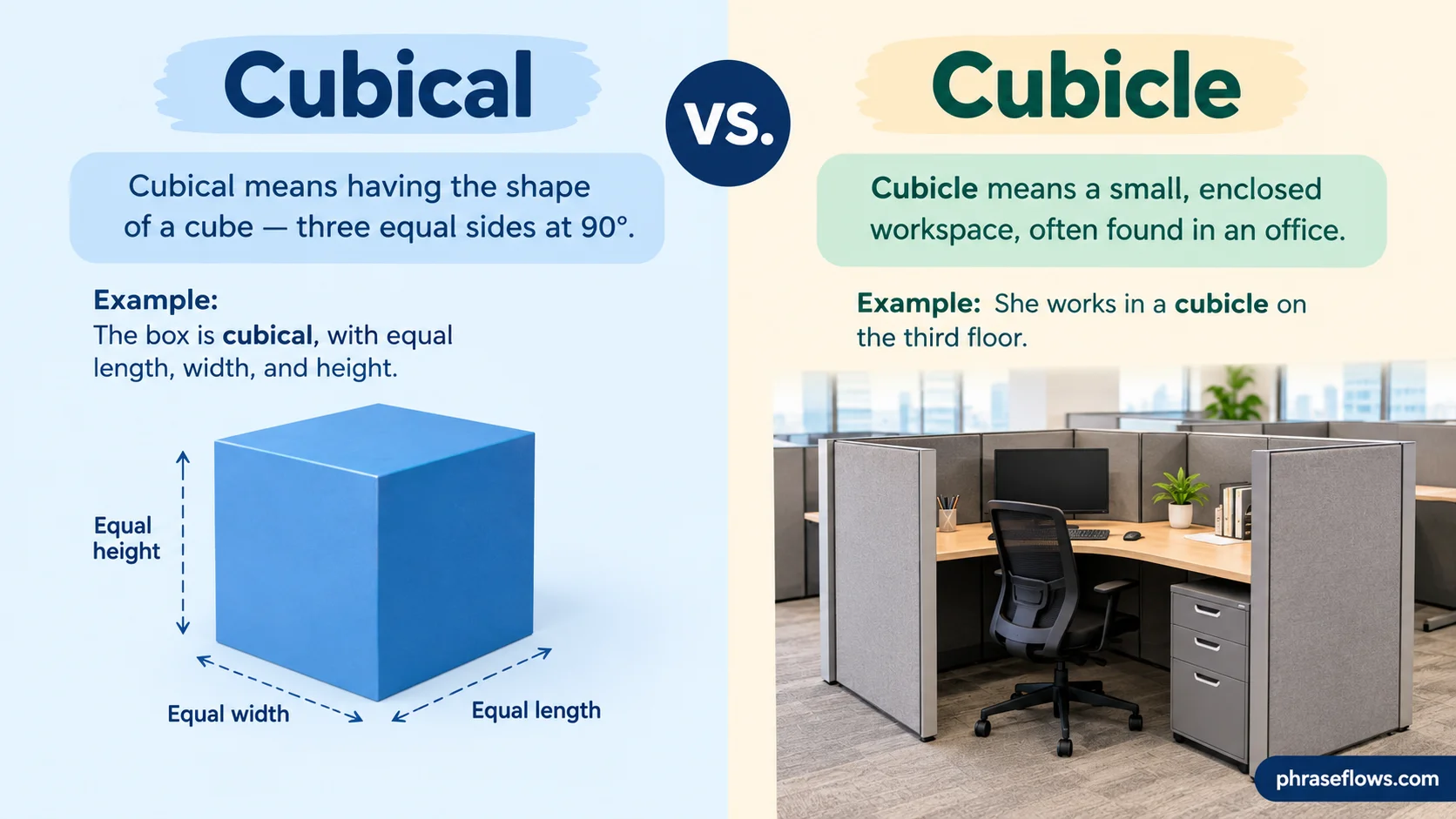

Have you ever paused while writing because you weren’t sure whether to use cubical vs. cubicle? You’re not alone. These two words look and sound similar, which makes them easy to mix up. However, they have different meanings and serve different purposes in English. Choosing the wrong one can change the meaning of your sentence, even if the spelling mistake seems small.
The main difference is simple: cubical is an adjective that describes something shaped like a cube, while cubicle is a noun that refers to a small enclosed or partitioned space. For example, you might use cubical when describing a geometric shape, but you’d use cubicle when talking about a workspace in an office. Both are correct English words, but you cannot use them interchangeably.
In this guide, you’ll learn the meanings of cubical vs. cubicle, explore their key differences, and see how to use each word in everyday and professional writing. We’ll also look at practical examples and common mistakes so you can recognize the correct spelling, understand the context, and choose the right word with confidence.
Quick Answer: Cubical vs. Cubicle
The quickest way to understand cubical vs. cubicle is to remember that one describes a shape while the other names a space.
- Cubical: An adjective meaning cube-shaped or resembling a cube.
- Cubicle: A noun referring to a small separate area, usually created with walls or partitions.
For example:
- Cubical: The designer created a cubical storage unit for the room.
- Cubicle: Sarah decorated her office cubicle with photographs.
In the first sentence, cubical describes the shape of the storage unit. In the second, cubicle identifies Sarah’s separate workspace.
| Feature | Cubical | Cubicle |
| Part of speech | Adjective | Noun |
| Meaning | Shaped like a cube | A small enclosed space |
| Main purpose | Describes shape or form | Identifies a separate area |
| Common contexts | Geometry, architecture, design | Offices, bathrooms, changing rooms |
| Example | A cubical box | An office cubicle |
| Related word | Cube | Cubicles |
Easy memory trick: Cubical relates to a cube’s shape, while cubicle refers to a separate space.
What Does Cubical Mean?
Cubical is an adjective that describes something with the shape or general appearance of a cube. A cube is a three-dimensional geometric solid with six equal square faces, twelve equal edges, and eight vertices.
When you call something cubical, you’re describing its physical form rather than identifying its purpose. For example, a storage container, building section, or decorative object might have a cubical design.
The word commonly appears in mathematics, architecture, engineering, product design, and everyday descriptions. It’s especially useful when you want to explain that an object has a cube-like appearance.
Cubical as an Adjective
An adjective provides additional information about a noun. It helps readers understand what something looks like, what it feels like, or what qualities it has.
In the phrase cubical structure, the word cubical describes the structure’s shape. Similarly, in cubical container, it tells readers that the container resembles a cube.
Consider these examples:
- The architect designed a cubical building for the exhibition.
- We purchased a cubical storage box for the garage.
- The sculpture has a simple cubical form.
- The engineer examined the cubical structure of the model.
In each sentence, cubical answers the question, “What kind of shape does it have?”
Common Uses of Cubical
You’ll often encounter cubical when someone describes the shape or appearance of an object.
Here are some common expressions:
- Cubical shape: An object with a cube-like form.
- Cubical structure: A structure designed around a cube-like shape.
- Cubical object: An object that resembles a cube.
- Cubical design: A design featuring cube-like proportions or forms.
- Cubical form: The general three-dimensional appearance of something.
One important distinction is that cubical doesn’t necessarily mean perfectly cube-shaped. In ordinary descriptions, people sometimes use it for objects that resemble cubes without having mathematically exact proportions.
For precise mathematical descriptions, however, it’s better to specify the object’s actual dimensions and properties.
Cubical Examples in Sentences
The following sentences demonstrate how to use cubical correctly.
- The artist placed a cubical sculpture in the center of the gallery.
- A cubical container can fit neatly into the storage cabinet.
- The architect preferred a cubical design for the small building.
- The children arranged several cubical blocks on the floor.
- We noticed a cubical structure in the science exhibition.
- The product features a compact, cubical shape.
- The designer created a cubical display stand for the showroom.
Notice that cubical describes the appearance of the noun following it. It doesn’t name a separate room, workstation, or private compartment.
What Does Cubicle Mean?
Cubicle is a noun that refers to a small, separate area within a larger space. People commonly use partitions or partial walls to create cubicles in offices, bathrooms, changing rooms, and other shared facilities.
The word is especially familiar in workplace settings. An office cubicle gives an employee a designated workstation without requiring a completely separate room.
Cubicles can include desks, chairs, computers, storage shelves, and dividing panels. Their layouts vary depending on the building and the needs of the people using them.
Unlike cubical, which describes an object’s shape, cubicle identifies a physical space.
Cubicle in an Office
An office cubicle is a small workstation separated from surrounding work areas by partitions. Businesses often use cubicles to organize employees within shared office environments.
For example, imagine an office with twenty employees working on one floor. Instead of giving everyone a private room, the company might install partitions to create individual workstations.
Each employee gets a designated area while remaining part of the larger office.
Common features of an office cubicle include:
- A desk or work surface.
- A chair and computer.
- Partition panels for separation.
- Storage drawers or cabinets.
- Lighting and electrical connections.
- Space for office supplies and personal belongings.
Office cubicles can also vary in height and design. Some have low partitions that encourage communication, while others provide more separation for focused work.
Other Common Types of Cubicles
The word cubicle doesn’t belong exclusively to office environments. It can describe different kinds of small, separated spaces.
Common examples include:
- Office cubicles: Individual workstations in shared offices.
- Shower cubicles: Enclosed shower areas in bathrooms.
- Changing cubicles: Private spaces where people change clothes.
- Bathroom cubicles: Partitioned toilet spaces in public or shared restrooms.
- Study cubicles: Separate work areas in libraries or learning facilities.
Although these spaces serve different purposes, they share one important feature: each provides a designated area within a larger room or facility.
Cubicle Examples in Sentences
Here are several examples showing how to use cubicle correctly:
- My colleague works in the cubicle beside the reception desk.
- The company installed new cubicles to accommodate additional employees.
- Please use the available shower cubicle near the changing area.
- She decorated her office cubicle with small plants.
- The library offers quiet study cubicles for students.
- Each customer can use a separate changing cubicle.
- The maintenance team repaired the damaged bathroom cubicle.
In these examples, cubicle acts as a noun because it identifies a particular space or compartment.
Cubical vs. Cubicle: Differences in Parts of Speech
One of the easiest ways to distinguish cubical vs. cubicle is to examine their grammatical roles. Although the words share similar spelling and pronunciation, they perform different jobs in a sentence.
Cubical functions as an adjective, while cubicle functions as a noun. Understanding this distinction makes it easier to choose the correct spelling without relying on guesswork.
When to Use Cubical
Use cubical when you want to describe something that resembles a cube or has a cube-like form.
It usually appears before a noun or after a linking verb. The surrounding sentence should make it clear that you’re talking about shape or form.
For example:
- The company manufactured cubical containers for storing equipment.
- This sculpture has a cubical appearance.
- The architect designed a cubical building.
- The wooden blocks have a cubical structure.
You can also use cubical in technical contexts involving volume or three-dimensional forms. In mathematics and science, the related adjective cubic is often more common, especially in expressions such as cubic units and cubic equations.
When to Use Cubicle
Use cubicle when you need a noun for a small enclosed or partitioned area.
The word commonly appears in descriptions of workplaces and shared facilities. It identifies the space itself rather than describing its shape.
For example:
- The manager assigned me a new office cubicle.
- My brother works in the cubicle near the entrance.
- The swimming pool has several changing cubicles.
- Employees gathered outside the meeting room’s cubicle area.
The plural form is cubicles. You can use it when referring to multiple separate workstations or compartments.
How to Identify the Correct Word in a Sentence
When you’re unsure whether to write cubical or cubicle, focus on the meaning of the sentence.
Ask yourself one simple question:
Am I describing a shape or naming a separate space?
- If you’re describing a cube-like shape, choose cubical.
- If you’re identifying a small enclosed area, choose cubicle.
Consider these examples:
| Sentence | Correct word | Reason |
| The designer created a ___ storage box. | Cubical | Describes the box’s shape |
| I work in a small office ___. | Cubicle | Names a workspace |
| The sculpture has a ___ appearance. | Cubical | Describes its form |
| She entered the shower ___. | Cubicle | Identifies an enclosed area |
| Several office ___ need repairs. | Cubicles | Refers to multiple workstations |
Another useful technique is to replace the word temporarily.
If cube-shaped makes sense, use cubical. If small enclosed space makes sense, use cubicle.
This quick substitution test works in most everyday writing situations.
Common Mistakes When Using Cubical and Cubicle
Even experienced writers sometimes confuse these words. Their similar spelling makes mistakes easy, particularly when someone writes quickly or relies on memory instead of sentence meaning.
However, a few simple distinctions can prevent most errors.
Using Cubical Instead of Cubicle for an Office
This is one of the most common mistakes.
An office workstation separated by partitions is called a cubicle, not a cubical. The word identifies a designated work area within a larger office.
Incorrect: I spend eight hours working in my office cubical.
Correct: I spend eight hours working in my office cubicle.
The corrected sentence uses cubicle because it refers to a physical workspace.
Remember that an office cubicle doesn’t have to resemble a perfect cube. Its name describes the partitioned area rather than its exact geometric shape.
Using Cubicle Instead of Cubical to Describe a Shape
Another mistake occurs when writers use cubicle as an adjective.
For example:
Incorrect: The artist created a cubicle sculpture.
Correct: The artist created a cubical sculpture.
The second sentence is correct because the writer describes the sculpture’s shape.
Similarly:
- Incorrect: The company designed a cubicle storage box.
- Correct: The company designed a cubical storage box.
- Incorrect: The building has a cubicle appearance.
- Correct: The building has a cubical appearance.
The key is to identify whether the sentence describes an object or names a separate space.
Confusing Cubicles and Cubicals
The plural form of cubicle is cubicles. Writers sometimes mistakenly use cubicals when they mean multiple office workstations.
However, these words don’t have the same grammatical function.
| Word | Grammatical form | Meaning |
| Cubical | Adjective | Having a cube-like shape |
| Cubically | Adverb | In a cubical manner |
| Cubicle | Singular noun | A small separate space |
| Cubicles | Plural noun | Multiple separate spaces |
| Cubicalness | Noun | The quality of being cubical |
For example:
- Correct: The office has twelve cubicles.
- Incorrect: The office has twelve cubicals.
You can use cubical before a plural noun, though. For example, cubical blocks describes multiple blocks that have cube-like shapes.
Choosing Words Based Only on Pronunciation
Pronunciation can also contribute to confusion. In standard American English, cubical and cubicle are generally pronounced alike.
Both have three syllables and the same commonly listed pronunciation: /ˈkjuː.bɪ.kəl/.
This means you can’t always distinguish them by listening. You need to consider the spelling and context.
For instance, someone might say:
“I left my notebook in the cubicle.”
The listener understands that the speaker means a separate workspace or compartment. However, when describing an object as cube-shaped, the written form changes to cubical.
Practical tip: Don’t depend on pronunciation alone when choosing between similar-looking words. Check the meaning and grammatical role instead.
Using the Wrong Word in Professional Writing
Word choice matters in workplace communication because a small spelling mistake can make an otherwise clear message confusing.
Imagine writing an office layout report. You want to explain that a company installed new workstations for its employees.
Incorrect: The company installed eight new cubicals on the second floor.
Correct: The company installed eight new cubicles on the second floor.
The corrected version identifies the workstations accurately.
Here are additional examples:
| Incorrect usage | Correct usage |
| Please clean your office cubical. | Please clean your office cubicle. |
| The company purchased cubicle storage boxes with cube-like shapes. | The company purchased cubical storage boxes. |
| Employees returned to their cubicals. | Employees returned to their cubicles. |
| The architect proposed a cubicle building design. | The architect proposed a cubical building design. |
When writing emails, reports, presentations, or workplace instructions, always check whether you’re describing a shape or referring to a separate area.
Cubical vs. Cubicle Examples in Everyday Sentences
Examples make confusing vocabulary much easier to understand. Instead of memorizing definitions alone, look at how each word works in different situations.
Examples Using Cubical
Use cubical when describing geometric forms, objects, or structures.
Geometry and mathematics:
- The teacher used a cubical model to explain three-dimensional shapes.
- Students examined the volume of a cubical block.
- The diagram showed a solid with a cubical form.
Architecture and construction:
- The architect proposed a cubical building for the exhibition.
- The designer selected a cubical structure for the outdoor installation.
Product design and storage:
- The manufacturer introduced a cubical storage container.
- The furniture company created a cubical display stand.
- The room featured several cubical decorative objects.
In all these examples, the word describes the object’s physical appearance.
Examples Using Cubicle
Use cubicle when referring to a separate area or compartment.
Office conversations:
- My new cubicle is close to the manager’s office.
- The employees decorated their cubicles for the holiday season.
- Please leave the documents on my cubicle desk.
Workplace descriptions:
- The company installed several new cubicles.
- Each employee received an individual office cubicle.
- The open-plan office contains twenty-four work cubicles.
Bathrooms and changing areas:
- The hotel renovated its shower cubicles.
- Visitors used separate changing cubicles.
- The public restroom has four bathroom cubicles.
Libraries and study spaces:
- Students reserved quiet study cubicles.
- The library provides individual reading cubicles.
- Each cubicle offers a separate area for focused work.
Incorrect vs. Correct Sentences
The following comparison table brings the main spelling differences together.
| Incorrect sentence | Correct sentence |
| I work in an office cubical. | I work in an office cubicle. |
| The box has a cubicle shape. | The box has a cubical shape. |
| Employees decorated their cubicals. | Employees decorated their cubicles. |
| The artist made a cubicle sculpture. | The artist made a cubical sculpture. |
| We installed three new office cubicals. | We installed three new office cubicles. |
| The designer created a cubical workstation. | The designer created a cubicle workstation. |
Important: A word isn’t automatically incorrect because it looks unfamiliar. Its correctness depends on how you use it. Both cubical and cubicle are established English words.
Is Cubical a Correct English Word?
Yes, cubical is a correct English word. It isn’t a misspelling of cubicle.
Major dictionaries recognize cubical as an adjective describing something shaped like a cube or relating to volume. Collins also lists technical meanings involving the third power.
Collins English Dictionary
+2
The word has a long history in English. Dictionary.com traces its first recorded use to approximately 1490–1500 and identifies its formation from cubic and the suffix -al.
Dictionary.com
+1
For example:
- The architect designed a cubical structure.
- The manufacturer created a cubical container.
- The sculpture features a simple cubical form.
These examples demonstrate that the word has a legitimate purpose in everyday and technical English.
However, its existence doesn’t mean you can use it whenever you need the word cubicle. Each word has a separate meaning.
Is Cubicle the Correct Word for an Office Space?
Yes. Cubicle is the standard English word for a small office workstation separated from surrounding areas by partitions or low walls.
It’s especially common in American English. Companies use cubicles to organize employees within shared office environments without building individual rooms for everyone.
The Cambridge Dictionary defines an office cubicle as a small office space created with low walls.
English meaning – Cambridge Dictionary
+1
Consider these examples:
- The manager assigned each employee a separate cubicle.
- My office cubicle has enough space for a computer and filing cabinet.
- The company plans to replace its old cubicles with modern workstations.
- She moved her belongings into the cubicle near the window.
You might occasionally see someone write office cubical, but this isn’t the standard expression for a partitioned workstation.
Remember: Use office cubicle when discussing a workspace. Use cubical office structure only when you’re describing something with a cube-like architectural shape.
Can Something Be Both Cubical and a Cubicle?
Yes. An object or space can be both cubical in shape and a cubicle by function.
These words describe different characteristics. One identifies the shape while the other identifies the type of space.
For example, imagine a small enclosed structure designed for private meetings. If it has approximately equal dimensions on all sides, you could describe it as a cubical cubicle.
Consider these sentences:
- The architect designed a cubical cubicle for the exhibition.
- The company installed a cubicle with a cubical exterior design.
- The designer created a small cubicle shaped like a cube.
These examples demonstrate how both words can appear together without creating a grammatical mistake.
However, using both words isn’t always necessary. If you’re simply talking about an ordinary office workstation, cubicle is enough. Add cubical only when its shape matters to the description.
Read More: Until vs. Untill: Which Spelling Is Correct and What’s the Difference?
Cubical vs. Cubicle: Easy Ways to Remember the Difference
Remembering the distinction becomes much easier when you connect each word with something familiar.
You don’t need complicated grammar rules. A simple association with shape and space will usually help you choose correctly.
Remember Cubical Through Cube
The word cubical contains the same root as cube. This connection makes its meaning easier to remember.
A cube has six equal square faces. Therefore, something described as cubical has a cube-like shape.
Think about these examples:
- A cubical box.
- A cubical sculpture.
- A cubical building.
- A cubical storage container.
Whenever you’re describing an object’s shape, cubical is the appropriate choice.
Remember Cubicle Through Space
Think of an office workstation when you see the word cubicle.
An office cubicle is a designated workspace separated from other areas by partitions. The same word also describes enclosed shower areas and changing spaces.
Associate cubicle with:
- An office workstation.
- A private changing area.
- A separate shower space.
- A partitioned bathroom area.
This connection helps you remember that cubicle identifies a place rather than describing an object’s shape.
Apply the Shape-or-Space Test
Here’s a simple method you can use whenever you’re uncertain:
Which word should you choose?
Practical Case Study: Using Cubical and Cubicle in an Office Description
Consider a company renovating its office. The management team wants to install several new workstations and purchase storage units for employees.
During the planning process, a writer prepares a short description of the renovation.
Initial draft:
“The company plans to install twenty new cubicals. Each employee will receive a cubical storage box with a matching design.”
The draft contains two different uses of the confused words.
The first sentence refers to workstations. Therefore, cubicles is correct.
The second sentence describes the shape of the storage boxes. Therefore, cubical is appropriate.
Corrected version:
“The company plans to install twenty new cubicles. Each employee will receive a cubical storage box with a matching design.”
This example highlights an important lesson: You shouldn’t choose between these words based on how similar they look. Instead, consider what the sentence communicates.
A single paragraph can correctly contain both words because they perform different grammatical functions.
Conclusion:
Understanding cubical vs. cubicle is easy once you know their meanings and grammatical roles. Cubical is an adjective that describes something shaped like a cube or related to cube geometry. Cubicle, on the other hand, is a noun that refers to a small enclosed or partitioned space, such as an office workspace, shower area, or changing space. Although these words look and sound similar, they cannot replace each other. Remembering this simple difference will help you avoid spelling mistakes, improve your English grammar, and choose the correct word in everyday and professional writing.
FAQs:
1. Is cubical or cubicle the correct spelling?
Both cubical and cubicle are correct English words. However, they have different meanings. Use cubical to describe a cube-shaped object and cubicle to refer to a small enclosed space.
2. What does cubical mean?
Cubical is an adjective that means shaped like a cube or related to a cube. For example, a box with six equal square sides has a cubical shape.
3. What does cubicle mean?
Cubicle is a noun that refers to a small enclosed or partitioned area. It commonly describes a workspace in an office, but it can also refer to a shower or changing area.
4. What is the difference between cubical and cubicle?
The main difference is their meaning and part of speech. Cubical describes a shape, while cubicle names a small enclosed space. One is an adjective, and the other is a noun.
5. Is an office workspace called a cubical or a cubicle?
An office workspace is called a cubicle. It usually has partitions that separate one worker’s area from the rest of the office. Cubical would be incorrect when referring to an office workspace.




1 thought on “Cubical vs. Cubicle: Meaning, Differences, Usage, and Common Mistakes”