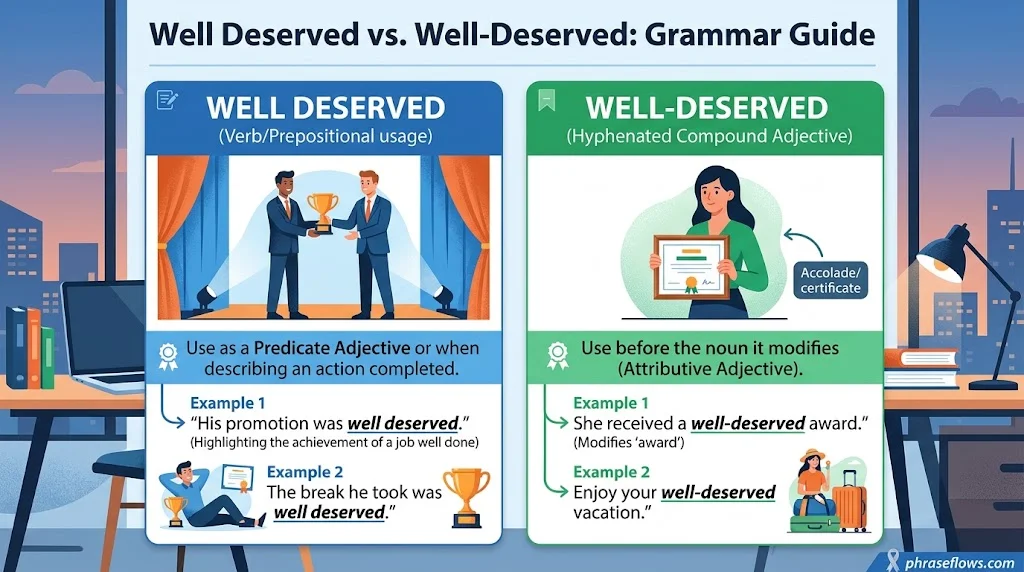

The difference between well deserved and well-deserved can confuse many English writers. Both forms look similar and express the idea that someone has earned something through their efforts or actions. However, the correct choice depends on how the phrase is used in a sentence. Understanding this small grammar rule can help you avoid common spelling and punctuation mistakes.
The main difference is the hyphen. Well-deserved usually appears before a noun as a compound adjective, such as “a well-deserved break.” In contrast, well deserved generally appears after a linking verb, as in “The break was well deserved.” Both forms can be correct, but their grammatical positions help determine which one to use.
Learning the difference between well deserved vs. well-deserved can make your writing clearer and more accurate. Whether you are writing emails, school assignments, articles, or professional messages, knowing when to use the hyphen helps your sentences sound natural. In this guide, you will learn the meaning of both forms, understand the grammar rule, and explore examples that make the correct usage easier to remember.
Well Deserved vs. Well-Deserved: Which One Is Correct?
Both forms are acceptable, but they serve different grammatical roles in common usage. The hyphen usually depends on whether the phrase appears before the noun it describes or after a linking verb.
Use well-deserved when the phrase acts as a compound adjective directly before a noun. Use well deserved when it describes a subject after a linking verb such as is, was, seems, or feels.
Consider these examples:
- Correct: She received a well-deserved award.
- Correct: The award was well deserved.
- Correct: He enjoyed a well-deserved vacation.
- Correct: His vacation was well deserved.
Notice that the meaning stays almost the same. The phrase describes something that a person has earned or rightly merits. Only its grammatical position changes.
Here’s a quick comparison to make the distinction easier to remember.
| Situation | Preferred form | Example |
| Before a noun | Well-deserved | She earned a well-deserved promotion. |
| After a linking verb | Well deserved | Her promotion was well deserved. |
| Before a noun | Well-deserved | They celebrated a well-deserved victory. |
| After a linking verb | Well deserved | Their victory was well deserved. |
| Before a noun | Well-deserved | He took a well-deserved rest. |
| After a linking verb | Well deserved | His rest was well deserved. |
The easiest rule to remember is this: use the hyphen when well-deserved works as a single modifier before a noun. In the usual construction after a linking verb, leave the hyphen out.
This is a practical guideline rather than an absolute rule for every compound or editorial style. When writing for a publication, follow its preferred style guide and remain consistent.
What Does Well Deserved Mean?
The phrase well deserved means that something has been earned fairly or is fully justified. It often describes a reward, compliment, achievement, break, or recognition that someone has earned through effort, skill, good work, or other relevant circumstances.
The word deserved comes from the verb deserve, which means to be worthy of something because of your actions, qualities, or situation. Adding well emphasizes that the outcome is particularly justified or appropriate.
For example, imagine a student who spends weeks preparing for an important examination. The student studies consistently, completes practice questions, and performs well on the test. You might say:
“The student’s excellent result was well deserved.”
The sentence suggests that the result was justified by the student’s preparation and performance.
The phrase also appears in everyday situations. Someone who finishes a demanding project might enjoy a well-deserved break. An employee who performs exceptionally well might receive well-deserved recognition. A sports team that plays skillfully throughout a season might earn a well-deserved victory.
Examples of Well Deserved in Sentences
Here are several examples that show how the phrase works without a hyphen.
- Her success was well deserved after years of dedication.
- The teacher’s praise was well deserved.
- His promotion was well deserved because of his strong performance.
- Their victory was well deserved after a challenging competition.
- The recognition she received was well deserved.
- The team’s celebration was well deserved after a successful season.
In each example, the phrase appears after a linking verb or as part of the sentence’s descriptive complement. It tells readers that the achievement, praise, or reward was justified.
What Is the Difference Between Deserved and Well Deserved?
Although the expressions are closely related, well deserved adds emphasis.
Deserved means that someone has earned or merits something. Well deserved places greater emphasis on how justified or appropriate that outcome is.
Compare these examples:
- “She deserved the award.” This states that she earned or merited the award.
- “The award was well deserved.” This emphasizes that the award was justified.
- “He deserved a break.” This says that he had earned some rest.
- “His break was well deserved.” This emphasizes that the rest was entirely appropriate.
The difference is subtle. Both expressions communicate a similar idea, but well deserved often adds a stronger sense of fairness or recognition.
What Does Well-Deserved Mean?
Well-deserved has the same basic meaning as well deserved: something is fully earned or justified by a person’s actions, qualities, or circumstances. The difference is that the hyphenated form commonly works as a compound adjective before a noun.
For example, Cambridge Dictionary gives well-deserved break as a standard construction and also illustrates the open form in sentences where the phrase follows a linking verb. You can explore these examples in the Cambridge Dictionary entry for well deserved.
Think of the hyphen as a small link between two words that work together to describe something. In “a well-deserved reward,” the complete expression tells you what kind of reward the person received.
Examples of Well-Deserved in Sentences
Here are examples from common situations:
- After completing the project, Nina took a well-deserved break.
- The employee received a well-deserved promotion.
- The players celebrated their well-deserved victory.
- His thoughtful comments earned him well-deserved praise.
- The author developed a well-deserved reputation for clear writing.
- After a busy semester, the students enjoyed a well-deserved vacation.
In each sentence, well-deserved appears directly before a noun. The hyphen connects the two words into one descriptive unit.
Why the Hyphen Matters in Well-Deserved
The hyphen helps readers understand how words relate to one another. It isn’t merely decorative punctuation.
Compare these examples:
- Preferred: She received a well-deserved award.
- Less conventional in edited writing: She received a well deserved award.
Most readers would understand both sentences. However, the hyphenated version makes the compound modifier clearer and follows the usual convention for this expression before a noun.
This principle appears in other English expressions, too. You might write a well-known author but the author is well known. Similarly, you would write a well-written report but the report was well written.
The pattern provides a useful guide, although individual compounds and editorial styles can differ.
When to Use Well Deserved Without a Hyphen
Use well deserved without a hyphen when the phrase follows a linking verb and describes the subject. Common linking verbs include is, was, seems, and feels.
Consider this sentence:
“The recognition was well deserved.”
The phrase describes the recognition after the linking verb was. It doesn’t appear directly before the noun recognition, so the open form is the conventional choice.
The same pattern works in many everyday situations.
Well Deserved Examples for Everyday Writing
- Her success was well deserved.
- The teacher’s praise was well deserved.
- His promotion is well deserved.
- The team’s victory was well deserved.
- Their recognition seemed well deserved.
- The applause felt well deserved after the performance.
These sentences show that the open form works naturally in professional, academic, and informal writing.
How Well Deserved Works After a Linking Verb
A linking verb connects the subject to information that describes it. In “The award was well deserved,” the subject is the award, the linking verb is was, and the phrase well deserved describes the award.
You can use the same structure with other subjects:
- The reward was well deserved.
- The recognition is well deserved.
- Her success seems well deserved.
- Their praise felt well deserved.
The important point is the phrase’s role in the sentence. It describes the subject rather than acting as a compound modifier placed immediately before a noun.
Can Well Deserved Appear at the End of a Sentence?
Yes. In fact, this is a common construction.
For example:
- After years of hard work, the promotion was well deserved.
- The team’s success was well deserved.
- Everyone agreed that the recognition was well deserved.
You can also place the phrase in a longer sentence:
“Although the competition was difficult, the winner’s success was well deserved.”
The sentence remains clear because the phrase describes the winner’s success after the linking verb was.
When to Use Well-Deserved With a Hyphen
Use well-deserved when the phrase acts as a compound adjective directly before a noun. This is especially common when describing a reward, break, victory, compliment, or achievement.
The basic pattern is:
well-deserved + noun
For example, “a well-deserved rest” describes the kind of rest someone takes. Likewise, “a well-deserved compliment” describes praise that someone has earned.
Well-Deserved Examples in Different Contexts
At work
- She received a well-deserved promotion.
- The manager offered the team well-deserved recognition.
- His dedication earned him a well-deserved bonus.
At school
- The student earned a well-deserved scholarship.
- The class received a well-deserved reward.
- Her presentation earned well-deserved praise.
In sports
- The players celebrated a well-deserved victory.
- The captain received a well-deserved award.
- Their performance brought a well-deserved win.
In everyday life
- After a long week, he enjoyed a well-deserved break.
- They planned a well-deserved vacation.
- She finally had time for a well-deserved rest.
These examples show why the hyphenated form is useful. It allows two words to work together smoothly as one modifier.
Why Writers Hyphenate Well-Deserved Before a Noun
English uses hyphens in many compound modifiers to show that multiple words work together. Without the hyphen, a reader may need an extra moment to work out the intended relationship between the words.
For example:
- A well-deserved award: well-deserved modifies award.
- The award was well deserved: well deserved describes the award after was.
The meaning stays consistent, but the grammar changes.
For more on how adjectives function before and after nouns, consult Purdue OWL’s overview of parts of speech.
Well Deserved vs. Well-Deserved: Examples in Sentences
The quickest way to understand well deserved vs. well-deserved is to compare both forms in similar sentences. Once you see how the phrase moves within a sentence, the hyphen becomes much easier to manage.
| Sentence | Preferred form | Why it works |
| She received a well-deserved award. | Well-deserved | The phrase modifies award. |
| The award was well deserved. | Well deserved | The phrase follows was. |
| He enjoyed a well-deserved rest. | Well-deserved | The phrase modifies rest. |
| His rest was well deserved. | Well deserved | The phrase describes the subject after was. |
| They earned well-deserved praise. | Well-deserved | The phrase modifies praise. |
| Their praise was well deserved. | Well deserved | The phrase follows a linking verb. |
| It was a well-deserved victory. | Well-deserved | The phrase appears before victory. |
| The victory seemed well deserved. | Well deserved | The phrase follows seemed. |
The pattern is consistent in these examples. However, remember that hyphenation conventions can vary for some compounds, so follow your publication’s style guide when one applies.
Workplace Examples
Professional writing often uses this expression when discussing achievements, promotions, and recognition.
- “Congratulations on your well-deserved promotion.”
- “Her promotion was well deserved.”
- “The team received well-deserved recognition for completing the project.”
- “The recognition they received was well deserved.”
School and Academic Examples
Students and teachers can use the phrase to describe achievements and positive feedback.
- “He earned a well-deserved scholarship.”
- “Her excellent grade was well deserved.”
- “The research team received well-deserved recognition for its contribution.”
- “The praise for their work was well deserved.”
Personal Messages and Social Media
The expression also works naturally in congratulations and friendly messages.
- “Enjoy your well-deserved vacation!”
- “You’ve earned a well-deserved break after such a busy week.”
- “Your success is well deserved.”
- “That was a well-deserved win!”
In short, the context doesn’t determine whether you need a hyphen. The phrase’s grammatical role does.
Read More: Challenge vs. Challange: Which Is Correct? Meaning, Spelling, and Examples
Common Mistakes to Avoid With Well Deserved and Well-Deserved
Even experienced writers sometimes overlook hyphens. The problem usually comes from treating the expression as though it must always have the same spelling.
Here are the mistakes worth watching for.
Forgetting the Hyphen Before a Noun
Consider this sentence:
“After months of preparation, she received a well deserved award.”
The meaning is clear, but standard edited English generally prefers:
“After months of preparation, she received a well-deserved award.”
The compound adjective appears directly before award, so the hyphen is the conventional choice.
Adding the Hyphen Everywhere
The opposite mistake occurs when writers use a hyphen even when the phrase follows a linking verb.
For example:
- Preferred: The award was well deserved.
- Less conventional in standard usage: The award was well-deserved.
The second version appears in some writing, so it’s not helpful to claim that every post-verb hyphen is automatically wrong. Still, the open form is the usual choice for this construction.
Assuming the Meaning Changes
A hyphen doesn’t give well deserved and well-deserved different definitions.
Compare:
- She received a well-deserved reward.
- The reward was well deserved.
Both sentences communicate that the reward was justified. The difference concerns sentence structure, not meaning.
Confusing Well Deserved With Well Deserve
Another common mistake involves changing the form of deserve.
- Correct: She deserves the recognition.
- Correct: The recognition was well deserved.
- Incorrect in this context: The recognition was well deserve.
Use deserves when the present-tense verb agrees with a singular subject. Use deserved when the sentence calls for the past-tense or participial form.
A Quick Editing Checklist
Before publishing your writing, check these points:
- Does well-deserved appear directly before a noun?
- Does well deserved follow a linking verb?
- Have you used the same style consistently?
- Have you checked your publication’s preferred dictionary or style guide?
- Does the complete sentence sound natural when read aloud?
These simple checks can help you catch most errors without overthinking the grammar.
Well Deserved vs. Well-Deserved: Grammar and Hyphenation Rules
The distinction between these forms comes from a broader English writing convention: hyphens can connect words that work together as a compound modifier before a noun.
A compound modifier consists of two or more words that jointly describe another word. In well-deserved award, the words well and deserved work together to describe award.
When the phrase follows a linking verb, the structure changes. In the award was well deserved, the phrase describes the subject rather than appearing before the noun as a compound modifier.
The Cambridge Dictionary entry for well deserved illustrates both constructions, including the open form after a linking verb and the hyphenated form before a noun.
Similar Expressions That Follow the Same Pattern
Learning this pattern helps you with other common expressions, too.
| Before a noun | After a linking verb |
| A well-known actor | The actor is well known. |
| A well-written article | The article was well written. |
| A well-planned event | The event was well planned. |
| A well-earned rest | The rest was well earned. |
| A well-informed decision | The decision was well informed. |
| A well-prepared student | The student was well prepared. |
These examples follow a familiar pattern in English. Still, don’t apply it mechanically to every compound. Established spellings and house styles can differ.
What Should You Do in Formal Writing?
For essays, reports, professional emails, and published articles, choose the form that fits the sentence and follow a consistent editorial standard.
If your style guide gives a specific instruction, use that guidance. If it doesn’t, the conventional pattern offers a reliable starting point:
- Before a noun: a well-deserved achievement.
- After a linking verb: the achievement was well deserved.
The goal isn’t to add as many hyphens as possible. It’s to make the relationship between words clear.
Synonyms for Well Deserved and Well-Deserved
Sometimes a synonym makes your sentence more precise or helps you avoid repetition. The best replacement depends on what you want to emphasize.
| Synonym | Meaning | Example |
| Well-earned | Gained through effort or experience | She enjoyed a well-earned rest. |
| Merited | Justified by someone’s actions or qualities | His success was merited. |
| Justified | Supported by good reasons or evidence | The praise was justified. |
| Warranted | Appropriate or supported by the circumstances | The recognition was warranted. |
| Deserved | Rightfully earned | They received the reward they deserved. |
Well-earned is especially close in meaning to well-deserved. Cambridge Dictionary defines well-earned as something deserved because of what someone has done or experienced. See its definition of well-earned.
However, these words aren’t always interchangeable. For example, justified often emphasizes a sound reason, while well-earned emphasizes effort or experience.
Choose the word that expresses your intended meaning rather than replacing phrases just to make your writing look different.
FAQs:
Is Well Deserved One Word or Two Words?
Well deserved is written as two words when it appears without a hyphen. For example, “Her success was well deserved.”
When the phrase acts as a compound adjective before a noun, it is commonly written with a hyphen: “She achieved a well-deserved success.”
Should Well-Deserved Always Have a Hyphen?
No. The hyphenated form is common before a noun, as in a well-deserved award. The open form is conventional after a linking verb, as in the award was well deserved.
Always consider the sentence structure and your chosen style guide.
Is It a Well Deserved Break or a Well-Deserved Break?
A well-deserved break is the preferred form in standard edited English.
The phrase well-deserved modifies the noun break, so the hyphen connects the words into one compound adjective.
Conclusion:
The difference between well deserved vs. well-deserved is mainly grammatical. Both forms express the idea that something has been earned or is justified, but their hyphenation usually depends on where they appear in a sentence.
Remember the basic pattern, check your sentence structure, and stay consistent with your chosen style guide. Once you understand how the phrase works, choosing the right form becomes a simple part of clear, confident writing.




1 thought on “Well Deserved vs. Well-Deserved: Which Is Correct? Meaning, Grammar, and Examples”