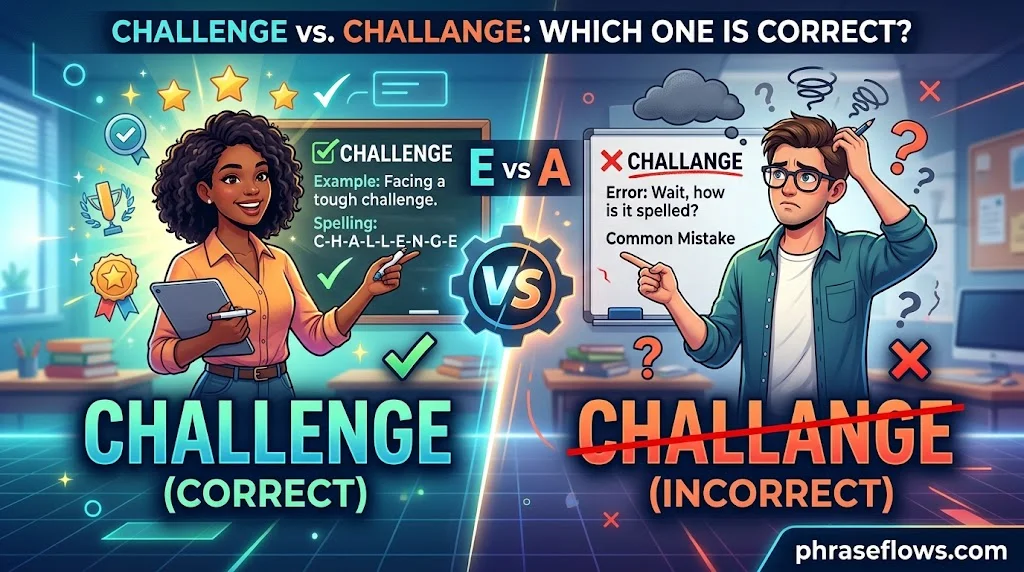

The English language contains many words that sound similar or look almost identical, making spelling mistakes easy to make. One common example is challenge vs. challange. Although both forms may look familiar, only one is correct in standard English. Knowing the right spelling helps you communicate clearly and avoid mistakes in everyday writing.
The correct spelling is challenge, which refers to a difficult task, situation, or problem that requires effort and skill. For example, learning a new language can be a challenge because it takes time and practice. On the other hand, challange is a misspelling and is not accepted as the standard spelling of this word. The confusion often happens because other English words, such as change and strange, use the -ange letter pattern.
Understanding challenge vs. challange can improve your spelling and make your writing more professional. Whether you are preparing an email, writing a school assignment, or creating an important report, using the correct form matters. In this guide, you will learn the meaning of challenge, why challange is incorrect, and how to use the correct spelling in simple sentences and everyday conversations.
Challenge vs. Challange: Which Spelling Is Correct?
Challenge is the correct spelling in standard American English. Challange is incorrect when you intend to use the word challenge.
The confusion usually occurs because both spellings look almost identical. However, the correct word uses an e in its final syllable, not an a.
Consider these examples:
- Correct: Learning to drive can be a challenge.
- Incorrect: Learning to drive can be a challange.
- Correct: She challenged her classmates to solve the puzzle.
- Incorrect: She challanged her classmates to solve the puzzle.
In each example, the incorrect spelling results from replacing the e in challenge with an a. The same mistake can appear in related forms, such as challanges instead of challenges.
You should use challenge in school assignments, business documents, blog posts, social media captions, and everyday messages. Spell-checking tools can catch many instances of challange, but understanding the correct spelling helps you recognize the error yourself.
What Does Challenge Mean?
The word challenge has several related meanings. It can describe a difficult task, an invitation to compete, or an act of questioning something. Its precise meaning depends on how you use it in a sentence.
For example, a student might face a challenge when studying a difficult subject. A coach might challenge a team to improve its performance. Meanwhile, a researcher might challenge an established theory by presenting new evidence.
These uses share a common idea: testing ability, questioning something, or facing a demanding situation.
Challenge as a Noun
As a noun, challenge refers to a difficult task, problem, test, or situation that requires effort and skill. It can also describe an invitation to compete or an objection to something.
Here are some examples:
- Education: The final mathematics exam was a challenge for many students.
- Work: Meeting the deadline became our biggest challenge.
- Personal development: Learning a new language is a rewarding challenge.
- Sports: The team accepted the challenge of competing against a stronger opponent.
- Everyday life: Finding enough time to study and relax can be a challenge.
The word doesn’t always describe something negative. A challenge can help you learn new skills, build confidence, or discover a better way to solve a problem.
For instance, learning to play the guitar may feel difficult at first. However, regular practice can turn that challenge into an enjoyable experience.
Common expressions using challenge as a noun include:
- Face a challenge: Deal with a difficult situation.
- Accept a challenge: Agree to attempt a demanding task.
- Overcome a challenge: Successfully deal with an obstacle.
- Pose a challenge: Present a difficulty or problem.
- Meet a challenge: Respond successfully to a demanding situation.
Understanding these expressions makes it easier to use the word naturally in conversation and writing.
Challenge as a Verb
As a verb, challenge means to question something, test someone’s ability, invite competition, or ask someone to prove a claim.
Its meaning changes slightly depending on the context.
For example:
- The teacher challenged the students to explain their answers.
- She challenged the accuracy of the report.
- My friend challenged me to a game of chess.
- The new evidence challenged the original conclusion.
- The coach challenged the players to work together.
In the first sentence, challenged means the teacher encouraged the students to test their abilities. In the second, it means someone questioned whether the report was accurate.
This distinction matters because challenging something doesn’t always mean opposing it aggressively. You can challenge an idea by asking thoughtful questions or examining the evidence behind it.
The verb also appears in different grammatical forms:
| Form | Example |
| Base form | I challenge the decision. |
| Third-person singular | She challenges the decision. |
| Past tense | He challenged the decision. |
| Present participle | They are challenging the decision. |
| Past participle | The decision has been challenged. |
Notice that every form retains the correct spelling pattern from challenge.
What Does Challange Mean?
Challange is a misspelling of challenge. In standard American English, it doesn’t have a recognized, separate dictionary meaning that would make it an appropriate substitute for the correct word.
You might encounter challange in a text message, online comment, school assignment, or website. Its appearance doesn’t make it correct. In most cases, the writer simply intended to type challenge but chose the wrong vowel.
For example:
- Incorrect: Completing the assignment was a difficult challange.
- Correct: Completing the assignment was a difficult challenge.
The corrected sentence communicates exactly the intended meaning without a spelling error.
It’s also important to recognize that challange isn’t the correct spelling of any standard grammatical form of challenge. The past tense is challenged, the plural is challenges, and the present participle is challenging.
If you encounter the word Challange as part of a company name, username, or other proper name, its spelling may be intentional. However, that special use doesn’t make it a standard spelling of the English word.
Why Do People Confuse Challenge and Challange?
The confusion between challenge and challange often develops through a combination of spelling habits, pronunciation, and typing mistakes.
Although the difference is small, understanding why it happens can help you avoid repeating the same error.
Similar-Looking Spellings
Both words begin with the same letters and have similar overall shapes. When you’re reading quickly or typing from memory, you might overlook the vowel difference.
The correct spelling contains e before the final n-g-e sequence. The incorrect version replaces that vowel with a.
Compare the two:
- Challenge: c-h-a-l-l-e-n-g-e
- Challange: c-h-a-l-l-a-n-g-e
The easiest way to catch the mistake is to check the letters immediately before the final nge.
Pronunciation Can Cause Confusion
In American English, challenge is commonly pronounced /ˈtʃælɪndʒ/. The final syllable is unstressed, so its vowel may sound less distinct than the first vowel.
When a syllable receives little emphasis, listeners may find it harder to identify the exact vowel from sound alone. This can lead some writers to choose the wrong letter when spelling the word.
However, the standard spelling remains challenge, regardless of how clearly someone pronounces the final syllable.
You can check its pronunciation and meaning in the Cambridge English Dictionary.
Typing Too Quickly
Fast typing can also cause spelling errors. You may know the correct word but accidentally enter an extra letter or substitute one vowel for another.
For instance, you might type challange in a long article without noticing it. If you reuse the word several times, the same mistake may appear throughout the document.
To prevent this problem, review your writing before publishing. Spell-checking tools can help identify errors, although a final manual review remains useful.
Challenge vs. Challange: Key Differences
The following table summarizes the differences between the two spellings.
| Feature | Challenge | Challange |
| Spelling status | Correct | Incorrect |
| Standard English usage | Accepted | Not accepted as a standard spelling |
| Part of speech | Noun and verb | No standard grammatical use as a separate word |
| Meaning | A difficult task, test, competition, or act of questioning | No established meaning as a separate standard word |
| Plural or related form | Challenges | Challanges is incorrect when intended to mean challenges |
| Past tense | Challenged | Challanged is incorrect when intended to mean challenged |
| Example | The assignment presents a challenge. | The assignment presents a challange. |
The key takeaway is simple: use challenge whenever you mean a difficult task, a test of ability, or an act of questioning something.
Examples of Challenge in Sentences
Seeing a word in context makes its meaning easier to understand. The examples below demonstrate how challenge works in different situations.
Challenge Used as a Noun
When challenge functions as a noun, it names a task, difficulty, test, or objection.
- The final examination was a serious challenge for the entire class.
- Starting a small business can be a rewarding challenge.
- She accepted the challenge and completed the project before the deadline.
- Finding reliable information presented an unexpected challenge.
- Learning to manage time effectively is a common challenge for students.
- The team faced its toughest challenge during the final match.
- Improving customer service became the company’s main challenge.
- Solving the puzzle was an enjoyable challenge for the children.
In each sentence, challenge identifies something that requires effort, skill, or attention.
Challenge Used as a Verb
When challenge functions as a verb, it describes an action. Someone might question a claim, test another person’s abilities, or invite someone to compete.
- The teacher challenged the students to explain their reasoning.
- She challenged the accuracy of the published report.
- My brother challenged me to a chess match.
- The new findings challenge the earlier theory.
- The coach challenged the team to improve its coordination.
- He decided to challenge the decision through the proper process.
- The assignment will challenge your problem-solving skills.
- They are challenging the assumptions behind the proposal.
These examples also demonstrate why learning the word’s grammatical forms matters. The spelling changes slightly when you add an ending, but the correct base spelling remains recognizable.
Common Phrases With Challenge
Certain expressions appear frequently in everyday American English.
| Expression | Meaning | Example |
| Face a challenge | Encounter a difficult situation | We face a challenge at work. |
| Accept a challenge | Agree to attempt something difficult | She accepted the challenge. |
| Overcome a challenge | Successfully deal with a difficulty | He overcame the challenge through practice. |
| Rise to the challenge | Respond successfully to a demanding situation | The students rose to the challenge. |
| Pose a challenge | Create a difficulty | The new rules pose a challenge. |
| Challenge an idea | Question or test an idea | Researchers challenged the original idea. |
| Challenge someone to a game | Invite someone to compete | She challenged her friend to a game. |
Learning these phrases helps you recognize the word in different contexts and use it more naturally in your own writing.
Incorrect and Correct Uses of Challenge vs. Challange
Spelling errors can affect more than the original word. They may also appear in its plural, past-tense, or present-participle forms.
Use the following examples as a quick reference.
| Incorrect spelling | Correct spelling | Example of correct usage |
| Challange | Challenge | This task is a challenge. |
| Challanges | Challenges | Students face different challenges. |
| Challanged | Challenged | She challenged the decision. |
| Challanging | Challenging | It was a challenging assignment. |
Notice that the correct forms follow consistent spelling patterns.
Challenge becomes challenges when you form the plural or use the verb with a third-person singular subject. For the past tense, you add -d to create challenged. For the present participle, you add -ing and remove the final silent e to create challenging.
These are useful patterns to remember when proofreading your work.
A Practical Example: Correcting a Short Paragraph
Imagine a student writes the following paragraph:
Learning a new language is a challange. At first, remembering new words feels difficult. However, I challanged myself to practice every day. Over time, I became more confident and handled the challanges more easily.
The paragraph contains three spelling mistakes. Here’s the corrected version:
Learning a new language is a challenge. At first, remembering new words feels difficult. However, I challenged myself to practice every day. Over time, I became more confident and handled the challenges more easily.
The meaning hasn’t changed. The corrections simply make the paragraph accurate and polished.
This example highlights an important proofreading lesson: check related word forms, not just the original spelling.
How to Remember the Correct Spelling of Challenge
You don’t need to memorize complicated spelling rules to remember challenge. A few practical techniques can help you recognize the correct form whenever you write it.
Remember the E in Challenge
The simplest technique is to focus on the e in the final syllable.
Write the word slowly:
C-H-A-L-L-E-N-G-E
Then compare it with the incorrect version. The difference becomes easier to spot when you look at the letters rather than relying on memory alone.
Use a Familiar Phrase
Associate the word with a phrase you already know, such as:
- Accept the challenge.
- Face the challenge.
- Overcome the challenge.
- Rise to the challenge.
Each phrase reinforces the correct spelling through repetition.
Practice With Short Sentences
Write a few original sentences using challenge as both a noun and a verb.
For example:
- The project presents a new challenge.
- I enjoy a good challenge.
- She challenged the original conclusion.
- The difficult exercise is challenging.
This exercise helps you remember the base spelling and its common grammatical forms.
Use Spell-Checking Tools
A spell-checker can catch challange in many ordinary sentences. Word processors and browser-based writing tools often flag this mistake automatically.
However, don’t rely entirely on automated suggestions. A spell-checker may miss errors in unusual contexts, names, or text that it doesn’t interpret correctly.
For important writing, combine automated checks with a quick manual review.
Read More: Training vs. Trainning: Which One Is Correct? Meaning, Spelling, and Examples
Challenge Word Forms and Related Words
Understanding the different forms of challenge helps you use the word correctly in a wider range of sentences.
| Word form | Grammatical use | Example |
| Challenge | Noun or base verb | This challenge requires patience. |
| Challenges | Plural noun or present-tense verb | She faces several challenges. |
| Challenged | Past-tense or past-participle verb | They challenged the decision. |
| Challenging | Present participle or adjective | The task is challenging. |
| Challenger | Noun for a person or group that challenges | The challenger presented a strong argument. |
| Challengeable | Adjective meaning capable of being challenged | The decision may be challengeable under the applicable rules. |
These forms are useful in everyday writing, academic discussions, workplace communication, and formal arguments.
For example, challenge can describe a problem, while challenging describes something demanding. A challenger is someone who questions, competes with, or seeks to defeat another person or group.
Remember that challanges, challanged, and challanging are incorrect spellings when you intend to use the standard forms challenges, challenged, and challenging.
Challenge vs. Challange in American English
American English uses challenge as the standard spelling. The word is also spelled challenge in British English.
Unlike certain words that have accepted regional spelling differences, this pair doesn’t represent an American-versus-British spelling distinction.
For example, American and British writers may choose different spellings for words such as color and colour. However, both use challenge.
The same rule applies across common writing situations:
- Academic writing: The research presents a significant challenge.
- Professional writing: Meeting the deadline remains our biggest challenge.
- Online publishing: Discover practical ways to overcome everyday challenges.
- Personal communication: I accepted the challenge and gave it my best effort.
Whether you’re writing for an American audience or an international readership, choose challenge.
FAQs:
Is Challenge or Challange Correct?
Challenge is correct. Challange is a misspelling in standard English. Use challenge when referring to a difficult task, a test of ability, a competition, or an act of questioning something.
Why Is Challange Incorrect?
Standard English spells the word challenge, with an e in the final syllable rather than an a. The spelling challange is a common error, not an accepted alternative spelling.
What Is the Plural of Challenge?
The plural is challenges.
For example: “Students face many challenges when learning a new subject.”
The word changes from challenge to challenges by adding s after the final e.
What Is the Past Tense of Challenge?
The past tense is challenged.
For example: “The researcher challenged the earlier conclusion.”
To form the past tense, add -d to challenge. Don’t write challanged.
Is Challange Ever an Acceptable Spelling?
Not as a standard spelling of the ordinary English word challenge. You might see Challange in a proper name, username, or other intentionally nonstandard form, but those uses don’t make it correct in regular writing.
Conclusion:
When comparing challenge vs. challange, the answer is straightforward: challenge is the correct spelling, while challange is a common misspelling.
The correct word can function as both a noun and a verb. You can face a challenge, overcome a challenge, challenge an idea, or challenge someone to a competition. Its meaning depends on the context, but its standard spelling stays consistent. To avoid mistakes, remember the e in challenge and pay attention to related forms such as challenges, challenged, and challenging. Use spell-checking tools when helpful and review your writing before submitting or publishing it.




1 thought on “Challenge vs. Challange: Which Is Correct? Meaning, Spelling, and Examples”