
Have you ever wondered whether to write half day vs.half-day? The difference looks small, but choosing the right form can make your writing clearer and more professional. You’ll often encounter both spellings in work emails, school notices, training schedules, travel descriptions, and everyday conversations.
The good news is that both forms can be correct. The right choice depends on how you use the expression in a sentence and which spelling convention your dictionary or style guide follows. Once you understand the basic grammar, you’ll know when to use each form without second-guessing yourself.
In this guide, you’ll learn the meaning of half day and half-day, explore their grammatical differences, review practical examples, and discover common mistakes to avoid. You’ll also find a comparison table and answers to frequently asked questions.
Half Day vs. Half-Day: The Quick Answer
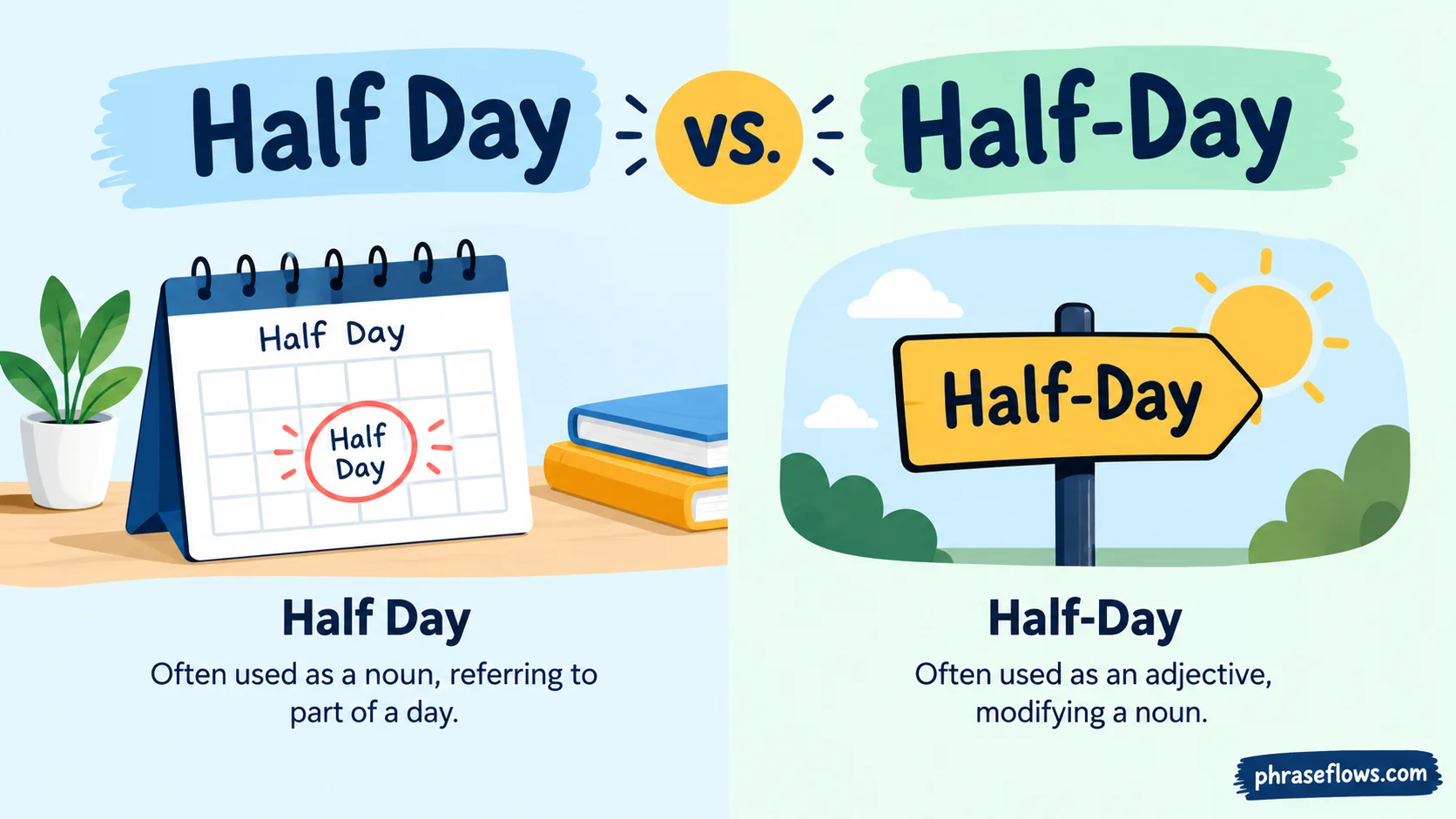
Half day and half-day both refer to a period that covers approximately half of a normal day or working day. However, dictionaries don’t always treat the two spellings identically.
The Cambridge Dictionary lists half day as a noun and half-day as an adjective used before a noun. Oxford’s Advanced Learner’s Dictionary also recognizes half-day as a noun. These entries show why it’s important to consider both grammar and dictionary conventions rather than rely on one rigid rule.
Here’s a quick comparison:
| Form | Common use | Example |
| Half day | Noun phrase referring to a shortened day | Friday is a half day at school. |
| Half-day | Compound adjective before a noun | We attended a half-day workshop. |
| Half a day | Expression describing a duration | The repairs took half a day. |
| Halfday | Generally nonstandard in ordinary writing | Use half day or half-day instead. |
The easiest rule to remember is this: use half-day before a noun when it acts as a compound modifier, and use half day when your chosen dictionary or style guide treats it as an open noun phrase. When you describe a duration, half a day is another natural and often clearer option.
What Does Half Day Mean?
The expression half day describes a day during which someone works, studies, or operates for only part of the usual day. In a workplace, it might mean working only in the morning or afternoon. At school, it can refer to a shortened schedule that ends earlier than usual.
The exact number of hours depends on the setting. For example, if a company defines a normal workday as eight hours, a half day might mean four hours. A school might use a different schedule, so the expression doesn’t always represent precisely twelve hours.
You can use the phrase when discussing schedules, appointments, business hours, and time off.
Examples include:
- Friday is a half day at our office.
- The students have a half day before the holiday.
- I took a half day off to attend an appointment.
- The store operates for a half day on certain holidays.
In these examples, the phrase refers to a shortened day or a portion of the usual schedule.
Examples of Half Day in a Sentence
Looking at complete sentences helps you understand how the expression works in everyday English.
- Work: Monday is a half day for our department.
- School: The children have a half day before winter break.
- Business: The shop will observe a half day on the holiday.
- Personal schedule: I need a half day to handle some errands.
- Office notice: Employees can request a half day with their supervisor’s approval.
Notice that the phrase doesn’t tell you the exact starting or ending time. The surrounding context provides that information.
For example, a company might announce a half day on Friday without specifying the hours. Employees would still need to check the official schedule to learn when their workday ends.
When to Use Half Day
Use half day when it functions as an open noun phrase in your sentence and matches your chosen dictionary or house style.
Common contexts include:
- Work schedules: Describing a day with reduced working hours.
- School calendars: Announcing early dismissal or shortened classes.
- Business operations: Explaining when a store or office closes early.
- Leave requests: Referring to a partial day away from work.
- Personal planning: Discussing how much time an activity requires.
For example, a manager might write, “Friday is a half day for the entire team.” The phrase identifies the type of working day employees can expect.
However, don’t assume that every sentence requires the open spelling. The hyphenated form also appears as a noun in some dictionaries, so consistency with your preferred reference matters.
What Does Half-Day Mean?
Half-day is commonly used as a compound adjective to describe something that lasts for approximately half a day.
A compound adjective combines words that work together to describe another word. In half-day workshop, the expression half-day tells readers what kind of workshop you’re describing.
Consider these examples:
- We booked a half-day tour of the city.
- The company organized a half-day training session.
- She attended a half-day seminar on digital marketing.
- The school introduced a half-day program for younger students.
- Our team scheduled a half-day meeting to discuss the project.
In each sentence, half-day modifies the noun that follows it.
The hyphen connects the words and helps readers process them as one descriptive unit. It’s a small mark with a useful job.
Examples of Half-Day in a Sentence
Here are additional examples showing how the hyphenated form works.
- Education: The university offers a half-day orientation for new students.
- Business: We arranged a half-day workshop for the sales team.
- Travel: They booked a half-day excursion to explore nearby attractions.
- Healthcare administration: The clinic scheduled a half-day training session for its staff.
- Community events: Volunteers attended a half-day preparation meeting.
- Professional development: Every new employee completes a half-day induction program.
These examples share the same pattern: half-day appears before a noun and describes the event, activity, or program.
When to Use Half-Day
Use half-day when the hyphenated form suits your chosen style guide, particularly when it appears before a noun as a compound modifier.
You might use it in:
- Event descriptions: A half-day conference.
- Training materials: A half-day safety workshop.
- Travel listings: A half-day sightseeing tour.
- School announcements: A half-day orientation program.
- Business documents: A half-day planning session.
- Service descriptions: A half-day consultation package.
For example, a travel company might advertise a “half-day city tour.” The expression tells potential customers how much time the tour generally occupies.
Keep in mind that a half-day activity doesn’t necessarily last exactly four hours. Its duration depends on the provider’s schedule and the meaning of a full day in that context.
Half Day vs. Half-Day: Key Differences
The main difference concerns spelling conventions and grammatical use rather than the underlying idea of dividing a day into two parts.
Cambridge distinguishes half day as a noun from half-day as an adjective. Oxford also records half-day as a noun, illustrating that established references can differ.
The following table offers a practical guide.
| Feature | Half day | Half-day |
| Spelling | Two separate words | Two words joined by a hyphen |
| Common grammatical use | Open noun phrase | Compound adjective |
| Typical example | Friday is a half day. | We booked a half-day tour. |
| Common settings | Work schedules, school calendars | Workshops, tours, programs |
| Meaning | A shortened day or part of a day | Something lasting or covering half a day |
| Important consideration | Follow your dictionary or style guide | Follow your dictionary or style guide |
How Grammar Changes the Choice
Compare these two sentences:
Example A: Friday is a half day at the office.
Example B: Friday’s schedule includes a half-day training session.
In Example A, half day identifies a shortened working day. In Example B, half-day describes the training session.
The grammatical roles differ, even though the basic idea remains similar.
Now consider a third sentence:
Example C: The training session lasted half a day.
Here, half a day expresses the duration directly. It is a natural choice when you want to explain how long an activity took rather than label the activity itself.
This distinction is useful because it gives you more than one way to express the same general idea without making your sentence awkward.
Half Day vs. Half-Day at Work
Workplace writing is one of the most common places you’ll encounter these expressions. Employees use them when discussing shortened shifts, leave requests, training sessions, and office schedules.
Half Day for Work Schedules
When referring to a shortened working day, you might write:
- Friday is a half day for our department.
- The office will observe a half day before the holiday.
- Our team has a half day every other week.
These examples describe a work schedule rather than a specific event.
Half-Day for Workplace Activities
When the expression describes a meeting or training activity, the hyphenated form is common:
- We have a half-day training session on Tuesday.
- The manager organized a half-day planning workshop.
- New employees attend a half-day orientation program.
The compound modifier helps communicate the expected length of the activity.
Half Day vs. Half-Day Leave
Leave policies deserve extra care because companies may use specific terms in official documents.
For example:
- “I would like to request a half day off on Friday.”
- “The company offers half-day leave under its flexible scheduling policy.”
The first sentence uses a common open form. The second uses a hyphenated modifier before leave.
Both examples communicate the intended idea, but an employer’s official terminology may differ. If you’re submitting a leave request, follow the wording used in your employee handbook or scheduling system.
Also, don’t assume that a half day automatically means four hours of paid leave. Your workplace’s policy determines how it calculates partial-day absences.
Half Day vs. Half-Day at School
Schools often use these expressions when announcing early dismissals, special schedules, staff development days, and shortened classes.
Half Day at School
Examples include:
- The students have a half day before the holiday.
- Thursday is a half day for all grade levels.
- The school announced a half day because of a scheduled event.
These sentences refer to the school day itself.
Half-Day School Programs
The hyphenated form commonly describes an educational program or activity:
- The school offers a half-day preschool program.
- New students attend a half-day orientation session.
- Teachers participated in a half-day professional development workshop.
In these examples, the modifier describes the program or event rather than the entire school calendar.
Does a Half Day Always Mean Four Hours?
No. The duration depends on the institution’s normal schedule and its definition of a shortened day.
A school that normally operates from 8 a.m. to 3 p.m. might dismiss students at noon. Another school could follow a different arrangement. The phrase alone doesn’t establish a universal number of hours.
For accurate information, check the school’s calendar or official announcement.
Half Day vs. Half-Day for Events and Activities
Event organizers often use half-day to describe activities that occupy part of a day. This wording helps readers understand the general time commitment before registering.
Common examples include:
- Half-day workshop: A focused session for learning or practicing a skill.
- Half-day seminar: An educational event with presentations and discussions.
- Half-day tour: A guided visit to several attractions within a limited schedule.
- Half-day conference: A shorter professional gathering.
- Half-day excursion: An organized outing that takes part of a day.
For example, an event page might state, “Registration includes access to a half-day marketing workshop.”
If you’re describing the duration instead, you could write, “The marketing workshop lasts half a day.”
Both sentences communicate similar information, but their structures differ. The first labels the workshop. The second tells readers how long it lasts.
When publishing event details, include the actual start and end times whenever possible. That information is more useful than relying on the label alone.
Half Day vs. Half-Day in Formal and Informal Writing
The right choice also depends on the document you’re writing. Grammar matters, but consistency matters too.
In Emails
Use the form that fits your sentence naturally.
Example:
“Could I take a half day off next Wednesday for a personal appointment?”
For an event announcement, you might write:
“Please attend the half-day planning workshop next Wednesday.”
Both examples sound natural in professional communication.
In Reports and Business Documents
Formal documents benefit from consistent spelling. If your organization follows a dictionary or editorial style guide, use that reference throughout the document.
For example, a report might refer to a “half-day training program” in one section and describe employees taking “a half day off” in another. The different forms serve different grammatical purposes.
In Calendars and Notices
Short labels can be less flexible than complete sentences. A calendar might use “Half Day” as an event title or “Half-Day Workshop” as an activity label.
In headings and titles, capitalization is a separate question from hyphenation. Follow the publication’s capitalization rules while preserving the spelling convention you have chosen.
In Informal Messages
Everyday messages don’t need complicated wording.
You could write:
- “It’s a half day at school tomorrow.”
- “We’re doing a half-day workshop on Friday.”
- “The trip takes half a day.”
Choose the version that makes your meaning clear. When the exact duration matters, provide a time rather than expecting the reader to guess.
Common Half Day vs. Half-Day Mistakes to Avoid
Even experienced writers can hesitate over small spelling differences. Fortunately, a few simple checks can prevent most errors.
Assuming Only One Form Is Correct
One common mistake is declaring half day correct in every situation and half-day incorrect, or vice versa.
Established dictionaries recognize different uses of both forms. Cambridge distinguishes the open noun from the hyphenated adjective, while Oxford records half-day as a noun as well.
Better approach: Check the grammatical role and follow a consistent reference.
Using Half-Day in Every Sentence
A hyphen isn’t automatically necessary whenever the words half and day appear together.
For example:
- Common noun phrase: “Friday is a half day.”
- Compound modifier: “We attended a half-day workshop.”
- Duration expression: “The workshop lasted half a day.”
Each construction serves a different purpose.
Writing Halfday as One Word
In standard American English, halfday is generally not the conventional spelling.
Use half day, half-day, or half a day, depending on the sentence. A brand, product, or proper name may use a different spelling, but that doesn’t establish the standard form for ordinary writing.
Ignoring the Meaning of the Sentence
A sentence can become unclear when the writer focuses only on the spelling.
For example, “The program is half day” sounds less natural than “The program is a half-day program” or “The program lasts half a day.”
The best revision depends on what you want to emphasize. Are you naming the type of program or describing its duration?
Forgetting to Check Workplace Policies
A company’s definition of half-day leave may differ from another organization’s policy. Spelling and scheduling rules are separate matters.
Use the official policy when discussing paid leave, work hours, or attendance requirements.
Half Day vs. Half-Day: More Examples in Context
The following examples show how these expressions work in practical situations.
| Sentence | Preferred form | Explanation |
| Friday is a half day at our office. | Half day | Open noun phrase describing the schedule |
| We booked a half-day tour. | Half-day | Compound modifier describing the tour |
| The workshop lasted half a day. | Half a day | Duration expression |
| The school announced a half day before the holiday. | Half day | Open noun phrase describing the school day |
| She attended a half-day seminar. | Half-day | Compound modifier describing the seminar |
| The repairs took half a day. | Half a day | Describes the time required |
| Our department has a half day on Friday. | Half day | Refers to a shortened working day |
| They organized a half-day training session. | Half-day | Describes the training session |
| The trip took half a day to complete. | Half a day | Expresses duration |
| The museum offers a half-day guided tour. | Half-day | Describes the tour |
A Practical Editing Example
Imagine you’re preparing a notice for a company training event. Your first draft says:
“The company has planned a half day workshop for new employees. The workshop will last half-day.”
The meaning is understandable, but the wording can be improved.
A clearer version would read:
“The company has planned a half-day workshop for new employees. The workshop will last half a day.”
Why does this version work?
- Half-day workshop uses a compound modifier before the noun.
- Half a day describes the duration of the workshop.
- The revised wording follows a common and clear distinction between the two constructions.
This is a useful editing technique: identify whether the phrase labels an activity or explains how long it lasts. Then choose the form that fits.
Read More: Stigmatism vs. Astigmatism: Difference, Meaning, Spelling, and Usage
Is Halfday One Word?
Halfday is generally not the standard spelling in ordinary American English.
The conventional options are:
- Half day: A noun phrase referring to a shortened day.
- Half-day: A hyphenated form commonly used before a noun.
- Half a day: A natural expression describing a duration.
For example, write “We attended a half-day seminar” rather than “We attended a halfday seminar.”
You may encounter Halfday in a business name, product name, username, or other specialized context. Proper names can follow their own branding choices, so those exceptions don’t change the standard spelling rule.
Is Half-Day Hyphenated in American English?
In American English, half-day is commonly hyphenated when it acts as a compound modifier before a noun.
Examples include:
- A half-day workshop.
- A half-day training course.
- A half-day conference.
- A half-day excursion.
- A half-day orientation program.
However, don’t turn this useful guideline into an absolute rule for every possible sentence. Dictionaries can list half-day as a noun as well, and editorial conventions sometimes differ.
For example, the Oxford Advanced American Dictionary lists half day as a noun for a day when people work or attend school only in the morning or afternoon. The Cambridge Dictionary distinguishes the noun half day from the adjective half-day.
These references support a practical conclusion: pay attention to grammar, consult a trusted dictionary, and use one convention consistently.
FAQs:
Is Half Day or Half-Day Correct?
Both forms are accepted in standard English, although their use can differ. Half day commonly functions as a noun phrase, while half-day often acts as a compound adjective before a noun. Some dictionaries also recognize the hyphenated form as a noun.
Should I Write Half-Day Leave or Half Day Leave?
Half-day leave is a common choice when the expression modifies leave. However, workplace policies may use their own terminology. If your organization has an established spelling convention, follow it in official requests and records.
Is It a Half Day or a Half-Day?
Both constructions can appear in standard English. “It’s a half day at school” uses the open noun phrase. “It’s a half-day program” uses the hyphenated form before a noun. The correct choice depends on the sentence’s grammatical structure and your preferred reference.
Should Half-Day Be Hyphenated Before a Noun?
It is commonly hyphenated when it works as a compound modifier before a noun. For example, “We attended a half-day workshop.” Follow your chosen dictionary or house style if it specifies a different convention.
Is Halfday One Word or Two Words?
In ordinary writing, halfday is generally nonstandard. Use half day or half-day instead. When describing duration, half a day is also a natural option.
How Do You Write Half Day in a Work Schedule?
You might write, “Friday is a half day for our team.” If you’re describing a scheduled activity, write, “The team will attend a half-day training session.” Include the exact hours when employees need precise scheduling information.
Is Half a Day the Same as Half-Day?
They express a similar idea, but their grammatical roles differ. Half a day usually describes a duration, as in “The project took half a day.” Half-day often modifies a noun, as in “a half-day project workshop.” The expressions aren’t interchangeable in every sentence.
Does Half Day Always Mean Four Hours?
No. Four hours may represent half of a standard eight-hour workday, but schedules vary. Schools, businesses, and event organizers may define a half day differently. Check the relevant timetable or policy to determine the actual duration.
Conclusion:
The difference between half day vs. half-day becomes easier to understand when you look at the phrase’s role in a sentence. The open form commonly refers to a shortened day, while the hyphenated form often describes a workshop, meeting, tour, or other activity lasting approximately half a day.
These patterns will help you choose the right wording in most everyday situations. However, because dictionaries and style guides don’t always use identical conventions, check your preferred reference when writing formal documents.
Above all, aim for clear, consistent English. Once you understand the difference between naming a shortened day and describing an activity’s duration, you’ll find it much easier to use these expressions confidently.

1 thought on “Half Day vs. Half-Day: Which Is Correct? Meaning, Rules, and Examples”