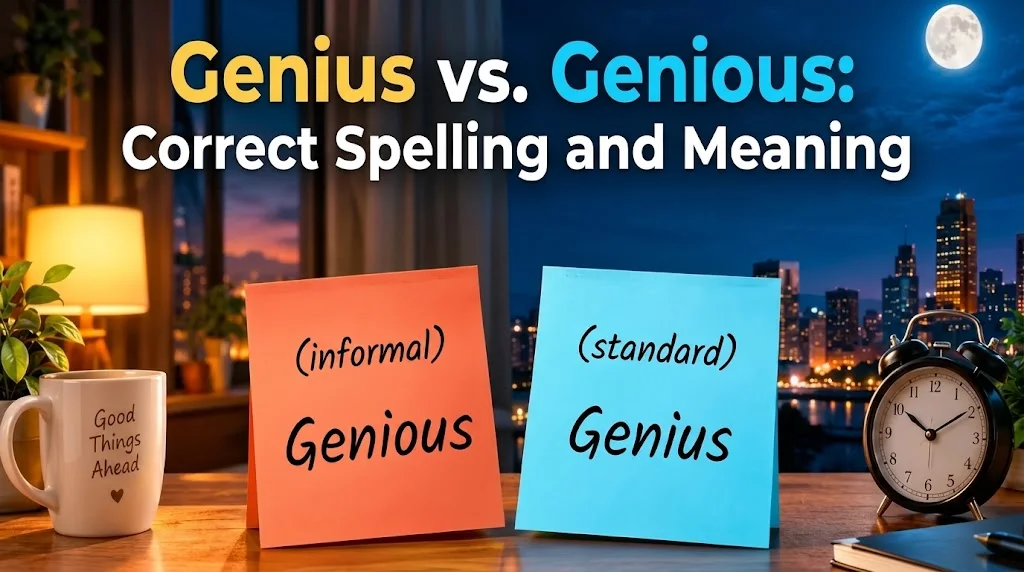

Have you ever typed genious and wondered whether you spelled it correctly? You’re not alone. Many English learners and confident writers mix up genius vs. genious because the two forms look almost identical. A small difference in their letters can cause spelling confusion, especially when you’re typing quickly or thinking about familiar words with similar endings.
The correct spelling is genius, while genious is a common misspelling. The word genius describes someone with exceptional intelligence, creativity, talent, or originality. It can also describe an unusually clever idea or solution. For example, you might call a scientist a genius because of an important discovery or describe a smart way to solve a problem as a stroke of genius. Although genious may look reasonable, it isn’t an accepted alternative spelling in standard English.
Understanding the difference between genius vs. genious can help you improve your spelling accuracy and written communication. This distinction matters in school assignments, academic papers, professional writing, emails, blog posts, and everyday messages. In this guide, you’ll learn the correct spelling, meaning, pronunciation, and usage of genius, explore why people misspell it, and see practical examples that make the difference easier to remember.
Genius vs. Genious: Quick Difference
The difference between genius vs. genious is simple: genius is the correct English spelling, while genious is a misspelling. They don’t represent two different words with separate meanings.
The word genius describes exceptional intelligence, natural talent, or remarkable creative ability. It can also refer to someone who demonstrates these qualities.
For example, you might call a scientist a genius because of an important discovery. You could also describe an unusually clever solution as a stroke of genius.
Here’s a quick comparison:
| Feature | Genius | Genious |
| Spelling | Correct | Incorrect |
| Standard English word | Yes | No |
| Meaning | Exceptional intelligence or ability | No established standard meaning |
| Part of speech | Primarily a noun; also informal adjective use | Not standard |
| Pronunciation | /ˈdʒiː.ni.əs/ | No standard pronunciation |
| Example | She is a musical genius. | Incorrect spelling |
Correct: Her genius helped her develop a creative solution.
Incorrect: Her genious helped her develop a creative solution.
Remember one important point: always write genius without an extra o. This spelling works in academic, professional, and everyday English.
What Does Genius Mean?
The word genius refers to unusually high intelligence, exceptional natural ability, or outstanding creative skill. It can describe a person or the remarkable ability that person demonstrates.
According to the Cambridge Dictionary, genius describes very great and rare natural ability or skill, particularly in fields such as science and art. The word also refers to someone who possesses that ability.
However, genius doesn’t always mean someone excels in every subject. A person might demonstrate extraordinary mathematical ability while having ordinary skills in other areas. Another person might show exceptional creativity through music, writing, engineering, or design.
Consider these examples:
- A scientist develops a groundbreaking scientific theory.
- A musician creates an original composition that influences other artists.
- An inventor designs a practical solution to a difficult problem.
- A mathematician solves a complex problem using an unusual approach.
Each example demonstrates a different form of exceptional ability.
Genius as a Noun
The most common grammatical use of genius is as a noun. It can describe an exceptionally talented person or the unusual ability that makes someone stand out.
For example:
- Albert Einstein is widely recognized as a scientific genius.
- Her genius for mathematics became clear at an early age.
- The artist’s genius appears throughout his paintings.
- His creative genius helped transform the industry.
Notice that the word can describe both a person and an ability.
When you say, “She is a genius,” you’re describing the person. When you say, “Her work shows genius,” you’re describing the exceptional quality of her work.
The word can also appear in expressions such as:
- A stroke of genius: An unusually clever or brilliant idea.
- A work of genius: Something demonstrating exceptional creativity or skill.
- A genius for something: A natural ability to perform a particular activity exceptionally well.
For example, “Her decision to simplify the entire process was a stroke of genius.”
Genius as an Adjective
Although genius primarily functions as a noun, English speakers also use it informally as an adjective. In this use, it describes something particularly clever, inventive, or effective.
For example:
- That was a genius idea.
- She came up with a genius solution.
- This is a genius way to organize your workspace.
- His genius plan helped the team finish early.
In these sentences, genius describes an idea, solution, method, or plan rather than a person.
This informal adjective use is common in everyday American English. However, in formal writing, you might choose brilliant, ingenious, or exceptionally clever, depending on the intended meaning.
What Does Genious Mean?
The spelling genious is incorrect in standard English. It doesn’t have an established dictionary meaning as an alternative form of genius.
People usually write it by mistake when they remember the sound of the word but not its exact spelling. The additional o may seem natural because English contains many words with similar letter patterns.
For example, words such as obvious, previous, and serious end with similar letter combinations. This visual familiarity can sometimes lead writers to add an unnecessary letter when spelling genius.
However, spelling depends on the established form of each word. You can’t automatically apply the pattern of one word to another.
Examples of the spelling mistake:
| Incorrect sentence | Correct sentence |
| He is a genious. | He is a genius. |
| That was a genious idea. | That was a genius idea. |
| Her genious impressed everyone. | Her genius impressed everyone. |
| We need a genious solution. | We need a genius solution. |
If you encounter genious in an article, assignment, email, or social media post, correct it to genius.
It’s also worth distinguishing genious from ingenious. The latter is a real English word with its own meaning, which we’ll explore later.
Why Is Genius the Correct Spelling?
The spelling genius comes from the established English form borrowed from Latin. Its history helps explain why the word has its particular spelling.
The Latin word genius originally referred to a guardian spirit or protective deity believed to accompany a person from birth. Over time, its meaning expanded to include a person’s natural character, inborn qualities, talent, and intellectual ability.
According to the Oxford Learner’s Dictionaries, the English word developed from the Latin term through Middle English. Its modern meaning gradually shifted toward exceptional natural intelligence and artistic or intellectual ability.
The Online Etymology Dictionary also traces the word to Latin genius, connecting its earlier meaning with natural character and inborn ability.
Here’s a simplified look at its development:
| Period | Meaning or development |
| Latin | Guardian spirit, natural character, or inborn quality |
| Late Middle English | Guardian spirit or protective influence |
| Late 1500s | Characteristic disposition or natural inclination |
| Mid-1600s | Exceptional natural intelligence or talent |
| Modern English | Exceptional ability or a person possessing it |
This history confirms that genius is the established spelling. There is no need to add an o.
The easiest way to remember it is to learn the word as a complete spelling rather than trying to build it from similar-looking English words.
Genius vs. Genious: Pronunciation Difference
Pronunciation can sometimes make spelling more confusing, especially when a word contains several syllables. Fortunately, genius has a consistent standard pronunciation in American English.
The word is pronounced:
- IPA: /ˈdʒiː.ni.əs/
- Syllables: Ge-ni-us
- Stress: First syllable
According to the Cambridge Dictionary pronunciation guide, American and British English use the same standard IPA transcription for this word.
To understand the pronunciation, break it into three parts:
| Sound | Pronunciation guide |
| /dʒ/ | The beginning sound in jump |
| /iː/ | The long vowel sound in sheep |
| /n/ | The beginning sound in name |
| /i/ | The vowel sound in happy |
| /ə/ | The unstressed vowel sound in above |
| /s/ | The ending sound in say |
The main stress falls on the first syllable. The remaining syllables receive less emphasis.
One important distinction: genious doesn’t have a separate standard English pronunciation because it isn’t an accepted alternative spelling. When someone intends to write genius, the correct spelling remains the same regardless of accent.
Genius in a Sentence: Examples of Correct Usage
Seeing genius in different sentences makes its meaning easier to understand. The word works in conversations, academic writing, professional communication, and descriptions of creative achievements.
Here are several examples showing how to use it correctly.
Genius as a Person
Use genius when describing someone with exceptional intelligence, creativity, or natural talent.
Examples:
- The young scientist proved to be a genius in mathematics.
- Everyone recognized her as a musical genius.
- The professor considered his student a scientific genius.
- That child is a genius when it comes to solving puzzles.
- History remembers many individuals who demonstrated extraordinary genius.
In these examples, genius identifies a person with exceptional abilities.
However, you don’t need to use the word only for famous scientists or historical figures. It can also describe someone who demonstrates remarkable skill in a particular area.
Genius as an Idea or Solution
You can also use genius informally to describe an unusually clever idea, plan, or method.
Examples:
- That was a genius way to organize the classroom.
- Her genius idea made the project easier to complete.
- Finding a simple solution to the problem was a stroke of genius.
- His genius approach helped everyone understand the instructions.
- This little invention is a genius solution to an everyday problem.
Here, the word highlights the quality of an idea rather than the intelligence of a person.
For example, a simple storage system might seem ordinary at first. However, if it solves a frustrating problem efficiently, someone might describe it as a genius idea.
Genius in Everyday Conversations
In casual American English, people often use genius as an expression of appreciation or humor.
Examples:
- You’re a genius for remembering that important detail.
- That trick was pure genius!
- She’s a genius at finding creative solutions.
- What a genius idea for a weekend project!
- I never thought of that. You’re a genius!
The word doesn’t always describe extraordinary intellectual ability in these situations. Sometimes, it simply expresses admiration for a clever decision.
Common Mistakes When Using Genius
Even though genius is a familiar word, writers sometimes make spelling and grammar mistakes when using it. Understanding these errors can help you write more accurately.
Here are some common mistakes to avoid.
Adding an unnecessary O
The most common mistake is writing genious instead of genius. Remember that the correct spelling contains no letter o.
- Incorrect: He is a genious.
- Correct: He is a genius.
Confusing genius with ingenious
These words look similar, but their meanings differ. Genius describes exceptional intelligence or ability, while ingenious describes something clever and inventive.
- Incorrect: Her genius solution was very ingeniously.
- Better: Her ingenious solution worked perfectly.
Using genius without considering the context
Calling someone a genius can sound exaggerated when you’re simply describing ordinary competence.
For example, completing a basic task doesn’t necessarily demonstrate exceptional intelligence. In casual conversation, however, people often use the word playfully.
Confusing a person’s ability with a specific skill
Someone can have a genius for music without being exceptionally talented in mathematics.
For example:
- Correct: She has a genius for creative writing.
- Correct: He is a musical genius.
These examples show that genius can describe exceptional ability in a particular field.
Genius vs. Similar Words: Understanding the Differences
Several English words describe intelligence, creativity, and natural ability. Although they share related meanings, they don’t always communicate the same idea.
Understanding these differences will help you choose the most accurate word.
Genius vs. Intelligent
Genius describes exceptional intellectual ability or a person with extraordinary talent. Intelligent describes someone who understands information, learns quickly, and uses knowledge effectively.
For example:
- Genius: The mathematician was a genius who developed an original theory.
- Intelligent: The student was intelligent and understood the lesson quickly.
Someone can be intelligent without being considered a genius. The word genius usually suggests a much higher or more unusual level of ability.
Genius vs. Talented
Genius often refers to exceptional intellectual or creative ability. Talented describes someone with a natural ability or developed skill in a particular activity.
For example:
- Genius: Her scientific genius changed how researchers approached the problem.
- Talented: She is a talented painter who creates beautiful artwork.
A talented person may have excellent practical skills without demonstrating the extraordinary ability associated with genius.
Genius vs. Brilliant
Brilliant describes someone or something exceptionally intelligent, impressive, or creative. It can also describe an outstanding idea or performance.
For example:
- Genius: He is a genius in computer science.
- Brilliant: He developed a brilliant solution to the technical problem.
These words sometimes overlap. However, brilliant is more flexible because it can describe people, ideas, performances, and achievements.
Genius vs. Gifted
Gifted describes someone with an unusually strong natural ability in a particular area. It often appears in educational discussions about students who demonstrate advanced abilities.
For example:
- Genius: The young scientist demonstrated extraordinary genius.
- Gifted: The gifted student showed advanced mathematical skills.
A gifted person may have exceptional potential without necessarily demonstrating the achievements or originality associated with genius.
Here’s a quick comparison:
| Word | Main meaning | Example |
| Genius | Exceptional intelligence or ability | She is a scientific genius. |
| Intelligent | Good reasoning and understanding | He is an intelligent student. |
| Talented | Natural or developed skill | She’s a talented musician. |
| Brilliant | Exceptionally clever or impressive | That was a brilliant idea. |
| Gifted | Unusually strong natural ability | He is a gifted artist. |
Synonyms and Related Words for Genius
Using synonyms can make your writing more interesting and prevent unnecessary repetition. However, you should choose a replacement that matches the intended meaning.
Here are some useful alternatives:
| Synonym | Meaning | Example |
| Brilliant | Exceptionally intelligent or impressive | She is a brilliant scientist. |
| Gifted | Naturally talented | He’s a gifted musician. |
| Exceptional | Unusually good or outstanding | Her work shows exceptional ability. |
| Intelligent | Capable of learning and reasoning | She’s an intelligent researcher. |
| Prodigy | A young person with extraordinary ability | The musical prodigy performed confidently. |
| Mastermind | Someone who plans or directs something skillfully | He was the mastermind behind the project. |
| Intellectual | Someone strongly interested in thinking and knowledge | The intellectual enjoyed discussing philosophy. |
| Whiz | Someone exceptionally skilled in a particular area | She’s a computer whiz. |
Important distinction: These synonyms aren’t interchangeable in every sentence.
For example, prodigy generally refers to a young person with exceptional abilities. Meanwhile, mastermind often emphasizes planning, organization, or leadership.
Choosing the right word helps communicate your intended meaning more clearly.
How to Remember the Correct Spelling of Genius
Remembering the correct spelling becomes easier when you focus on the exact letter sequence.
The correct spelling is:
G – E – N – I – U – S
There is no O between the letters I and U.
Here are a few practical ways to remember it:
- Memorize the letter sequence: Practice writing G-E-N-I-U-S until it becomes familiar.
- Use a common phrase: Remember “a genius idea” or “a mathematical genius.”
- Write example sentences: Use the word in short sentences to reinforce its spelling.
- Check unfamiliar spellings: Consult a reliable dictionary when you’re unsure.
- Watch for the extra O: If you type genious, recognize it as a spelling error and correct it.
You can also use this simple reminder:
A genius needs no extra O.
It’s a short way to remember that genius contains six letters, not seven.
A Practical Spelling Example
Imagine you’re writing a school assignment about an inventor.
Your first draft says:
“Thomas Edison was a genious who developed many useful inventions.”
The sentence contains a spelling mistake. You don’t need to rewrite the entire sentence. Simply remove the extra o.
Corrected sentence:
“Thomas Edison was a genius who developed many useful inventions.”
This small correction makes the sentence accurate and more professional.
Genius vs. Ingenious: What’s the Difference?
One reason people confuse genius and genious is the existence of another correctly spelled English word: ingenious.
Although these words look similar, they have different meanings and grammatical uses. Understanding the distinction will help you avoid another common writing mistake.
Genius refers to exceptional intelligence, extraordinary talent, or someone who possesses these qualities.
Ingenious describes someone or something that demonstrates cleverness, originality, or inventive thinking.
Consider these examples:
- Genius: Marie is a genius when it comes to mathematics.
- Ingenious: Marie developed an ingenious method for solving the equation.
The first sentence describes a person’s exceptional ability. The second describes the cleverness of her method.
Here’s a more detailed comparison:
| Feature | Genius | Ingenious |
| Part of speech | Primarily noun | Adjective |
| Meaning | Exceptional intelligence or ability | Clever, original, or inventive |
| Describes | A person or exceptional ability | A person, idea, method, or solution |
| Example | He is a genius. | He created an ingenious device. |
Why do people confuse these words?
Their similar appearance can lead writers to remember the spelling of ingenious when they actually mean genius. However, both words have established spellings and distinct meanings.
Remember:
- Use genius when discussing exceptional intelligence or ability.
- Use ingenious when describing something particularly clever or inventive.
- Avoid genious because it isn’t the correct spelling of either word.
Grammar Rules for Genius
Knowing the correct spelling is only the beginning. You should also understand how genius works in different grammatical situations.
The following rules cover articles, plural forms, possessives, and capitalization.
Is It a Genius or An Genius?
The correct expression is a genius, not an genius.
English speakers use a before words that begin with consonant sounds. They use an before words that begin with vowel sounds.
Although genius begins with the letter G, its pronunciation also starts with a consonant sound.
Examples:
- She is a genius in mathematics.
- He became a genius in the field of engineering.
- My brother is a genius at solving puzzles.
Remember that article selection depends on pronunciation rather than simply looking at the first letter.
What Is the Plural of Genius?
The standard plural form of genius is geniuses.
Use this form when discussing two or more exceptionally talented people or multiple examples of exceptional ability.
Examples:
- The university welcomed several young geniuses.
- History remembers many scientific geniuses.
- Those musicians are creative geniuses.
- The exhibition celebrates the work of artistic geniuses.
You may also encounter genii as an alternative plural. However, this form is especially associated with historical or mythological guardian spirits. Geniuses is the natural choice when referring to intelligent or talented people.
| Form | Usage | Example |
| Genius | Singular | She is a genius. |
| Geniuses | Standard plural | They are musical geniuses. |
| Genii | Historical or mythological plural | The story describes ancient guardian genii. |
For ordinary modern English writing, choose geniuses.
What Is the Possessive Form of Genius?
The possessive form shows ownership, association, or a relationship with something.
For the singular noun genius, the usual possessive form is genius’s.
Examples:
- The genius’s discovery changed the scientific discussion.
- The genius’s creativity impressed the entire team.
- We studied the genius’s original research.
For the plural noun geniuses, use geniuses’ when showing possession.
Examples:
- The geniuses’ inventions attracted public attention.
- The geniuses’ research received international recognition.
- The geniuses’ ideas inspired younger students.
Here’s a quick reference:
| Form | Example |
| Singular | Genius |
| Singular possessive | Genius’s |
| Plural | Geniuses |
| Plural possessive | Geniuses’ |
Be careful not to confuse possessive forms with contractions. An apostrophe doesn’t automatically make a word plural.
Should Genius Be Capitalized?
In ordinary writing, genius doesn’t need capitalization.
Use lowercase when the word appears in the middle of a sentence.
Examples:
- She is a genius at solving difficult problems.
- His genius became clear during the competition.
- The invention demonstrated extraordinary genius.
However, capitalize it in these situations:
- At the beginning of a sentence: “Genius often involves creativity and original thinking.”
- In a proper name or official title when the capitalization is part of that name.
- In a heading when following your chosen capitalization style.
The general rule is straightforward: use lowercase genius unless standard capitalization rules require an uppercase letter.
A Practical Case Study: Correcting Genius vs. Genious in Writing
Consider a student preparing an article about famous inventors. During the first draft, the student repeatedly writes genious instead of genius.
The mistake appears in several places:
| Original sentence | Corrected sentence |
| The inventor was a genious. | The inventor was a genius. |
| His genious helped him solve problems. | His genius helped him solve problems. |
| It was a genious invention. | It was a genius invention. |
After reviewing the article, the student identifies the repeated spelling error and corrects each occurrence.
The student also notices another opportunity to improve the writing:
Original: The inventor was a genius and created a genius invention.
Improved: The inventor was a genius who developed an ingenious invention.
The revised sentence uses genius to describe the person and ingenious to describe the invention.
This example demonstrates two important lessons:
- Correct spelling improves the accuracy and readability of your writing.
- Understanding related words helps you communicate ideas more precisely.
The example is illustrative, but the lesson applies to school assignments, blog posts, business documents, and everyday communication.
Read More: Currier vs. Courier: Differences, Meanings, and Correct Usage
Genius vs. Genious: Which Spelling Should You Use?
When choosing between genius and genious, always use genius in standard English writing.
The correct spelling applies across different situations, including:
- Academic writing: Use genius when discussing exceptional intelligence or intellectual ability.
- Professional communication: Describe an unusually clever idea or a highly talented individual using the correct spelling.
- Creative writing: Use genius when describing characters, inventors, artists, or extraordinary abilities.
- Everyday conversations: Use genius naturally when praising someone’s intelligence or a clever solution.
- Online content: Check the spelling before publishing articles, captions, and social media posts.
There is no American English versus British English spelling difference here. Both varieties use genius.
For quick reference:
- Correct: She is a genius.
- Incorrect: She is a genious.
- Correct: That was a genius idea.
- Incorrect: That was a genious idea.
- Correct: They are brilliant geniuses.
- Incorrect: They are brilliant geniouses.
The spelling is simple once you remember the correct six-letter form.
Conclusion:
Understanding genius vs. genious is simple once you remember the correct spelling. Genius is the standard English word used to describe exceptional intelligence, creativity, talent, or an unusually clever idea. Genious is a misspelling and should be avoided in formal and informal writing. Although the extra letter may seem natural because of words ending in -ious, it doesn’t belong in this word. Make genius part of your regular vocabulary, and check your spelling during proofreading to keep your writing clear, accurate, and professional.
FAQs:
1. Is it genius or genious?
Genius is the correct spelling. Genious is a common misspelling and isn’t accepted as the standard form of the word.
2. What does the word genius mean?
Genius refers to exceptional intelligence, creativity, talent, or originality. It can describe a highly intelligent person or an exceptionally clever idea.
3. Why do people spell genius as genious?
People often write genious because they associate the word with familiar English words ending in -ious, such as curious and serious. However, genius follows a different spelling pattern.
4. Can genious be used in formal or academic writing?
No. Genious is considered a spelling error when you intend to write genius. Use the correct spelling in academic papers, business documents, emails, and professional communication.
5. What is an example of genius in a sentence?
Here is an example: “The scientist showed remarkable genius through her groundbreaking discovery.” In this sentence, genius describes exceptional intellectual ability.

1 thought on “Genius vs. Genious: Correct Spelling, Meaning, and Usage Explained”