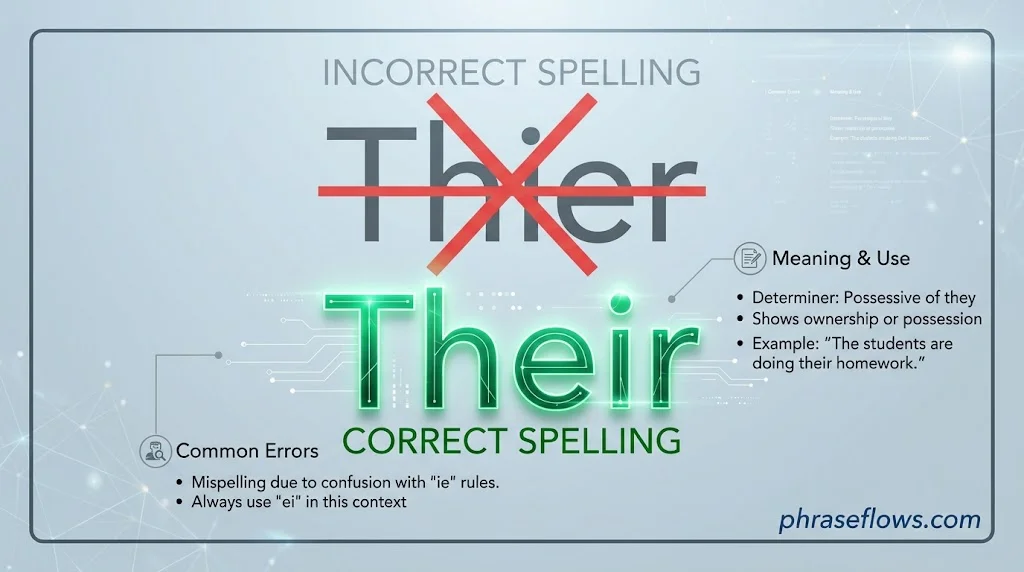

Have you ever stopped while writing because you weren’t sure whether to use their vs. thier? You’re not alone. This is a common spelling mistake in English, but the correct form is their. The word thier is simply a misspelling. Although the two look similar, only one follows standard English spelling rules.
The confusion can become even greater when you add there and they’re to the mix. All three words have the same pronunciation, but they serve different purposes. Their shows ownership, there refers to a place or introduces something that exists, and they’re is a contraction of they are. Understanding these differences helps you avoid spelling mistakes in emails, messages, school assignments, and professional writing.
In this guide, you’ll learn how to use their, there, and they’re correctly, with simple examples that make each meaning easier to remember. You’ll also discover useful memory tricks and a quick substitution test to help you choose the right word. Whether you’re an English learner or simply want to improve your grammar, these easy explanations will help you write more clearly and confidently.
Their vs. Thier: The Key Difference
The main difference between their and thier is spelling. Their is a standard English word that shows possession or association. Thier is simply a spelling error.
Although the two forms contain the same letters, their arrangement matters. In their, the letters appear in the order t-h-e-i-r. In the incorrect version, the i and e switch places.
Here’s a quick comparison:
| Word | Correct or Incorrect? | Meaning | Example |
| Their | Correct | Shows possession or association | Their house is beautiful. |
| Thier | Incorrect | No standard English meaning | Thier house is beautiful. |
The first sentence correctly uses their to show that the house belongs to or is associated with a group of people. The second sentence contains a spelling mistake.
Remember: Always write their when you want to express possession. Avoid thier in academic, professional, and casual writing.
What Does Their Mean?
Their is a possessive determiner that indicates ownership, belonging, or association. It usually appears before a noun to show that something belongs to or relates to multiple people.
For example:
- Their car is parked outside.
- The students submitted their assignments.
- We visited their new house.
- The children packed their school bags.
- Everyone should bring their identification.
In these examples, their connects a person or group with something they own, use, or are associated with.
Unlike they, which functions as a subject or object pronoun, their usually comes before a noun.
Consider the following comparison:
| Word | Grammatical Function | Example |
| They | Subject pronoun | They are playing outside. |
| Them | Object pronoun | I invited them to dinner. |
| Their | Possessive determiner | Their garden looks lovely. |
| Theirs | Possessive pronoun | The garden is theirs. |
These words have related meanings, but they don’t perform the same grammatical jobs.
Their as a Possessive Determiner
A possessive determiner identifies who owns or is associated with something. Other examples include my, your, his, her, and our.
For instance:
- My book is on the table.
- Your shoes are near the door.
- Her brother studies medicine.
- Our classroom needs new chairs.
- Their teacher explained the lesson.
Notice that each possessive determiner appears before a noun. The same pattern applies to their.
You can use it with different types of nouns, including:
- People: Their parents arrived early.
- Objects: Their computers need repairs.
- Places: Their office is downtown.
- Ideas: Their opinions differ from ours.
- Responsibilities: Their duties include organizing meetings.
Can Their Refer to One Person?
Yes. Their can refer to one person when you use the singular form of they.
English speakers commonly use singular they when someone’s gender is unknown, irrelevant, or unspecified. Some people also use they/them pronouns as their personal pronouns.
For example:
- Someone left their notebook in the classroom.
- Every student should bring their own lunch.
- Alex said their appointment starts at noon.
- If anyone calls, tell them I’ll return their message.
This usage is widely accepted in modern English. It also helps writers avoid awkward expressions when they don’t know someone’s gender.
For example, instead of writing:
“Someone forgot his or her umbrella.”
You can write:
“Someone forgot their umbrella.”
The second version sounds more natural and concise.
What Does Thier Mean?
Thier is not a standard English word. It is a common misspelling of their, usually caused by placing the letters i and e in the wrong order.
Unlike their, it doesn’t function as a possessive determiner or pronoun. You won’t find a standard grammatical use for it in ordinary English writing.
For example:
Incorrect
- Thier house is near the park.
- The employees completed thier assignments.
- Everyone brought thier books.
Correct
- Their house is near the park.
- The employees completed their assignments.
- Everyone brought their books.
The correction is simple: replace thier with their.
Why Is Thier Considered Incorrect?
English spelling follows several patterns, but not every word follows the same rule. Some words have unusual letter combinations that writers must learn through practice.
The spelling their can cause confusion because people sometimes apply the familiar ie pattern incorrectly.
For example, English has words such as:
- Believe
- Chief
- Field
- Piece
- Relief
These words contain the letters i and e in that order. However, their uses the opposite order.
The incorrect spelling often happens when someone remembers the sound of a word but doesn’t recall its exact letter arrangement.
The important point is that pronunciation doesn’t change the correct spelling. Even if their and thier look similar, standard English recognizes only their.
When to Use Their in a Sentence
Knowing the definition is helpful, but understanding how to use their in different situations makes your writing more accurate.
You can use this word in everyday conversations, academic assignments, professional emails, and formal documents. The main requirement is that the sentence must express possession or association.
Showing Possession With Their
The most common use of their is to indicate that something belongs to someone.
For example:
- The children cleaned their bedroom.
- My neighbors painted their house.
- The workers collected their tools.
- The students forgot their notebooks.
- The company updated their website.
In each sentence, their identifies the person or group associated with the following noun.
You can use it with both singular and plural nouns:
- Their car is new.
- Their cars are new.
- Their decision surprised everyone.
- Their decisions surprised everyone.
The noun following their doesn’t have to be plural. What matters is the person or people the possessive word refers to.
Referring to Multiple People
When you’re talking about two or more people, their helps connect those people with something they own, share, or use.
For example:
- The players celebrated their victory.
- The parents attended their children’s school meeting.
- The employees discussed their working hours.
- The guests left their coats near the entrance.
- The neighbors decorated their homes for the festival.
This usage appears frequently in conversations and written communication.
It also prevents unnecessary repetition. Instead of repeatedly naming the same people, you can use their to make sentences shorter and smoother.
Using Their for One Person
As mentioned earlier, their also works with singular they.
This is especially useful when discussing an unidentified person or someone whose pronouns are they/them.
Examples include:
- A customer left their phone at the counter.
- Someone forgot their password.
- Each participant received their certificate.
- Jordan brought their laptop to the meeting.
Notice that their remains the same whether it refers to one person or several people.
This makes singular they practical in everyday English. It also provides a natural alternative when a person’s gender isn’t known.
Using Their in Everyday and Professional Writing
The word their appears in almost every type of English communication. Its meaning stays the same, although the context changes.
In everyday conversations:
- Their children are very polite.
- I like their new apartment.
In academic writing:
- Students should review their notes before the examination.
- Researchers explained their findings in the report.
In professional communication:
- Employees must complete their assigned tasks.
- Customers can check their order status online.
In business documents:
- The partners discussed their responsibilities.
- The organization updated their annual policies.
Using the correct spelling helps your writing look polished and professional.
Why Do People Confuse Their and Thier?
Even experienced writers occasionally make spelling mistakes. The confusion between their and thier usually comes from typing habits, incorrect letter order, and unfamiliarity with the word’s spelling.
Although the difference involves only two letters, several factors can make the mistake more likely.
Confusion Between IE and EI
English contains many words with the letter combination ie. Examples include:
- Believe
- Achieve
- Friend
- Piece
- Field
Because writers see this combination frequently, they may accidentally apply it to their.
However, their follows a different spelling pattern. The correct order is e before i.
A helpful reminder is to memorize the complete spelling rather than relying on a general spelling rule. English has exceptions, and their is one word worth learning individually.
Typing Mistakes and Keyboard Errors
Fast typing can cause people to reverse letters without noticing. This often happens when someone writes quickly or doesn’t review the finished sentence.
For example:
- Incorrect: They forgot thier tickets.
- Correct: They forgot their tickets.
Spell-checking tools can catch many mistakes, but you shouldn’t rely on them entirely. Some typing errors may remain unnoticed, especially when a sentence contains several other words.
Pronunciation Can Cause Confusion
In standard American English, their is commonly pronounced /ðer/. The letters ie and ei don’t create a noticeable difference between the two spellings because thier isn’t a separate standard word with its own pronunciation.
As a result, listening to the word won’t tell you which spelling is correct.
The best solution is to remember its written form and understand its grammatical purpose.
Their vs. There vs. They’re: Understanding the Differences
The confusion doesn’t stop with their and thier. Many English learners also mix up their, there, and they’re because these words sound alike in many American English accents.
However, each word has a different meaning and grammatical function.
Their – Possession
Their indicates that something belongs to or relates to a person or group.
Examples:
- Their house has a large garden.
- The children finished their homework.
- Everyone should bring their identification.
There – Place or Existence
There commonly refers to a location. It can also introduce a statement about the existence of something.
Examples:
- Put your shoes over there.
- There is a book on the desk.
- We went there last weekend.
They’re – They Are
They’re is a contraction of they are. Writers use it to make sentences shorter and more conversational.
Examples:
- They’re waiting outside.
- They’re going to the movies.
- I think they’re ready for the meeting.
Their vs. There vs. They’re: Quick Comparison Table
| Word | Meaning | Grammatical Function | Example |
| Their | Belonging to them | Possessive determiner | Their dog is friendly. |
| There | In or at that place | Adverb | Your bag is over there. |
| There | Indicates existence | Introductory word | There are three chairs. |
| They’re | They are | Contraction | They’re very helpful. |
| Thier | Incorrect spelling | No standard function | Incorrect spelling of their |
How to Choose Between Their, There, and They’re
A simple substitution trick can help you select the correct word.
For their: Ask whether the sentence expresses ownership or association.
Example: The students brought their books.
The books belong to or are associated with the students. Therefore, their is correct.
For there: Check whether the sentence refers to a place or introduces something that exists.
Example: There are several restaurants nearby.
The word introduces the existence of several restaurants.
For they’re: Replace the word with they are. If the sentence still makes sense, they’re is correct.
Example:
They’re working on a new project.
Replacement:
They are working on a new project.
The sentence remains grammatically correct.
This simple technique can prevent many common English grammar mistakes.
Common Mistakes When Using Their
Even when writers understand the meaning of their, they sometimes use it incorrectly. Learning these mistakes can help you recognize and correct them.
Writing Thier Instead of Their
This is the main spelling mistake discussed in this article.
Incorrect: The students submitted thier assignments.
Correct: The students submitted their assignments.
The correction requires switching the i and e back into their proper positions.
Confusing Their With There
These words sound similar, but they communicate different ideas.
Incorrect: Their is a beautiful park near my house.
Correct: There is a beautiful park near my house.
The second sentence correctly introduces the existence of a park.
However, if you’re describing ownership, use their.
Example: Their house is near the park.
Confusing Their With They’re
Another common mistake involves using the possessive word instead of the contraction.
Incorrect: Their going to visit their grandparents.
Correct: They’re going to visit their grandparents.
The first word means they are, while the second indicates possession or association.
Confusing Their With Theirs
Although these words express possession, they don’t appear in exactly the same way.
Their normally comes before a noun:
- Their car is outside.
- Their opinions matter.
- Their children attend this school.
Theirs replaces a noun phrase:
- That car is theirs.
- The opinions are theirs.
- The children are theirs.
For example, you wouldn’t normally write, “That is their.” You would write, “That is theirs” or “That is their car.”
Understanding this distinction makes your sentences more natural and grammatically accurate.
Easy Tricks to Remember the Correct Spelling of Their
Memorizing the correct spelling doesn’t need to be difficult. A few simple techniques can help you remember their and avoid writing thier.
Remember the Correct Letter Order
The easiest approach is to memorize the spelling as:
T – H – E – I – R
Pay particular attention to the letters e and i. In their, the e comes first.
Write the word several times if necessary. Repeated exposure can help you recognize the correct form more quickly.
Associate Their With Ownership
Another useful trick is to connect their with the question “Whose?”
For example:
- Whose books are these? Their books.
- Whose house is that? Their house.
- Whose responsibilities are these? Their responsibilities.
Whenever you express ownership or association, consider whether their fits the sentence.
Remember the Word Heir
Here’s another simple memory trick: their contains the word heir.
An heir is someone who inherits property or a position. Both heir and their contain the letter sequence eir.
You can use this connection to remember the correct spelling:
- Heir: H-E-I-R
- Their: T-H-E-I-R
Think of the phrase “their heir” to reinforce the letter order.
This isn’t a grammatical rule, but it’s a useful spelling reminder.
Replace Their With Our
The word our can help you check whether you’re expressing possession.
For example:
“Their house needs repairs.”
Replace their with our:
“Our house needs repairs.”
Both sentences express possession and remain grammatically correct.
This substitution works in many situations, although it isn’t a universal test. Always consider the full meaning of your sentence.
Proofread Your Writing With Context
A quick proofreading session can catch spelling mistakes before anyone else sees them.
Pay particular attention to:
- Emails and professional messages.
- School assignments and essays.
- Website content and blog posts.
- Business reports and presentations.
- Social media captions.
If you frequently type thier, add their to your personal spelling practice list. You can also use a grammar checker to identify repeated mistakes.
Read More: Outting vs. Outing: Which Is the Correct Spelling?
Their vs. Thier: Examples in Sentences
Examples make spelling differences easier to understand. The following sentences show how to use their correctly in different situations.
Everyday Examples Using Their
- Their house is located near the shopping center.
- The children finished their dinner before going outside.
- My friends invited me to their birthday party.
- Their garden looks beautiful in the spring.
- The neighbors repaired their old fence.
- The students brought their books to class.
- Their dog enjoys playing in the backyard.
- The workers collected their belongings after the meeting.
Academic and Professional Examples Using Their
- Students should complete their assignments before the deadline.
- Researchers published their findings in an academic journal.
- Employees must follow their company’s workplace policies.
- The managers discussed their plans for the upcoming year.
- Each applicant should submit their resume online.
- The teachers prepared their lesson materials before class.
Examples Showing Singular Their
- Someone left their wallet on the counter.
- Every student should bring their own notebook.
- The new employee introduced themself and shared their experience.
- Jordan said their presentation was ready.
- If anyone needs help, they should contact their instructor.
Incorrect vs. Correct Their Examples
| Incorrect Sentence | Correct Sentence |
| Thier parents are visiting. | Their parents are visiting. |
| The children lost thier toys. | The children lost their toys. |
| Everyone should bring thier lunch. | Everyone should bring their lunch. |
| Thier office is on the second floor. | Their office is on the second floor. |
| The students completed thier work. | The students completed their work. |
| I visited thier house yesterday. | I visited their house yesterday. |
A Practical Editing Case Study
Consider a short workplace email containing the following sentence:
Original version
“All employees should collect thier documents before they’re leaving the office.”
This sentence contains two issues. The first is a spelling mistake, while the second involves an incorrect contraction.
Corrected version
“All employees should collect their documents before they leave the office.”
Here’s what changed:
- Thier became their because the sentence expresses possession.
- They’re became they because the sentence needs a subject pronoun before the verb leave.
- The corrected sentence communicates the instruction clearly.
This example shows why proofreading requires more than checking individual spellings. You must also understand how each word functions within its sentence.
Conclusion:
Understanding their vs. thier is easier once you remember that their is the correct spelling and thier is a misspelling. However, don’t confuse their with there or they’re. Use their to show ownership, there to refer to a place or indicate existence, and they’re when you mean they are. A simple substitution test can help you choose the correct word whenever you feel unsure. With regular practice and attention to sentence meaning, you’ll avoid these common grammar mistakes and improve your English writing skills.
FAQs:
1. Is it their or thier?
Their is the correct spelling. Thier is a common spelling mistake and isn’t accepted as a standard English word.
2. What is the difference between their and there?
Their shows ownership or possession, while there refers to a place or introduces something that exists. For example, “Their car is parked over there.”
3. When should I use they’re?
Use they’re when you mean they are. For example, “They’re waiting outside” means “They are waiting outside.”
4. Are their, there, and they’re homophones?
Yes. Their, there, and they’re are homophones because they share the same pronunciation but have different meanings and uses.
5. How can I remember the difference between their, there, and they’re?
Use these simple memory tricks:
- Their: Think of ownership or something belonging to them.
- There: Think of a place or location.
- They’re: Replace it with “they are.” If the sentence still makes sense, they’re is correct.




1 thought on “Their vs. Thier: Which One Is Correct in English Grammar?”