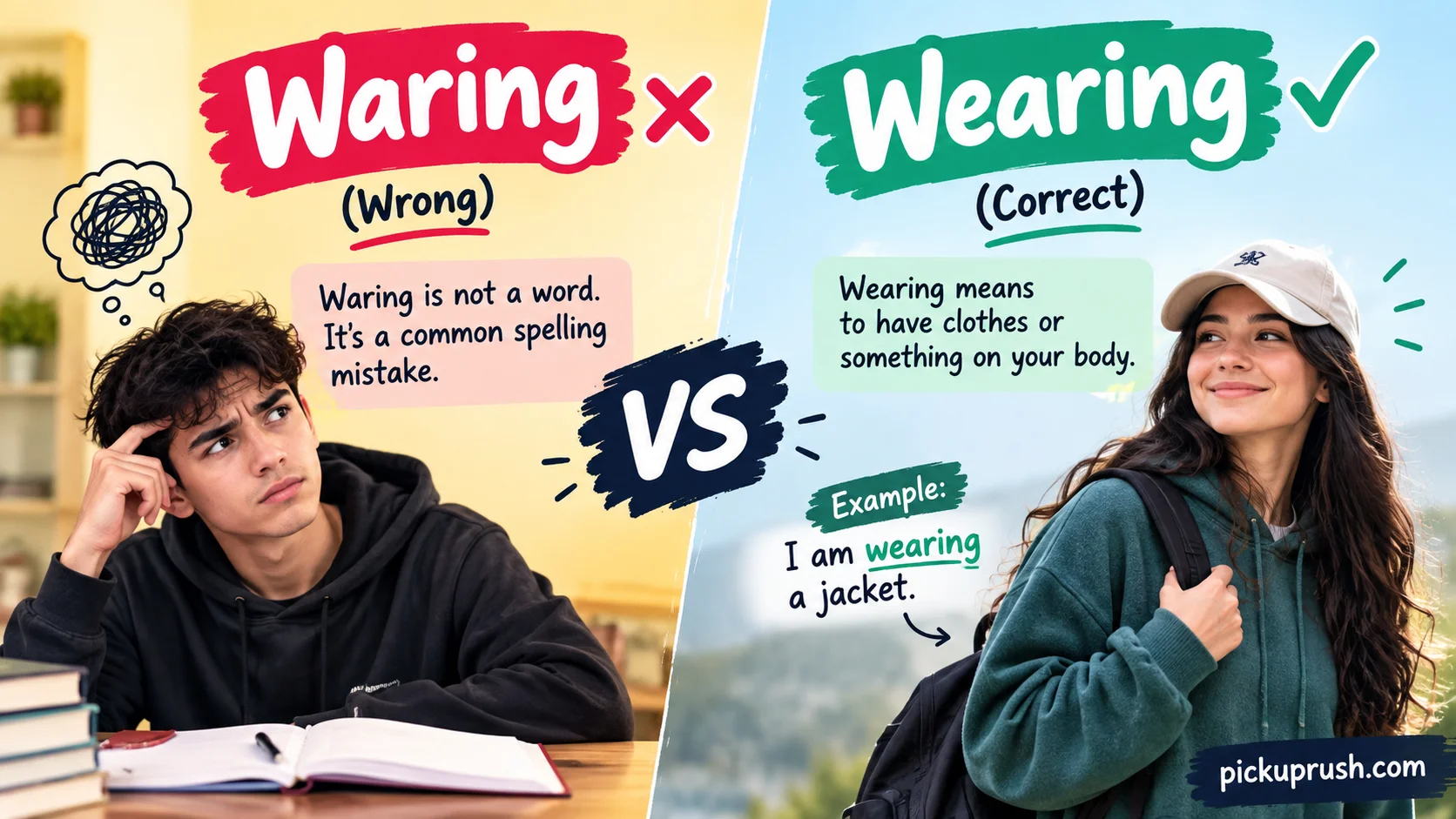

Waring vs Wearing: Differences, Meaning, and Correct Usage With Examples explains why wearing is correct for clothes, while waring is rarely used.
If you have ever paused while typing these two words, you are not alone. They look remarkably similar, and their sound may seem almost identical in some accents. However, their meaning, usage, and correctness are different. Wearing is the standard and widely accepted form when you are talking about clothes, shoes, accessories, uniforms, jewelry, or other personal items on the body. Waring, by contrast, is usually the incorrect form for this everyday meaning. This common mix-up can lead to spelling mistakes, writing errors, and reduced clarity in captions, emails, essays, and product descriptions.
Understanding this difference can improve your English writing, English spelling, and overall confidence. It also helps to connect wearing with related commonly confused words such as wear, ware, and where, which have different parts of speech, meanings, and uses. A warning, meanwhile, has a different definition because it refers to a message or sign about danger or risk. With a little attention to context, standard spelling, and correct usage, you can avoid confusion, eliminate errors, and make your writing clearer in everyday English.
Waring vs Wearing: Quick Difference
Here’s the simplest way to separate the words:
| Word | Main use | Meaning | Example |
| Wearing | Common English | Having something on your body | She is wearing a blue jacket. |
| Waring | Rare word form or proper name | Usually connected with ware or used as a name | Waring can be a surname. |
| Warring | Common English | Engaged in conflict | The two warring groups reached an agreement. |
The most important rule is straightforward:
If you mean “having clothes or something similar on your body,” use “wearing.”
The standard dictionary form of wear lists wearing as its present participle. The same verb has the familiar forms wear, wears, wore, worn, and wearing.
So:
- wear → wearing
- war → warring
- ware → waring
That small distinction explains most of the confusion.
What Does “Wearing” Mean?
Wearing is the present participle of the verb wear. It describes the act or state of having something on your body.
For example:
- She is wearing a red sweater.
- He was wearing black shoes.
- I am wearing my new glasses.
- They are wearing school uniforms.
- She has been wearing that necklace all week.
Dictionaries define wear in this context as having something such as clothing, shoes, or jewelry on your body.
Wearing Clothes
This is by far the most common use.
You can wear:
- shirts
- pants
- dresses
- coats
- jackets
- shoes
- hats
- gloves
- socks
- uniforms
- costumes
- jewelry
- watches
- glasses
- contact lenses
- protective equipment
For example:
Maria is wearing a yellow raincoat because it’s raining outside.
Here, wearing describes what Maria has on her body.
Wearing Accessories
The word isn’t limited to clothing. You can also use it for many objects worn as accessories.
Consider these sentences:
- He is wearing a silver watch.
- She is wearing earrings.
- The actor was wearing a colorful costume.
- My brother is wearing sunglasses.
- The workers are wearing protective helmets.
The basic idea remains the same: the item is on the person’s body or being used as something worn on the body.
Wearing Can Have Other Meanings
Here’s where the word becomes more interesting.
Wearing doesn’t always describe clothing. Because wear has several meanings, its -ing form can appear in other contexts too.
Wearing Something Down
The verb wear can describe gradual damage caused by repeated use, friction, pressure, or time.
For example:
- The constant rubbing is wearing the fabric down.
- Years of use are wearing the surface away.
- The machine is wearing down after years of heavy use.
This meaning comes from the idea of something becoming weaker or damaged through continued use. Dictionaries also recognize wear in this sense.
Wearing as “Tiring”
Wearing can also work as an adjective meaning tiring, exhausting, or demanding.
For example:
- The long meeting was wearing.
- Dealing with constant interruptions can be wearing.
- The stressful situation became increasingly wearing.
This use is established in English dictionaries, particularly in descriptions of situations that consume physical or mental energy.
So the word has more range than it might first appear to have.
Is “Waring” a Word?
Yes, but there’s an important catch.
Waring can exist as a legitimate word form, although it is extremely uncommon in everyday modern English. Wiktionary records waring as the present participle and gerund of ware.
That doesn’t mean you should use waring whenever you mean wearing. The two words come from different verbs.
The distinction looks like this:
| Base word | -ing form | General meaning |
| wear | wearing | Having something on; gradually using or damaging something |
| war | warring | Engaging in conflict |
| ware | waring | Rare or archaic/regional meanings |
This is why saying that waring is “always a misspelling” isn’t quite accurate. The word has documented uses. However, those uses are not the normal meaning people intend when discussing clothes.
Waring as a Proper Name
There’s another reason you might encounter Waring.
Waring is also an English surname. It can therefore appear in names of people, organizations, places, and other proper nouns.
For example:
- Mr. Waring attended the meeting.
- The Waring family lived in the area.
- Waring appears in the historical record.
In these examples, Waring isn’t a form of the verb wear. It’s a name.
Capitalization provides an important clue. Common words such as wearing normally appear in lowercase unless they begin a sentence. A surname such as Waring normally begins with a capital letter.
However, capitalization alone doesn’t tell you everything. Context still matters.
Waring vs Wearing: The Spelling Difference
The spelling becomes much easier when you start with the base verb.
Wear + -ing = Wearing
The standard formation is:
wear + ing = wearing
The base word wear already contains the letters ea and ends in r. When you add -ing, you get wearing.
Examples include:
- wear → wearing
- wear → wears
- wear → wore
- wear → worn
The verb is irregular because its past tense and past participle don’t follow the usual -ed pattern. But its present participle is straightforward: wearing.
Why “Waring” Causes Problems
When someone writes waring to mean wearing clothes, they have removed the e from the spelling of wear.
Compare:
- ❌ She is waring a dress.
- ✅ She is wearing a dress.
The missing e changes the word.
A useful memory trick is simple:
Start with “wear.” Keep “wear” visible when you add “-ing.”
That gives you wearing.
Waring vs Wearing Pronunciation
In ordinary English, wearing has the pronunciation associated with the verb wear. Dictionary sources give American pronunciation around /ˈwɛrɪŋ/ and British pronunciation around /ˈwɛərɪŋ/.
The spelling is therefore especially important because Waring and wearing can sound alike or nearly alike in some contexts.
This creates a classic homophone-style spelling problem: you may hear a word correctly while still choosing the wrong spelling.
That’s why relying only on pronunciation can lead to mistakes.
For example, imagine someone says:
“She is wearing a jacket.”
If you’re writing the sentence from dictation, the sound won’t necessarily remind you whether the middle of the word contains ea.
The safest approach is to connect the word to its base verb:
wear → wearing
Waring vs Wearing vs Warring
This three-way comparison is particularly useful because people sometimes confuse all three.
| Word | Base | Meaning | Example |
| wearing | wear | Having something on | She is wearing a coat. |
| warring | war | Fighting or being in conflict | The warring groups negotiated. |
| waring | ware | Rare form with specialized or archaic/regional uses | The form appears in historical or specialized contexts. |
The second word deserves special attention.
Warring Means Engaged in Conflict
If you want to describe people, countries, groups, or factions involved in conflict, use warring.
Examples:
- The two warring kingdoms eventually negotiated.
- The story follows several warring factions.
- The warring groups agreed to meet.
- The novel describes two warring families.
So if you write:
❌ The two groups were waring.
you likely need:
✅ The two groups were warring.
The extra r matters because the base verb is war, not wear or ware.
Wearing in Different Grammatical Forms
Understanding the grammar behind wearing can help prevent spelling mistakes.
Present Continuous
Use am/is/are + wearing to describe something happening now or around the current period.
Examples:
- I am wearing a blue shirt.
- She is wearing glasses.
- They are wearing uniforms.
- We are wearing matching hats.
The structure is:
Subject + am/is/are + wearing + object
Past Continuous
Use was/were + wearing when describing something that was happening at a particular time in the past.
Examples:
- She was wearing a red jacket.
- He was wearing his school uniform.
- They were wearing protective clothing.
Present Perfect Continuous
You can also use have/has been wearing when an action began in the past and continues or has relevance in the present.
Examples:
- She has been wearing glasses for several years.
- He has been wearing the same style of shoes recently.
Future Continuous
The same form appears with the future continuous:
- Tomorrow, she will be wearing her new uniform.
- At the ceremony, everyone will be wearing formal clothes.
Notice something important: the form “wearing” stays the same. The helping verb changes to show the tense.
Common Mistakes With Waring and Wearing
Mistake: “She Is Waring a Dress”
Incorrect:
She is waring a dress.
Correct:
She is wearing a dress.
The intended base verb is wear.
Mistake: “He Was Waring Glasses”
Incorrect:
He was waring glasses.
Correct:
He was wearing glasses.
Again, the correct present participle is wearing.
Mistake: “They Were Waring Uniforms”
Incorrect:
They were waring uniforms.
Correct:
They were wearing uniforms.
The spelling follows wear + ing.
Mistake: “The Two Sides Were Waring”
If the intended meaning is conflict, neither wearing nor waring is appropriate.
Correct:
The two sides were warring.
That’s because the base verb is war.
Waring vs Wearing Examples
The following examples show how context determines the correct form.
Examples of “Wearing”
- She is wearing a beautiful blue dress.
- He was wearing a warm winter coat.
- I am wearing my favorite pair of sneakers.
- The students are wearing their uniforms.
- She is wearing sunglasses because the sunlight is bright.
- He was wearing a silver watch.
- They were wearing helmets while cycling.
- The actor is wearing a costume for the performance.
- She has been wearing contact lenses for years.
- The fabric is wearing thin after repeated washing.
Examples of “Waring”
Because waring is rare, it shouldn’t appear in ordinary clothing sentences.
If you see it in a historical, dialectal, linguistic, or specialized context, examine the sentence carefully. It may relate to the verb ware rather than wear.
It can also appear as part of a proper name, in which case capitalization and context matter.
Examples of “Warring”
- The two warring factions finally met.
- Several warring kingdoms appear in the historical account.
- The novel centers on two warring families.
- The leaders attempted to unite the warring groups.
A Simple Comparison Table
| Sentence | Correct? | Explanation |
| She is wearing a coat. | ✅ | Wearing comes from wear. |
| She is waring a coat. | ❌ | Waring isn’t the standard clothing form. |
| They are wearing uniforms. | ✅ | Correct use of wearing. |
| The groups were warring. | ✅ | Warring comes from war. |
| The groups were waring. | ❌ | Not the standard modern form for conflict. |
| Waring is his surname. | ✅ | Waring is being used as a proper name. |
| He was wearing glasses. | ✅ | Glasses can be worn. |
| She was waring glasses. | ❌ | The intended verb is wear. |
How to Remember the Correct Spelling
A good memory trick doesn’t need to be complicated.
Think of the base word first:
WEAR → WEARING
Don’t try to memorize wearing as an isolated spelling. Remember its family:
- wear
- wears
- wore
- worn
- wearing
If you’re writing a sentence about clothes, ask yourself:
“What is the base verb?”
The answer is wear.
Therefore:
wear + ing = wearing
If you’re describing conflict, ask a different question:
“What is the base verb?”
The answer is war.
Therefore:
war + ing = warring
This tiny mental check can prevent a surprisingly common spelling mistake.
When Should You Use “Wearing”?
Use wearing when someone has something on their body or when wear is being used in one of its other established senses.
You can use it for:
- clothing
- footwear
- accessories
- jewelry
- glasses
- uniforms
- costumes
- protective equipment
- hairstyles
- makeup and similar appearance-related uses
For example:
The athlete was wearing protective equipment.
You can also use wearing when something gradually becomes damaged:
Constant friction is wearing the surface down.
And you can use wearing as an adjective when something is tiring:
The constant noise became wearing.
These broader meanings are all connected to the established meanings of wear.
When Should You Use “Waring”?
Use Waring when the context specifically requires a proper name.
For example, if someone’s surname is Waring, you shouldn’t change it to Wearing simply because the words look similar.
You may also encounter lowercase waring in specialized linguistic or historical material where it functions as the present participle of ware. That’s a legitimate but uncommon use.
For everyday writing, however, the practical rule is much simpler:
If you’re talking about clothes, write “wearing.”
Don’t use waring as a shortened version.
A Real-World Writing Check
Suppose you’re proofreading these three sentences:
Sarah is waring a blue sweater.
The two kingdoms were waring for control.
Sarah’s surname is Waring.
How should you handle them?
The first should become:
Sarah is wearing a blue sweater.
The second should become:
The two kingdoms were warring for control.
The third is already correct if Waring is genuinely the person’s surname.
This example shows why context matters more than simply deciding that one spelling is “good” and another is “bad.”
Read More: Midday vs. Mid Day: Which Spelling Is Correct in Modern English?
Final Waring vs Wearing Comparison
| Question | Answer |
| What is the correct word for having clothes on? | Wearing |
| What is the base verb of wearing? | Wear |
| What is the past tense of wear? | Wore |
| What is the past participle of wear? | Worn |
| What is the -ing form of wear? | Wearing |
| What does warring mean? | Engaged in conflict |
| What is the base verb of warring? | War |
| Can waring be a real word? | Yes, but it is rare and connected to ware |
| Can Waring be a name? | Yes, it is an established surname |
| Should you write “waring” for clothes? | No |
Conclusion:
The difference between waring vs wearing is mainly about correct spelling and meaning. Wearing is the correct and widely accepted word when you talk about clothes, shoes, accessories, uniforms, or jewelry that someone has on their body. Waring may appear in rare historical, literary, or proper-name contexts, but it should not normally be used as a spelling of wearing.
Remembering this simple distinction can help you avoid spelling mistakes, improve writing clarity, and communicate with greater confidence. When you are unsure, check the meaning and context of the sentence. In ordinary English, wearing is the form you need.
FAQs:
Is “waring” or “wearing” correct?
Wearing is correct when you mean having clothes, shoes, accessories, or other items on your body. Waring is not the standard spelling for this meaning.
What does “wearing” mean?
Wearing means having something such as clothes, shoes, jewelry, or an accessory on your body. For example, “She is wearing a blue jacket.”
Is “waring” a real word?
Yes, waring can occur in rare historical or literary contexts and may also appear in proper names. However, it is not the normal spelling of wearing.
Why do people confuse “waring” and “wearing”?
The words look and sound very similar, so writers may accidentally leave out the e. This is a common spelling mistake, especially for English learners.
How can I remember the correct spelling?
Connect wearing with the verb wear. When you mean putting on or having clothes or accessories on your body, use wearing with the e.




1 thought on “Waring vs Wearing: Differences, Meaning, and Correct Usage With Examples”