
Have you ever typed “goodmorning” in a text message or email and wondered whether you should leave a space between the two words? You’re not alone. English contains many compound words, such as “goodbye” and “goodnight,” so it’s easy to assume that this familiar greeting follows the same pattern.
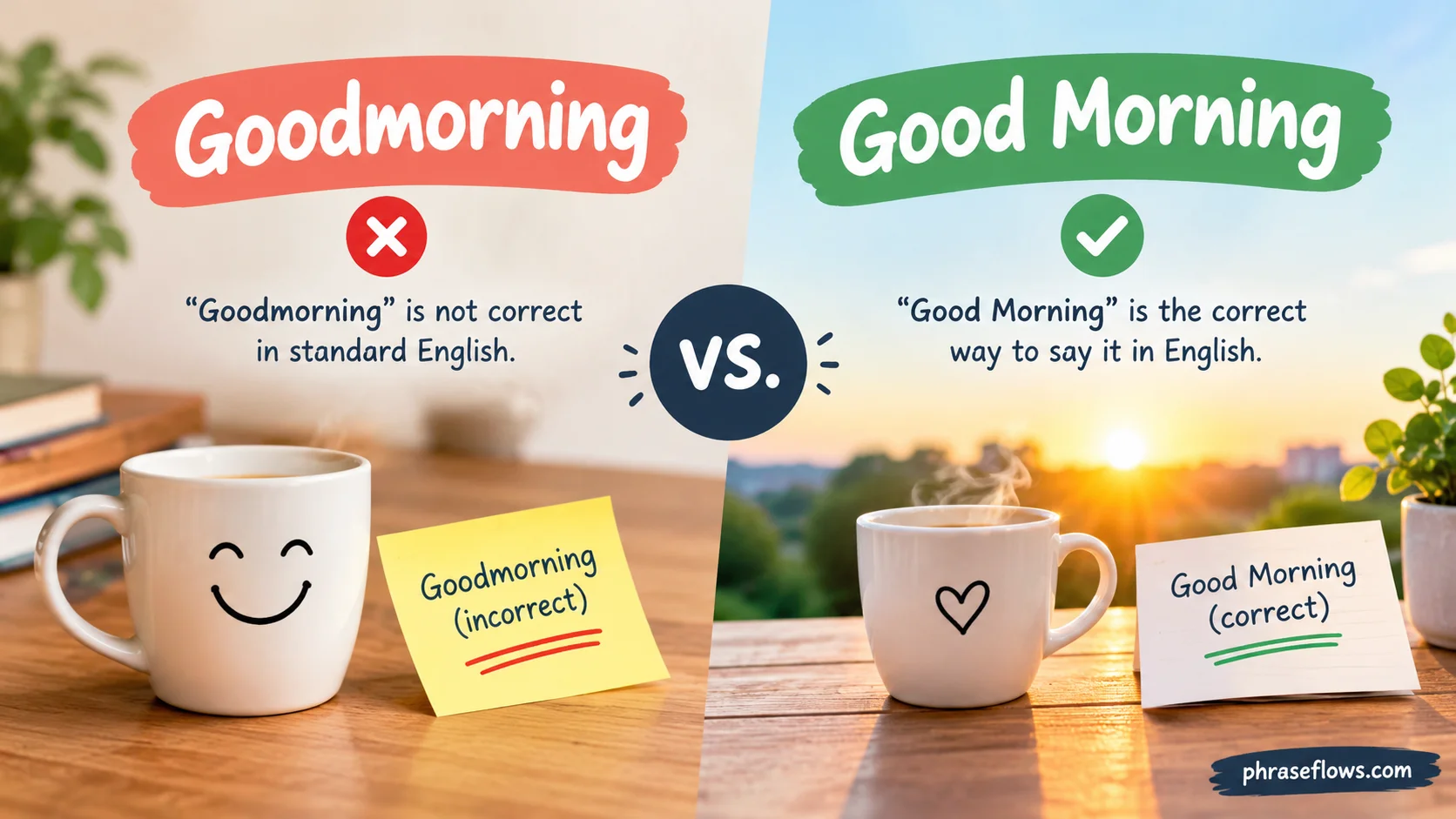
However, “good morning” is the correct standard spelling, with a space between “good” and “morning.” The one-word form, “goodmorning,” isn’t the standard spelling used in everyday English writing. Although you might see it in usernames, creative designs, or brand names, you should write the two-word version in emails, school assignments, articles, and professional messages.
The good news is that the rule is simple once you understand how the expression works. Let’s explore its meaning, grammar, capitalization, punctuation, and common mistakes so you can use good morning vs. goodmorning correctly in any situation.
Goodmorning vs. Good Morning: Which One Is Correct?
The correct form is good morning, written as two separate words. Use it when greeting someone in the morning or wishing them a pleasant start to the day.
The Cambridge Dictionary defines “good morning” as a polite greeting used when you meet someone in the morning. Its entry uses the standard two-word spelling, confirming the conventional written form.
You can check the definition in the Cambridge Dictionary.
By contrast, “goodmorning” combines the words without following the standard spelling convention. Readers will probably understand what you mean, but the joined form can look like a typing mistake in ordinary writing.
Consider these examples:
- Correct: Good morning, Emily! I hope you slept well.
- Incorrect in standard writing: Goodmorning, Emily! I hope you slept well.
- Correct: Good morning, everyone. Let’s get started.
- Incorrect in standard writing: Goodmorning, everyone. Let’s get started.
The difference is only one space, but that space keeps your writing consistent with standard English.
Goodmorning vs. Good Morning: Quick Comparison
| Feature | Good morning | Goodmorning |
| Standard spelling | Correct | Nonstandard |
| Number of words | Two | One |
| Dictionary usage | Established greeting | Not the standard greeting form |
| Professional emails | Recommended | Avoid |
| School assignments | Recommended | Avoid |
| Creative usernames | May be used | Possible as a stylistic choice |
Quick rule: Whenever you mean the ordinary English greeting, write good morning, not “goodmorning.”
What Does Good Morning Mean?
Good morning is a polite expression people use to greet one another during the morning. It can communicate friendliness, respect, warmth, or simple acknowledgment when you meet someone at the start of the day.
For example, when you enter a classroom and see your teacher, saying “Good morning” is a courteous way to begin the interaction. Similarly, greeting your coworkers with the same expression helps establish a friendly tone before a meeting begins.
The phrase can serve several purposes:
- Greeting someone: “Good morning, Daniel!”
- Welcoming a group: “Good morning, everyone.”
- Starting a professional conversation: “Good morning, Ms. Johnson.”
- Sending a friendly message: “Good morning! Have a wonderful day.”
- Describing a positive start: “We had a good morning at the park.”
Notice that the last example uses the same two words but doesn’t function as a direct greeting. Instead, it describes the quality of a morning.
This distinction matters because the meaning and grammatical role of a phrase depend on how you use it in a sentence.
Is Good Morning Only Used Before Noon?
People generally use “good morning” during the morning hours, often from the time they wake up until around noon. However, everyday usage isn’t controlled by a strict clock.
For instance, if you meet a coworker at 11:55 a.m., “Good morning” sounds perfectly natural. If you meet the same person at 12:30 p.m., “Good afternoon” may be more appropriate.
The setting also matters. A person starting a night shift at 6 a.m. might use “good morning” even if they’ve been awake all night. The greeting usually reflects the time of day rather than the speaker’s sleep schedule.
Why Is Good Morning Written as Two Words?
To understand the spelling, look at the two words separately.
Good is an adjective that describes something positively. Morning is a noun that refers to the early part of the day. Together, they form a familiar expression that functions as a greeting.
Here is the basic structure:
| Word | Part of speech | Function |
| Good | Adjective | Expresses a positive quality |
| Morning | Noun | Names a period of the day |
| Good morning | Greeting expression | Politely greets someone |
English often keeps familiar word combinations separate even when people use them together frequently. The fact that two words appear next to each other doesn’t automatically turn them into one word.
Consider these common expressions:
- Good afternoon
- Good evening
- High school
- Real estate
- Social media
Each expression contains separate words with an established spelling. The same principle applies to “good morning.”
Why Doesn’t Goodmorning Follow the Same Pattern as Goodbye?
This is one of the main reasons people get confused. English has words that begin with “good” and appear as a single word, including “goodbye.” Some people assume that “good morning” should follow the same pattern.
However, English spelling doesn’t follow one universal rule for every familiar expression. Some combinations become established as single words over time, while others remain separate. Writers need to follow the accepted spelling of each expression rather than combine words based on appearance alone.
For example:
- Goodbye: A standard one-word expression used when leaving someone.
- Good morning: A standard two-word expression used as a greeting.
- Good afternoon: A standard two-word expression used during the afternoon.
The spelling of “goodbye” doesn’t provide a reason to write “goodmorning.” Each expression has its own conventional form.
Is Good Morning a Compound Word?
In ordinary usage, “good morning” is best treated as a two-word greeting phrase, not as a single closed compound word.
A closed compound combines its elements into one word, as in “bedroom” or “notebook.” An open compound or phrase keeps the elements separate, as in “high school” or “good morning.”
You don’t need to memorize every category to write correctly. Just remember that the established form of this greeting contains a space.
Good Morning vs. Goodmorning: Key Differences in Usage
Although the two spellings look almost identical, only one follows standard English conventions for this greeting.
Spelling Differences
The standard form contains two words:
Good morning, Alex.
The nonstandard form joins them:
Goodmorning, Alex.
The second version may still be understandable, especially in a quick text. Nevertheless, readers may interpret it as a spelling error rather than a deliberate choice.
Grammatical Differences
“Good morning” can function as a greeting on its own or appear within a longer sentence.
For example:
- “Good morning!” — A direct greeting.
- “I wished my neighbor good morning.” — A greeting reported within a sentence.
- “We enjoyed a good morning outdoors.” — A description of a pleasant morning.
In all three examples, the phrase retains its standard two-word spelling.
Usage Differences
The best choice depends on whether you’re writing ordinary English or creating a special name.
In a professional email, school assignment, article, or formal message, use good morning. In a username, company name, graphic design, or hashtag, someone might intentionally join the words for visual reasons.
For instance, a social media account could use a name such as “GoodmorningStudio.” That spelling may be part of its chosen identity, but it doesn’t change the standard spelling of the greeting.
Remember: Creative styling and standard spelling serve different purposes. Don’t confuse a name’s design choice with a general grammar rule.
How to Use Good Morning Correctly in Sentences
Examples make spelling rules easier to remember. The following sentences show how “good morning” works in greetings, conversations, messages, and descriptive writing.
Good Morning as a Direct Greeting
Use the expression when you first address someone during the morning.
- Good morning, Sarah! I hope you have a lovely day.
- Good morning, everyone. Thank you for joining us.
- Good morning, Dad! What’s for breakfast?
- Good morning, team. Let’s review today’s plans.
When you address a specific person or group, a comma usually separates the greeting from the name or form of address.
Good Morning in the Middle of a Sentence
The phrase doesn’t always appear at the beginning of a sentence. When it appears within a sentence, the spelling stays the same.
Examples:
- I said good morning to my teacher before class.
- She forgot to say good morning when she arrived.
- We exchanged good morning greetings in the hallway.
- He sent me a good morning message before work.
These examples also show why context matters. The phrase may function as a greeting or form part of a longer description, but it remains two words.
Good Morning in a Longer Greeting
You can combine the expression with a question, a welcome, or another polite statement.
- Good morning! How are you feeling today?
- Good morning, everyone, and welcome to our workshop.
- Good morning, Olivia. Did you receive my email?
- Good morning! I hope your presentation goes well.
Keep the greeting natural. You don’t need to make every message long or formal; a simple “Good morning!” is often enough.
Is Good Morning One Word or Two?
The answer is straightforward: good morning is two words in standard English.
People sometimes join the words because they pronounce the expression smoothly. In fast conversation, the space between written words has no direct sound, so the greeting may feel like a single unit. However, spoken rhythm doesn’t determine written spelling.
Compare these examples:
| Incorrect or nonstandard | Correct standard form |
| Goodmorning, teacher. | Good morning, teacher. |
| I sent a goodmorning text. | I sent a good morning text. |
| Goodmorning, everybody! | Good morning, everybody! |
| She wished me goodmorning. | She wished me good morning. |
The corrected versions use the standard two-word form.
Is Good-Morning Correct With a Hyphen?
For the ordinary greeting, write good morning without a hyphen. The forms “goodmorning” and “good-morning” aren’t the standard spellings of this expression.
A hyphen can join words in certain compound modifiers, but that doesn’t mean every familiar phrase needs one. Unless a specific name or special context requires unusual styling, keep the greeting open.
Is Good Morning Capitalized?
Capitalization depends on the phrase’s position and the writing format. The space between the words never disappears, but the first letter may change from uppercase to lowercase.
Good Morning at the Beginning of a Sentence
Capitalize “good” when it begins a sentence.
Example:
Good morning, everyone! Today’s lesson starts in five minutes.
The first word begins the sentence, so it takes a capital letter. “Morning” remains lowercase because it isn’t a proper noun.
Good Morning in the Middle of a Sentence
Use lowercase letters when the phrase appears in the middle of an ordinary sentence, unless another rule calls for capitalization.
Example:
I wished my classmates good morning before sitting down.
Here, “good morning” appears within the sentence, so neither word needs a capital letter.
Good Morning in Emails and Letters
A greeting at the beginning of an email commonly starts with a capital letter.
Example:
Good morning, Professor Lee,
I hope you’re doing well. I’m writing to ask about tomorrow’s assignment.
The exact punctuation after an email greeting can vary with style and personal preference. Some writers use a comma, while others use a colon in more formal correspondence. The important point is to keep Good morning correctly spelled.
Good Morning in Titles and Headings
Titles may follow title case or sentence case, depending on the publication’s style guide.
For example:
- Title case: Good Morning: A Guide to Better Greetings
- Sentence case: Good morning: A guide to better greetings
Both examples preserve the two-word spelling. The capitalization changes because the heading styles differ.
Should You Write Good Morning or Goodmorning in Emails and Text Messages?
Whether you’re sending a professional email or a casual text, good morning is the safest and clearest choice.
A greeting sets the tone for your message. Correct spelling helps your writing look polished, especially when you contact a teacher, customer, manager, colleague, or someone you don’t know well.
In Professional Emails
Use “Good morning” when you want a polite opening.
Example:
Good morning, Ms. Carter,
I hope you’re doing well. I’m writing to confirm our meeting scheduled for Thursday.
Best regards,
Jordan
This greeting is polite without sounding overly formal. It also works well when you want to begin a conversation on a respectful note.
In Text Messages
A casual message can be short and friendly.
Example:
Good morning! Hope you have a great day 😊
Even in informal messages, the standard spelling remains two words. Fast typing doesn’t make “goodmorning” the accepted form.
On Social Media
Captions and posts usually benefit from the standard spelling too.
For example:
- “Good morning! Enjoy the little things today.”
- “Good morning, friends. Wishing everyone a peaceful day.”
- “A cup of coffee and a good morning make a lovely start.”
Hashtags and usernames sometimes omit spaces because of platform conventions or design choices. That formatting doesn’t change how you should write the phrase in a normal sentence.
Read More: In Line vs. Inline: Which One Is Correct? Meaning, Differences, and Examples
Common Mistakes to Avoid When Writing Good Morning
The spelling is simple, but a few related mistakes can make your writing less polished. Here’s how to avoid them.
Joining the Words Together
Incorrect: Goodmorning, everyone!
Correct: Good morning, everyone!
The standard greeting always keeps the space between the two words.
Using Unnecessary Capital Letters
Less appropriate in an ordinary sentence: She wished me Good Morning before class.
Correct: She wished me good morning before class.
When the phrase appears in the middle of a sentence, lowercase letters are usually appropriate.
Forgetting the Comma Before a Name
Incorrectly punctuated: Good morning Sarah!
Correct: Good morning, Sarah!
When you directly address someone by name, place a comma after the greeting.
Assuming Informal Usage Makes a Spelling Standard
You might see “goodmorning” in a caption, username, or quick message. Repeated exposure can make a nonstandard spelling look familiar.
However, familiarity isn’t the same as standard usage. If you’re writing something that needs to follow conventional English spelling, choose “good morning.”
Confusing the Greeting With a Description
Compare these sentences:
- Greeting: Good morning, everyone!
- Description: We had a good morning at the beach.
The first sentence greets people. The second describes an enjoyable morning. Both use the same two-word spelling, but they serve different purposes.
Good Morning vs. Similar Greetings
Comparing “good morning” with other greetings can help you recognize their conventional spellings. Although these expressions serve similar purposes, English doesn’t always write them in the same way.
| Expression | Standard spelling | Typical use |
| Good morning | Two words | Morning greeting |
| Good afternoon | Two words | Afternoon greeting |
| Good evening | Two words | Evening greeting |
| Good night | Two words | Farewell or wish before sleep |
| Goodbye | One word | Farewell |
| Hello | One word | General greeting |
| Hi there | Two words | Informal greeting |
The comparison highlights an important point: you can’t determine a phrase’s spelling simply by comparing it with another expression.
For example, “goodbye” is one word, while “good morning” contains two. Both are correct in their established forms.
Good Morning vs. Good Afternoon
Use “good morning” during the morning and “good afternoon” later in the day. Both expressions are written as two words.
Examples:
- “Good morning, everyone. Welcome to class.”
- “Good afternoon, everyone. Let’s begin the presentation.”
Neither greeting requires joining its words together.
Good Morning vs. Good Evening
“Good evening” is another standard two-word greeting, generally used later in the day.
For example, you might greet a visitor with “Good evening” when they arrive for dinner. The spelling follows the same open form as “good morning.”
Good Morning vs. Good Night
These expressions have different common uses. “Good morning” typically greets someone, while “good night” often signals that you’re leaving or that someone is going to sleep.
Examples:
- “Good morning! It’s nice to see you.”
- “Good night! I’ll see you tomorrow.”
In standard writing, “good night” is also commonly written as two words. Don’t assume it must be written as “goodnight” simply because that form appears in some informal contexts or other uses.
Good Morning vs. Goodmorning: Correct and Incorrect Examples
If you want a quick way to test your understanding, review the following examples. Each correction shows how a small spacing change makes the phrase consistent with standard English.
| Nonstandard spelling | Correct example |
| Goodmorning, Anna! | Good morning, Anna! |
| Goodmorning, class. | Good morning, class. |
| I sent him a goodmorning text. | I sent him a good morning text. |
| She said goodmorning to her neighbor. | She said good morning to her neighbor. |
| Goodmorning, and welcome to the meeting. | Good morning, and welcome to the meeting. |
Notice that the correction doesn’t require changing the meaning or rewriting the entire sentence. You simply separate the words.
A Practical Example: Writing a Morning Email
Imagine you’re sending a message to your teacher before class. You want to ask a question about an assignment while keeping the tone polite.
Nonstandard version:
Goodmorning, Mr. Davis,
I wanted to ask whether we need to complete all the questions before Friday.
Corrected version:
Good morning, Mr. Davis,
I wanted to ask whether we need to complete all the questions before Friday.
Only the spacing changes. The corrected version follows standard spelling while keeping the original message and tone intact.
This small detail is useful in everyday writing because greetings often appear at the very beginning of an email or message. A correctly written opening helps establish a clear, professional tone from the start.
FAQs:
Is Goodmorning Ever Correct?
“Goodmorning” isn’t the standard spelling of the everyday greeting. It may appear in a creative name, username, brand, or stylized design, but use good morning in ordinary English writing.
Is Good Morning One Word or Two?
Good morning is two words. Keep a space between “good” and “morning” when using the expression as a greeting or within a sentence.
Should Good Morning Be Capitalized?
Capitalize “Good” when the expression begins a sentence or greeting. In the middle of a sentence, write it in lowercase unless another capitalization rule applies.
Is Good Morning Correct in Formal Emails?
Yes. “Good morning” is a polite, standard opening for professional emails and formal correspondence. You can follow it with a comma or use punctuation appropriate to your organization’s writing style.
Can I Write Goodmorning in a Text Message?
You can use creative spellings in casual messages, but “goodmorning” remains nonstandard. For clear, conventional writing, choose good morning, even in a short text.
Conclusion:
When choosing between “goodmorning” and “good morning,” the answer is clear: good morning is the correct standard form. Write it as two separate words whenever you’re greeting someone, beginning an email, sending a text, or using the expression in a sentence.
The confusion often comes from other familiar English words that combine into one. However, each expression follows its own established spelling, so “goodbye” doesn’t make “goodmorning” correct.

1 thought on “Goodmorning vs. Good Morning: Which Is Correct? Meaning, Rules, and Examples”