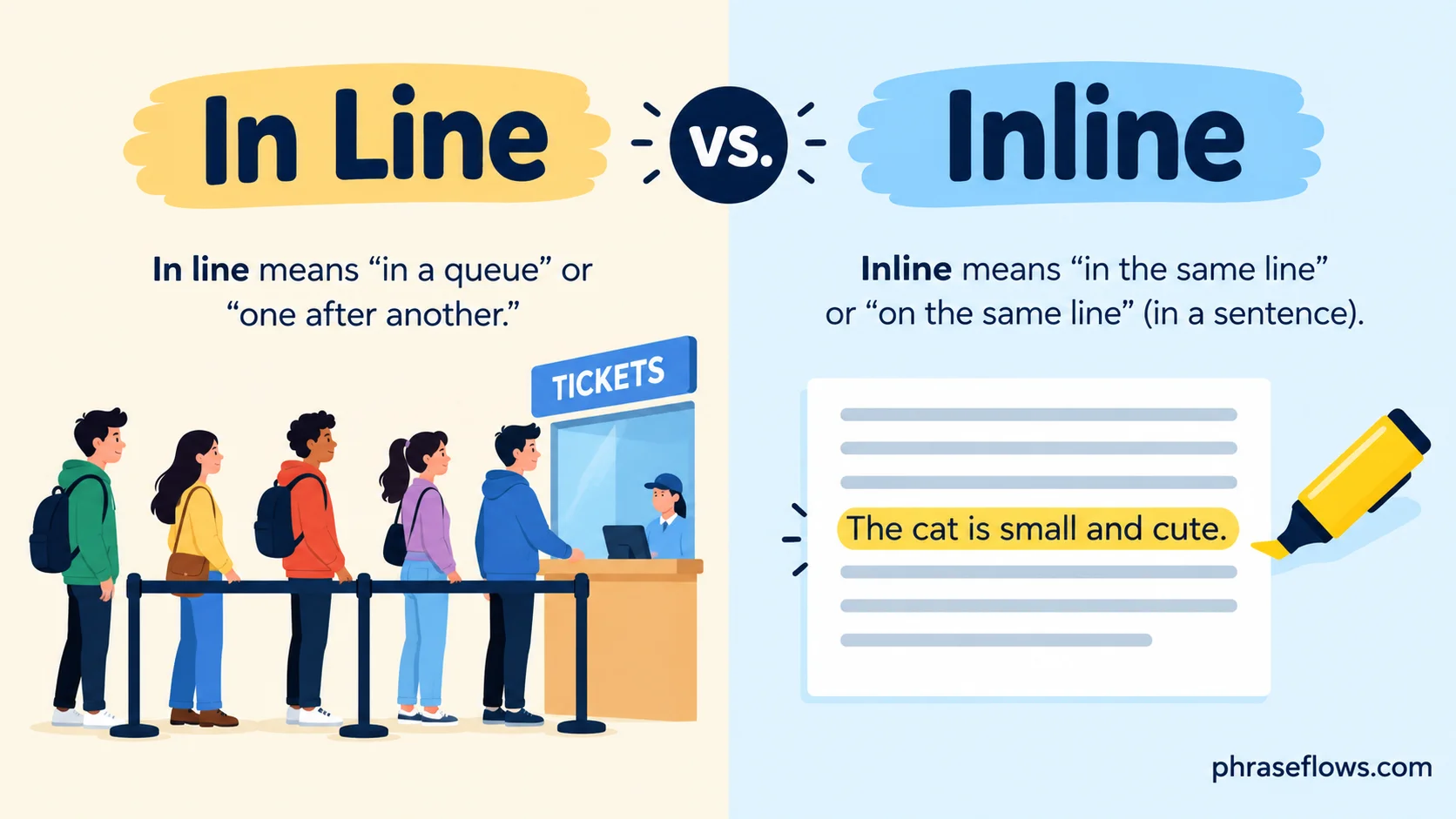

Have you ever paused while writing and wondered whether to use in line vs.inline? These two forms look almost identical and sound the same, but they serve different purposes. Choosing the right one depends on what you want to say and how you use it in a sentence.
The good news is that both spellings are correct in the right context. In line commonly refers to people waiting in a queue, objects arranged in a row, or something that agrees with a standard. Inline, on the other hand, often describes something placed directly within text, incorporated into a larger structure, or arranged along a line.
For example, you might write, “We stood in line at the store,” but “The editor added an inline comment to the document.” Both sentences use the correct spelling because each expresses a different idea.
In this guide, you’ll learn the meaning of each term, understand their grammatical differences, and explore practical examples from everyday conversations, business writing, and technology. By the end, choosing between in line vs. inline should feel straightforward.
In Line vs. Inline: The Quick Answer
The simplest way to distinguish these expressions is to consider their meaning. Use in line when talking about a queue, an arrangement, or consistency with a rule or expectation. Use inline when describing something incorporated directly into text, code, a system, or another structure.
Here’s a quick comparison:
| Feature | In Line | Inline |
| Spelling | Two words | One word |
| Main meaning | In a queue, row, or consistent with something | Included within text or integrated into a structure |
| Common use | Everyday English and business writing | Technology, editing, design, and technical descriptions |
| Example | We waited in line for lunch. | The document contains inline comments. |
| Common expression | In line with company policy | Inline code |
| Grammatical role | Usually a prepositional phrase | Often an adjective; also used as an adverb in technical contexts |
Remember: The two forms aren’t interchangeable in every sentence. The intended meaning determines which spelling works.
For instance, “The customers stood in line” describes people waiting their turn. However, “The website displays inline images” describes pictures appearing within the page’s content rather than in a separate section. The difference becomes clear once you look beyond the spelling.
What Does In Line Mean?
In line is a two-word expression that commonly describes a position in a queue, an arrangement, or a state of agreement with something. Its meaning depends on the words around it.
In everyday American English, you’ll often see it in sentences about waiting, organizing objects, following procedures, and meeting expectations.
In Line Meaning a Queue or Row
One of the most common uses of in line involves people waiting for their turn. Customers at a checkout counter, students outside a classroom, and visitors waiting to enter a museum can all stand in line.
The phrase can also describe objects arranged in a row. In this case, it focuses on their position rather than on people waiting.
Examples of in line in everyday English:
- We stood in line for tickets to the concert.
- The students waited in line outside the classroom.
- Please keep your shoes in line against the wall.
- Several customers were already in line at the bakery.
- The children formed a line before entering the playground.
Notice that the phrase remains two words in each example. Writing “We stood inline for tickets” would be inappropriate for standard American English when you mean that people were waiting in a queue.
In Line Meaning in Agreement With Something
Another important use appears in the expression in line with. This phrase means that something agrees with, follows, or matches a particular rule, principle, expectation, or standard.
You’ll often encounter it in professional emails, reports, school assignments, and business discussions. It helps explain whether an action or decision follows an established direction.
Consider these examples:
- The proposal is in line with the company’s goals.
- Her decision was in line with school policy.
- The new procedures are in line with current regulations.
- Our plans remain in line with the original agreement.
In each sentence, in line with communicates consistency or agreement. It doesn’t describe a person standing in a physical queue.
For example, a company might introduce a new policy that follows its existing values. You could say the policy is in line with the company’s principles. Writing “inline with the company’s principles” would not be the standard choice for this meaning.
In Line Meaning Within Expected Limits
The phrase in line with can also describe something that matches expected levels, estimates, or ordinary standards.
This use appears frequently in financial reports, project updates, budgets, and performance reviews. It helps readers understand whether actual results match what people anticipated.
Examples include:
- The project’s expenses remained in line with the budget.
- Sales figures were in line with the team’s forecasts.
- The final price was in line with similar products.
- The results were in line with our expectations.
Imagine that a team plans to spend $5,000 on a project and finishes with expenses of $4,950. If the spending matches the plan closely enough, a report might describe the costs as in line with the budget.
The phrase doesn’t automatically mean that two figures are identical. It means they are consistent or reasonably comparable in the context being discussed.
Other Common Expressions With In Line
Several related expressions use the same two-word spelling. Learning them can make your writing more accurate.
| Expression | Meaning | Example |
| In line with | Consistent with or similar to | The decision is in line with our values. |
| In line for | Likely to receive or experience something | She is next in line for promotion. |
| Keep in line | Maintain order or acceptable behavior | The supervisor helped keep the group in line. |
| Fall in line | Conform to a rule, order, or expectation | The new process helped everyone fall in line. |
| Get in line | Join a queue or, figuratively, follow an expected order | Please get in line before entering. |
These expressions have established meanings of their own. Pay attention to the complete phrase instead of deciding based on the word line alone.
What Does Inline Mean?
Inline is a compound word commonly used as an adjective to describe something included within a larger piece of content or integrated directly into a system. It can also describe components arranged along a line.
The term appears frequently in digital publishing, software development, engineering, and product descriptions. Cambridge Dictionary recognizes uses involving material included in the main text of a page, as well as objects arranged in a line. You can explore its definition in the Cambridge Dictionary.
Inline in Writing and Typography
In writing and digital publishing, inline usually describes an element that appears directly within the main content rather than separately.
For example, an inline image appears within an article or document. An inline citation appears alongside the relevant information instead of being presented only in a separate list of notes.
Here are some practical examples:
- The article includes an inline link to the original research.
- The editor added an inline comment beside the sentence.
- The report contains inline citations that identify its sources.
- The presentation displays inline images alongside the relevant explanations.
- The writing tool lets reviewers leave inline feedback.
Think about reviewing a long document. If someone places a comment beside the exact sentence that needs attention, you can understand the feedback without searching through a separate list. That’s the basic idea behind inline comments.
The term describes where the element appears and how it relates to the surrounding content.
Inline in Programming and Web Development
In programming and web development, inline has several specific meanings. Developers use it when describing code, styles, elements, and functions that appear within or become part of another structure.
For example, inline CSS refers to CSS declarations applied directly to an HTML element through its style attribute. This differs from placing styles in a separate stylesheet.
A simplified HTML example looks like this:
<p style=”color: blue;”>This paragraph uses inline CSS.</p>
In this example, the styling appears directly inside the paragraph’s opening tag.
Other common technical expressions include:
- Inline code: A short piece of code displayed within a sentence or paragraph.
- Inline elements: HTML elements that generally participate in the surrounding line of text under the applicable CSS layout rules.
- Inline functions: Functions that a compiler or programming language may expand or treat specially at the point of use, depending on the language and context.
- Inline comments: Comments displayed alongside relevant content or code.
- Inline editing: Editing content directly where it appears instead of opening a separate editing screen.
These expressions have different technical details, but they share a broad idea: something appears within or is integrated into another part of a system.
It’s also worth noting that inline doesn’t always mean physically inside a line of text. In programming, its exact meaning depends on the feature being described. For example, function inlining concerns how code is handled during compilation or execution rather than simply where text appears on a screen.
Inline in Engineering and Product Descriptions
The word inline also describes physical components integrated into a system or arranged along a common line.
For example, an inline filter sits within a pipe or fluid system so that material passes through it. An inline engine has its cylinders arranged in a single row along the crankshaft.
Examples include:
- The technician replaced the inline filter in the water system.
- The engine uses an inline six-cylinder configuration.
- The equipment includes an inline sensor to monitor the process.
- The manufacturer installed an inline control along the cable.
These examples show why inline isn’t limited to computers. It can describe the placement or arrangement of physical parts as well.
When a product manual uses the term, check the technical context. Its exact meaning may depend on the design of the equipment or system.
In Line vs. Inline: Key Differences Explained
Although the two expressions share the word line, they perform different jobs in a sentence. The clearest way to choose between them is to identify what you want to describe.
In line usually tells you about someone’s position, an arrangement, or a relationship with a standard. Inline usually describes a feature, component, or element incorporated into something else.
Compare these sentences:
- In line: The visitors stood in line outside the building.
- Inline: The website displays inline images throughout the article.
- In line with: The new policy is in line with the organization’s goals.
- Inline: The developer added inline styles to the page.
The first example describes people waiting. The second describes the placement of images. The third communicates agreement with a standard. The fourth describes a technical method of applying styles.
Here’s another useful comparison:
| Situation | Correct form | Example |
| Waiting for a turn | In line | We waited in line for lunch. |
| Objects arranged in a row | In line | Keep the chairs in line. |
| Agreement with a rule | In line with | The plan is in line with policy. |
| Consistency with forecasts | In line with | The results were in line with expectations. |
| Comments placed within a document | Inline | The editor added inline comments. |
| Styling applied directly to an HTML element | Inline | The developer used inline CSS. |
| A filter integrated into a pipe | Inline | The system includes an inline filter. |
| Cylinders arranged in one row | Inline | The vehicle uses an inline engine. |
The key distinction is meaning, not pronunciation. Because the forms sound alike, you can’t reliably choose the spelling by saying the sentence aloud. You need to consider the role the expression plays.
When to Use In Line vs. Inline
Choosing the correct spelling becomes easier when you follow a few practical rules. Rather than memorizing every possible example, identify the type of situation you’re describing.
Use In Line for Queues and Arrangements
Choose in line when people are waiting for their turn or objects are arranged in a row.
For example:
- We stood in line at the ticket counter.
- The students formed a line in line with the classroom entrance.
- Please arrange the boxes in line against the wall.
- Several people were waiting in line at the pharmacy.
In the second example, a more natural revision would be, “The students formed a line near the classroom entrance.” This illustrates an important writing lesson: even when a spelling is correct, the sentence should still sound natural and express the intended meaning clearly.
Use In Line With for Agreement or Consistency
Choose in line with when you mean that something follows a rule, matches an expectation, or agrees with a standard.
Examples:
- The proposal is in line with the client’s requirements.
- The revised schedule is in line with our original plan.
- The school’s procedures are in line with its published policies.
- The team’s performance remained in line with expectations.
This phrase works in both formal and everyday writing. It’s particularly useful when you want to express consistency without making a stronger claim than the evidence supports.
For instance, if a project follows the agreed schedule, saying that it remains in line with the timeline communicates that progress matches the plan.
Use Inline for Elements Incorporated Into Something Else
Choose inline when describing something that appears within content or forms an integrated part of a larger system.
Examples:
- Add an inline link to the relevant source.
- The editor supports inline comments.
- The developer applied inline CSS to the heading.
- The machine uses an inline filter.
- The messaging app allows inline replies.
A helpful memory trick is to connect inline with integrated. If an element is inserted into the surrounding content or built into a system, the one-word form may be appropriate.
However, don’t apply this shortcut blindly. Established expressions and industry conventions still matter.
Check the Complete Expression Before Deciding
Some expressions have a conventional spelling that you should learn as a complete unit.
For example, in line with is normally written as three words when it means consistent with something. Meanwhile, inline editing is conventionally written as one word followed by another.
If you’re unsure, consult a reliable dictionary or the style guide used by your school, workplace, or publication. For technical writing, the terminology used in the relevant documentation may also help.
Common Mistakes to Avoid With In Line and Inline
Most errors happen when writers focus on how the words look rather than what they mean. The following mistakes are easy to correct once you recognize the difference.
Using Inline When Describing a Queue
Incorrect: We waited inline for the bus.
Correct: We waited in line for the bus.
In standard American English, in line is the usual expression for waiting in a queue. The one-word form generally doesn’t fit this meaning.
Using Inline With When You Mean Agreement
Incorrect: The proposal is inline with company policy.
Correct: The proposal is in line with company policy.
The standard phrase for agreement or consistency is in line with. Here, the two-word expression forms part of a longer idiom.
Writing In Line CSS Instead of Inline CSS
Incorrect: The developer added in line CSS to the heading.
Correct: The developer added inline CSS to the heading.
In web development, inline CSS is the established term for styling applied directly to an HTML element. Splitting inline into two words changes the conventional technical expression.
Assuming Inline Always Refers to Computers
Incorrect assumption: Inline only describes digital content.
Better understanding: The term also appears in engineering and product terminology.
For example, an inline filter or inline engine describes a physical arrangement or integrated component. The word’s meaning extends beyond software and websites.
Adding a Hyphen Without Checking the Expression
Writers sometimes assume that in-line must always be the correct form before a noun. In reality, spelling conventions vary across expressions and technical fields.
Cambridge Dictionary lists inline and in-line as variants in certain uses, including descriptions of inline skating, embedded content, and components arranged in a line. Its business dictionary also records in-line in a specialized financial sense. See the Cambridge Dictionary entry for inline.
The safest approach is to follow the established spelling of the specific expression rather than applying a universal hyphen rule.
In Line vs. Inline: Real-World Examples in Sentences
Examples make the distinction easier to remember because they show how each form works in context.
Examples of In Line in Sentences
- The customers stood in line outside the bakery before it opened.
- We waited in line to collect our tickets.
- The chairs were arranged in line along the back wall.
- The updated policy is in line with the school’s requirements.
- The project remains in line with the agreed schedule.
- Her salary expectations were in line with the position’s stated range.
- The team’s results were in line with the original forecast.
- The manager asked everyone to get in line before the tour began.
- The new proposal is in line with our long-term objectives.
- The students stood in line before entering the auditorium.
These examples cover physical position, queues, and agreement with a standard. Notice how the phrase’s meaning changes with its surrounding words.
Examples of Inline in Sentences
- The article includes an inline link to the official report.
- The editor inserted inline comments to explain the revisions.
- The developer applied inline CSS to the HTML element.
- The tutorial displays an inline code example within the paragraph.
- The application supports inline editing of user profiles.
- The report includes inline citations beside relevant claims.
- The equipment uses an inline filter to remove unwanted particles.
- The engine features an inline six-cylinder configuration.
- The messaging platform allows users to post inline replies.
- The software displays inline notifications beside the relevant controls.
In each sentence, inline describes a feature or arrangement that belongs within a larger context.
Side-by-Side Examples of In Line vs. Inline
| In line | Inline |
| The shoppers waited in line. | The article contains inline links. |
| The decision is in line with policy. | The editor inserted inline comments. |
| Costs remained in line with estimates. | The developer used inline CSS. |
| The chairs stood in line along the wall. | The system contains an inline filter. |
| She was next in line for the role. | The vehicle has an inline engine. |
The difference is easier to see when both forms appear in similar contexts. One describes position or consistency; the other describes an integrated element or a recognized technical arrangement.
Read More: Half Day vs. Half-Day: Which Is Correct? Meaning, Rules, and Examples
In Line vs. Inline in American English
In American English, in line is the standard expression for waiting in a queue. It’s also the usual form in phrases such as in line with expectations and in line with policy.
Inline is established in technical and descriptive language. It appears in expressions such as inline editing, inline images, inline skating, and inline engine.
These aren’t simply American and British versions of the same spelling. The difference generally involves meaning, grammatical function, and conventional usage.
One related regional distinction is worth knowing: some speakers in parts of the northeastern United States say on line when referring to waiting in a queue. Dictionary.com discusses this regional variation in its article on on line vs. in line. However, in line remains the broadly recognized choice for general American English writing.
When writing for a wide audience, use the form that most clearly communicates your meaning. In professional or technical documents, follow the relevant publication’s style guide whenever it specifies a preferred spelling.
In Line vs. Inline vs. In-Line: What About the Hyphen?
The hyphenated form in-line adds another layer to the discussion. It appears in certain compound expressions, particularly in technical descriptions, but it isn’t a universal replacement for either in line or inline.
Compare these examples:
| Form | Typical use | Example |
| In line | Queue, position, or consistency | We stood in line for admission. |
| Inline | Integrated content or a recognized compound term | The page displays inline images. |
| In-line | A variant used in certain established compounds | The manual describes an in-line inspection process. |
The hyphenated form may appear in established technical terminology or a publication’s preferred style. For example, dictionaries recognize in-line in some descriptions of engines, skating equipment, and specialized business terminology.
However, don’t assume that a hyphen belongs in in line with when the phrase means agreement or consistency. The usual spelling is:
- The decision is in line with the rules.
- The budget is in line with our expectations.
- The proposal is in line with the original plan.
For technical terms, check a current dictionary, the relevant industry documentation, or your organization’s style guide. Consistency matters, especially when a document uses the same expression many times.
A Practical Case Study: Choosing the Right Form
Imagine that a company is preparing a report about a new website and its customer service process. During editing, the team encounters several sentences containing in line or inline.
Here’s how the writer can correct them.
| Draft sentence | Corrected sentence | Why? |
| Customers waited inline at the service desk. | Customers waited in line at the service desk. | The sentence describes a queue. |
| The new process is inline with company policy. | The new process is in line with company policy. | The phrase expresses agreement with a standard. |
| The website displays in line comments. | The website displays inline comments. | The comments appear within the relevant content. |
| The developer used in line CSS. | The developer used inline CSS. | This is the established web development term. |
| Costs stayed inline with the forecast. | Costs stayed in line with the forecast. | The phrase describes consistency with expected figures. |
The lesson is simple: don’t correct these expressions by appearance alone. Identify the meaning first, then select the conventional spelling.
A quick review can prevent small wording mistakes from distracting readers or making technical writing less precise.
FAQs:
Is Inline One Word or Two?
Inline is one word when it describes something incorporated into content, integrated into a system, or arranged along a line. Examples include inline comments, inline editing, and inline filters.
However, use in line as two words when referring to a queue or when using the expression in line with to mean consistent with something.
Is It In Line or Inline for Waiting?
Use in line when describing people waiting for their turn in standard American English.
For example, write, “We stood in line at the grocery store,” rather than “We stood inline at the grocery store.”
Some speakers in certain regions use on line for this meaning, but in line is the broadly recognized choice in general American English.
Is It In Line With or Inline With?
The standard expression is in line with when you mean that something agrees with a rule, matches a standard, or remains consistent with expectations.
For example, “The plan is in line with our objectives” is correct for this meaning.
By contrast, inline appears in technical expressions such as inline editing and inline code. Don’t confuse the two constructions.
Is Inline a Real Word?
Yes. Inline is an established English word used in writing, technology, engineering, sports, and other contexts.
It can describe content incorporated into a page, a technical feature integrated into a system, or components arranged along a line. Its exact meaning depends on the expression and context.
Conclusion:
The difference between in line vs. inline comes down to meaning and conventional usage. Although the two forms sound alike, they don’t serve the same purpose in every sentence.
Use in line when describing people waiting in a queue, objects arranged in a row, or something that agrees with a standard. The phrase in line with is particularly useful when discussing policies, expectations, budgets, and plans.
Use inline when describing content incorporated into a larger piece of text, features integrated into a system, or components arranged along a line. Common examples include inline comments, inline CSS, and inline filters.




1 thought on “In Line vs. Inline: Which One Is Correct? Meaning, Differences, and Examples”