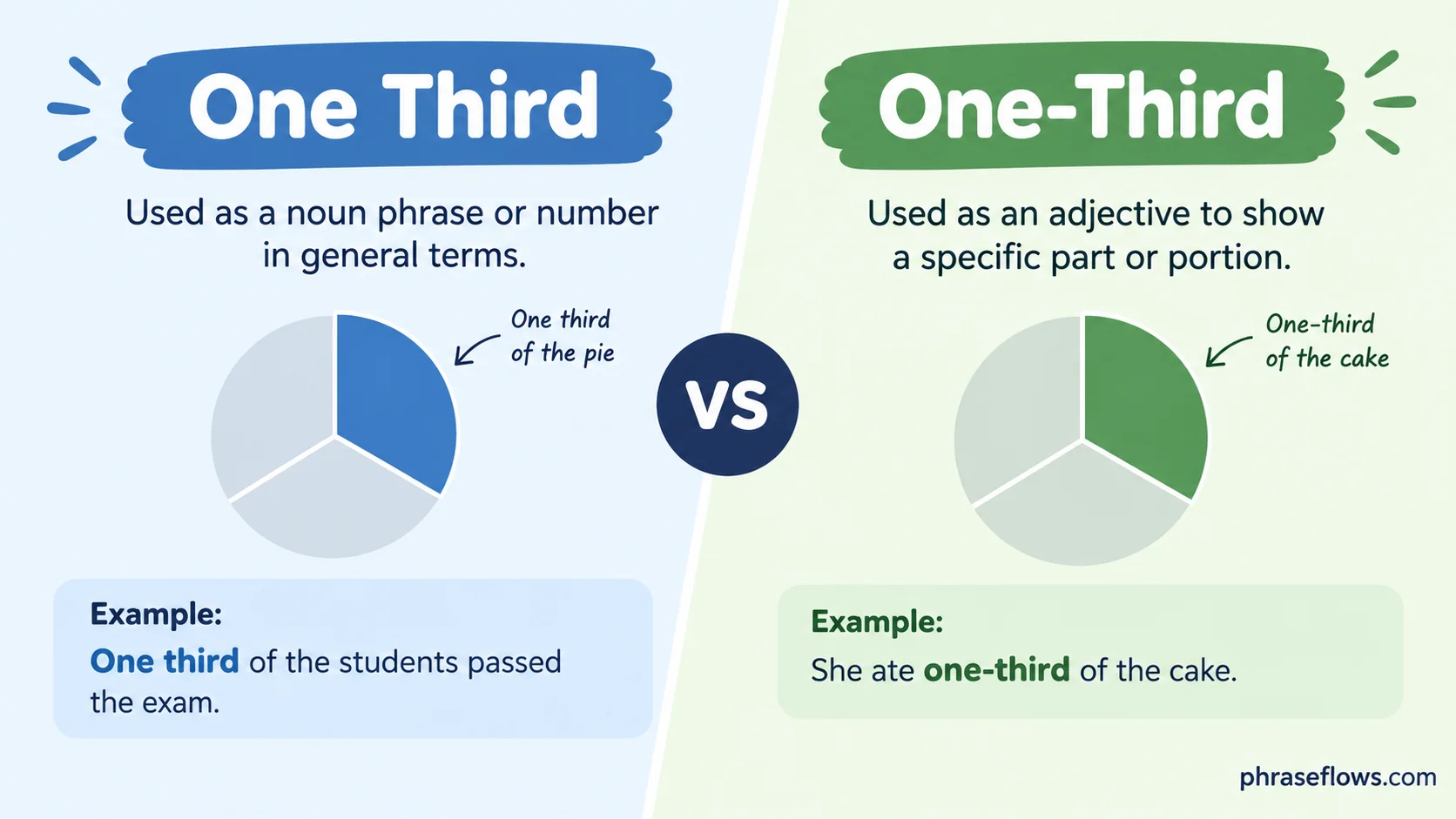

Have you ever wondered whether to write one third vs. one-third? Both forms appear in English writing, which can make it difficult to know which one is correct. The difference comes down to hyphenation and how different style guides handle fractions. Although the two forms look slightly different, they express the same mathematical value: one of three equal parts.
Understanding when to use one third vs. one-third can help you write more clearly and avoid common grammar mistakes. For example, you might write, “One-third of the students passed the exam,” or describe a business owner’s interest as “a one-third share.” Both constructions communicate a fraction, but the preferred spelling may depend on the sentence structure and the editorial rules you follow.
In this guide, you’ll learn the meaning of one third and one-third, explore their differences, and discover how to use them in everyday conversations, academic assignments, business documents, and measurements. You’ll also find practical examples, common mistakes, and simple tips for choosing the appropriate form. By the end, you’ll understand how to write fractions consistently and confidently.
One Third vs. One-Third: The Quick Answer
Both one third and one-third can be correct. The main difference concerns hyphenation, and different editorial styles handle written fractions differently.
In American English, the Associated Press (AP) style generally hyphenates fractions written in words, including fractions used independently. The Chicago Manual of Style also recommends hyphenating simple fractions, while some other style guides distinguish between fractions used as nouns and those used as modifiers. Sources: AP Stylebook guidance and Language Portal of Canada guidance.
Here’s a practical comparison:
| Form | Typical use | Example |
| One third | An open-form fraction under a style that permits or prefers it | One third of the class passed. |
| One-third | A hyphenated fraction, often used before a noun | The business sold a one-third share. |
| 1/3 | A numerical fraction, especially in calculations or technical contexts | The measurement equals 1/3 of a meter. |
The key takeaway: Neither spelling is universally wrong. Follow your publication’s style guide and use the same convention consistently throughout your writing.
What Does One Third Mean?
One third represents one of three equal parts of a whole. In mathematics, it is written as 1/3, and its decimal value begins with 0.3333.
Imagine cutting a pizza into three equal slices. If you take one slice, you’ve taken one third of the pizza. The same principle applies to money, measurements, groups, time, and other quantities.
The fraction has two parts:
- Numerator: The top number, 1, tells you how many parts you’re considering.
- Denominator: The bottom number, 3, tells you how many equal parts make up the whole.
For example, if a school has ninety students and one third attend a field trip, you can calculate the number of students by dividing ninety by three.
903=30
Therefore, one third of ninety students is thirty students.
The meaning stays the same whether you write the fraction as one third, one-third, or 1/3. Only the written form changes.
One Third in Everyday Sentences
You encounter this fraction in ordinary conversations more often than you might realize. It can describe food portions, shared expenses, time, or parts of a group.
Examples include:
- One third of the cake remained after dinner.
- I spent one third of my allowance on books.
- One third of the guests arrived before noon.
- The bottle was one third full.
- We completed one third of the assignment yesterday.
These examples show the fraction describing a quantity. Depending on the style guide, the writer may use the open or hyphenated form.
One Third in Academic and Formal Writing
Fractions also appear frequently in research reports, school assignments, business documents, and scientific explanations.
For example:
- One third of the participants completed the survey.
- The sample contained one third of the original observations.
- The team used one third of the available material.
- One third of the total volume was removed during testing.
In formal writing, consistency and clarity matter more than switching between forms without a clear reason. If your institution requires a particular style guide, use its fraction rules throughout the document.
What Does One-Third Mean?
One-third expresses the same fraction as one third: one out of three equal parts. The hyphen connects the two words and can make the fraction easier to recognize as a single unit.
Many style guides recommend hyphenating fractions when they act as compound modifiers, meaning they describe or qualify another word.
Consider this example:
– The company sold a one-third share of its property.
Here, one-third describes the type or size of the share. The hyphen connects the words so readers can understand them together.
Compare that sentence with the following:
– The company sold one third of its property.
In the second example, the fraction identifies the amount sold. Under a style that distinguishes noun phrases from compound modifiers, the open form may be appropriate.
However, this distinction isn’t universal. The AP Stylebook and the Chicago Manual of Style generally favor hyphenated forms for simple fractions, including those used independently. The Language Portal of Canada explains that usage varies but recommends hyphenating fractions in both roles. Read the Language Portal of Canada’s fraction guidelines.
One-Third Before a Noun
When a fraction appears before a noun and describes it, a hyphen often helps show that the words work together.
Examples include:
- The partners own a one-third share of the business.
- The researchers studied a one-third portion of the original sample.
- The project experienced a one-third reduction in expenses.
- The team built a one-third-scale model of the structure.
In each example, one-third functions as a modifier. It tells readers more about the share, portion, reduction, or model.
A hyphen can be especially helpful when a phrase contains several words. For instance, one-third-scale model shows that the fraction modifies the scale rather than the model’s other characteristics.
One-Third in Measurements and Quantities
Fractions often describe measurements in recipes, construction plans, science experiments, and other practical situations.
Consider these examples:
- Add a one-third-cup measure of milk.
- Leave a one-third-inch gap between the panels.
- Use a one-third-foot section of material.
- Build a one-third-scale replica of the original design.
These constructions combine a fraction with a unit of measurement and a noun. Hyphens can connect the elements into a clear compound modifier.
However, the best wording often depends on the sentence. For example, a recipe might simply say, “Add one third of a cup of milk.” A construction guide might use “a one-third-inch gap.”
Don’t add hyphens automatically to every measurement. Choose a clear construction and follow the style guide relevant to your document.
Key Differences Between One Third and One-Third
The two forms share the same mathematical meaning. Their main difference lies in spelling conventions and editorial preference.
| Feature | One third | One-third |
| Spelling | Two separate words | Two words joined by a hyphen |
| Mathematical meaning | One of three equal parts | One of three equal parts |
| Use as a noun phrase | Accepted by some styles | Preferred by styles that hyphenate simple fractions |
| Use as a modifier | May appear in some house styles | Commonly recommended |
| Example | One third of the budget remained. | A one-third share was transferred. |
The table shows common patterns rather than a universal rule. Some publications use one-third in both sentences, while others make a distinction between the two grammatical functions.
Does the Hyphen Change the Meaning?
No. The hyphen doesn’t change the fraction’s numerical value.
Both one third and one-third refer to 1/3, which is approximately 33.33% of a whole.
For example:
- One third of $900 is $300.
- A one-third share of $900 is also $300.
The wording changes to suit the sentence, but the calculation remains identical.
This distinction matters because writers sometimes treat the hyphen as if it changes the meaning. It doesn’t. The hyphen is a punctuation choice that connects words.
When to Use One Third Without a Hyphen
The open form, one third, appears in many everyday and formal texts. Writers who follow a style that leaves independent fractions open may use it when the fraction functions as a noun phrase or describes a quantity.
For example:
- One third of the audience left early.
- We used one third of the available supplies.
- She saved one third of her earnings.
- The container was one third full.
Notice that the fraction identifies an amount or condition rather than forming a compound modifier directly before a noun.
Still, writers following AP or Chicago style would generally hyphenate simple written fractions in these examples. If you’re writing for a publication, don’t assume the open form is automatically preferred simply because the fraction stands independently.
One Third in Everyday Conversation
In informal writing, you may see both forms. Messages, personal notes, and casual explanations often use whichever form the writer finds natural.
For example:
- I ate one third of the sandwich.
- One third of the movie was already over.
- We paid one third of the total cost.
- He read one third of the book during the weekend.
These sentences communicate their meaning clearly. If you’re writing an article or school assignment, however, it’s worth checking whether your required style guide prefers hyphenated fractions.
One Third in Academic and Formal Writing
Academic writing benefits from consistency. A research paper might discuss one third of a sample in several sections, so the writer should establish a convention and apply it throughout.
For example:
One third of the participants completed the first survey. The remaining participants completed it later.
A publication following AP or Chicago style would generally write one-third in the first sentence instead.
The important point is to avoid changing the spelling randomly within the same document. Readers shouldn’t have to guess whether the difference carries a special meaning.
When to Use One-Third With a Hyphen
Use one-third when your chosen style guide calls for hyphenated fractions. This form is especially common when the fraction acts as a compound modifier before a noun.
Examples include:
- A one-third share of the company was transferred.
- The team recorded a one-third decline in spending.
- The architect designed a one-third-scale building model.
- The committee approved a one-third allocation of the budget.
The hyphen links the words and helps readers process the fraction as one unit.
One-Third in Business and Finance
Business documents frequently describe ownership, funding, revenue, and expenses through fractions.
For example, imagine three partners invest equal amounts in a small company. Each partner owns one third of the business, assuming the ownership is divided equally.
You could express the arrangement in two ways:
- Independent fraction: Each partner owns one-third of the business.
- Compound modifier: Each partner has a one-third ownership stake.
The first sentence uses a hyphenated fraction under AP and Chicago conventions. The second uses one-third as part of the compound modifier one-third ownership.
If the business has a total value of $60,000 and three partners hold equal shares, each share represents $20,000.
This example illustrates the mathematical meaning of the fraction. The hyphenation follows the chosen editorial style rather than the financial calculation.
One-Third in Recipes and Measurements
Cooking provides another useful example because recipes often use fractions to specify ingredients.
Suppose a recipe calls for one third of a cup of flour. The ingredient quantity can be written as 1/3 cup, one-third cup, or one third of a cup, depending on the recipe’s formatting conventions.
For a sentence such as “Add one third of a cup of flour,” the open form is common in ordinary prose. In a phrase such as “a one-third-cup measure,” the hyphens help connect the fraction and unit to the noun measure.
When precision matters, especially in technical instructions, make sure the measurement is clear. A hyphen should never make the quantity harder to understand.
One Third vs. One-Third in Different Sentence Structures
The easiest way to understand these forms is to compare how they appear in complete sentences. Rather than memorizing one rigid rule, look at the sentence’s structure and the style you’re using.
| Sentence | Explanation |
| One-third of the applicants qualified. | A hyphenated fraction used independently under AP and Chicago conventions. |
| A one-third share of the property was transferred. | The fraction modifies share. |
| The amount was one-third of the original total. | The fraction follows a linking verb; AP and Chicago conventions still favor the hyphen. |
| The model was built at one-third scale. | The fraction describes the model’s scale. |
| The recipe requires 1/3 cup of sugar. | A numerical fraction commonly used in recipes. |
The third example is particularly useful. Some writers assume a fraction should lose its hyphen whenever it follows a linking verb such as was or is. However, AP and Chicago generally hyphenate simple fractions regardless of whether they function as nouns or modifiers.
The safest approach is to check the style guide instead of relying on sentence position alone.
Common Mistakes When Using One Third and One-Third
Even experienced writers sometimes struggle with fraction hyphenation. Most mistakes happen when people apply a rule too broadly or switch between styles without noticing.
Hyphenating Fractions Inconsistently
A writer might use one-third in one paragraph and one third in the next without a reason.
Although both forms appear in English, inconsistent usage can make an article look poorly edited. Choose a style guide and apply its recommendations throughout the document.
Assuming One Form Is Always Wrong
Neither form is universally incorrect. The open spelling appears in some editorial styles, while other guides consistently hyphenate simple fractions.
For example, the Language Portal of Canada recommends hyphenating fractions whether they function as nouns or adjectives. Its fraction-hyphenation guidance explains this distinction and notes an exception for certain fractions containing an already hyphenated number.
Adding Unnecessary Hyphens to Measurements
A fraction combined with a measurement may need more than one hyphen when it forms a compound modifier. However, rewriting the sentence can sometimes make it clearer.
Compare:
- A one-third-inch gap separated the panels.
- The gap between the panels measured one third of an inch.
The first describes the gap with a compound modifier. The second expresses the measurement directly. Both communicate the intended size, although the hyphenation depends on the chosen style.
Confusing Fractions With Percentages
One third is approximately 33.33%, but the two expressions aren’t identical in precision when rounded.
For example:
- One third of 300 is exactly 100.
- 33.33% of 300 is 99.99.
The small difference comes from rounding the percentage, not from the spelling of the fraction.
Remember: Hyphenation affects written presentation, while rounding affects numerical precision.
Read More: Goodmorning vs. Good Morning: Which Is Correct? Meaning, Rules, and Examples
One Third vs. One-Third in American English
American English doesn’t have one universal rule for every fraction. Instead, professional writers often follow a specific editorial guide.
Two important references are the Associated Press Stylebook and the Chicago Manual of Style.
- AP Stylebook: Generally spells out amounts below one and hyphenates the words in simple fractions, such as one-third and two-thirds.
- Chicago Manual of Style: Also favors hyphenated simple fractions. Its current guidance appears in the Chicago Manual of Style’s numbers section.
- Google developer documentation: Recommends connecting the numerator and denominator with a hyphen when spelling out fractions, unless one part is already hyphenated. See its numbers and fractions guidance.
These sources illustrate why you may encounter different conventions online. Writers don’t always follow the same style guide.
For a blog post written for a general American audience, one-third is a practical, widely recognized choice. If your employer, school, or publisher requires another convention, follow that requirement instead.
How to Remember the Difference Between One Third and One-Third
You don’t need to memorize dozens of examples. A few practical checks can help you choose a consistent form.
- Check your style guide first. This matters more than any general rule about sentence position.
- Recognize the compound modifier. A phrase such as one-third share commonly uses a hyphen to connect the words.
- Keep your meaning clear. Rewrite awkward measurement phrases when a simpler construction works better.
- Don’t confuse spelling with mathematics. Both forms represent the same fraction.
- Edit for consistency. Search your document for both spellings before publishing.
Here’s a simple reminder: The hyphen connects the words, but it doesn’t change the fraction.
FAQs:
Is One Third One Word or Two Words?
One third consists of two separate words. One-third also contains two words, but a hyphen joins them. The appropriate form depends on the editorial convention you’re following.
Should One Third Always Have a Hyphen?
Not in every style. Some guides prefer hyphens in all simple written fractions, while others distinguish between fractions used independently and fractions used as modifiers. Follow your publication’s rules.
Is One-Third Grammatically Correct?
Yes. One-third is a standard written form, particularly in compound modifiers such as a one-third share and a one-third reduction. AP and Chicago conventions also favor it for simple fractions used independently.
Should I Write One Third of a Cup or One-Third of a Cup?
Both constructions appear in English writing. In ordinary prose, one third of a cup is common. Some style guides prefer one-third of a cup, while a compound modifier such as a one-third-cup measure uses hyphens to connect the elements.
What Is the Difference Between One Third and One-Third?
Both forms represent one of three equal parts. The difference is hyphenation, not meaning. The preferred spelling depends on the grammatical construction and the style guide governing your writing.
Conclusion:
The choice between one third and one-third comes down to spelling conventions and editorial style. Both expressions represent the same fraction, so neither changes the underlying mathematical meaning.
Some writers distinguish between fractions used independently and those used as compound modifiers. However, major American style guides such as AP and Chicago generally favor hyphenating simple fractions in both situations.
For clear, professional writing, choose a reliable style guide and apply its rules consistently. When in doubt, check the publication’s preferred convention rather than assuming that one spelling always works.


1 thought on “One Third vs. One-Third: Which Is Correct? Meaning, Grammar, and Examples”