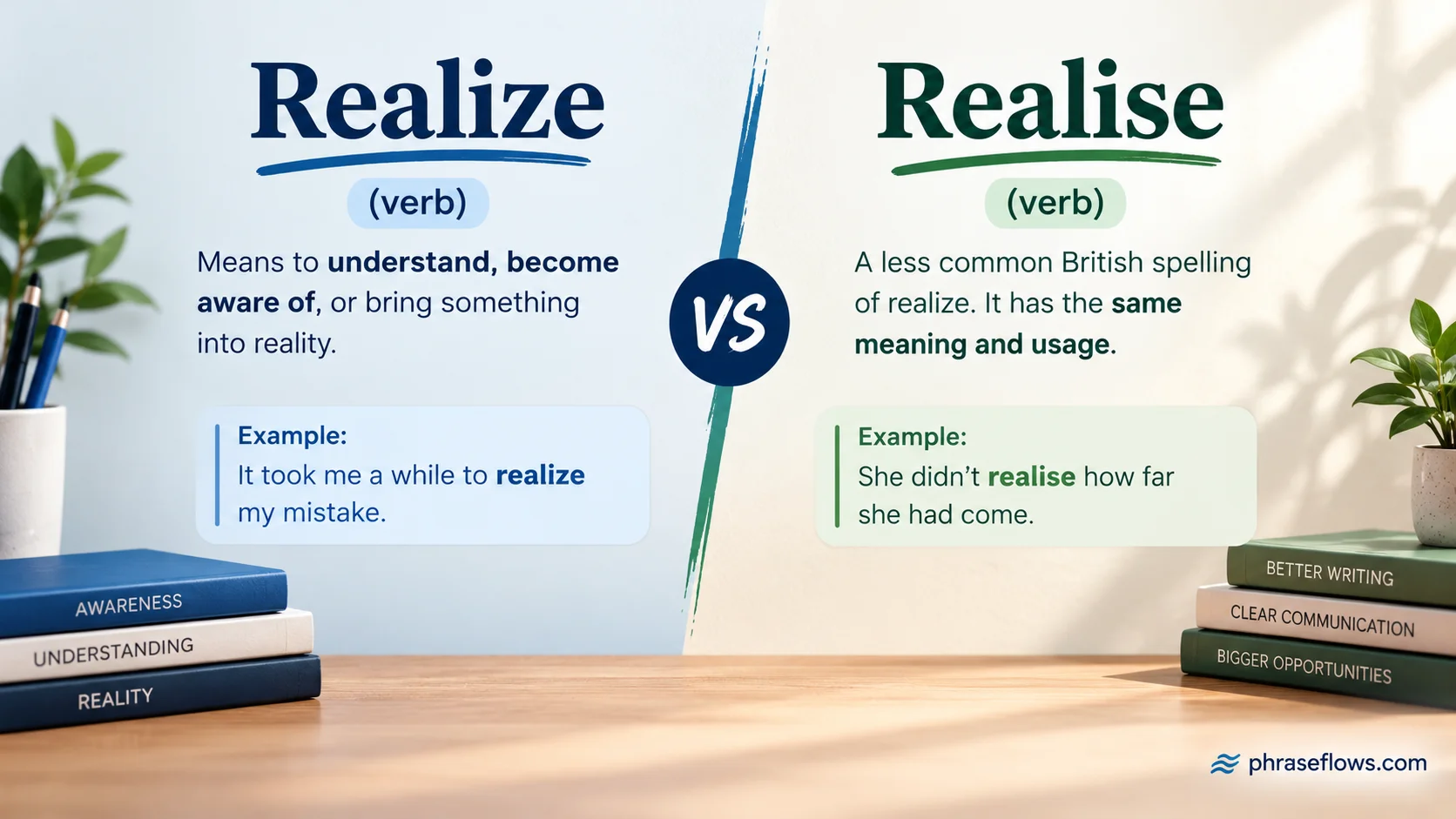

Have you ever paused while writing because you weren’t sure whether to use realize vs. realise? You’re not alone. Both spellings appear in English, and they have the same meaning and pronunciation. However, the correct choice depends on the type of English you’re using. This small spelling difference often confuses students, writers, bloggers, and even experienced professionals.
The main difference between realize vs. realise is regional spelling. Realize is the standard form in American English, while realise is commonly used in British English, Australian English, and several other English varieties. Both forms mean to become aware of something, understand a fact, or recognize a situation. Neither spelling is automatically wrong, but using the appropriate form for your audience helps keep your writing consistent and clear.
In this guide, you’ll learn the meaning of realize vs. realise, understand their spelling differences, and see how each form works in everyday and formal writing. You’ll also find practical examples to help you choose the right spelling for your audience. Whether you write for readers in the United States, the United Kingdom, or other countries, understanding this difference can improve your spelling accuracy and make your communication clearer.
Realize vs. Realise: The Quick Answer
Both realize and realise are correct English spellings. Neither is a spelling mistake. The main difference is the regional or editorial convention a writer follows.
- Realize: The standard and preferred spelling in American English.
- Realise: A common spelling in British English, Australian English, and New Zealand English.
- Meaning: Both words mean to become aware of something, understand a fact, or achieve something.
- Pronunciation: Both forms have the same pronunciation.
- Usage: Choose the spelling that matches your audience or preferred style guide.
For example:
- American English: I didn’t realize how important the meeting was.
- British English: I didn’t realise how important the meeting was.
Both sentences communicate exactly the same idea.
One important detail deserves attention: British English doesn’t exclusively use realise. The Oxford style tradition also uses -ize spellings for many words. Therefore, the distinction depends partly on the dictionary or editorial standard being followed.
What Does Realize or Realise Mean?
The verb realize or realise has several meanings. Its exact meaning depends on the context in which you use it.
Most commonly, it describes the moment when someone understands something, becomes aware of a fact, or recognizes a situation. It can also describe achieving an ambition or obtaining financial value from an asset.
Here are its main meanings.
Realize or Realise as Becoming Aware of Something
One common meaning is to become aware of something that you didn’t previously know or notice.
This often happens when someone discovers new information, notices a mistake, or suddenly understands a situation.
For example:
- I didn’t realize that the store closed so early.
- She began to realise how much time the project required.
- They finally realized why the instructions were confusing.
In each example, the person becomes aware of information that wasn’t previously clear.
Realize or Realise as Understanding a Fact
The word can also describe understanding or accepting something as true.
Unlike simply noticing something, this meaning often involves deeper thought or recognition. You might understand the consequences of a decision or recognize the importance of an experience.
Examples include:
- He eventually realized that honesty mattered more than winning.
- I didn’t realise how difficult the examination would be.
- She realized that her original assumption was incorrect.
Here, the verb communicates a change in understanding.
Realize or Realise as Achieving Something
Another meaning involves making something happen or turning an idea into reality.
This usage commonly appears in discussions about ambitions, plans, personal achievements, and business goals.
For example:
- She worked hard to realize her dream of becoming an author.
- The company hopes to realise its expansion plans.
- With patience and determination, they realized their long-term ambitions.
In these sentences, the word describes achieving something that previously existed as an idea or possibility.
Realize or Realise in Financial Contexts
In financial and business writing, realize or realise can mean obtaining money or value from an asset, investment, or transaction.
For instance:
- The company realized a profit from selling its property.
- Investors hope to realise a return on their investment.
- The business decided to realize some of its assets.
This meaning appears frequently in accounting, investment discussions, and business reports.
The intended meaning becomes clear through the surrounding words and circumstances.
Why Are There Two Spellings of Realize and Realise?
The difference between realize and realise developed through the history of English spelling. Over time, American and British English adopted different preferences for certain word endings.
The disagreement mainly involves the suffix -ize versus -ise.
Both endings appear in English words, but dictionaries and publishers don’t always follow the same conventions.
The Historical Development of -ize and -ise
The suffix -ize has historical connections to Greek and entered English through French and Latin influences. It commonly forms verbs that mean to make, become, or cause something to happen.
For example:
- Modernize
- Organize
- Recognize
- Realize
- Apologize
The spelling with Z has a long history in British English. It isn’t simply an American invention.
However, the S spelling also became established in British publishing and everyday writing. As spelling conventions developed, different dictionaries and editorial traditions began favoring different forms.
Noah Webster’s Influence on American Spelling
Noah Webster played an important role in shaping American English spelling.
His dictionaries promoted spelling reforms that helped distinguish American writing from British conventions. Some well-known examples include:
| American English | British English |
| Color | Colour |
| Center | Centre |
| Theater | Theatre |
| Organize | Organise |
| Realize | Realise |
However, the final two examples need an important qualification. American English strongly prefers organize and realize, but British English accepts both Z and S spellings for many -ize words, depending on the style followed.
Webster’s influence helped establish American preferences, but the history of -ize goes much further back.
Why Do Both Spellings Remain Acceptable?
English doesn’t have one worldwide authority that controls every spelling choice.
Instead, dictionaries, publishers, educational institutions, and style guides establish conventions for different audiences.
Consequently, both forms remain accepted:
- Realize follows the Z spelling convention.
- Realise follows the S spelling convention.
The difference doesn’t affect grammar, meaning, or pronunciation.
Realize vs. Realise: Differences Between American and British English
The most familiar distinction between these spellings involves American and British English. American writers generally choose realize, whereas British writers often prefer realise.
However, British spelling conventions aren’t completely uniform. Some British publishers use the Z ending because it reflects the word’s historical Greek origin.
Realize in American English
In American English, realize is the standard spelling. Writers use it in everyday conversations, educational materials, business documents, newspapers, and professional publications.
American dictionaries, including Merriam-Webster, follow the Z spelling convention for this word.
Consider these examples:
- I didn’t realize that you had already completed the assignment.
- She hopes to realize her dream of starting a successful business.
- We soon realized that the original plan wouldn’t work.
- The company expects to realize additional profits this year.
If you’re writing for an American audience, choose realize and maintain that spelling throughout your document.
Realise in British English
In British English, realise is widely used and accepted. It follows the S spelling convention found in many British publications and educational resources.
For example:
- I didn’t realise that the library closed at five.
- She wants to realise her ambition of becoming a teacher.
- They eventually realised that something was missing.
- The organization hopes to realise its long-term objectives.
Notice that the meaning remains unchanged. Only the final letter differs.
However, the Oxford spelling convention also accepts and prefers realize. This is why you’ll encounter both forms in British publications.
Oxford Owl for Home
+2
Which Spelling Is Used in Australian, Canadian, and Other English Varieties?
Other English-speaking countries have their own spelling preferences. Although these conventions often resemble British or American English, some differences remain.
| English variety | Common spelling | Notes |
| American English | Realize | Standard American spelling |
| British English | Realise / Realize | Both are accepted; preferences vary |
| Australian English | Realise | Common traditional preference |
| New Zealand English | Realise | Common traditional preference |
| Canadian English | Realize | Z spelling is commonly preferred |
Canadian English deserves particular attention because it combines features of British and American spelling. For this word, realize is commonly used.
If you’re writing for an international publication, check its preferred dictionary or editorial guide. Don’t assume that every country follows exactly the same rules.
Realize vs. Realise: Examples in Sentences
Examples make spelling differences easier to understand. Since both words have the same meaning, you can usually replace one spelling with the other without changing the sentence.
The following examples demonstrate how each form works in everyday writing.
Examples of Realize in American English
Here are sentences using the American spelling:
- I didn’t realize how much work the assignment required.
- She finally realized that her decision was correct.
- We realize the importance of protecting the environment.
- He wants to realize his full potential.
- They didn’t realize that the deadline had changed.
- The company hopes to realize a profit from the investment.
- After reading the instructions, I realized my mistake.
Each sentence uses the Z spelling while expressing a different meaning.
Examples of Realise in British English
These sentences demonstrate the corresponding British spelling:
- I didn’t realise how much work the assignment required.
- She finally realised that her decision was correct.
- We realise the importance of protecting the environment.
- He wants to realise his full potential.
- They didn’t realise that the deadline had changed.
- The company hopes to realise a profit from the investment.
- After reading the instructions, I realised my mistake.
The sentences communicate the same ideas as their American counterparts.
How to Use Realize and Realise in Different Contexts
Your choice of spelling should remain consistent across different types of writing.
Everyday conversations:
- American: Did you realize what happened yesterday?
- British: Did you realise what happened yesterday?
Business communication:
- American: We realize the importance of customer satisfaction.
- British: We realise the importance of customer satisfaction.
Academic writing:
- American: Researchers realized that the results required further investigation.
- British: Researchers realised that the results required further investigation.
Personal writing:
- American: I finally realized what I wanted to accomplish.
- British: I finally realised what I wanted to accomplish.
Regardless of the context, the main spelling distinction remains the same.
Realize vs. Realise: Meaning and Usage Differences
Although realize and realise are spelling variants, their different meanings depend on how you use them in a sentence.
Understanding these meanings helps you choose the right word for your message.
Realize or Realise as Becoming Aware of Something
Use either spelling when someone becomes aware of information or notices something they previously overlooked.
For example:
- I suddenly realized that I had forgotten my notebook.
- She didn’t realise that everyone was waiting for her.
- They realized that the train was running late.
This meaning often appears with words such as suddenly, finally, and eventually.
These expressions emphasize the moment when someone discovers or understands something.
Realize or Realise as Understanding a Fact
You can also use the verb when someone recognizes a situation, accepts a truth, or understands the consequences of an action.
For example:
- He realized that his decision affected everyone.
- She began to realise the importance of regular practice.
- We eventually realized that our original assumption was wrong.
In this context, the word describes a mental change rather than simply discovering something new.
Realize or Realise as Achieving Something
When you want to describe accomplishing an ambition, goal, or plan, either spelling works.
For example:
- She worked for years to realize her professional ambitions.
- The team hopes to realise its full potential.
- They finally realized their dream of opening a school.
You can also use expressions such as realize your potential, realize your ambitions, and realize a dream.
These phrases are common in personal development, education, and professional writing.
Realize or Realise in Financial Contexts
Financial writing uses the verb in a more specialized way.
It can describe obtaining money from an investment, selling property, or receiving a particular amount from an asset.
Examples include:
- The investor realized a substantial profit after selling the shares.
- The paintings are expected to realise a considerable amount at auction.
- The company decided to realize some of its assets.
A useful distinction exists between realizing a profit and simply expecting a profit.
When someone realizes a profit, the financial gain has generally become actual through a completed transaction. The exact accounting treatment depends on the transaction and applicable accounting rules.
Cambridge Dictionary also identifies these financial meanings, including selling assets to obtain cash.
English meaning – Cambridge Dictionary
+1
Realize vs. Realise: Related Word Forms
The spelling difference doesn’t disappear when you change the tense or turn the verb into another part of speech.
If you choose realize, use its corresponding Z spellings. If you choose realise, follow the S spelling convention.
Here are the most important related forms.
Realized vs. Realised
Both realized and realised are correct past-tense and past-participle forms.
- American English: Realized
- British English: Realised (also realized under Oxford spelling)
Examples:
- I realized that I had made a mistake.
- She realised her dream of becoming a writer.
- They had already realized the importance of the changes.
The spelling doesn’t affect the tense or meaning.
Realizing vs. Realising
These are the present participle and gerund forms of the verb.
- American English: Realizing
- British English: Realising
Examples:
- I’m realizing how important communication is.
- She is realising her professional potential.
- Realizing your mistakes can help you make better decisions.
The same spelling convention applies when adding -ing.
Realization vs. Realisation
Both forms are nouns that describe the process or moment of becoming aware of something. They can also refer to making an idea or ambition real.
- American English: Realization
- British English: Realisation (also realization under Oxford spelling)
Examples:
- The realization changed how he approached the problem.
- Her greatest realisation came after years of experience.
- The realization of their plans required careful preparation.
Remember that the noun uses -ation, not -ing.
Realizable vs. Realisable
These are adjective forms that describe something capable of being achieved, made real, or converted into value.
- American English: Realizable
- British English: Realisable (also realizable under Oxford spelling)
Examples:
- The proposal presents a realizable business opportunity.
- They developed a realisable plan for the project.
- The expected financial benefits weren’t immediately realizable.
The adjective appears less frequently than the verb and noun forms, but it’s useful in formal and business writing.
Realize vs. Realise: Comparison Table
A side-by-side comparison makes the differences easier to remember. Although the spellings vary, their definitions, grammatical functions, and pronunciations remain the same.
| Feature | Realize | Realise |
| Spelling | Z ending | S ending |
| American English | Preferred | Less common |
| British English | Accepted | Common |
| Australian English | Less common | Common |
| New Zealand English | Less common | Common |
| Meaning | Become aware or achieve | Become aware or achieve |
| Pronunciation | Same | Same |
| Part of speech | Verb | Verb |
| Past tense | Realized | Realised |
| Present participle | Realizing | Realising |
| Noun | Realization | Realisation |
Key takeaway: Neither spelling changes the meaning of the word. Your audience and chosen writing convention should determine which version you use.
Common Mistakes to Avoid When Using Realize and Realise
Even though the difference seems straightforward, writers sometimes misunderstand how these spellings work.
Here are several mistakes worth avoiding.
Assuming Realise Is Incorrect
Some American writers assume that realise is a spelling mistake because it doesn’t follow standard American English conventions.
However, it’s a legitimate English spelling used in several English-speaking regions.
Likewise, British writers shouldn’t automatically consider realize incorrect. Oxford spelling accepts the Z form.
Mixing American and British Spelling Conventions
Using different spelling systems in one document can make your writing look inconsistent.
For example:
Incorrectly mixed:
- I realized that the company needed to organise its records.
- She realised that the new color scheme looked better.
The sentences combine different regional conventions.
A more consistent American version would be:
- I realized that the company needed to organize its records.
- She realized that the new color scheme looked better.
A consistent British S-spelling version would be:
- I realised that the company needed to organise its records.
- She realised that the new colour scheme looked better.
The important point is to follow one established style throughout your document.
Confusing Spelling Differences With Meaning Differences
Another common mistake involves assuming that realize and realise describe different actions.
They don’t.
Both spellings can express awareness, understanding, achievement, and financial gain. The surrounding sentence determines which meaning applies.
For example:
- She realized her mistake.
- She realised her mistake.
Both sentences mean that she became aware of an error.
Incorrectly Forming Related Words
Writers sometimes change the main spelling but forget to adjust its related forms.
For example, someone might write realise in one sentence and realizing in another while following the British S convention.
A consistent approach would use:
- Realise
- Realised
- Realising
- Realisation
- Realisable
Alternatively, an American spelling approach would use:
- Realize
- Realized
- Realizing
- Realization
- Realizable
Using Realize When Another Verb Fits Better
Although realize has several meanings, it doesn’t replace every word associated with understanding or achievement.
Consider these distinctions:
| Word | Meaning | Example |
| Realize | Become aware of something | I realized my mistake. |
| Recognize | Identify or acknowledge something | I recognized her voice. |
| Understand | Comprehend an idea | I understand the instructions. |
| Discover | Find something previously unknown | They discovered a new method. |
| Achieve | Successfully accomplish something | She achieved her goal. |
Choosing the most precise verb makes your writing clearer and more natural.
Realize vs. Realise: Which Spelling Should You Use?
The best spelling depends on your intended audience and the editorial standards you follow.
You don’t need to memorize complicated rules. A few practical guidelines will help you make the right choice.
Choose realize when:
- You’re writing for an American audience.
- You’re following American English spelling conventions.
- Your publication uses the Merriam-Webster dictionary.
- You’re preparing American business documents, articles, or educational materials.
Choose realise when:
- You’re following a British English style guide that prefers S spellings.
- You’re writing for an audience accustomed to traditional British spelling.
- Your publication consistently uses organise, recognise, and similar forms.
Use realize when:
- Your publisher follows Oxford spelling.
- Your editorial guidelines specifically prefer the Z ending.
- You’re following a dictionary that lists realize as its preferred form.
The most important rule is consistency. Once you’ve selected a spelling convention, apply it to related words throughout your document.
An Illustrative Case Study: Choosing the Right Spelling for a Blog
Imagine a writer preparing two versions of the same educational article.
The first version targets American readers. The second targets readers in the United Kingdom.
For the American article, the writer chooses:
- Realize
- Organize
- Recognize
- Realization
For the British article, the writer follows an editorial guide that prefers S spellings:
- Realise
- Organise
- Recognise
- Realisation
Both articles communicate the same information. However, each follows the spelling expectations of its intended audience.
Now imagine that the writer accidentally combines the two conventions. The result may still be grammatically understandable, but it creates an inconsistent reading experience.
The lesson: Before writing an article, identify your target audience and establish a spelling convention. This small decision makes editing much easier.
Read More: Smoky vs. Smokey: Differences, Meaning, Examples, and Correct Usage
Synonyms of Realize and Realise
Sometimes, another word communicates your intended meaning more precisely. Although realize and realise work in several contexts, their synonyms aren’t always interchangeable.
Here are some useful alternatives.
| Synonym | Meaning | Example |
| Understand | Comprehend something | I understand the situation. |
| Recognize | Identify or acknowledge | She recognized the problem. |
| Notice | Become aware through observation | He noticed the difference. |
| Discover | Find previously unknown information | They discovered the truth. |
| Comprehend | Understand something fully | She comprehended the explanation. |
| Accomplish | Successfully complete something | He accomplished his objective. |
| Achieve | Reach a desired result | They achieved their goal. |
| Attain | Reach something through effort | She attained professional success. |
When Should You Use These Synonyms?
Consider the exact meaning you want to express.
- Use understand when someone comprehends information.
- Use recognize when someone identifies a person, fact, or situation.
- Use notice when someone observes something.
- Use discover when someone finds information that was previously unknown.
- Use achieve when someone successfully reaches a goal.
- Use accomplish when someone completes a task or objective.
For example, I realized the answer was incorrect emphasizes becoming aware of a mistake. Meanwhile, I noticed the answer was incorrect emphasizes observing the error.
The difference is subtle, but choosing the right word can improve clarity.
Conclusion:
Choosing between realize and realise is simple once you understand their regional spelling differences. Both words have the same meaning and pronunciation. Realize is the standard American spelling, while realise is commonly used in British and Australian English. Neither form is incorrect. The best choice depends on your audience and preferred writing style. To keep your work clear and professional, follow one spelling convention throughout your writing. This small habit will help you avoid unnecessary spelling confusion and communicate with confidence.
FAQs:
1. Is it realize or realise?
Both realize and realise are correct spellings. Realize is standard in American English, while realise is commonly used in British and Australian English.
2. Do realize and realise have the same meaning?
Yes. Both words mean to become aware of something, understand a fact, or recognize a situation. Their meaning and pronunciation are the same.
3. Is realize American or British English?
Realize is the standard spelling in American English. However, some British dictionaries and style guides also accept it.
4. Is realise wrong in American English?
Realise is not a spelling mistake in general English, but it isn’t the standard American form. American writers usually use realize.
5. How can I remember the difference between realize and realise?
Remember that realize uses Z and is the usual American spelling. Realise uses S and is common in British and Australian English. Choose the form that matches your audience and use it consistently.



1 thought on “Realize vs. Realise: Which Spelling Is Correct? Meaning, Differences, and Usage”