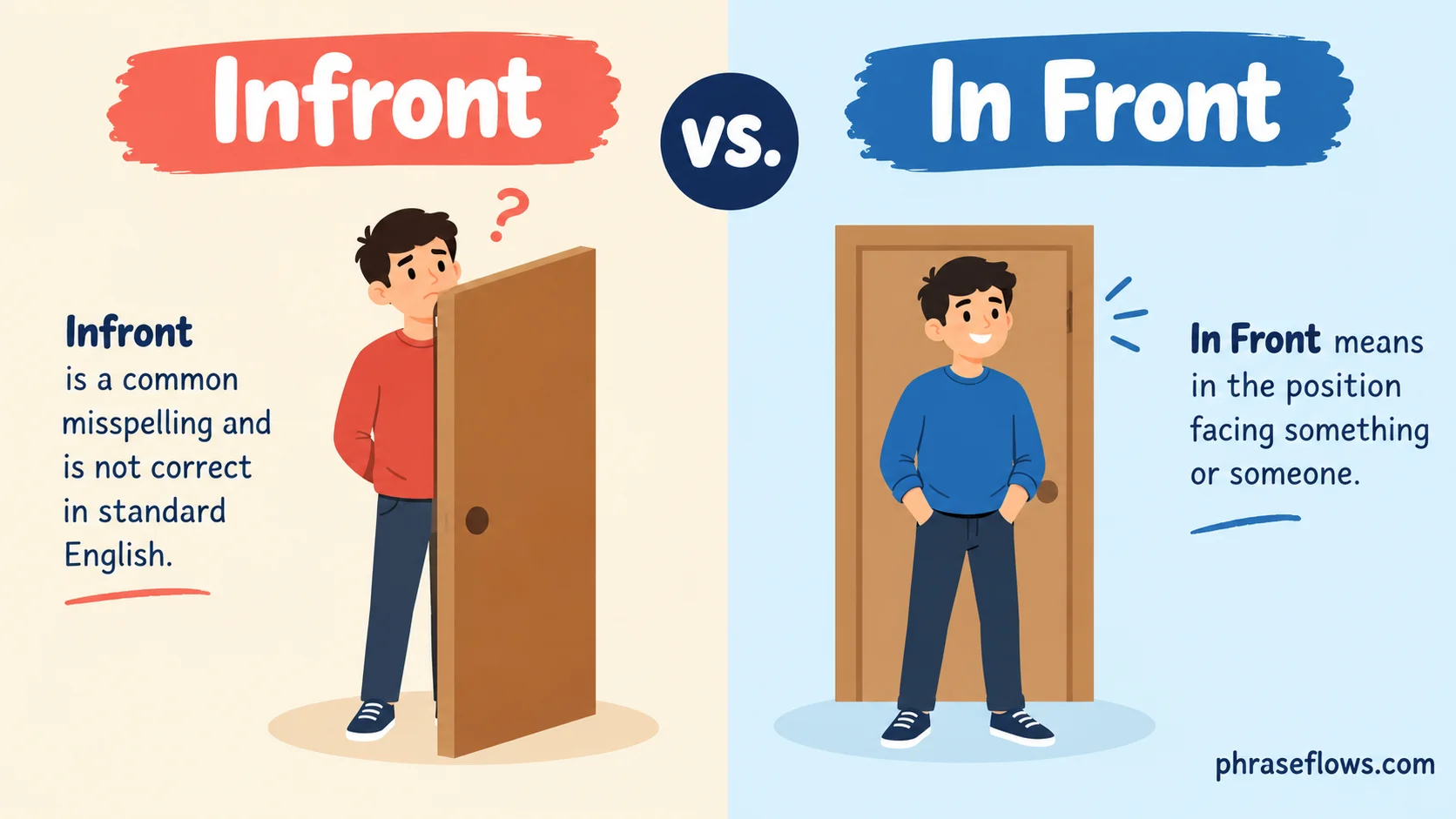

Have you ever stopped while writing because you weren’t sure whether to use infront or in front? You’re not alone. These spellings look almost identical, but only one is standard in everyday English. Knowing the difference helps you write clearer emails, school assignments, articles, and professional documents.
The correct spelling is in front, written as two separate words. It describes a position ahead of someone or something. For example, you might stand in front of a building, park in front of a store, or sit in front of a computer. By contrast, infront is not the standard spelling of this expression and should be avoided in ordinary English writing.
Although this may seem like a small spelling detail, it matters when you want your writing to look polished and professional. The good news is that the rule is simple once you understand how the phrase works. Let’s explore its meaning, grammar, sentence patterns, common mistakes, and differences from similar expressions.
Infront vs. In Front: Which Spelling Is Correct?
In front is the correct spelling in standard American English. You should write it as two words whenever you describe something positioned ahead of another person or object. The spelling is the same in British English.
The phrase appears in everyday conversations and formal writing. You can use it to describe physical location, movement, order, or someone’s position relative to another person. Cambridge Dictionary defines in front as being farther forward than someone or something else. Read the Cambridge Dictionary definition.
Infront, written as one word, is generally a spelling mistake when you intend to express this meaning. It isn’t an accepted alternative in standard English.
Consider these examples:
- Correct: The children waited in front of the school.
- Incorrect: The children waited infront of the school.
- Correct: Please stand in front of the camera.
- Incorrect: Please stand infront of the camera.
- Correct: A taxi stopped in front of our house.
- Incorrect: A taxi stopped infront of our house.
The difference is simply the space between the two words. However, that small space makes the difference between standard spelling and an error.
In Front vs. Infront: Quick Comparison
| Feature | In Front | Infront |
| Standard spelling | Correct | Incorrect for this expression |
| Word structure | Two separate words | One combined word |
| Standard English usage | Common and accepted | Not accepted as the standard spelling |
| Meaning | Ahead of someone or something | No standard meaning as this expression |
| Example | She stood in front of me. | She stood infront of me. |
Remember: Whenever you mean a position ahead of someone or something, write in front as two words.
What Does In Front Mean?
The phrase in front describes a position that is farther forward than another person or object. Its exact meaning depends on the situation. Sometimes it refers to a physical location, while in other cases it describes a position in a line, race, or competition.
For example, imagine you’re waiting outside a movie theater. If another person stands between you and the entrance, that person is in front of you. The phrase describes the person’s position relative to yours.
The expression can also refer to being ahead in a competition. If a team scores more points than its opponent, it may move in front on the scoreboard.
Here are a few examples:
- The bus stopped in front of the hotel.
- My brother walked in front of me.
- A large tree stands in front of our house.
- Our team moved in front during the second half.
- The student in front answered the teacher’s question.
In each sentence, in front identifies a forward position or a lead over someone else.
In Front as a Phrase of Place
One of the most common uses of in front describes where a person or object is located. The phrase often appears with of, which identifies the person, place, or object used as the reference point.
For example, in the sentence The bicycle is in front of the garage, the garage provides the reference point. The sentence tells you where the bicycle is positioned.
This pattern is especially common when describing buildings, entrances, vehicles, furniture, and everyday activities.
Examples include:
- The delivery driver left the package in front of the door.
- A flower bed grows in front of the house.
- We waited in front of the library.
- The teacher stood in front of the classroom.
- A bus was parked in front of the shopping center.
Notice that the phrase doesn’t always mean something is directly touching the object or standing immediately beside it. It generally identifies a position ahead of or near the forward-facing side of the reference point. The surrounding context helps you understand the precise location.
For instance, The car is in front of the house usually places the car on the side facing the house’s front. It doesn’t necessarily mean the car touches the building.
In Front to Describe Position or Order
The expression also describes someone’s position relative to others in a line, sequence, or competition. In these situations, it can indicate who is ahead or who occupies a forward position.
Imagine five people waiting to buy tickets. If you stand behind the first two people, those two people are in front of you. The phrase helps establish the order of the line.
Consider these examples:
- Three runners finished in front of Daniel.
- The customer in front of me ordered two coffees.
- Our team moved in front after scoring another goal.
- The first speaker stood in front of the remaining presenters.
- She finished in front of her closest competitor.
In a race, in front may mean leading. In a queue, it usually refers to physical order. The context determines which meaning applies.
Why Is Infront Incorrect?
The main issue with infront is that standard English treats this expression as two separate words. Although English contains many compound words, you can’t automatically combine two words simply because they frequently appear together.
For example, inside is one word, while in front is two. Both expressions are common, but they follow different spelling conventions. Familiarity with one compound word doesn’t establish the spelling of another.
The phrase in front retains its separate word structure in standard usage. Writing it as infront changes the conventional spelling without creating an accepted alternative.
Compare these examples:
| Incorrect Spelling | Correct Spelling |
| He waited infront of the store. | He waited in front of the store. |
| Put the chair infront of the desk. | Put the chair in front of the desk. |
| She stood infront of the mirror. | She stood in front of the mirror. |
| The dog sat infront of the fireplace. | The dog sat in front of the fireplace. |
| Park your bike infront of the gate. | Park your bike in front of the gate. |
Why Do People Write Infront?
There are several understandable reasons why writers make this mistake.
The words appear together frequently. Because people often use in front of as a single expression, they may mistakenly treat it as one word.
English spelling can be unpredictable. Words such as inside, into, and within are written as single words. This may lead some writers to assume that infront follows the same pattern.
Typing habits encourage shortcuts. When writing quickly on a phone or computer, someone may omit the space between words without noticing.
Spell-checking isn’t a substitute for proofreading. Digital tools can miss errors, especially when a mistake doesn’t prevent a reader from understanding the sentence.
The best solution is to learn the standard spelling and check the phrase whenever you proofread. A quick review can prevent this simple error from appearing in otherwise excellent writing.
How to Use In Front Correctly in a Sentence
The phrase in front fits naturally into many sentence structures. You can use it at the end of a sentence, after a verb, or near the beginning to establish a location.
One common pattern is:
Subject + verb + in front of + noun or pronoun
Examples:
- The teacher stood in front of the students.
- A delivery truck stopped in front of the building.
- I parked my bicycle in front of the garage.
- The child sat in front of her mother.
- We met in front of the museum.
The noun or pronoun after of identifies the reference point. Depending on the sentence, that reference point might be a person, place, vehicle, or object.
You can also place the phrase at the beginning of a sentence to emphasize location.
For example:
- In front of the school, several parents waited for their children.
- In front of the fireplace, the family placed a comfortable chair.
- In front of the audience, the speaker explained the new project.
This structure works well when location matters to the story or explanation.
Using In Front Without Of
Although in front of is very common, in front can also appear without of when the reference point is clear from context.
For example:
- The car in front suddenly stopped.
- The person in front raised a hand.
- Our team is finally in front.
In the first two examples, in front identifies a person or vehicle ahead of the speaker. The missing of isn’t an error because the phrase has a different grammatical structure.
In the third example, in front means leading or ahead in a competition. The surrounding context makes the meaning clear.
However, if you want to identify a specific building, person, or object, you will often need in front of.
- Correct: We waited in front of the theater.
- Incorrect for the intended meaning: We waited in front the theater.
The second sentence omits of, which the construction requires when the noun directly follows the phrase in this way.
In Front Of vs. In the Front Of
In front of and in the front of look similar, but they can describe different positions. Understanding the distinction helps you communicate more precisely.
In front of usually describes a position ahead of or outside the forward-facing side of something. In the front of often identifies the front section inside a larger space, such as a vehicle or room.
Compare the following sentences:
| Expression | Example | Meaning |
| In front of | The car is in front of the bus. | The car is positioned ahead of the bus. |
| In the front of | She sat in the front of the bus. | She sat in the forward section of the bus. |
| In front of | A tree grows in front of the house. | The tree stands ahead of the house’s front side. |
| In the front of | There is a small storage area in the front of the car. | The storage area is in the car’s forward section. |
The difference becomes clearer when you picture the setting. If you stand outside a building facing its entrance, someone standing between you and the entrance may be in front of the building. If you sit in the first row of seats inside a bus, you’re in the front of the bus.
In Front vs. At the Front
Another related expression is at the front. It often refers to a specific leading part or position within a group, room, or structure.
For example:
- The teacher stood at the front of the classroom.
- A car was parked in front of the classroom building.
- We sat at the front of the auditorium.
- The bicycle was in front of the garage.
The first and third examples describe positions within a space. The second and fourth describe positions relative to a building or garage.
These phrases can sometimes overlap, so context matters. Choose the expression that most accurately describes the position you mean.
In Front vs. Ahead
The words in front and ahead can both describe a forward position. However, ahead has broader uses and often emphasizes progress, distance, or future events.
| Expression | Example | Main Idea |
| In front | The cyclist is in front of me. | The cyclist occupies a forward position. |
| Ahead | The cyclist is ahead of me. | The cyclist is farther forward or leading. |
| In front | A car is parked in front of the house. | The car is positioned ahead of the house. |
| Ahead | We have a busy week ahead. | A busy week is coming in the future. |
Use in front of when you need to identify the person or object that establishes the position. Use ahead when you want to emphasize forward progress or something that lies in the future.
For instance, There are several challenges ahead refers to upcoming difficulties. You wouldn’t normally replace ahead with in front in that sentence without changing the construction and meaning.
Common Mistakes When Using In Front
Even when you know the correct spelling, other mistakes can affect how you use the phrase. Learning these patterns will help you write more accurately.
Combining In and Front Into One Word
This is the most obvious mistake.
- Incorrect: The children stood infront of the stage.
- Correct: The children stood in front of the stage.
Always preserve the space between in and front when using the standard expression.
Omitting Of
When a noun or pronoun directly follows the phrase as its reference point, you generally need of.
- Incorrect: She waited in front the restaurant.
- Correct: She waited in front of the restaurant.
However, remember that in front can stand alone when the sentence doesn’t require a following reference point.
Confusing In Front Of With In the Front Of
These expressions can describe different locations.
- The taxi stopped in front of the hotel.
- The passenger sat in the front of the taxi.
The first sentence describes the taxi’s location relative to the hotel. The second places the passenger inside the taxi’s forward section.
Using In Front When Another Expression Is Clearer
Sometimes ahead of, before, or at the front communicates the intended meaning more naturally.
For example:
- The runner moved ahead of the others.
- Please arrive before noon.
- The presenter stood at the front of the room.
These expressions aren’t interchangeable in every context. Choose the one that matches the relationship you want to describe.
Trusting Autocorrect Without Reviewing the Sentence
Typing tools can help identify spelling errors, but they don’t always understand your intended meaning. A sentence may still contain the wrong word spacing even if the software doesn’t flag it.
For reliable results, read your sentence again before submitting an assignment, sending an email, or publishing an article.
In Front vs. Infront in American and British English
English has regional differences in spelling. For example, American English commonly uses color, while British English generally uses colour. However, in front follows the same standard spelling in both varieties.
You should write in front in American school assignments, British reports, international business emails, and general online content.
Examples in American English:
- The store is in front of the bank.
- Please stand in front of the screen.
Examples in British English:
- The shop is in front of the bank.
- Please stand in front of the screen.
Notice that the phrase itself doesn’t change. The nouns store and shop reflect a regional vocabulary difference, but the spelling of in front remains the same.
There is no standard American-versus-British spelling distinction that makes infront acceptable in ordinary usage. If you want to follow conventional English spelling, keep the words separate.
Read More: One Third vs. One-Third: Which Is Correct? Meaning, Grammar, and Examples
Easy Ways to Remember In Front vs. Infront
You don’t need to memorize complicated grammar rules to get this spelling right. A few simple habits can help you remember it.
Remember the two-word rule. Whenever you mean a position ahead of someone or something, write in front as two words.
Learn a familiar example. Remember the sentence, “The car is in front of the house.” Recalling a correct example can help you recognize the spelling when you write a similar sentence.
Check the phrase before publishing. Search your draft for infront. If you intended the standard expression, replace it with in front.
Pay attention to the word after front. When you identify a reference point, the phrase will often be in front of the door, in front of me, or in front of the building.
Don’t assume frequent usage makes a spelling correct. You may encounter infront in informal posts or unedited text. Seeing a mistake repeatedly doesn’t make it standard English.
Quick Practice: In Front or Infront?
Choose the correct spelling for each sentence.
- The dog is sitting ___ the fireplace.
- Please stand ___ the camera.
- We met ___ the library.
- A cyclist rode ___ of our car.
Answers:
- The dog is sitting in front of the fireplace.
- Please stand in front of the camera.
- We met in front of the library.
- A cyclist rode in front of our car.
Each sentence uses the same standard spelling. Practicing with familiar situations makes the rule easier to apply in your own writing.
FAQs:
Is Infront One Word or Two?
The standard spelling is in front, written as two words. Infront is generally incorrect when used to describe a position ahead of someone or something.
Is In Front Always Followed by Of?
No. You can use in front without of when the reference point is understood or when the phrase describes a lead in a competition.
For example, “The car in front stopped” and “Our team is in front” are both correct. When you identify a specific reference point, use in front of, as in “The car is in front of the house.”
Is Infront Ever Correct?
Infront isn’t the standard spelling of the ordinary English expression. However, it may appear as part of a proper name, brand name, or other deliberately chosen name. Such uses don’t make it a standard substitute for in front in normal sentences.
Is In Front Correct in American English?
Yes. In front is the standard spelling in American English. British English uses the same spelling, so you don’t need to change it for a different English-speaking audience.
What Is the Difference Between In Front and In Front Of?
In front can describe a position without naming a reference point, as in “The person in front waved.” In front of identifies the reference point, as in “The person stood in front of the entrance.”
Can I Use In Front in Formal Writing?
Yes. In front is suitable for formal, academic, professional, and casual writing. You can use it in essays, reports, emails, instructions, and articles whenever it accurately describes the position or relationship.
Is In Front the Same as Ahead Of?
Not always. Both expressions can describe a forward position, but ahead of can also emphasize progress, ranking, or being further along. In front of often identifies a physical position relative to a specific person or object.
How Do I Correct Infront in a Document?
Use your document’s search function to locate infront. Review each occurrence and replace it with in front when you intend the standard expression. Check the surrounding sentence afterward to make sure the wording and spacing are correct.
Conclusion:
When comparing infront vs. in front, the answer is straightforward: in front is the correct standard spelling. Write it as two separate words whenever you describe something positioned ahead of a person or object.
The phrase works in many everyday situations, from describing a car in front of a house to explaining who stands ahead in a line. You can also use it to describe a lead in a competition or someone’s position relative to others.
Remember the distinction between in front of and in the front of as well. The first often describes a position ahead of something, while the second can identify a forward section inside a vehicle or other space.
Most importantly, don’t let a missing space slip into your writing. In front is the form to use in standard American and British English. Once you remember that simple rule, you’ll be able to use the phrase confidently in everyday conversations and professional writing.




1 thought on “Infront vs. In Front: Which Is Correct? Meaning, Rules, and Examples”