
Have you ever paused while writing a sentence because you weren’t sure whether to spell it training or trainning? You’re not alone. English spelling can be confusing, especially when some words double their final consonant before adding -ing while others don’t.
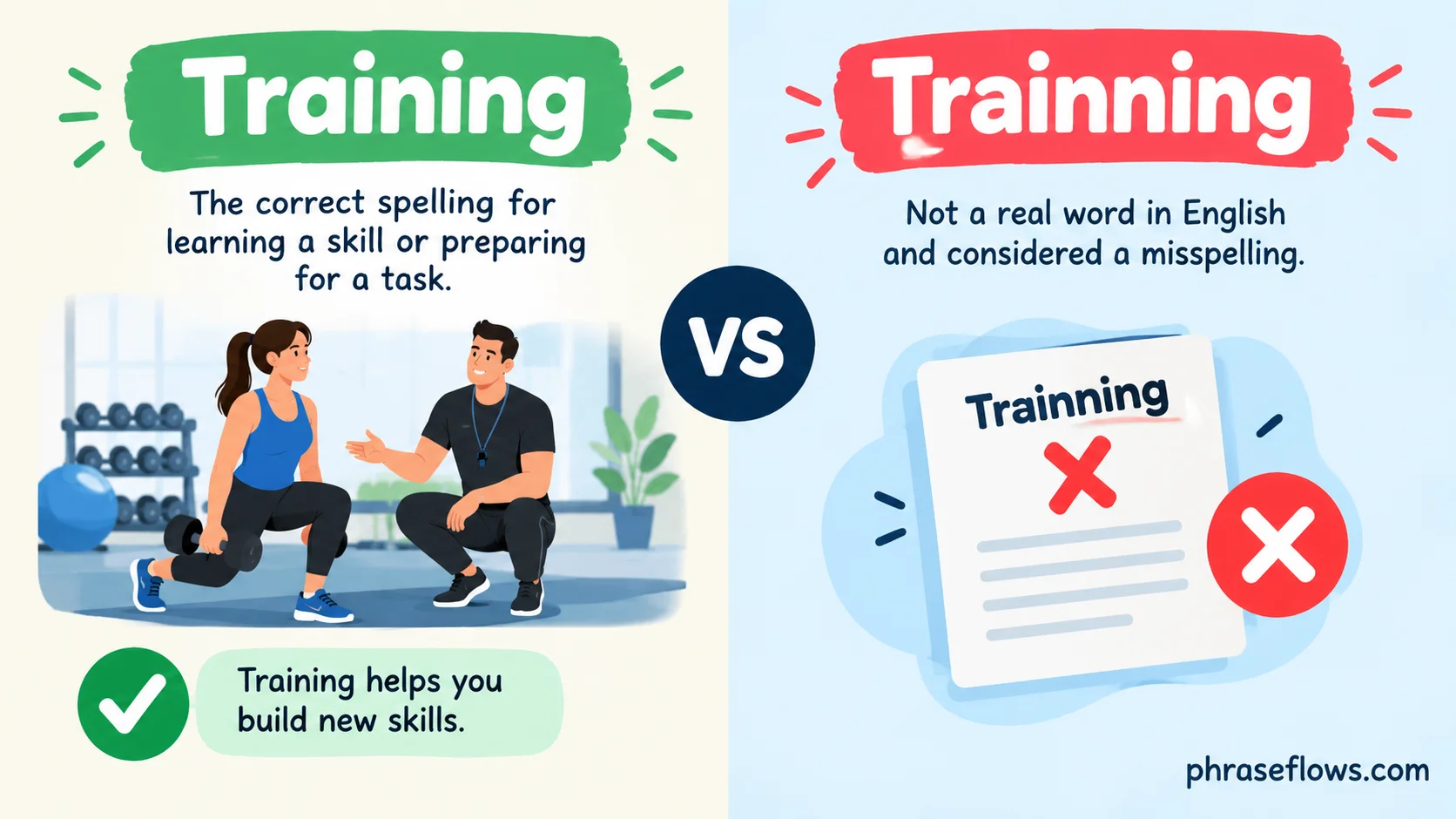
Here’s the simple answer: training is the correct spelling, while trainning is a misspelling. The correct form applies in American and British English. Whether you’re writing a school assignment, preparing a resume, creating website content, or sending a professional email, you should always use training.
Although the difference involves just one extra letter, understanding the spelling rule can help you avoid similar mistakes. Let’s explore the meaning of training, its grammatical uses, the reason behind its spelling, and practical examples you can apply to everyday writing.
Training vs. Trainning: Which Spelling Is Correct?
Training is the standard spelling in English. The word comes from the verb train and takes the suffix -ing without doubling the final n.
On the other hand, trainning is an incorrect spelling. It isn’t an accepted alternative, a regional variation, or a separate word with its own meaning.
Here’s a quick comparison:
| Feature | Training | Trainning |
| Spelling | Correct | Incorrect |
| Standard English usage | Accepted | Not accepted |
| Meaning | Learning or developing skills | Intended to mean training |
| Grammar | Noun or verb form | No standard grammatical role |
| American English | Correct | Incorrect |
| British English | Correct | Incorrect |
| Professional writing | Appropriate | Should be corrected |
For example, you might write, “The company provides training for new employees.” Writing “The company provides trainning for new employees” introduces a spelling error.
The meaning remains understandable, but the incorrect spelling can distract readers. In formal writing, even small errors can make a document look less polished.
What Does Training Mean?
Training refers to the process of learning, teaching, practicing, or developing the skills needed for a particular activity, job, or goal. It can involve formal lessons, hands-on experience, repeated practice, or a combination of these methods.
Think about someone learning to drive. Reading traffic rules provides useful knowledge, but practical lessons help the learner apply that knowledge on the road. Together, these activities form part of the person’s driving training.
The word appears in many areas of everyday life, including education, business, sports, healthcare, technology, and personal development.
Training as a Noun
As a noun, training describes the process or activity of developing a skill or gaining knowledge.
Consider these examples:
- The company provides safety training to its employees.
- She completed first aid training before joining the volunteer team.
- His football training takes place every afternoon.
- The school offers computer training for beginners.
- Proper training helps workers understand workplace procedures.
In each sentence, training names an activity or process rather than simply describing an action in progress.
The noun often appears with another word that identifies its purpose. For example, job training focuses on workplace skills, while athletic training focuses on preparing for sports and physical performance.
Training as a Verb Form
Training also functions as the present participle of the verb train. You commonly see it after forms of be, such as am, is, and are, to describe an ongoing activity.
Examples include:
- She is training to become a nurse.
- The manager is training the new staff.
- They are training for the school competition.
- He has been training every morning.
- We are training our dog to follow basic commands.
Notice that the spelling remains the same in every sentence. The grammatical role changes according to the sentence, but the word never becomes trainning.
Common Phrases That Use Training
You’ll often encounter training in familiar expressions. Learning these phrases can help you recognize the correct spelling and use the word naturally.
| Phrase | Meaning | Example |
| Employee training | Learning workplace skills | Employee training begins Monday. |
| Job training | Preparation for a particular job | The program provides job training. |
| Safety training | Learning how to work safely | Safety training is required before using the equipment. |
| Athletic training | Preparation for sports performance | Her athletic training includes regular practice. |
| Professional training | Developing career-related skills | He completed professional training in accounting. |
| On-the-job training | Learning while performing work | New staff receive on-the-job training. |
| Online training | Learning through digital materials or classes | Online training lets students study remotely. |
| Training session | A specific period of instruction or practice | Our next training session is tomorrow. |
These expressions cover different situations, but they all use the same spelling: training.
What Does Trainning Mean?
The spelling trainning doesn’t have a standard meaning in English because it isn’t the accepted spelling of the word. When someone writes it, they almost always intend to write training.
The mistake usually happens when a writer assumes that the final consonant must double before adding -ing. English does use this pattern in certain words, but it doesn’t apply to every verb.
Here are some common examples of the mistake and its correction:
| Incorrect | Correct | Example |
| Trainning | Training | The training starts tomorrow. |
| Trainning program | Training program | She joined a training program. |
| Trainning course | Training course | He enrolled in a training course. |
| Trainning for a race | Training for a race | I’m training for a race. |
| Staff trainning | Staff training | Staff training improves job readiness. |
For instance, imagine you’re preparing a resume and writing about a course you completed. The phrase customer service training is correct, while customer service trainning contains a spelling error.
Remember: The extra n doesn’t create a new word or change the meaning. It simply makes the spelling incorrect.
Why Is Training the Correct Spelling?
The easiest way to understand the difference is to look at the word’s structure.
The verb train becomes training when you add the suffix -ing. You don’t remove any letters from the base word, and you don’t double its final consonant.
The spelling follows this pattern:
Train + ing = Training
Not this:
Train + ning = Trainning
The Merriam-Webster Dictionary entry for training recognizes training as both a noun and the present participle of train. Its pronunciation guide also reflects the standard form.
Merriam-Webster
The Spelling Rule Behind Training
English sometimes doubles the final consonant of a verb before adding -ing. However, this rule applies under specific conditions rather than to every verb.
Consider these examples:
- Run → Running: The final n doubles.
- Sit → Sitting: The final t doubles.
- Plan → Planning: The final n doubles.
- Stop → Stopping: The final p doubles.
- Train → Training: The final n stays single.
- Rain → Raining: The final n stays single.
- Clean → Cleaning: The final n stays single.
Why do these words behave differently? The spelling pattern depends on the letters and sounds at the end of the base word, along with factors such as syllable stress in longer verbs.
Words such as run and sit end in a consonant preceded by a single short vowel. By contrast, train contains the vowel combination ai before its final consonant. It doesn’t meet the usual conditions for doubling that consonant.
This is why training follows the normal spelling pattern for train.
Why Train Doesn’t Become Trainning
Look closely at the base word:
- T is the first consonant.
- R is another consonant.
- AI represents the vowel sound in train.
- N is the final consonant.
When you add -ing, the original spelling remains intact. The suffix supplies the letters i-n-g, so the result is training.
The common mistake comes from focusing only on the final n. Writers may remember running and planning but overlook the different vowel pattern in train.
A useful comparison is rain → raining. Both rain and train retain their final n when they take -ing.
Training vs. Trainning: Examples in Everyday Sentences
Seeing a word in context makes its correct spelling easier to remember. The following examples show how training works in ordinary conversation, schoolwork, and professional writing.
Correct Examples of Training
- Workplace: The company provides training to help new employees learn their responsibilities.
- Education: The students received training in basic computer skills.
- Sports: Our team is training for the regional tournament.
- Healthcare: The volunteers completed first aid training before the event.
- Technology: The developer is training a machine-learning model with relevant data.
- Personal development: She started public-speaking training to feel more confident during presentations.
- Animal care: The family is training its puppy to respond to simple commands.
- Career development: He completed technical training before applying for the position.
Each example uses training correctly. The word can describe a learning process, a structured program, or an activity that continues over time.
Incorrect Examples of Trainning
The following sentences contain the misspelling trainning. Each one includes a corrected version.
| Incorrect Sentence | Correct Sentence |
| The company offers trainning to its staff. | The company offers training to its staff. |
| She is trainning for a marathon. | She is training for a marathon. |
| I completed my trainning last month. | I completed my training last month. |
| The school provides computer trainning. | The school provides computer training. |
| We need more trainning before the project begins. | We need more training before the project begins. |
The correction is straightforward: replace trainning with training. You don’t need to change the rest of the sentence unless another error exists.
A Practical Example: Writing a Resume
Imagine that you’re updating your resume for an entry-level office position. You want to show that you’ve learned how to use spreadsheets and manage customer requests.
A weak version might say:
Completed computer trainning and customer service trainning.
The corrected version reads:
Completed computer training and customer service training.
The second version looks more polished and uses standard English spelling. The same principle applies to cover letters, applications, school projects, and professional profiles.
Training vs. Trainning in American and British English
Some English words have different spellings in American and British English. For example, American English commonly uses color, while British English generally uses colour. Similarly, organize and organise reflect different spelling conventions.
However, training is spelled the same way in American and British English.
| Context | American English | British English |
| Workplace instruction | Training | Training |
| Sports preparation | Training | Training |
| Education and skills | Training | Training |
| Present participle of train | Training | Training |
| Incorrect form | Trainning | Trainning |
You don’t need to choose between regional spelling options here. The correct form remains training regardless of where your readers live.
This consistency also makes the word easy to use in international communication. Whether you’re writing for an American company, a British school, or an international audience, choose training.
Training vs. Trainning: Pronunciation Differences
Correct spelling and pronunciation work together, but they aren’t the same thing. A word may sound familiar even when someone spells it incorrectly.
The standard pronunciation of training is /ˈtreɪ.nɪŋ/. In simple terms, it sounds like TRAY-ning, with the stress on the first syllable.
You can hear the standard pronunciation through the Merriam-Webster dictionary entry.
Here are the main pronunciation details:
- First syllable: The train part contains the long a sound, as in rain.
- Second syllable: The ending -ing has a short, unstressed vowel sound.
- Word stress: The emphasis falls on the first syllable.
- Spelling: The standard written form is training, with no extra n.
The misspelling trainning doesn’t represent a separate standard English word with its own established pronunciation. In most cases, readers will understand it as an attempt to write training.
Remember that English spelling doesn’t always match pronunciation perfectly. You should learn the standard spelling rather than relying only on how a word sounds.
Read More: Infront vs. In Front: Which Is Correct? Meaning, Rules, and Examples
Common Spelling Mistakes Related to Training
The confusion between training and trainning is part of a wider pattern. English uses several different spelling rules when verbs take the suffix -ing. Understanding those patterns can help you avoid other errors.
Words That Double the Final Consonant
Some verbs double their final consonant before adding -ing.
| Base Verb | Correct Form | Incorrect Form |
| Run | Running | Runing |
| Sit | Sitting | Siting, when the intended word is the form of sit |
| Plan | Planning | Planing, when the intended word is the form of plan |
| Stop | Stopping | Stoping |
| Swim | Swimming | Swimmming |
For example, running needs two n letters after the u. However, training doesn’t follow that pattern because the base verb train has a different vowel structure.
Be careful with examples such as siting and planing. These spellings can be correct words in other contexts. Siting refers to choosing or locating a site, while planing can describe smoothing a surface with a plane. The correct form depends on the intended meaning.
Words That Don’t Double the Final Consonant
Other verbs simply take -ing without doubling their final consonant.
| Base Verb | Correct Form | Common Mistake |
| Train | Training | Trainning |
| Rain | Raining | Rainning |
| Clean | Cleaning | Cleanning |
| Explain | Explaining | Explainning |
| Open | Opening | Openning |
| Visit | Visiting | Visitting |
These examples show why you shouldn’t double a consonant just because a verb ends with one. The spelling depends on the word’s structure and the relevant English spelling rules.
Why Writers Make These Mistakes
Several factors can lead to spelling errors:
- Overgeneralizing a rule: You learn that run becomes running and assume that train must work the same way.
- Typing too quickly: Your fingers may repeat a letter accidentally.
- Relying on sound: Pronunciation doesn’t always reveal the correct spelling.
- Skipping proofreading: Small errors can remain unnoticed when you review your writing too quickly.
The solution is simple: learn the base word, understand the suffix rule, and proofread your work before sharing it.
How to Remember the Correct Spelling of Training
You don’t need to memorize a complicated grammar lesson every time you write this word. A few simple habits can make the correct spelling easier to recall.
Remember the Base Word
Start with train. Then add -ing.
Train + ing = Training
The original word already contains the letters needed before the suffix. You don’t need another n.
Compare Training With Raining
Think about the word rain. When you add -ing, you get raining, not rainning.
The same pattern applies to train:
- Rain → Raining
- Train → Training
This comparison gives you a quick reminder whenever you hesitate.
Read the Word in Context
Short sentences help reinforce the spelling naturally.
Try reading these examples:
- I’m training for a competition.
- The company offers professional training.
- She completed her training last week.
- Our next training session begins tomorrow.
Each sentence reinforces the same correct form. Over time, repeated exposure can make the spelling feel more familiar.
Use Spell-Check Tools
Spell-check tools can help identify trainning in emails, documents, and website content. However, don’t rely on them completely. Automated tools can miss errors or overlook problems with the surrounding sentence.
For important writing, combine spell-checking with a final manual review.
Training vs. Trainning: A Quick Reference Guide
If you need a fast reminder, use this summary.
| Question | Answer |
| What is the correct spelling? | Training |
| Is trainning correct? | No |
| What is the base word? | Train |
| Which suffix do you add? | -ing |
| Do you double the final n? | No |
| What does training mean? | The process of learning, practicing, or developing skills |
| Can training be a noun? | Yes |
| Can training be a verb form? | Yes |
| Is the spelling different in American and British English? | No |
| How do you remember it? | Train + ing = training |
Keep this table handy if you frequently write about education, professional development, sports, or skill-building.
Conclusion:
When comparing training vs. trainning, training is the correct spelling in standard American and British English. Trainning is a common spelling mistake that occurs when writers incorrectly double the final letter n. The rule is simple: take the base word train and add -ing to form training.
Whether you’re writing a resume, preparing a school assignment, or discussing professional development, always use training. Remembering this simple spelling rule will help you write more clearly and avoid similar mistakes in the future.
FAQs:
Is it training or trainning?
Training is the correct spelling. Trainning is incorrect because the final n in train doesn’t need to be doubled when adding -ing.
Why is training spelled with one n instead of two?
The word follows the spelling pattern of its base verb, train. Adding the suffix -ing produces training without changing the original spelling.
What does training mean?
Training means learning, teaching, or practicing skills to improve your ability to perform a task. It can refer to workplace instruction, sports practice, education, or personal development.
Is training spelled the same way in American and British English?
Yes. Both American and British English use training. The spelling doesn’t change between these varieties of English.
How do you use training in a sentence?
You can use training as a noun or as a verb form. For example, “The company provides training for new employees” uses it as a noun, while “She is training for a competition” describes an ongoing activity.



1 thought on “Training vs. Trainning: Which One Is Correct? Meaning, Spelling, and Examples”