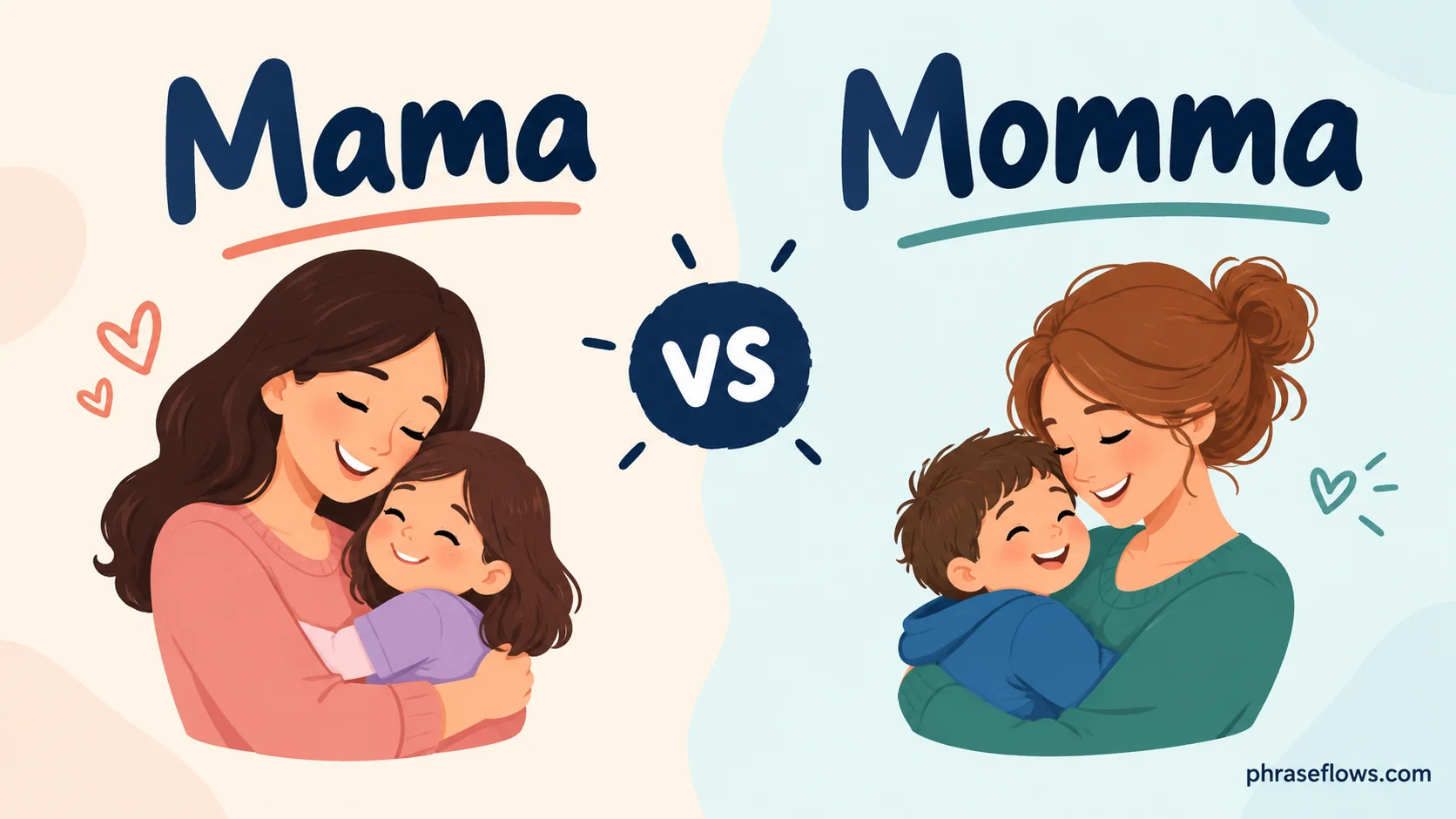

Mama vs. momma is a spelling comparison that can seem confusing because both words refer to the same person: your mother. So, is one correct and the other wrong?
The short answer is no. Both mama and momma are established English words. Dictionaries describe momma as a variant of mama or as an informal word for mother. The main difference comes from usage, regional preference, family preference, and writing style rather than meaning.
You may see mama in everyday speech, family writing, literature, and affectionate references to a mother. Momma appears especially often in North American English and informal contexts. Oxford lists momma as an informal child’s word for mother, while Collins identifies it as a US and Canadian term.
Mama vs Momma: Which Spelling Is Correct?
Both mama and momma are correct spellings when you use them as informal terms for “mother.”
Mama has a broad history as a word for mother and appears in dictionaries as an informal term. Momma developed as a variant and remains an established informal form. American Heritage, for example, lists mama, mamma, and momma as forms meaning “informal mother.”
That means you don’t need to “correct” momma to mama simply because it contains an extra m.
The better question is which form fits the context?
| Word | Correct? | Meaning | Typical use |
| Mama | Yes | Mother | Informal and affectionate |
| Momma | Yes | Mother | Informal, especially North American |
| Mamma | Yes | Mother | Informal or traditional usage |
| Mother | Yes | Mother | Neutral or formal |
| Mom | Yes | Mother | Common informal American English |
For ordinary writing, mama is a straightforward choice. If you’re reproducing someone’s family speech or a character’s voice, momma may be the more natural choice.
What Does “Mama” Mean?
Mama is an informal word for mother. It can describe a person’s mother or serve as a direct form of address.
For example:
- “My mama makes the best soup.”
- “I called my mama last night.”
- “Come here, Mama.”
- “Her little boy ran toward his mama.”
The word can sound affectionate, familiar, traditional, or childlike depending on the speaker and situation.
Dictionary sources recognize mama as an informal word for mother. Collins also notes that English speakers can use it for someone who raises a child as a mother would.
Interestingly, mama isn’t limited to very young children. Adults may continue using it because it has become a familiar family name for their mother.
In other words, growing older doesn’t automatically turn Mama into Mom.
What Does “Momma” Mean?
Momma also means mother. It carries essentially the same basic meaning as mama.
Oxford classifies momma as informal and gives it as a child’s word for a mother. Collins similarly defines it as an informal term and identifies it with US usage in its American English entry.
Examples include:
- “My momma always told me to be kind.”
- “The child called for his momma.”
- “Her momma lives across town.”
- “Momma said dinner was ready.”
The spelling can give a sentence a slightly different voice, even though the underlying meaning remains the same.
That’s particularly useful in fiction. An author might choose momma because it reflects the way a particular character or family speaks.
Mama vs Momma: Key Differences
The biggest point is simple: the words usually have the same meaning.
The differences are mostly about form, context, and linguistic association.
| Feature | Mama | Momma |
| Basic meaning | Mother | Mother |
| Standard word? | Yes | Yes |
| Register | Informal | Informal |
| Common association | Broad usage | North American usage |
| Tone | Familiar or affectionate | Familiar or affectionate |
| Can adults use it? | Yes | Yes |
| Can it be a form of address? | Yes | Yes |
| Useful in character dialogue? | Yes | Yes |
| Appropriate for formal writing? | Usually no | Usually no |
Neither spelling automatically makes the speaker more affectionate. Personal and family habits matter more than the number of letters.
For example, one family may always say Mama. Another may use Momma. Both choices can feel completely natural to the people involved.
Mama vs Momma in American English
The distinction becomes particularly interesting in American English.
American dictionaries recognize momma as a variant of mama. Oxford’s American English material gives momma as an informal form, while Collins labels the word US and informal in its American English entry.
However, it would be misleading to say that every American region uses momma in the same way.
American English contains enormous regional and family-level variation. You may hear Mom, Mama, Momma, Mommy, Ma, or another family-specific term.
A person’s choice can depend on:
- Where they grew up
- What their parents called their own parents
- Family traditions
- Local speech patterns
- Age
- Cultural background
- Personal preference
- The style of a particular piece of writing
So while momma has a strong North American association, the spelling doesn’t belong exclusively to one American state or community.
Is “Momma” a Misspelling of “Mama”?
No.
This is one of the most important points in the mama vs. momma debate.
Momma is not simply a typing mistake involving an unnecessary m. Major dictionaries recognize it as a word in its own right. Collins describes it as a variant of mama, and Dictionary.com likewise defines momma as a variation of mama.
That makes the distinction similar to many other English variants. A different spelling doesn’t necessarily mean that one version is incorrect.
Consider these examples:
“My mama called me.”
and
“My momma called me.”
Both sentences can mean exactly the same thing.
The second spelling simply gives the sentence a different written form.
Is Mama More Correct Than Momma?
No. It is more useful to describe mama as the broader or more familiar spelling in many contexts rather than calling it “more correct.”
If you’re writing a general article, school assignment, or ordinary piece of prose, mama may be the simpler choice because readers widely recognize it.
However, if you’re writing dialogue and the character naturally says momma, changing it to mama could remove part of that character’s voice.
A useful rule
Choose the spelling that matches the context.
- Use mama for a broadly familiar informal form.
- Use momma when it reflects a person’s preferred family term or voice.
- Use mother when you need a formal or neutral term.
- Follow a source’s original spelling when quoting or closely representing its language.
That’s more accurate than treating one spelling as universally superior.
Mama vs Momma: Pronunciation
In many varieties of English, mama and momma have very similar pronunciations.
The exact vowel sounds can change with accent and region. American Heritage gives mama and momma closely related pronunciations, while Oxford lists North American momma with its standard pronunciation.
The spelling therefore doesn’t necessarily create a major difference in pronunciation.
This is important because English spelling often preserves historical or stylistic differences that aren’t obvious in modern speech.
You shouldn’t assume that adding the extra m automatically creates an entirely different sound.
When Should You Use “Mama”?
Mama works well when you want a familiar, affectionate, and widely understood word for mother.
You might use it in:
- Family conversations
- Personal writing
- Children’s speech
- Informal storytelling
- Fiction
- Memoirs
- Social posts
- Affectionate references
For example:
“My mama always encouraged me to keep trying.”
Here, mama gives the sentence warmth without sounding overly formal.
It can also work as a direct name-like form:
“Mama, can you help me?”
When someone uses the word as a personal form of address, capitalization often makes sense because the word functions much like a name.
When Should You Use “Momma”?
Momma makes sense when the spelling reflects the speaker’s or family’s normal usage.
It’s also useful when writing dialogue.
Imagine a novel featuring a character who consistently calls their mother “Momma.” Replacing every instance with “Mama” could subtly change the character’s voice.
For example:
“Momma, we’re home!”
The spelling immediately establishes a particular informal register.
That doesn’t mean the character must come from a specific state or background. Context should support the choice rather than stereotypes.
Mama vs Momma in Formal Writing
Neither mama nor momma is normally the best choice for formal writing.
If you’re writing a business letter, academic paper, professional report, or formal biography, mother usually works better.
Compare these sentences:
| Context | Better wording |
| Academic writing | “Her mother worked as a teacher.” |
| Formal biography | “His mother encouraged his education.” |
| Everyday conversation | “My mom is at home.” |
| Informal personal writing | “My mama always supported me.” |
| Character dialogue | “Momma said I should wait.” |
The issue isn’t correctness. It’s register.
A word can be grammatically correct while still sounding out of place in a particular setting.
Mama vs Momma Capitalization
Capitalization depends on how the word functions in the sentence.
When Mama or Momma acts like a name or direct form of address, capitalization is common:
- “I asked Mama about it.”
- “Thank you, Momma.”
- “Mama, we’re ready to leave.”
- “Momma said I could go.”
When the word functions as a regular noun, lowercase is generally appropriate:
- “My mama lives nearby.”
- “Her momma called earlier.”
- “The child ran toward his mama.”
A simple test can help:
If you’re using the word almost like the person’s name, capitalize it.
If you’re describing the relationship rather than using it as a name, lowercase often works better.
Style guides can differ in specific situations, so consistency matters most within a particular document.
Mama vs Momma in Dialogue and Fiction
Writers have an additional reason to care about this distinction: voice.
Dialogue isn’t simply about grammatical correctness. It also shows how a character talks.
Suppose a character says:
“Mama told me not to go.”
That feels different from:
“Momma told me not to go.”
The difference is subtle, but spelling can contribute to the character’s perceived voice.
Why writers choose “Momma”
A writer may choose momma to:
- Reflect family usage
- Preserve a character’s speech pattern
- Establish an informal atmosphere
- Match surrounding dialogue
- Represent a particular cultural or regional setting
However, dialect should be handled carefully. Spelling alone cannot accurately represent an entire community’s speech.
Using momma doesn’t automatically make a character Southern, rural, uneducated, or anything else. Those assumptions depend on the broader context.
Mama vs Momma vs Mommy vs Mom vs Mother
English has several common ways to refer to a mother. Each one carries a slightly different social or emotional flavor.
| Term | General tone | Typical context |
| Mother | Neutral/formal | Professional, academic, formal writing |
| Mom | Informal | Common American everyday speech |
| Mama | Informal/affectionate | Family speech and personal writing |
| Momma | Informal/affectionate | Family speech, children’s language, North American usage |
| Mommy | Very familiar/childlike | Often associated with young children |
| Ma | Informal | Family or regional usage |
These categories aren’t rigid.
An adult can absolutely call their mother Mama. Another adult may say Momma throughout their entire life. Family language often survives long after childhood.
That’s one reason dictionary definitions tend to describe these words as informal rather than limiting them strictly to children.
The History Behind Mama and Momma
The story gets more interesting when you look at the words’ history.
Words resembling mama appear in many languages. Etymonline traces mamma in English to an old child-oriented form and notes related forms across languages, including Greek, Latin, Persian, Russian, and Welsh.
The basic ma sound is also easy for infants to produce. Linguists have long connected words for parents with early child speech, although the exact historical path differs from language to language.
English developed several related forms over time.
Etymonline records:
- mama in English from around 1707
- momma from around 1810
- mum from around 1823
- mummy from around 1839
- mommy from around 1844
- mom from around 1867
These dates show something useful: English did not settle on one universal spelling for this family term.
Instead, different forms developed and continued to coexist.
A note about “mamma”
There’s another spelling worth knowing: mamma.
In the sense of “mother,” mamma is a variant of mama. American Heritage lists mamma as a variant, while Collins also identifies it as an alternative spelling.
However, mamma has another technical meaning in biology and anatomy. In that context, it refers to a mammary structure.
So context matters even more with mamma than it does with mama or momma.
Common Mistakes With Mama and Momma
A few mistakes appear repeatedly when people compare these words.
Treating momma as incorrect
This is the biggest mistake.
Momma is an established informal word, not merely a misspelling.
Assuming they always sound different
They often have very similar pronunciations. Regional accents can affect the actual vowel sounds.
Using informal terms in formal writing
If you’re writing an academic paper, mother is generally more suitable than either mama or momma.
Capitalizing every use
You don’t need to capitalize mama or momma simply because it refers to someone’s mother.
Capitalization often depends on whether the term functions as a name or as an ordinary noun.
Assuming spelling reveals someone’s entire background
Words can suggest regional or cultural associations, but one spelling doesn’t tell you everything about a speaker.
Facts About Mama and Momma
Here are several useful facts that clarify the relationship between the two words:
- Mama and momma both mean “mother” in their informal uses.
- Momma is recognized as a variant of mama by major dictionaries.
- Oxford labels momma as informal and identifies it as a child’s word for mother.
- Collins identifies momma with US and Canadian usage in its British English entry.
- The related form mamma can also mean mother, but it has a separate technical meaning in anatomy.
- Historical records show momma in English by around 1810.
- The words belong to a much larger family of informal terms connected with ma, mom, mummy, and mommy.
Read More: Taught vs Tought: Correct Spelling and Usage
Mama vs Momma: Which One Should You Choose?
The easiest way to decide is to think about purpose rather than correctness.
If you’re writing a general piece of informal English, mama is a safe and familiar choice.
If you’re writing dialogue or reproducing a family’s preferred terminology, momma may be exactly right.
If the setting is formal, choose mother.
Quick decision guide
Choose “mama” when:
- You want a familiar informal term.
- You don’t need to signal a particular speech style.
- You’re writing personal or family-oriented content.
- The spelling matches the person’s preference.
Choose “momma” when:
- That’s the family’s preferred spelling.
- You’re representing a character’s voice.
- The surrounding language supports the informal North American usage.
- You’re deliberately preserving the spelling found in a source.
Choose “mother” when:
- You’re writing formally.
- You want a neutral term.
- The relationship needs to be described without an informal tone.
Conclusion:
Both mama and momma are acceptable informal terms for a mother, but they differ slightly in spelling, style, and usage. Mama is a common spelling used in many English-speaking regions, while momma is often associated with a warm, affectionate, or familiar way of addressing a mother. The preferred form may depend on regional habits, family traditions, and personal preference.
When choosing between mama vs momma, consider your audience and the tone you want to convey. Use the spelling that feels natural in your context, and remember that neither word is automatically incorrect. The most important thing is to use the term consistently and communicate your meaning clearly.
FAQs:
Is mama or momma the correct spelling?
Both mama and momma are accepted informal spellings for a mother. The choice depends on personal preference, regional usage, and context.
What is the main difference between mama and momma?
The main difference is spelling and usage style. Mama is widely recognized across different English-speaking regions, while momma often conveys a more affectionate or conversational tone.
Is momma more informal than mama?
Both words are informal and affectionate. However, momma may feel more expressive or familiar in certain contexts, depending on regional and family traditions.
Should I use mama or momma in formal writing?
Neither term is generally preferred in formal writing. In professional or academic contexts, mother is usually the more appropriate choice unless you are quoting someone or discussing a specific name or expression.
Are mama and momma pronounced the same way?
They are often pronounced similarly, although pronunciation can vary by region and speaker. Both are commonly used as affectionate terms for a mother.




1 thought on “Mama vs Momma: Correct Spelling and Difference”