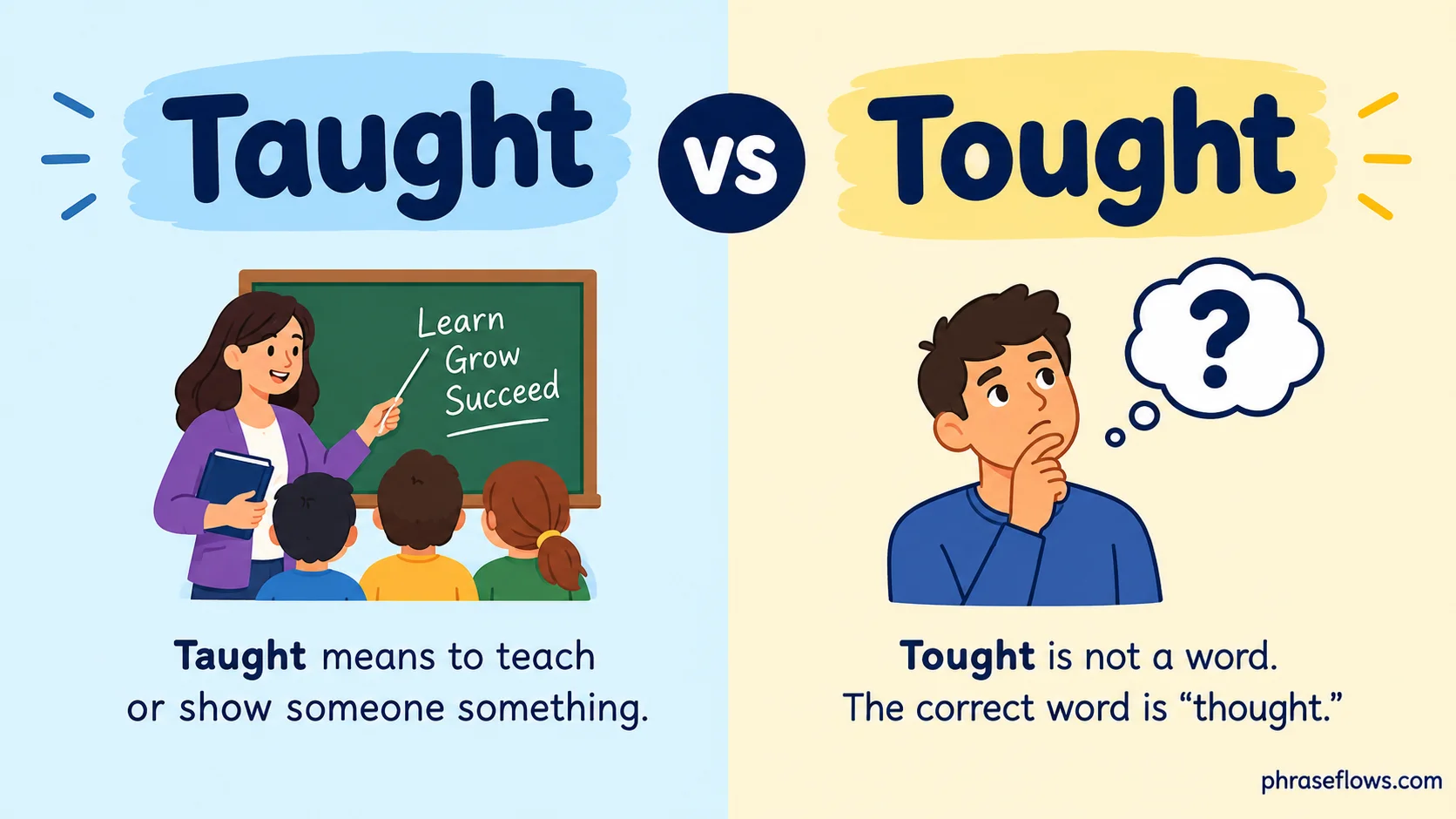

Taught vs tought is an easy spelling mix-up, especially because English pronunciation doesn’t always make spelling obvious. If you’ve ever wondered whether you should write taught or tought, the answer is straightforward: taught is the correct spelling.
The word taught is the past tense and past participle of teach. It describes something that someone instructed, explained, trained, or helped another person learn in the past. Tought, on the other hand, isn’t a standard English word. It’s simply a misspelling of taught. Cambridge Dictionary lists taught as the past simple and past participle of teach.
The confusion becomes even more interesting when thought enters the picture. Thought is a completely different word related to think. Although taught and thought look and sound somewhat similar, they have different meanings and grammatical functions.
Taught vs Tought: Which One Is Correct?
Taught is correct. Tought is incorrect.
There isn’t a standard English situation in which tought replaces taught. If you’re writing an email, school assignment, article, report, or everyday message, use taught when you need the past form of teach.
| Word | Correct spelling? | Meaning | Related verb |
| Taught | Yes | Instructed, trained, or gave knowledge | Teach |
| Tought | No | No standard English meaning | — |
| Thought | Yes | Considered, believed, or had an idea | Think |
For example:
- Correct: My teacher taught us grammar.
- Incorrect: My teacher tought us grammar.
- Correct: I thought the class started at nine.
The simplest rule is worth remembering:
Teach → taught
Don’t create the past tense by trying to spell the pronunciation. English has many irregular verbs, and teach → taught is one of them.
What Does Taught Mean?
Taught means that someone gave another person knowledge, instruction, training, or guidance. It is the past form of teach.
Cambridge Dictionary defines teach as giving someone knowledge or training and identifies taught as both its past tense and past participle.
You can use taught in several situations:
- A teacher gives students information.
- A parent shows a child a skill.
- A coach trains athletes.
- A mentor explains a process.
- Someone shows another person how to do something.
- An experience gives someone an important lesson.
For example:
- My mother taught me how to bake.
- The coach taught the players a new strategy.
- Our instructor taught us the basics of photography.
- Experience taught him to be more careful.
- She taught English at a local school.
The word doesn’t always involve a formal classroom. You can teach a skill, behavior, idea, technique, or lesson.
Taught as the Past Tense of Teach
Taught is the simple past form of teach.
Compare these sentences:
- I teach English.
- I taught English last year.
- She teaches English at a school.
- She taught English at a school.
The tense changes because the time changes. If the teaching happened in the past, taught is usually the form you need.
Cambridge specifically gives taught as the past tense and past participle of teach.
Taught as a Past Participle
Taught also works as the past participle of teach. You commonly see it after helping verbs such as has, have, and had.
Examples include:
- She has taught English for several years.
- They have taught hundreds of students.
- He had taught the lesson before the bell rang.
- I have taught myself several useful skills.
This is one reason taught is especially useful in English. The same irregular form serves both the simple past and past participle roles.
Why Is Tought Incorrect?
The spelling tought looks plausible because English spelling can sometimes make learners expect a particular letter pattern.
However, tought isn’t the past form of teach. The standard form is taught.
English doesn’t always form past-tense verbs by adding -ed. Regular verbs such as walk become walked, while irregular verbs change in different ways.
Consider:
| Present verb | Past form |
| Teach | Taught |
| Think | Thought |
| Buy | Bought |
| Bring | Brought |
| Catch | Caught |
| Go | Went |
These forms don’t always follow a neat spelling formula. That’s why memorizing the relationship teach → taught is more reliable than trying to construct the word from sound.
Why People Write Tought
A person might write tought because they remember the pronunciation but not the spelling. They may also associate the ending with other words containing -ought, such as thought or bought.
The problem is that English spelling doesn’t work like a mathematical equation. You can’t always hear a word and accurately predict every letter.
For that reason, the safest approach is simple: whenever the sentence means “gave someone instruction or knowledge in the past,” use taught.
Taught vs Thought: Don’t Confuse These Words
The taught vs thought confusion is much more important than it may first appear.
Both words are correct English words. The difference is that they come from different verbs.
- Teach → taught
- Think → thought
Taught relates to instruction or learning.
Thought relates to thinking, believing, considering, or having an idea. Thought can also function as a noun meaning an idea or mental process.
Compare:
She taught me how to swim.
Here, someone provided instruction.
She thought about learning to swim.
Here, someone considered an idea.
The two words may look similar on the page, but swapping them changes the meaning completely.
| Word | Base verb | Meaning | Example |
| Taught | Teach | Gave instruction | He taught me Spanish. |
| Thought | Think | Considered or believed | He thought about Spanish. |
A useful memory trick is:
Taught = teaching.
Thought = thinking.
That small distinction can prevent a surprisingly common spelling mistake.
Taught vs Tought vs Thought at a Glance
When three similar-looking words appear together, the difference becomes much easier to see.
| Spelling | Standard English? | Connected to | Example |
| Taught | Yes | Teach | She taught me to cook. |
| Tought | No | Nothing in standard modern English | Incorrect spelling |
| Thought | Yes | Think | I thought about your suggestion. |
So if you’re writing about education, instruction, training, or learning, taught is probably the word you need.
If you’re writing about ideas, opinions, beliefs, or mental activity, thought may be the right choice.
If you write tought, check the sentence again. In standard English, you almost certainly mean taught.
How to Use Taught in a Sentence
There are several common sentence patterns with taught. Learning these structures makes correct usage much easier.
Taught Someone Something
One common pattern is:
Subject + taught + person + something
Examples:
- My father taught me patience.
- The teacher taught us grammar.
- Her grandmother taught her traditional recipes.
- The coach taught the team a new technique.
Here, the person receiving the instruction comes directly after taught.
Taught Something to Someone
You can also place the thing being taught first:
Subject + taught + something + to + person
Examples:
- She taught English to new students.
- He taught the technique to his assistant.
- The instructor taught basic coding to the class.
Both structures can be grammatical. The best choice often depends on what information you want to emphasize.
Taught Someone How to Do Something
Another very common construction is:
Subject + taught + person + how to + verb
Examples:
- My dad taught me how to drive.
- She taught him how to cook.
- The instructor taught us how to use the equipment.
- My brother taught me how to fix the bike.
Cambridge also provides examples using the structure teach someone to do something, such as teaching someone how to cook.
Common Examples of Taught
The word taught appears in far more situations than formal education.
School and Education
- The professor taught us American history.
- My teacher taught me how to write clearly.
- She taught mathematics for ten years.
- The instructor taught the class several useful techniques.
Parents and Family
- My father taught me how to ride a bicycle.
- My grandmother taught me a family recipe.
- His parents taught him good manners.
Sports and Hobbies
- The coach taught us a new passing technique.
- She taught her brother how to play chess.
- He taught me the basics of guitar.
Life Lessons
Taught can also describe lessons learned through experience rather than direct instruction.
- The experience taught me to be patient.
- Failure taught her an important lesson.
- The mistake taught him to check his work carefully.
This figurative use is important because teaching doesn’t always require a classroom or instructor.
Common Mistakes With Taught
Using Tought Instead of Taught
This is the most direct spelling mistake.
Incorrect:
“My teacher tought us English.”
Correct:
“My teacher taught us English.”
The correction isn’t a matter of American versus British spelling. Taught is the standard form in both major varieties of English.
Confusing Taught With Thought
These words come from different verbs.
Incorrect:
“I thought him how to drive.”
Correct:
“I taught him how to drive.”
The first sentence uses the wrong verb because thought comes from think. The second sentence correctly uses the past form of teach.
Using Teach Instead of Taught
If the action happened in the past, you generally need taught.
Incorrect:
“She teach me yesterday.”
Correct:
“She taught me yesterday.”
However, teach remains correct when the sentence uses the present tense:
Correct:
“She teaches me every Saturday.”
The time expression helps reveal which form belongs in the sentence.
Using Taught When Teach Is Needed
The reverse mistake can happen too.
If something happens regularly in the present, don’t automatically use taught.
Compare:
- She teaches English every Monday.
- She taught English last Monday.
The first sentence describes a current routine. The second refers to a completed past event.
Taught in Different Tenses
Understanding the broader verb pattern makes taught easier to use correctly.
| Tense | Example |
| Present | I teach science. |
| Present third person | She teaches science. |
| Present continuous | They are teaching science. |
| Simple past | I taught science yesterday. |
| Present perfect | I have taught science for five years. |
| Past perfect | I had taught the lesson before lunch. |
| Future | I will teach science tomorrow. |
Notice an important point: taught doesn’t appear in every past-related construction. The exact tense determines which form you need.
Taught Pronunciation and Spelling
The pronunciation of taught can also contribute to spelling confusion.
Cambridge gives the American pronunciation as /tɔt/ and the British pronunciation as /tɔːt/.
Because English pronunciation differs somewhat across accents, the sound may not provide enough information to determine the spelling.
That’s why spelling by sound can be risky.
For example, hearing taught might remind someone of thought, bought, or other words with similar sounds. Yet each word has its own spelling and meaning.
The safest connection remains:
teach → taught
Rather than asking, “How does this sound?” ask, “What is the base verb?” If the base verb is teach, its past form is taught.
How to Remember the Correct Spelling
A few simple memory techniques can make this distinction stick.
Remember the Verb Pair
Keep this pair together:
Teach → Taught
If you remember the present form, the unusual past form becomes easier to recall.
Separate Taught and Thought
Use their meanings as the memory cue:
- Taught → teach
- Thought → think
The first concerns instruction. The second concerns thinking.
Use a Time-Based Example
Try remembering this short pattern:
I teach today. I taught yesterday.
The sentence connects the present and past forms naturally.
Watch for the “Ough” Trap
Many English words contain -ough, but that doesn’t mean they all follow the same spelling pattern.
Words such as thought, bought, and brought are not evidence that taught should become tought. English spelling has developed through a long history of sound changes and borrowed forms, so similar sounds don’t always produce identical spellings.
Taught vs Tought in American English
In American English, taught is the standard spelling.
There is no standard American spelling variation that changes taught to tought. The latter remains a spelling error.
Cambridge’s American English entry identifies taught as both the past tense and past participle of teach.
Examples:
- She taught fifth grade.
- He taught me how to swim.
- They taught the students basic grammar.
Taught vs Tought in British English
The same rule applies in British English.
Taught is correct, while tought is not a standard alternative. Cambridge’s British entry likewise lists taught as the past simple and past participle of teach.
So this isn’t one of those spelling differences where American and British English use separate forms.
For example, both varieties use:
- “She taught English.”
- “He taught me how to cook.”
- “The experience taught us a valuable lesson.”
Quick Grammar Guide: Teach, Taught, and Teaching
The verb teach has several common forms. Keeping them organized helps prevent tense mistakes.
| Verb form | Example |
| Teach | I teach English. |
| Teaches | She teaches English. |
| Taught | She taught English yesterday. |
| Teaching | She is teaching English. |
The important irregular form is taught.
Unlike a regular verb such as walk → walked, teach doesn’t become teached. The correct past form is taught.
That’s a useful grammar fact to remember because “teached” is another form learners sometimes create incorrectly.
Taught vs Tought: Quick Decision Guide
When you’re proofreading your writing, use this quick checklist:
- Do you mean gave instruction? Use taught.
- Do you mean the past of teach? Use taught.
- Are you thinking about an idea or belief? You may need thought.
- Did you write tought? Change it to taught.
- Does the sentence describe a present routine? You may need teach or teaches instead.
Here are three quick examples:
Instruction:
“She taught me French.”
Thinking:
“She thought about learning French.”
Present routine:
“She teaches French.”
The meaning of the sentence usually makes the correct choice clear.
Read More: Shinning vs Shining: Correct Spelling and Usage Explained
Examples of Taught in Everyday English
Here are some natural examples showing how flexible taught can be:
- My uncle taught me how to fish.
- The teacher taught us about fractions.
- She taught herself to draw.
- Our coach taught the team a new strategy.
- His experience taught him to stay calm.
- My sister taught me how to make pasta.
- The instructor taught the students basic safety procedures.
- That mistake taught me to read the instructions carefully.
- Her grandfather taught her an old family tradition.
- The course taught us several practical skills.
These examples show that taught can describe formal education, personal instruction, self-directed learning, training, and lessons learned through experience.
A Simple Case Study: Choosing Between Taught and Thought
Consider this short scenario.
A student wants to write:
“My older brother ___ me how to repair a bicycle.”
The correct choice is taught because the brother provided instruction.
Now change the sentence:
“I ___ the bicycle would be easy to repair.”
Here, the correct word is thought because the sentence describes a belief or assumption.
The two words may seem similar at first glance, but the verbs behind them solve the problem immediately:
teach → taught
think → thought
This approach works better than trying to remember isolated spellings. When you identify the base verb, the correct form becomes much easier to choose.
Conclusion:
Understanding taught vs tought is simple once you know the correct spelling and meaning of each word. Taught is the correct English word. It is the past tense and past participle of teach, meaning to give someone knowledge, skills, or instructions. For example, “My teacher taught me how to write clearly.”
On the other hand, tought is a misspelling of taught and is not accepted as a standard English word with the same meaning. Although the two spellings look similar, only taught is appropriate when discussing past teaching or instruction. Remembering this difference will help you avoid spelling mistakes in school assignments, emails, essays, and professional writing. Whenever you need to describe something you learned from another person, choose taught, not tought.
FAQs:
Is taught or tought the correct spelling?
Taught is the correct spelling when referring to the past tense of teach. Tought is a common spelling mistake and should not be used in standard English writing.
What does the word taught mean?
Taught means that someone gave another person knowledge, skills, or instructions in the past. For example, “My father taught me how to ride a bicycle.”
Is tought a real English word?
Tought is not a standard English word used as the past tense of teach. The correct word is taught. Always use taught when describing a lesson or skill someone provided.
What is the difference between taught and teach?
Teach is the present-tense verb, while taught is its past tense and past participle. For example, “I teach English today” describes a present activity, while “I taught English yesterday” describes a past activity.
How can I remember the spelling of taught?
A simple way to remember taught is to connect it with the verb teach. The spelling changes from teach to taught when describing a past action. Practicing sentences such as “She taught us mathematics” can help you remember the correct form and avoid writing tought by mistake.


1 thought on “Taught vs Tought: Correct Spelling and Usage”