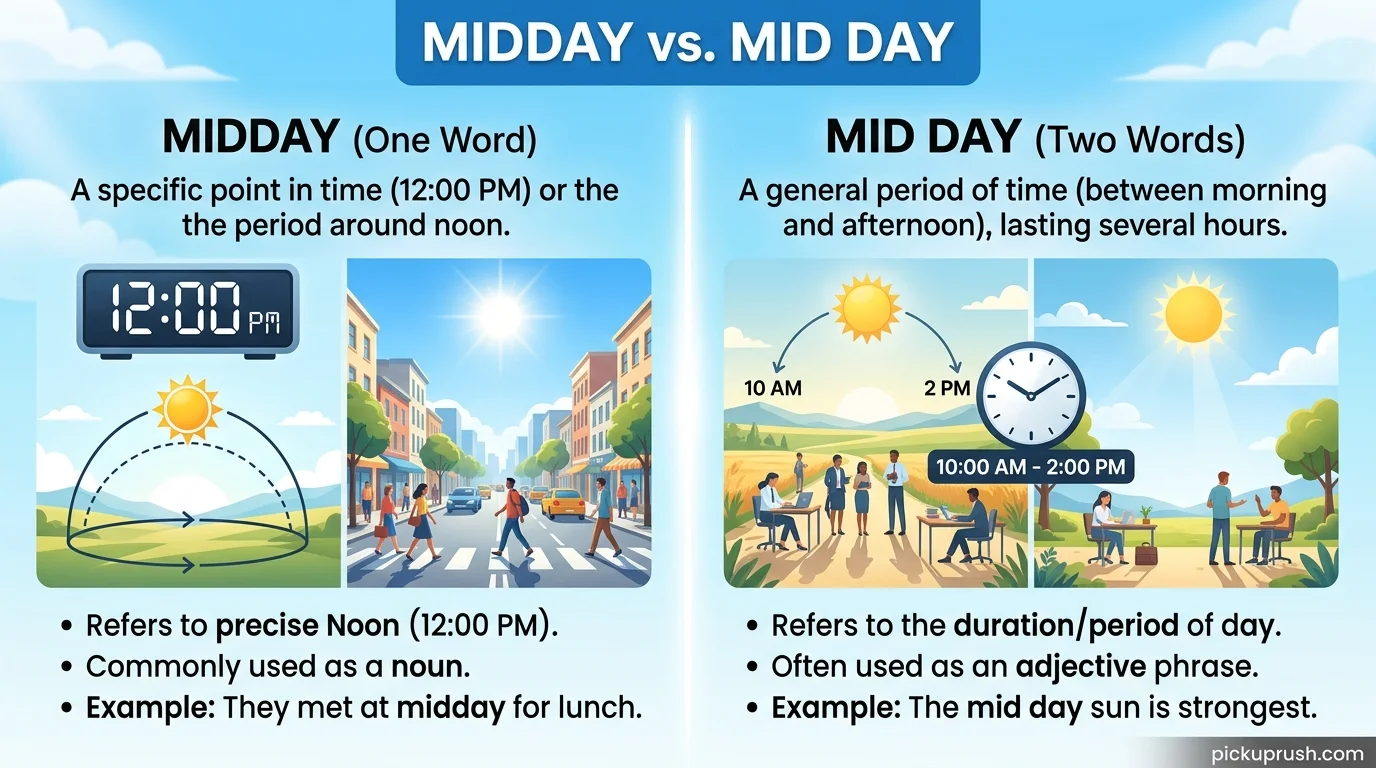

Midday vs. Mid Day: Which Spelling Is Correct in Modern English? is a common question for writers, students, and English learners. The two forms look almost identical, but modern English generally uses midday as one word. Knowing the correct spelling can help you write more clearly and avoid common mistakes in everyday and professional writing.
The word midday refers to the middle of the day, usually around the time when the sun is at its highest. While mid day may sometimes appear in older texts or informal writing, it is not the standard form in most modern English contexts. Understanding why midday is preferred makes it easier to use the word confidently in emails, essays, articles, and other types of writing.
In this guide, you’ll learn the difference between midday and mid day, including their meaning, usage, spelling, and common examples. We’ll also look at how English spelling has developed over time and explain why midday has become the accepted form in modern English.
Midday vs. Mid Day: The Quick Answer
The correct spelling depends on what you’re trying to express. However, when you’re talking about the middle of the day, midday is the standard modern form.
| Form | Standard use | Example |
| midday | The established word for the middle of the day | We arrived at midday. |
| mid day | Not normally used as the spelling of the time-of-day word | We arrived at mid day. |
| mid-day | A less common or style-dependent variant | The mid-day heat was intense. |
Cambridge lists midday as a noun and gives examples such as “at midday,” “by midday,” and “midday sun.” Its American English definition likewise identifies midday as the middle of the day, at or near 12 o’clock.
So if you’re writing an email, school assignment, article, report, or everyday message, midday is the straightforward choice.
The simple rule
If you mean the middle of the day, write “midday.”
That’s the rule most writers need.
What Does “Midday” Mean?
Midday refers to the middle of the day, especially around 12:00 p.m. The word can point to the exact time of noon or to the broader period surrounding it.
Oxford defines midday as 12 o’clock in the middle of the day or the period around that time. Cambridge gives a similar definition and lists noon as a synonym.
That distinction matters because everyday language isn’t always tied to a precise minute on the clock.
For example:
- The meeting starts at midday.
- The temperature usually rises by midday.
- We should reach the town around midday.
- The midday sun can be intense.
In the first sentence, midday can refer to approximately 12:00. In the third sentence, around midday clearly describes a period near that point rather than one exact minute.
Collins makes this distinction especially clear. It defines midday both as 12 o’clock in the middle of the day and as the middle part of the day, from late morning to early afternoon.
Is midday exactly 12:00 p.m.?
Not always.
In precise scheduling, 12:00 p.m. identifies a specific clock time. In ordinary language, midday can cover the general period around noon.
Think of it this way:
12:00 p.m. = a precise point on the clock
midday = that point and, depending on context, the surrounding part of the day
That’s why both expressions can be useful without being perfectly identical in every sentence.
Why Is “Midday” Written as One Word?
The spelling makes more sense when you look at how English compounds develop.
English frequently combines words into established compounds. Over time, some combinations remain open phrases while others become hyphenated or closed compounds. The form that becomes standard depends on historical development and conventional usage rather than a simple mathematical rule.
Midday has a particularly long history. Oxford gives its word origin as the Old English middæg, formed from elements corresponding to mid and day.
In other words, midday isn’t a modern invention created by randomly joining two words together. It has been an established compound for centuries.
That history helps explain why modern dictionaries treat it as one word.
The American Heritage Dictionary also lists midday as a noun meaning “the middle of the day; noon.”
Compound words don’t always follow common sense
This is one of those areas where English can feel inconsistent.
Consider words such as:
- afternoon
- midnight
- sunrise
- sunset
- daybreak
- daytime
- midday
Many of these started with transparent meanings but developed into established compounds. Once a compound becomes conventional, writers generally follow the established spelling rather than rebuilding it from its individual parts.
That’s why midday is preferred over mid day when the intended meaning is the established noun.
Is “Mid Day” Ever Correct?
This question needs a little nuance.
If you’re using mid day as an attempt to spell the standard noun meaning “noon,” then mid day is not the normal modern form. In that situation, write midday.
However, English grammar can sometimes place words such as mid and day in separate constructions. That doesn’t mean the standard word itself has suddenly changed spelling.
The key is grammatical function.
Compare:
We arrived at midday.
Here, midday is one established noun.
Now compare a construction such as:
The activity took place in the mid part of the day.
Here, mid is functioning separately as a modifier. The writer isn’t trying to spell the established noun midday.
This distinction prevents a common mistake: assuming that every occurrence of the concepts mid + day must use the same spelling.
A useful test
Ask yourself:
“Am I using a recognized word that means the middle of the day?”
If the answer is yes, use:
midday
If you’re actually building a different grammatical phrase, evaluate that phrase on its own.
What About “Mid-Day”?
The hyphenated spelling mid-day deserves separate attention.
You may encounter mid-day in older publications, particular editorial styles, or some dictionaries and texts. A hyphen can sometimes help readers see that two elements work together as a compound.
However, modern general English normally doesn’t require the hyphen in midday.
That doesn’t mean every appearance of mid-day is automatically a spelling error. English spelling conventions can vary across historical periods, publishers, and style systems.
The practical point is simpler:
For ordinary modern writing, choose “midday.”
If you’re editing a document that follows a particular house style, follow that style consistently.
Midday as a Noun
Midday is primarily used as an uncountable noun. Oxford labels it “[uncountable],” while Cambridge also lists it as a noun without a plural form in its learner dictionaries.
That means you normally don’t say:
We arrived at two middays.
Instead, you use midday to refer to the time or period.
Common noun constructions
At midday
The train arrives at midday.
By midday
We expect the work to be finished by midday.
Around midday
The weather should improve around midday.
Before midday
Please submit the form before midday.
After midday
The office becomes busier after midday.
These patterns are natural and common.
Cambridge’s examples include constructions such as “by midday,” “at midday,” and “midday sun,” showing how naturally the word fits into ordinary English.
Midday as an Adjective
Although dictionaries commonly define midday as a noun, it also appears naturally before other nouns as a modifier.
Examples include:
- midday sun
- midday heat
- midday meal
- midday break
- midday traffic
- midday light
- midday prayer
- midday temperature
For example:
The midday heat made the outdoor event uncomfortable.
Here, midday tells you what kind of heat you’re talking about.
Oxford specifically lists common collocations such as midday heat, midday meal, and midday prayer.
This is useful because strong writing isn’t only about knowing the correct spelling. It also means knowing how native speakers naturally combine the word with other words.
Common Expressions With “Midday”
Several expressions with midday appear regularly in everyday and professional English.
| Expression | Meaning | Example |
| at midday | At approximately noon | We met at midday. |
| around midday | Near noon | The rain should stop around midday. |
| by midday | No later than approximately noon | The work should be complete by midday. |
| before midday | Earlier than noon | Call me before midday. |
| after midday | Later than noon | The store gets busier after midday. |
| midday sun | Sun during the middle of the day | The midday sun was bright. |
| midday heat | Heat around the middle of the day | We avoided the midday heat. |
| midday meal | A meal eaten around noon | They prepared a light midday meal. |
These combinations also show why midday works so well as a compact word. Instead of writing the middle-of-the-day heat, English normally uses the cleaner compound midday heat.
Midday vs. Noon: Are They the Same?
Midday and noon are closely related, and dictionaries often list noon as a synonym for midday. Cambridge and Oxford both connect the two terms in their definitions.
Still, there can be a subtle difference in emphasis.
Noon usually points more directly to 12:00 p.m.
Midday can refer to 12:00 p.m. or the broader middle portion of the day, depending on context.
Consider these examples:
The meeting begins at noon.
This sounds precise.
The meeting begins around midday.
This allows slightly more flexibility.
The distinction becomes even clearer when midday modifies another noun:
The midday heat was unbearable.
Here, midday isn’t necessarily identifying one exact minute. It describes the conditions associated with the middle part of the day.
Midday vs. 12 P.M.: Which Should You Use?
The choice depends on how precise you need to be.
Use midday when you’re talking naturally about the middle of the day:
I’ll call you around midday.
Use 12 p.m. when the exact time matters:
The appointment begins at 12 p.m.
This difference becomes important in schedules, transportation, appointments, deadlines, and event notices.
Compare these examples
| Context | Natural choice | Why |
| Casual conversation | midday | Natural and flexible |
| General article | midday | Clear and readable |
| Weather description | midday | Describes a period |
| Exact appointment | 12 p.m. | Gives a precise time |
| Formal schedule | 12:00 p.m. | Removes ambiguity |
| General deadline | by midday | Gives an approximate time boundary |
If there’s any chance that a reader could misunderstand the timing, give the exact clock time.
A Note About 12 a.m. and 12 p.m.
The expressions 12 a.m. and 12 p.m. can cause confusion because different readers sometimes find the labels unintuitive.
For maximum clarity, especially in schedules, you can use:
- 12 noon
- midday
- 12:00 p.m.
Cambridge’s educational material explicitly identifies 12 p.m. as midday.
For a highly precise schedule, however, it’s often better to give the complete time and date rather than relying on a vague reference to midday.
Midday in American English
For American English, the standard choice is straightforward: midday.
Cambridge’s American English dictionary defines midday as the middle of the day, at or near 12 o’clock, and lists the word as a noun.
You can comfortably use midday in:
- Business emails
- School assignments
- Reports
- Articles
- News writing
- Websites
- Everyday messages
- Professional documents
For example:
Please send the revised document by midday.
Or:
The event will begin at midday on Saturday.
There’s no need to insert a space simply because the word contains mid and day.
Midday in British English
British English also uses midday as the standard spelling.
Cambridge’s British English entry defines midday as twelve o’clock in the middle of the day and gives examples such as midday meal and midday sun.
So this isn’t one of those cases where American and British English have fundamentally different spellings.
| Variety | Standard form |
| American English | midday |
| British English | midday |
| General modern English | midday |
There can be differences in punctuation, style, and historical usage across publications. But for the basic spelling question, midday is the safe standard on both sides of the Atlantic.
Common Mistakes With Midday
Even a simple word can cause several recurring problems.
Writing “Mid Day” for the Standard Noun
The most common mistake is separating the word:
We will arrive at mid day.
In standard modern prose, write:
We will arrive at midday.
The meaning hasn’t changed. Only the conventional spelling has.
Adding an Unnecessary Hyphen
Another common form is:
We will arrive at mid-day.
Although the hyphenated form can be found in English usage, midday is the normal modern choice.
Confusing Midday With Noon
These words overlap heavily, but midday can describe a wider period.
The train leaves at noon.
This sounds like a specific departure time.
The train usually leaves around midday.
This sounds less rigid.
Assuming Every Compound Works the Same Way
English compounds don’t follow one universal spelling formula.
You can’t reliably decide whether a compound should be open, hyphenated, or closed simply by looking at its component words.
That’s why dictionary evidence matters.
A Practical Case Study: Choosing the Right Form
Imagine you’re writing an event announcement:
The community meeting begins at mid day.
The reader understands the sentence immediately. Yet the spelling looks unusual because midday is the established form.
A cleaner version is:
The community meeting begins at midday.
Now imagine a precise schedule:
The community meeting begins at 12:00 p.m.
That version gives readers an exact clock time.
The three forms aren’t equally useful:
| Sentence | Assessment |
| The meeting begins at midday. | Standard and natural |
| The meeting begins at mid day. | Not the normal spelling |
| The meeting begins at 12:00 p.m. | Precise and schedule-friendly |
The lesson is simple: choose both the correct spelling and the right level of precision.
Examples of Correct “Midday” Usage
Here are practical examples you can use as models.
Everyday Writing
- I usually eat lunch around midday.
- We should arrive by midday.
- The store gets crowded around midday.
- She left the office before midday.
Professional Writing
- The report must be submitted by midday.
- The service will resume around midday.
- Staff will receive an update at midday.
- The delivery is expected before midday.
Descriptive Writing
- The midday sun covered the courtyard in bright light.
- The midday heat made the long walk uncomfortable.
- Birds became quieter during the hottest part of midday.
- The streets were unusually busy around midday.
Academic and Informational Writing
- Measurements were recorded at midday.
- The observations were repeated around midday.
- The temperature reached its highest level near midday.
Read More: Which vs. Witch vs. Wich: Differences, Meanings, and Correct Usage
A Quick “Midday” Usage Guide
If you’re still unsure, use this checklist:
- Do you mean the middle of the day? → Use midday.
- Do you mean exactly 12:00 p.m.? → Noon or 12:00 p.m. may be more precise.
- Are you describing a general period around noon? → Midday works naturally.
- Are you writing for a modern American English audience? → Choose midday.
- Does your publication have a specific house style? → Follow that style consistently.
- Are you tempted to write “mid day”? → Check whether you simply mean midday.
How to Remember the Correct Spelling
There’s no need for a complicated memory trick.
Think of midday as a single established word in the same broad family of time-related compounds:
- midday
- midnight
- daytime
- afternoon
- daybreak
When you’re referring to the middle of the day, keep midday together.
A useful mental sentence is:
“I’ll meet you at midday.”
Once that pattern becomes familiar, the spelling becomes much easier to remember.
Why Dictionary Sources Matter
When two spellings look plausible, intuition isn’t always enough.
English has many words whose modern forms don’t perfectly match what a reader might expect from their individual parts. Dictionary entries provide evidence about established spelling, meaning, grammar, and usage.
For this particular question, the evidence is consistent:
- Cambridge Dictionary lists midday as a noun and defines it as twelve o’clock in the middle of the day.
- Oxford Learner’s Dictionaries lists midday as an uncountable noun and gives examples such as midday meal and midday sun.
- American Heritage Dictionary lists midday as a noun meaning the middle of the day or noon.
- Collins Dictionary recognizes both the exact time around noon and the broader middle part of the day.
That agreement makes the modern spelling especially clear.
Conclusion:
The correct modern spelling is midday, written as one word. It refers to the middle of the day and is the standard form used in dictionaries, professional writing, and everyday English. While mid day may appear occasionally, especially in older or informal writing, it is generally not preferred in modern standard English.
Using midday consistently can help you avoid spelling and grammar mistakes and make your writing clearer and more professional. Once you remember that the word normally functions as a single compound noun, choosing the correct form becomes simple.
FAQs:
Is “midday” one word or two?
Midday is normally written as one word in modern English. It is the standard spelling for the time around the middle of the day.
Is “mid day” incorrect?
Mid day is generally considered nonstandard in modern English when you mean the middle of the day. You may still find it in older texts or occasional informal usage.
What does “midday” mean?
Midday means the middle of the day, commonly referring to around 12 noon, although the exact context can vary.
Should I use “midday” in formal writing?
Yes. Midday is appropriate for formal and professional writing, including emails, essays, reports, articles, and business documents.
Is “midday” the same as “noon”?
They are closely related, but they aren’t always identical in meaning. Noon specifically refers to 12:00 p.m., while midday generally means the middle part of the day and can be used more broadly.


1 thought on “Midday vs. Mid Day: Which Spelling Is Correct in Modern English?”