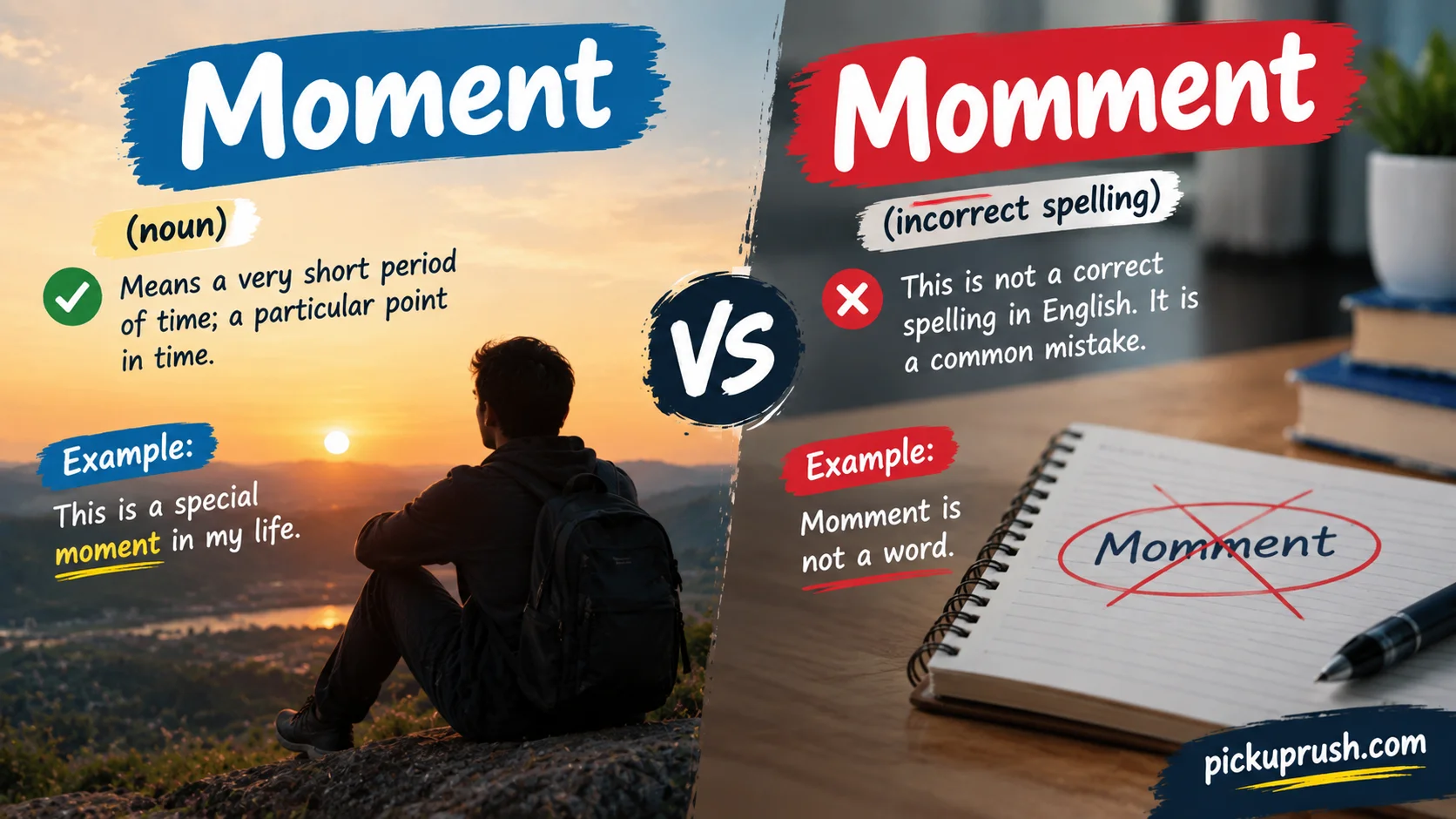

Have you ever stopped while writing and wondered whether moment or momment is the correct spelling? This small spelling difference can easily cause confusion, especially when you’re typing quickly. If you’ve searched for Moment vs. Momment: Difference and Correct Usage, you’re likely looking for a clear answer without complicated grammar rules.
The correct spelling is moment, with only one “m” in the middle. Momment is a common spelling mistake and isn’t accepted as a standard English word. The word moment can describe a short period of time, a specific point in time, or an important event, depending on how you use it in a sentence.
In this guide, you’ll learn the difference between moment and momment, understand the meaning and correct usage of moment, and see practical examples. You’ll also find simple tips to help you remember the correct spelling and avoid this easy typo in your everyday writing.
Moment vs. Momment: What’s the Difference?
The difference is simple: moment is correct, while momment is incorrect in standard English.
| Word | Correct spelling? | Meaning | Example |
| Moment | ✅ Yes | A short period or particular point in time | “Give me a moment.” |
| Momment | ❌ No | A misspelling of moment | “Give me a momment.” ❌ |
The correct spelling contains one m after “mo”:
M-O-M-E-N-T
The incorrect form adds another m:
M-O-M-M-E-N-T
That extra letter doesn’t create a new word or a different meaning. It simply produces a spelling error.
For example:
- ❌ “Please wait a momment.”
- ✅ “Please wait a moment.”
- ❌ “That was a special momment.”
- ✅ “That was a special moment.”
- ❌ “I’ll call you in a momment.”
- ✅ “I’ll call you in a moment.”
If you’re writing something important, moment is the form to use.
What Does “Moment” Mean?
The word moment is a noun with several closely related meanings. Its most common uses involve time, particularly a short period or a particular point in time.
Cambridge Dictionary defines moment as a very short period of time and also as a particular time or occasion. It also records uses connected with importance and several common expressions.
Moment as a Short Period of Time
The most familiar meaning of moment is a very short period of time.
You don’t normally use moment to describe an exact number of seconds. Instead, the word gives a general sense that something will take only a short while.
Consider these examples:
- “Wait a moment.”
- “I’ll be back in a moment.”
- “She paused for a moment.”
- “Give me a moment to think.”
- “He looked away for a moment.”
Notice that the exact length isn’t important. A moment could last a little longer or shorter depending on the situation.
That’s one reason the word works so naturally in everyday conversation.
Moment as a Particular Point in Time
Moment can also mean a particular point or occasion.
For example:
“At that moment, the phone rang.”
Here, moment doesn’t simply mean a short amount of time. It identifies a specific point in the sequence of events.
You can use the word this way when describing an event, decision, memory, or turning point.
Examples include:
- “That was the moment I understood the problem.”
- “She knew it was the right moment to leave.”
- “At that moment, nobody knew what would happen.”
- “He remembered the moment clearly.”
This use often gives writing a stronger sense of timing.
Moment as a Special or Important Occasion
Sometimes moment refers to an event that carries emotional or personal importance.
You might hear phrases such as:
- a special moment
- a proud moment
- a memorable moment
- a difficult moment
- a defining moment
- a historic moment
A defining moment, for example, refers to a particularly important point or event that can shape how a situation or period is remembered.
For example:
“Winning the championship was a defining moment in her career.”
The word moment here isn’t mainly about duration. It highlights the importance of the event.
Moment in Technical and Academic Contexts
The word moment also appears in technical fields.
In physics, for example, you may encounter terms such as moment of force, dipole moment, and angular moment. In mathematics and statistics, moment can describe mathematical quantities associated with a distribution.
These technical meanings are different from everyday expressions such as wait a moment. However, the spelling remains exactly the same:
moment
That makes the spelling distinction particularly easy. Whether you’re writing about everyday time or a specialized scientific concept, you don’t add a second m.
Why Is “Momment” Incorrect?
Momment is incorrect because standard English spells the word as moment.
The error usually involves unnecessary letter doubling. English contains many words where consonants double in particular spelling patterns. That can sometimes make writers unsure about whether a letter should be repeated.
However, moment doesn’t follow a pattern that requires a doubled m.
The correct structure is:
MO + MENT → MOMENT
Not:
MO + MMENT → MOMMENT
This is an important distinction because adding one letter can change a correct word into a spelling error.
For example:
| Incorrect | Correct |
| ❌ momment | ✅ moment |
| ❌ a momment ago | ✅ a moment ago |
| ❌ in a momment | ✅ in a moment |
| ❌ special momment | ✅ special moment |
If a spelling checker underlines momment, replacing it with moment will normally solve the problem.
How to Spell “Moment” Correctly
The simplest way to remember the spelling is to focus on its six letters:
M-O-M-E-N-T
There are two m’s in the whole word, but they are separated by o:
M O M E N T
That matters because the common mistake is to place the two m’s together.
Easy Memory Trick for “Moment”
Try this simple reminder:
“One extra M means one mistake.”
You can also break the word into two easy parts:
MO + MENT = MOMENT
That visual pattern makes it easier to avoid writing momment.
Another useful trick is to remember a familiar phrase such as “at the moment.” If you can spell that phrase correctly, you already have the spelling of the word locked in.
Moment in a Sentence
Seeing a word in context often makes its correct use much clearer. Here are examples covering several everyday situations.
Everyday Examples
- “Please wait a moment.”
- “I’ll be there in a moment.”
- “She stopped for a moment.”
- “Give me a moment to decide.”
- “He was quiet for a moment.”
Examples About Memories
- “That was one of the happiest moments of my life.”
- “She wanted to remember the moment forever.”
- “We captured the moment with a photograph.”
- “It was a beautiful moment between the two friends.”
Examples About Decisions
- “He waited for the right moment to speak.”
- “She knew this was the perfect moment to ask.”
- “Choosing the right moment can make a conversation easier.”
Examples in Professional Writing
- “Please give me a moment to review the document.”
- “The meeting reached an important moment when the team agreed on the proposal.”
- “We’ll discuss the issue in a moment.”
These examples show something important: moment is flexible. You can use it for a brief duration, a particular point, or an important occasion.
Common Phrases With “Moment”
One reason this word appears so often is that it forms several common expressions.
“At the Moment”
At the moment means now or at the present time.
Examples:
- “I’m busy at the moment.”
- “She isn’t available at the moment.”
- “We’re not accepting applications at the moment.”
Cambridge Dictionary specifically lists at the moment as meaning “now.”
Compare:
“She isn’t here at the moment.”
This means she isn’t here right now.
“In a Moment”
In a moment generally means very soon or after a short period.
Examples:
- “I’ll call you back in a moment.”
- “The doctor will see you in a moment.”
- “I’ll finish this in a moment.”
It doesn’t necessarily promise a mathematically exact amount of time. It’s a natural conversational expression for a short wait.
“For a Moment”
For a moment means during a short period of time.
Examples:
- “She closed her eyes for a moment.”
- “I thought about it for a moment.”
- “He stood there silently for a moment.”
The distinction between in a moment and for a moment is useful:
- In a moment = something will happen soon.
- For a moment = something continues for a short time.
“The Moment”
The moment can refer to a specific point in time. In another common structure, the moment (that) can mean as soon as.
For example:
“The moment I heard the news, I called her.”
Here, the moment means essentially as soon as.
Another example:
“At the moment the lights went out, everyone became quiet.”
Here, the moment identifies a particular point in the event.
“A Moment Ago”
A moment ago refers to a very short time before now.
Examples:
- “He was here a moment ago.”
- “I saw her a moment ago.”
- “The screen was working a moment ago.”
Again, the phrase doesn’t necessarily establish an exact number of seconds. It simply points to the recent past.
“Moment of Truth”
The expression moment of truth refers to a critical point when the real outcome or reality becomes clear.
For example:
“Opening the results was the moment of truth.”
The phrase emphasizes importance and consequence, not simply a brief amount of time.
Moment vs. Momment in Different Types of Writing
The correct spelling doesn’t change depending on where you use the word.
Everyday Communication
In texts, chats, notes, and casual messages, write:
- “Wait a moment.”
- “I’ll be there in a moment.”
- “Give me a moment.”
Casual writing may contain abbreviations and informal language, but moment remains the standard spelling.
Academic Writing
In an essay or assignment, you might write:
“This was a significant moment in the development of the argument.”
Or:
“At this moment in the experiment, the temperature began to change.”
Using momment in academic writing would be a spelling error.
Professional Writing
Business emails and workplace documents commonly use moment in polite requests:
“Please give me a moment to review the information.”
You might also write:
“We are currently reviewing the issue and will provide an update shortly.”
Both styles are possible, depending on the context. The important point is that whenever moment appears, its spelling stays the same.
Creative Writing
Creative writers often use moment to slow down a scene or emphasize an emotional turning point.
For example:
“For a moment, the room fell completely silent.”
Or:
“That was the moment she realized everything had changed.”
Here, the word helps create a sense of timing, emotion, and focus.
Moment vs. Momentum
Moment and momentum look similar because they share the beginning moment-, but they have different meanings.
| Word | Meaning | Example |
| Moment | A short period, point in time, or occasion | “Wait a moment.” |
| Momentum | The force or drive that keeps something moving or developing | “The team gained momentum.” |
Consider these sentences:
“Give me a moment to think.”
“The campaign gained momentum after the announcement.”
The first sentence deals with time. The second describes increasing force or progress.
Don’t replace one with the other.
Moment vs. Minute
Moment and minute can both describe a short period, but they’re not identical.
A minute is a specific unit of time equal to 60 seconds. A moment is less precise.
For example:
“I’ll be back in a minute.”
This literally refers to a minute, although everyday speakers may use it more loosely.
By contrast:
“I’ll be back in a moment.”
This simply indicates that the person expects to return soon.
The distinction becomes clearer in emotional or descriptive writing:
“It was a memorable moment.”
You wouldn’t normally replace moment with minute in that sentence.
Moment vs. Instant
Moment and instant overlap when they describe a very short period.
However, instant often emphasizes something that happens almost immediately.
Compare:
- “She hesitated for a moment.”
- “In an instant, everything changed.”
The first suggests a short period of hesitation. The second creates a stronger sense of suddenness.
Neither word is automatically better. The context determines which one communicates the intended idea.
Common Mistakes With “Moment”
The spelling problem is usually simple, but several related mistakes are worth watching.
Mistake: Writing “Momment”
❌ “I’ll be there in a momment.”
✅ “I’ll be there in a moment.”
The extra m doesn’t belong.
Mistake: Confusing “Moment” With “Momentum”
❌ “The project reached an important momentum in the meeting.”
✅ “The project reached an important moment in the meeting.”
However, if you’re talking about growing progress or force, momentum may be the correct word:
“The project gained momentum after the team secured funding.”
Mistake: Using “At a Moment” Instead of “At the Moment”
When you mean right now, the standard expression is:
✅ “I’m busy at the moment.”
Not:
❌ “I’m busy at a moment.”
The phrase at a moment can occur in different grammatical contexts, but it doesn’t normally replace at the moment when you mean “now.”
Mistake: Treating “Moment” as an Exact Measurement
A moment isn’t normally an exact unit of time in everyday English.
So if precision matters, use a measurable unit:
- second
- minute
- hour
- day
Use moment when the exact duration isn’t important.
A Practical Case Study: Choosing the Right Spelling
Imagine you’re writing an email to a customer.
You type:
“Please give us a momment while we review your request.”
At first glance, the mistake may be easy to miss. The word still looks familiar because only one letter has been added.
The corrected sentence is:
“Please give us a moment while we review your request.”
Why does this matter?
In professional writing, small spelling errors can distract readers from the message. A clean sentence looks more polished and makes the intended meaning immediately clear.
The same principle applies to school assignments, blog posts, applications, reports, and formal correspondence.
Accuracy often depends on small details.
Facts About the Word “Moment”
Here are several useful facts that make the word easier to understand:
- Moment is a noun in its common English uses.
- Its pronunciation in American English is /ˈmoʊ.mənt/.
- Its plural form is moments.
- It can describe a short period of time.
- It can identify a particular point or occasion.
- It can describe an important or significant occasion in certain expressions.
- At the moment means now.
- For the moment can mean something is true or being done for now, with the possibility of change later.
- In a moment commonly means very soon.
- Momment is not the standard spelling of this English word.
Quick Comparison: Moment vs. Momment
| Feature | Moment | Momment |
| Standard spelling | ✅ Yes | ❌ No |
| Standard English word | ✅ Yes | ❌ No |
| Meaning | Short period or point in time | No standard meaning as this spelling |
| Formal writing | ✅ Correct | ❌ Incorrect |
| Casual writing | ✅ Correct | ❌ Incorrect |
| Plural | Moments | — |
| Example | “Wait a moment.” | “Wait a momment.” ❌ |
This table gives you the essential answer at a glance: choose moment every time you mean the standard English word.
Read More: Faring vs. Fairing: What’s the Difference?
How to Remember the Correct Spelling
If momment keeps sneaking into your writing, use a simple visual trick.
Write:
MO + MENT = MOMENT
Now compare it with the common mistake:
MO + MMENT = MOMMENT ❌
The correct version has M-O-M at the beginning. The two m letters aren’t next to each other.
You can also remember the phrase:
“At the moment.”
Because this expression is extremely common, remembering it can reinforce the correct spelling naturally.
Another useful approach is to connect the spelling with meaning:
Moment = a point in time.
If you’re talking about a short period or a particular occasion, think moment.
Conclusion:
The correct spelling is moment, while momment is a common spelling mistake. Moment refers to a brief period of time or a particular point in time. For example, you can say, “Please wait a moment” or “That was a memorable moment.”
The confusion usually happens because some words double their final consonant in certain forms. However, moment doesn’t follow that pattern. It contains only one m after the initial vowel sound, so writing momment adds an unnecessary letter.
Whenever you’re unsure, remember the simple rule: Moment is the correct spelling; momment is incorrect. Using the correct form will keep your writing clear and polished in emails, essays, messages, and everyday communication.
FAQs:
Is “moment” or “momment” correct?
Moment is the correct spelling. Momment is incorrect and should not be used in standard English writing.
What does “moment” mean?
Moment usually means a short period of time or a specific point in time. For example, “She paused for a moment before answering.”
It can also describe an important or memorable point in an event, such as “Winning the award was a special moment.”
Why do people spell “moment” as “momment”?
The misspelling momment likely comes from adding an extra m by mistake. English has many words that contain doubled consonants, which can make spelling patterns confusing. However, moment uses only one m after the first vowel.
How do you use “moment” in a sentence?
You can use moment in several ways:
- Please wait a moment.
- I need a moment to think.
- That was an unforgettable moment.
- She arrived at the perfect moment.
- For a moment, everything became quiet.
What is the difference between “moment” and “momment”?
There is no difference in meaning because momment isn’t the standard spelling of an English word. Moment is the correct word and can refer to a brief period, a particular point in time, or a significant occasion.




1 thought on “Moment vs. Momment: Difference and Correct Usage”