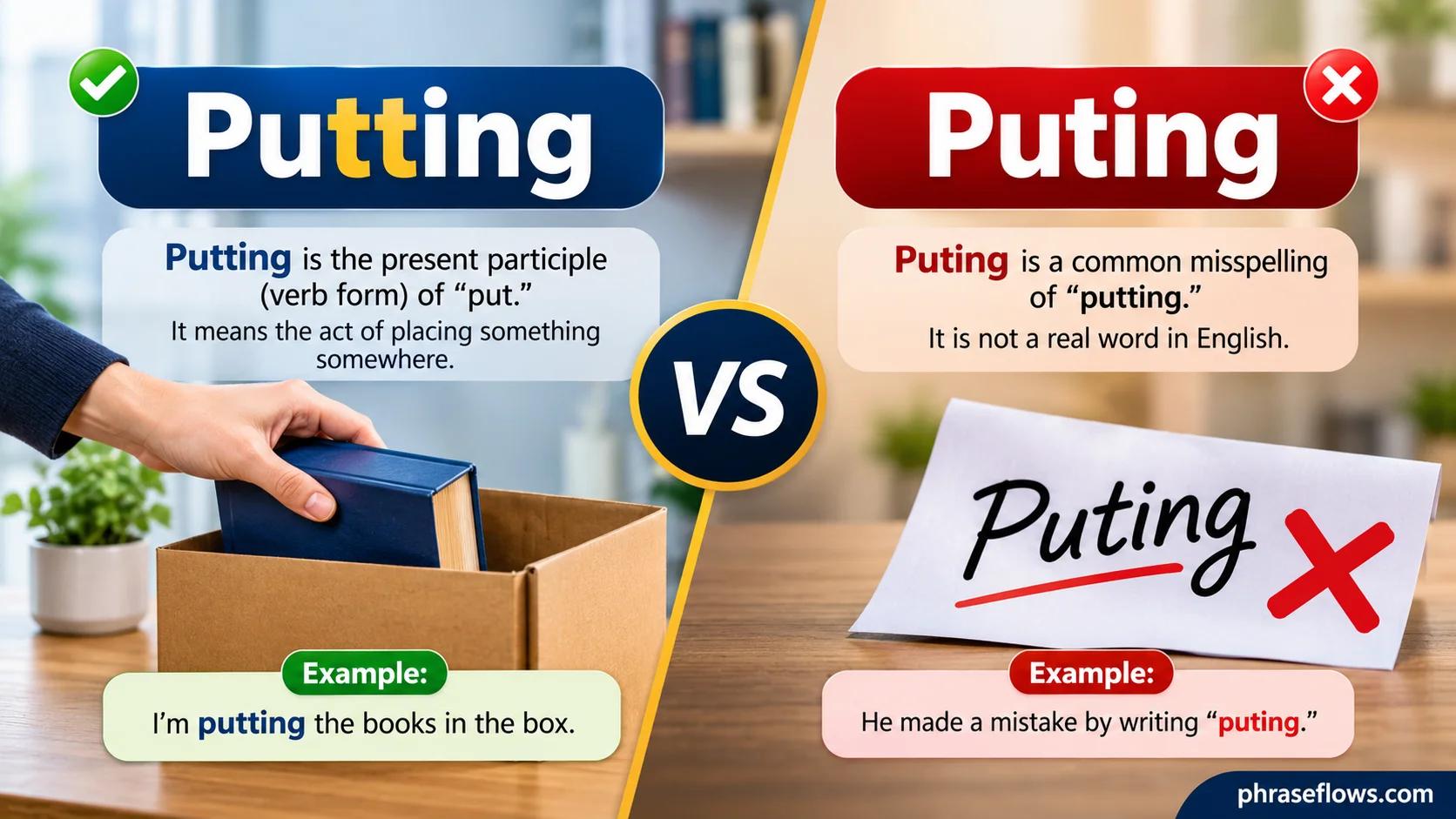

Have you ever paused while typing and wondered whether Putting or Puting is the correct spelling? These two forms look almost the same, so it’s easy to miss the extra letter when writing quickly. You might notice this mistake in emails, school assignments, social media posts, or everyday conversations. However, only one spelling is accepted in standard English.
Putting is the correct spelling. It comes from the verb put, which means to place or move something into a particular position. When you add -ing to put, you must double the final t before adding the ending. That’s why putting has two t’s, while puting is a common spelling mistake.
Understanding the difference between Putting vs. Puting can help you avoid this error in academic, professional, and everyday writing. In this guide, you’ll learn the correct spelling, understand the rule behind the double t, and explore clear examples of how to use putting in sentences. Once you know the pattern, choosing the right form becomes much easier.
Putting vs. Puting: The Quick Answer
Putting is the correct spelling in standard English. It is the present participle and gerund form of the verb put. You use it when describing an ongoing action or when treating the action of placing something somewhere as a noun.
On the other hand, puting is a misspelling. It doesn’t follow the standard rule for forming the -ing form of the verb put.
Here’s a quick comparison:
| Spelling | Correct or Incorrect? | Explanation |
| Putting | Correct | The standard -ing form of put. |
| Puting | Incorrect | Misses the second t required by the spelling rule. |
Examples:
- Correct: She is putting the books on the shelf.
- Incorrect: She is puting the books on the shelf.
The important thing to remember is that the verb put keeps its original spelling and doubles its final consonant before adding -ing.
What Does Putting Mean?
Putting comes from the verb put, which means to move, place, or position something somewhere. It describes the action of making something occupy a particular location or position.
For example, when you put your phone on a table, you move it from one place to another. When you say, “I am putting my phone on the table,” you’re describing that action as it happens.
The word appears in everyday conversations, workplace instructions, written communication, and many common expressions.
Consider these examples:
- I’m putting my clothes in the closet.
- He is putting the finishing touches on his project.
- They are putting their ideas into practice.
- She enjoys putting things in order.
Although these sentences use the same word, putting serves different grammatical purposes depending on the sentence.
Putting as a Present Participle
A present participle is a verb form that ends in -ing. It often works with a helping verb to describe an action that is happening or was happening over a period of time.
The word putting appears in several continuous verb tenses.
Present continuous tense
Use this form when an action is happening now or around the present time.
Examples:
- I am putting the groceries away.
- She is putting her presentation together.
- They are putting new furniture in the office.
Past continuous tense
Use this form when an action was in progress at a particular time in the past.
Examples:
- He was putting the dishes away when I arrived.
- We were putting the decorations up yesterday.
- She was putting her notes into a folder.
Future continuous tense
Use this form when an action will be in progress at a particular time in the future.
Examples:
- I will be putting the final documents together tomorrow.
- They will be putting the new system into operation next week.
In each example, putting describes an action in progress. The helping verb determines the tense while the present participle supplies the main action.
Putting as a Gerund
A gerund is a verb ending in -ing that functions as a noun. Although it looks like a verb, it can occupy positions normally held by nouns in a sentence.
For example:
- Putting things away keeps the room organized.
- I enjoy putting puzzles together.
- She dislikes putting unnecessary pressure on herself.
- Putting your ideas into practice takes patience.
In the first example, putting acts as the subject of the sentence. In the second, it serves as the object of the verb enjoy.
This distinction matters because putting doesn’t always describe an action happening at that exact moment. Sometimes it names an activity or general action.
Putting in Common Expressions
English speakers use putting in many expressions. These phrases often have meanings that go beyond physically moving something.
Here are some common examples:
| Expression | Meaning | Example |
| Putting something away | Returning something to its proper place | She is putting her books away. |
| Putting something together | Assembling or organizing something | We’re putting the furniture together. |
| Putting something into practice | Applying an idea or plan | He’s putting his training into practice. |
| Putting someone first | Giving someone’s needs priority | Parents often focus on putting their children first. |
| Putting something off | Delaying an activity | I’m putting off the meeting until Friday. |
| Putting something forward | Suggesting an idea or proposal | She is putting forward a new proposal. |
These expressions show how frequently the word appears in everyday English. Learning them can also help you understand its meaning in different contexts.
Why Is Putting the Correct Spelling?
The spelling putting follows an important English spelling rule: double the final consonant before adding -ing when certain conditions are met.
The verb put has three letters. It ends with a consonant, contains a short vowel sound, and follows a consonant-vowel-consonant pattern.
When you add -ing, you double the final t:
Put + ing = Putting
This process keeps the spelling consistent with the short vowel sound in the original word.
If you write puting, you leave out the consonant that standard English spelling requires.
The Consonant-Doubling Rule
The consonant-doubling rule applies to many short English verbs. When a verb ends in a single consonant preceded by a single short vowel, you generally double the final consonant before adding a vowel suffix such as -ing or -ed.
This rule commonly applies to one-syllable verbs.
Consider these examples:
| Base Verb | Correct -ing Form | Incorrect Form |
| Put | Putting | Puting |
| Sit | Sitting | Siting (when intended as the form of sit) |
| Run | Running | Runing |
| Cut | Cutting | Cuting |
| Hop | Hopping | Hoping (when intended as the form of hop) |
| Stop | Stopping | Stoping |
Notice the pattern. Each base verb ends with a consonant preceded by a short vowel. Doubling the final consonant preserves the expected short-vowel pronunciation.
However, the rule doesn’t apply to every verb ending in a consonant. For example:
- Help becomes helping.
- Work becomes working.
- Read becomes reading.
These verbs don’t follow the same consonant-vowel-consonant pattern.
There are also additional spelling considerations for longer verbs. Stress and syllable structure can affect whether the final consonant doubles.
Why Puting Is Incorrect
The spelling puting misses the second t. Although it might look like a reasonable form of put + ing, it doesn’t follow the accepted spelling convention.
English spelling often requires small changes when you add suffixes. Sometimes you remove a letter. In other cases, you double a consonant.
For example:
- Make becomes making because the final silent e disappears.
- Run becomes running because the final consonant doubles.
- Put becomes putting for the same consonant-doubling reason.
These changes aren’t random. They follow recognizable spelling patterns.
Remember: When forming the -ing version of put, don’t simply attach the suffix. Double the final consonant first.
Putting vs. Puting: Key Differences
The easiest way to understand putting vs. puting is to compare their spelling, grammatical role, and accepted usage.
Although both forms look similar, they don’t have the same status in standard English. One is the correct form of the verb put, while the other is simply a spelling mistake.
| Feature | Putting | Puting |
| Spelling | Correct | Incorrect |
| Number of T’s | Two | One |
| Base word | Put | Put |
| Word formation | Put + ing | Incorrect formation |
| Grammatical status | Present participle and gerund | Not a standard form |
| Standard English usage | Accepted | Not accepted |
| Example | She is putting her bag away. | She is puting her bag away. |
The main difference comes down to consonant doubling. English requires the final t in put to double before adding -ing.
For example, if you’re writing an email to a colleague, you should write:
- “I’m putting the revised document in the shared folder.”
- “We’re putting together a new project plan.”
Writing puting in either sentence would be incorrect.
Examples of Putting in Sentences
Understanding a spelling rule is useful, but seeing the word in real sentences makes it easier to remember. Putting appears in many situations, from simple household activities to professional communication.
Here are examples showing how to use it naturally.
Everyday conversation:
- I’m putting my shoes near the front door.
- She is putting the groceries in the refrigerator.
- We’re putting the children to bed.
- He keeps putting his phone on silent mode.
- They are putting the chairs back in their places.
Workplace and professional communication:
- The team is putting together a detailed project proposal.
- I’m putting the final changes into the presentation.
- Our manager is putting a new process into place.
- The company is putting more resources into employee training.
- We’re putting the revised schedule into effect.
Education and learning:
- The teacher is putting the assignments on the classroom board.
- Students are putting their knowledge into practice.
- She enjoys putting together study notes before exams.
- He is putting extra effort into his mathematics homework.
Different grammatical structures:
- Present continuous: I am putting the files in order.
- Past continuous: She was putting the dishes away.
- Future continuous: They will be putting the equipment together tomorrow.
- Gerund as subject: Putting things in order saves time.
- Gerund as object: I enjoy putting my thoughts into writing.
Notice that the spelling stays the same in every example. Whether you’re describing an ongoing action or naming an activity, you always write putting.
Putting vs. Other Words That Follow the Same Spelling Rule
The spelling of putting becomes easier to remember when you compare it with other verbs that follow the same pattern.
Many short English verbs double their final consonant before adding -ing. This happens because the original word ends with a short vowel sound followed by a single consonant.
Let’s examine some common examples.
Putting vs. Running
The correct spelling is running, not runing.
The base verb run contains a short vowel sound followed by the consonant n. When you add -ing, you double the final consonant.
- Correct: She is running in the park.
- Incorrect: She is runing in the park.
The same pattern applies to putting:
- Put + ing = Putting
- Run + ing = Running
Both words follow the consonant-doubling rule.
Putting vs. Sitting
The correct spelling is sitting, not siting, when you mean the -ing form of sit.
The verb sit ends with a short vowel sound followed by one consonant. Therefore, the final t doubles before adding -ing.
Examples:
- Correct: He is sitting near the window.
- Incorrect: He is siting near the window.
Be careful because siting is also a real English word. It refers to choosing or placing a location for something, such as a building or facility.
For example:
“The committee is siting the new facility outside the city.”
This is a different word with a different meaning. It doesn’t replace sitting.
Putting vs. Hopping
The correct spelling is hopping, not hoping, when describing the action of jumping on one foot or making small jumps.
However, hoping is also a correct English word. It comes from the verb hope.
Compare these examples:
- The rabbit is hopping across the garden.
- I’m hoping for good results.
The difference comes from the base verbs:
- Hop + ing = Hopping
- Hope + ing = Hoping
In hoping, the final silent e disappears before adding -ing. In hopping, the final consonant doubles.
This comparison highlights why you shouldn’t apply one spelling rule to every verb.
Putting vs. Stopping
The correct spelling is stopping, not stoping, when referring to the action of bringing something to a halt.
The verb stop follows the same consonant-doubling pattern as put.
Examples:
- Correct: The driver is stopping at the traffic light.
- Incorrect: The driver is stoping at the traffic light.
The spelling changes as follows:
Stop + ing = Stopping
The final p doubles because the original verb ends with a short vowel followed by a single consonant.
Putting vs. Cutting
The correct spelling is cutting, not cuting.
The verb cut follows the same pattern because it has a short vowel sound followed by one final consonant.
Examples:
- She is cutting paper for her project.
- He is cutting vegetables for dinner.
- The company is cutting unnecessary expenses.
In each sentence, the word needs two t’s.
Put, cut, sit, and stop all follow the consonant-doubling pattern when you add -ing.
Common Mistakes to Avoid When Using Putting
Even though putting is a simple word, writers sometimes make mistakes when forming or using it. Most errors happen because people overlook the spelling pattern or confuse different grammatical forms.
Here are some common mistakes worth avoiding.
Writing puting instead of putting
This is the most obvious mistake. Always double the final t before adding -ing.
- Incorrect: I’m puting the documents away.
- Correct: I’m putting the documents away.
Confusing putting with the past tense of put
The word putting isn’t the past tense of put. The verb put is irregular and uses the same form for its base form, past tense, and past participle.
| Verb Form | Correct Word |
| Base form | Put |
| Third-person singular | Puts |
| Present participle | Putting |
| Past tense | Put |
| Past participle | Put |
Examples:
- Present: I put my keys on the table.
- Present continuous: I am putting my keys on the table.
- Past: I put my keys on the table yesterday.
- Present perfect: I have put my keys on the table.
Notice that the past tense doesn’t become putted in ordinary uses of the verb meaning to place something somewhere. Cambridge Dictionary also identifies put as an irregular verb with identical base, past, and past participle forms. See Cambridge’s explanation of put.
Forgetting the consonant-doubling rule
Some writers attach -ing directly to a short verb without checking whether the final consonant needs to double.
For example:
- Run → Running
- Sit → Sitting
- Put → Putting
- Cut → Cutting
Learning these patterns can prevent several spelling mistakes at once.
Using the wrong word in context
Some words that look incorrect in one sentence are perfectly valid in another.
For example, hoping and hopping are both correct words. Their meanings depend on their base verbs.
The same applies to siting and sitting. Always consider the intended meaning before deciding whether a spelling is correct.
Read More: Their vs. Thier: Which One Is Correct in English Grammar?
How to Remember the Correct Spelling of Putting
Remembering putting doesn’t require complicated grammar lessons. A few simple techniques can help you recognize the correct spelling whenever you write.
Remember the double T
The easiest trick is to associate the word put with its doubled final consonant.
Instead of writing puting, remember:
Put + ing = Putting
The final t appears twice before the suffix.
Compare it with familiar words
Connect putting with other familiar verbs that follow the same rule:
- Run → Running
- Sit → Sitting
- Cut → Cutting
- Stop → Stopping
- Put → Putting
When you remember one pattern, you can apply it to several other words.
Practice with short sentences
Writing the word in different sentences helps reinforce its correct form.
Try these examples:
- I am putting my books away.
- She is putting the ingredients together.
- They are putting their plans into action.
- He enjoys putting things in order.
You can also create your own sentences using different verb tenses. Repeated exposure makes the correct spelling easier to recognize.
Use a quick proofreading check
Before submitting an assignment, sending an email, or publishing an article, check words ending in -ing.
Ask yourself:
- Does the base verb end in a short vowel followed by one consonant?
- Does the final consonant need to double?
- Have I added the suffix correctly?
- Does the spelling match the meaning I intend?
These small checks can improve your spelling accuracy.
A Practical Example: Using Putting in Everyday Writing
Imagine a student writing a short paragraph about organizing a study desk.
The student writes:
“I’m puting my notebooks on the shelf. Then I’m puting my pens in a small box. After that, I’m puting my schoolbooks in order.”
Although the paragraph communicates the intended meaning, it contains the same spelling mistake three times.
Here’s the corrected version:
“I’m putting my notebooks on the shelf. Then I’m putting my pens in a small box. After that, I’m putting my schoolbooks in order.”
What changed?
The writer doubled the final t in every instance. No other part of the paragraph needed revision.
This simple example demonstrates why understanding the spelling rule matters. One small correction can make an entire paragraph more polished and professional.
Conclusion:
The correct spelling is putting, not puting. It comes from the verb put, and you must double the final t before adding -ing. Although the two forms look similar, puting is a spelling mistake in standard English. Remembering this simple rule will help you avoid errors in school assignments, emails, business writing, and everyday communication. Whenever you use this word, choose putting to keep your writing clear and correct.
FAQs:
1. Is it putting or puting?
Putting is correct. Puting is a common misspelling because the final t in put must be doubled before adding -ing.
2. Why does putting have two t’s?
The verb put is a short word with a consonant-vowel-consonant pattern. When you add -ing, you double the final consonant, giving you putting.
3. Is puting ever correct in English?
No. Puting is not a standard English spelling. Use putting whenever you mean placing or moving something into a position.
4. What does putting mean?
Putting is the -ing form of the verb put. It describes the action of placing something somewhere. For example: “She is putting the books on the shelf.”
5. Does the spelling putting change in British and American English?
No. Putting is spelled the same way in both British and American English. The spelling rule does not change between these varieties.




1 thought on “Putting vs. Puting: Which Spelling Is Correct? Meaning, Rules, and Examples”