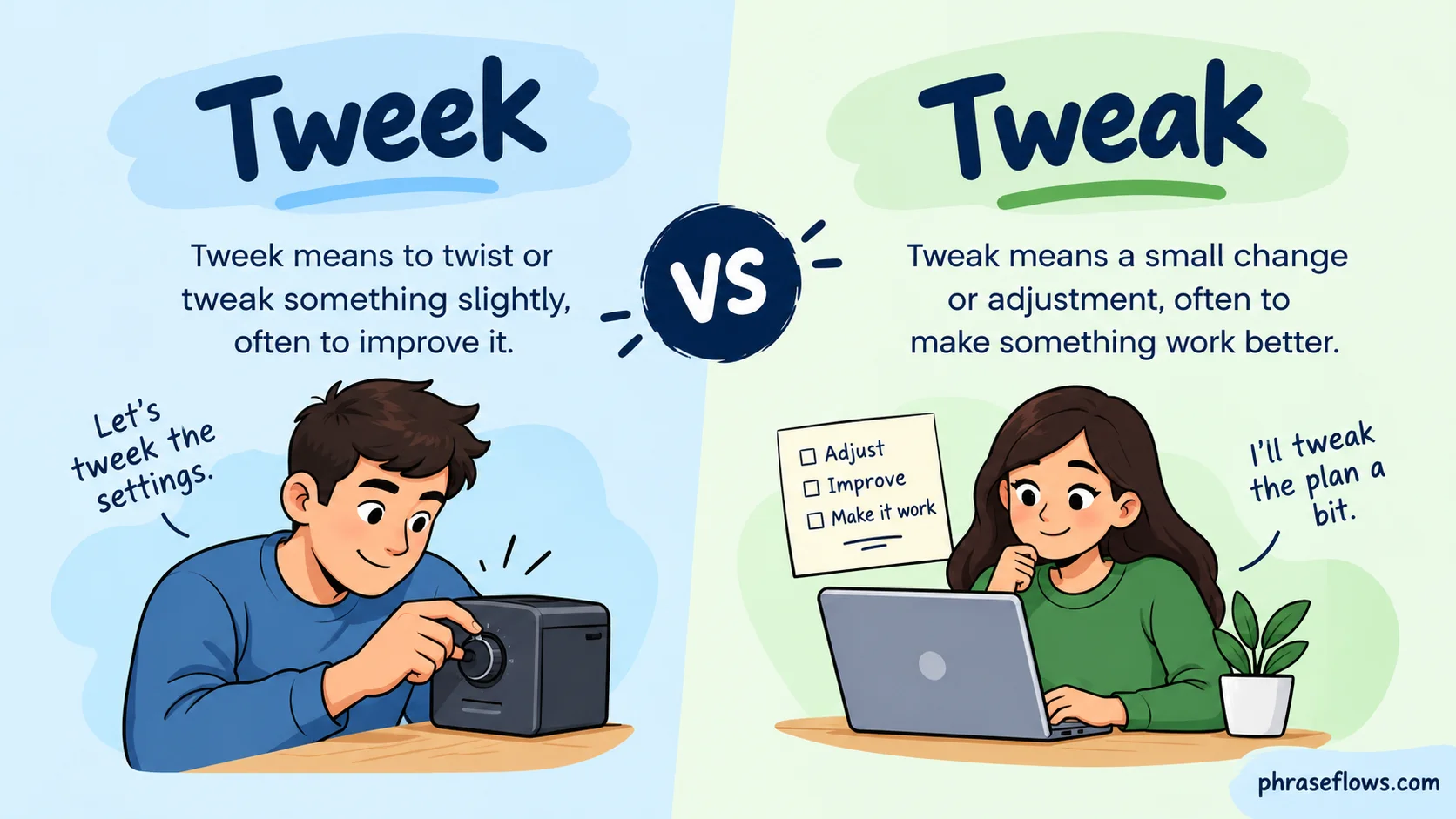

Have you ever stopped while writing because you weren’t sure whether to use tweek vs. tweak? These two spellings look and sound similar, so it’s easy to mix them up. You might face this small spelling dilemma while writing an email, editing a document, or chatting with someone. Although the difference seems minor, choosing the correct spelling helps keep your writing clear and accurate.
The correct spelling is tweak. It is a standard English verb that means to make a small adjustment, improve something slightly, or change a detail carefully. For example, you can tweak a recipe, adjust software settings, or make a small change to a sentence. On the other hand, tweek is not the standard spelling for this meaning, although it may appear in names, slang, or specific references.
Understanding Tweek vs. Tweak: Difference, Meaning, and Correct Usage can help you avoid common spelling mistakes and use the right word with confidence. In this guide, you’ll learn what tweak means, why tweek is usually incorrect, and how to use the correct spelling in different situations. Whether you’re writing for school, work, or everyday communication, knowing this simple difference will help you express your ideas more clearly.
Tweek vs. Tweak: Which Is the Correct Spelling?
Tweak is the correct standard English spelling. It describes making a small change to something, usually to improve its appearance, accuracy, performance, or overall effectiveness.
On the other hand, tweek is generally a misspelling when someone intends to use the word tweak. Both spellings have the same pronunciation, which explains why people sometimes confuse them.
For example, imagine you’ve finished writing an article. The information is correct, but a few sentences need improvement. You might say, “I need to tweak the introduction before publishing the article.”
Writing tweek in that sentence would be incorrect because the intended word is tweak.
Here is a quick comparison:
| Feature | Tweak | Tweek |
| Standard spelling | Correct | Incorrect as a spelling of tweak |
| Meaning | Make a small adjustment | No standard equivalent meaning |
| Part of speech | Noun and verb | Not the standard word |
| Pronunciation | /twiːk/ | Usually pronounced the same when intended as tweak |
| Formal writing | Accepted | Avoid |
| Example | I need to tweak the settings. | I need to tweek the settings. |
Remember: When you mean to make a small adjustment or improvement, always choose tweak.
What Does Tweak Mean?
The word tweak means to make a small change to something, particularly when you want to improve it or make it work better. It can describe adjustments to physical objects, written content, plans, designs, settings, and processes.
For instance, a writer might tweak a sentence to make its meaning clearer. A website designer might tweak a page layout to improve navigation. Similarly, a person might tweak a recipe by changing the amount of an ingredient.
The word doesn’t usually suggest a complete transformation. Instead, it describes a relatively minor adjustment that can produce a better result.
According to the Cambridge Dictionary, tweak can also describe pulling or twisting something with a small, sudden movement. Its noun form refers to either a slight adjustment or a small twisting pull. Cambridge Dictionary – Tweak.
Tweak as a Verb
As a verb, tweak describes the action of changing, adjusting, or improving something slightly.
It commonly appears when someone wants to make a small improvement without replacing or rebuilding the entire thing.
Consider a few everyday situations:
- Writing: You tweak a paragraph to make the explanation easier to understand.
- Technology: You tweak your computer settings to improve its performance.
- Business: A company tweaks its marketing strategy to reach customers more effectively.
- Design: A graphic designer tweaks the colors and spacing of a website.
- Cooking: You tweak a recipe by adjusting the seasoning.
- Planning: A project manager tweaks the schedule to accommodate a small change.
Here are additional examples showing how to use tweak correctly:
- I need to tweak the opening paragraph before submitting my assignment.
- She decided to tweak the presentation to make it more engaging.
- The designer will tweak the website’s layout this afternoon.
- We should tweak our schedule to allow more preparation time.
- He wants to tweak the instructions so everyone understands them.
In each sentence, tweak describes a relatively small adjustment rather than a complete change.
Tweak as a Noun
The word tweak also functions as a noun. In this form, it refers to a small change, modification, or adjustment.
Instead of describing the action of changing something, the noun identifies the change itself.
For example:
- The website needs a small tweak.
- A few tweaks made the presentation easier to follow.
- This design looks better after one final tweak.
- The manager suggested a minor tweak to the schedule.
- That little tweak improved the document’s readability.
Notice the difference between these two sentences:
- Verb: I will tweak the report before sending it.
- Noun: The report needs one final tweak.
In the first example, tweak describes an action. In the second, it identifies the adjustment itself.
This distinction is useful because many English words can serve different grammatical functions depending on how you use them.
What Does Tweek Mean?
Tweek is generally a misspelling of tweak when someone wants to describe a small adjustment or improvement.
For example, consider these sentences:
- Incorrect: I need to tweek the website design.
- Correct: I need to tweak the website design.
The difference involves only one letter, but standard English spelling requires the a in tweak.
However, it’s worth understanding that Tweek can appear as a proper name, username, brand name, or other deliberately chosen spelling. In those situations, its spelling serves a different purpose.
A proper name doesn’t automatically become a standard dictionary word with the meaning of another similarly pronounced word.
Therefore, context matters. If you’re describing a small modification, use tweak. Don’t substitute tweek simply because the two forms sound alike.
Why Do People Confuse Tweek and Tweak?
The confusion mainly comes from pronunciation and spelling patterns.
Both forms contain the same beginning and ending sounds. When people hear the word in conversation, they can’t always identify whether its middle vowel should be represented by ea or ee.
English spelling includes many different ways to represent similar sounds. For example:
- Speak: Contains the letters ea.
- Week: Contains the letters ee.
- Weak: Contains the letters ea.
- Tweak: Contains the letters ea.
Because week and tweak share a similar ending sound, some writers mistakenly apply the spelling pattern of week to tweak.
However, pronunciation alone doesn’t determine correct spelling. Learning the accepted written form is the easiest way to avoid this mistake.
Tweak vs. Tweek: Key Differences
Although tweak and tweek look similar, they don’t have interchangeable roles in standard English.
The following comparison highlights the important distinctions.
| Comparison | Tweak | Tweek |
| Correct standard spelling | Yes | No, when intended to mean tweak |
| Dictionary meaning | A small adjustment or modification; also a twisting pull | No standard equivalent meaning |
| Grammatical role | Noun and verb | May appear as a proper name |
| Professional usage | Appropriate | Incorrect as a substitute for tweak |
| Academic writing | Appropriate | Incorrect as a substitute for tweak |
| Common example | Tweak the final draft. | Tweek the final draft. |
Difference in Meaning
Tweak has established meanings in English. It can describe adjusting something slightly or pulling and twisting something with a small movement.
Tweek, when used as an attempted spelling of tweak, doesn’t carry those standard meanings.
Difference in Grammar
Tweak works as both a noun and a verb.
For example:
- Verb: They tweak the design regularly.
- Noun: The design needs a few tweaks.
Tweek doesn’t function as a standard alternative in either grammatical role.
Difference in Professional Writing
In professional communication, spelling accuracy helps make your writing clear and credible.
You might use tweak when discussing a report, presentation, website, proposal, or business process.
For example:
“Could you tweak the final section before we share the report?”
This sentence communicates a small requested adjustment without suggesting that the entire document needs rewriting.
Using tweek instead would introduce an avoidable spelling mistake.
Examples of Tweak in Sentences
Understanding a word becomes easier when you see how people use it in different situations.
The following examples demonstrate the correct spelling of tweak in everyday, academic, professional, and technical contexts.
Tweak in Everyday Conversations
People often use tweak when discussing small changes to ordinary activities or personal preferences.
- I need to tweak my morning schedule.
- She made a few tweaks to her shopping list.
- Let’s tweak the seating arrangement before everyone arrives.
- He tweaked the recipe to make it taste better.
- I might tweak my weekend plans slightly.
These examples show that tweak works naturally when you want to describe a minor adjustment.
Tweak in Academic Writing
Students and teachers may use tweak when discussing revisions to assignments, presentations, research documents, or study plans.
Examples include:
- I need to tweak my essay introduction.
- The teacher suggested a few tweaks to the presentation.
- She tweaked her research question to make it more specific.
- We made minor tweaks to the project outline.
- The student tweaked the conclusion after reviewing the feedback.
In formal academic writing, more precise alternatives such as revise or adjust may sometimes sound better. However, tweak remains a valid English word.
Tweak in Business Communication
In business settings, tweak frequently describes minor improvements to strategies, documents, processes, and plans.
Examples:
- The marketing team will tweak its campaign before launch.
- We need to tweak the proposal to reflect the client’s feedback.
- The manager suggested a few tweaks to the presentation.
- Our team tweaked the schedule to meet the deadline.
- The company made a small tweak to its customer service process.
These examples demonstrate how the word communicates a limited adjustment rather than a major business decision.
Tweak in Technology and Design
Technology provides some of the clearest examples of the word’s meaning.
People frequently adjust software settings, website layouts, digital designs, and application features. These small changes often improve how a product works or looks.
Examples:
- I tweaked the brightness settings on my monitor.
- The developer tweaked the application’s interface.
- She made a few tweaks to the website’s navigation.
- We need to tweak the font size for better readability.
- The designer tweaked the color scheme before publishing the page.
In each case, the word suggests fine-tuning rather than creating something entirely new.
Common Expressions and Phrases With Tweak
English speakers frequently combine tweak with other words to describe specific types of adjustments.
Learning these expressions can help you understand the word’s meaning and use it more naturally.
Make a Tweak
The expression make a tweak means to introduce a small change to something.
Examples:
- I want to make a tweak to the introduction.
- We made a small tweak to the schedule.
- The designer made one final tweak to the logo.
You can also use the plural form when several adjustments are involved.
Example: “The editor made a few tweaks to the article before publication.”
Tweak Something
Tweak something means to adjust or modify it slightly.
Examples:
- I need to tweak my presentation.
- She wants to tweak the project plan.
- They decided to tweak the website design.
This expression works well when you want to identify the thing receiving an adjustment.
Tweak the Settings
The phrase tweak the settings commonly appears in conversations about technology and digital devices.
It means changing particular settings to achieve a preferred result.
Examples:
- You can tweak the display settings for easier reading.
- He tweaked the application settings to suit his preferences.
- We need to tweak the printer settings before printing.
Tweak the Details
Tweak the details means making small changes to specific parts of something.
Examples:
- The writer tweaked the details in the final paragraph.
- We should tweak the details before approving the proposal.
- She tweaked the presentation details to improve its appearance.
This expression works particularly well when the overall structure is already complete but a few smaller elements need attention.
Correct Spelling of Tweak: Tweaked, Tweaking, and Tweaks
Knowing the base spelling is important, but you should also understand how the word changes when you use different verb forms.
The good news is that tweak follows a straightforward spelling pattern.
| Word form | Grammatical use | Example |
| Tweak | Base verb or singular noun | I will tweak the document. |
| Tweaks | Third-person singular verb or plural noun | She tweaks the design. |
| Tweaked | Simple past or past participle | He tweaked the settings. |
| Tweaking | Present participle or gerund | They are tweaking the layout. |
Tweak
Use the base form when describing an action in the present or future, or when using the infinitive.
Example: “I want to tweak the final paragraph.”
Tweaks
Use tweaks as the third-person singular form of the verb or as the plural form of the noun.
Examples:
- Verb: She tweaks her writing before submitting it.
- Noun: The website needs a few tweaks.
Tweaked
Add -ed to form the simple past tense and past participle.
Examples:
- I tweaked the presentation yesterday.
- They have tweaked the website’s layout.
- She tweaked the final paragraph.
Tweaking
Add -ing to describe an ongoing action or use the word as a gerund.
Examples:
- He is tweaking the design.
- Tweaking the settings improved the display.
- We are tweaking the final version of the document.
Important spelling tip: The word tweak keeps its final k when you add these endings. You don’t need to double the final consonant.
Common Mistakes to Avoid When Using Tweak
Even though tweak is a relatively simple word, writers sometimes make spelling and usage mistakes.
Understanding these errors will help you use the word correctly.
Writing Tweek Instead of Tweak
This is the most common spelling mistake associated with the keyword.
Incorrect: I need to tweek the article before publishing it.
Correct: I need to tweak the article before publishing it.
Always use tweak when describing a small adjustment.
Assuming Tweak and Tweek Are Interchangeable
Similar pronunciation doesn’t make two spellings interchangeable.
English contains many words that sound alike but follow different spelling patterns. You should learn the accepted written form rather than relying entirely on how a word sounds.
Using Tweak for a Major Transformation
The word tweak usually describes a minor adjustment. It isn’t always the best choice when something requires extensive changes.
For example:
- Better: I tweaked the introduction by changing two sentences.
- Better: I rewrote the entire introduction to improve its structure.
The first sentence describes a small adjustment. The second describes a more substantial revision.
Choosing the right verb helps readers understand how much work a change involves.
Confusing Tweak With Revise
Although tweak and revise sometimes overlap, they don’t always communicate the same level of change.
Tweak generally suggests a small modification. Revise can describe anything from minor corrections to substantial changes in content or structure.
For example:
- I tweaked the wording of one sentence.
- I revised the entire research paper.
The difference becomes clear when you consider the scale of the adjustment.
Synonyms and Alternatives for Tweak
Sometimes another word communicates your intended meaning more precisely.
Although tweak works well for minor adjustments, its alternatives can help you describe different types of changes.
| Synonym | Meaning | Example |
| Adjust | Change something to make it suitable | Adjust the chair’s height. |
| Modify | Make a change to something | Modify the original design. |
| Fine-tune | Make small improvements for better results | Fine-tune the presentation. |
| Refine | Improve something through careful changes | Refine the article’s wording. |
| Revise | Change or improve existing content | Revise the final draft. |
| Alter | Change something from its original form | Alter the project schedule. |
| Improve | Make something better | Improve the website’s navigation. |
Adjust
Adjust is a useful alternative when you change something to make it more suitable or accurate.
Example: “Please adjust the document’s margins before printing.”
Modify
Modify means changing something without necessarily replacing it completely.
Example: “The designer modified the original layout.”
Fine-Tune
Fine-tune is especially useful when something already works but needs small improvements.
Example: “We need to fine-tune the presentation before the meeting.”
Refine
Refine suggests improving quality through careful changes.
Example: “The editor refined the article to make its message clearer.”
Revise
Revise works well when you make changes to written material, plans, or ideas.
Example: “The student revised the essay after receiving feedback.”
Alter
Alter means changing something from its original form. Depending on the context, the change can be minor or substantial.
Example: “We decided to alter the original schedule.”
Choosing among these alternatives depends on the situation. If you’re making a small adjustment, tweak or fine-tune often works well. If you’re changing an entire document, revise may communicate your meaning more accurately.
Read More: Putting vs. Puting: Which Spelling Is Correct? Meaning, Rules, and Examples
Tweek vs. Tweak: A Practical Case Study
Consider a small business preparing to launch a new website.
The website already contains its main pages, product information, navigation menu, and contact details. However, the team notices several minor issues during its final review.
The homepage heading needs clearer wording. Some buttons appear too close together. The product descriptions also need a little polishing.
Instead of rebuilding the entire website, the team makes a few small adjustments.
Here’s how the word tweak applies:
| Situation | Adjustment | Correct usage |
| Homepage | Improve the heading | Tweak the heading |
| Navigation | Adjust menu spacing | Tweak the navigation |
| Product pages | Improve a few descriptions | Tweak the descriptions |
| Buttons | Change their placement slightly | Tweak the button layout |
| Contact page | Correct a minor wording issue | Tweak the contact information |
After these changes, the website becomes easier to navigate and the content reads more clearly.
The team might describe its work by saying:
“We made a few tweaks to the website before launching it.”
This example demonstrates why tweak is useful. It describes small improvements without suggesting that someone replaced the entire website.
Writing tweek in this context would simply be a spelling error.
The main lesson: Use tweak when you want to describe a small, purposeful adjustment. Choose another verb when the change involves a more substantial transformation.
Conclusion:
The correct spelling is tweak, not tweek, when you mean to make a small change or adjustment. Tweak is a standard English verb used in writing, technology, design, and everyday conversations. It means to improve something slightly or carefully change a detail. Although tweek may appear in names, slang, or specific references, it isn’t the accepted spelling for this meaning. Remembering this simple difference will help you avoid spelling mistakes and keep your writing clear and accurate.
FAQs:
1. Is it tweek or tweak?
Tweak is the correct spelling when referring to a small change or adjustment. Tweek is generally a misspelling in this context.
2. What does tweak mean?
Tweak means to make a small adjustment, improve something slightly, or change a detail carefully. For example, you can tweak a recipe or adjust a computer setting.
3. Is tweek a real word?
Tweek can appear as a name, slang term, or specific reference. However, it isn’t the standard spelling of the English verb tweak.
4. How do you use tweak in a sentence?
You can use tweak when describing a small improvement or adjustment. For example: “I need to tweak a few sentences before submitting my assignment.”
5. Why do people confuse tweek and tweak?
People often confuse these spellings because they look similar and may sound alike in spoken English. However, tweak is the accepted spelling for making a small change.


1 thought on “Tweek vs. Tweak: Difference, Meaning, and Correct Usage”