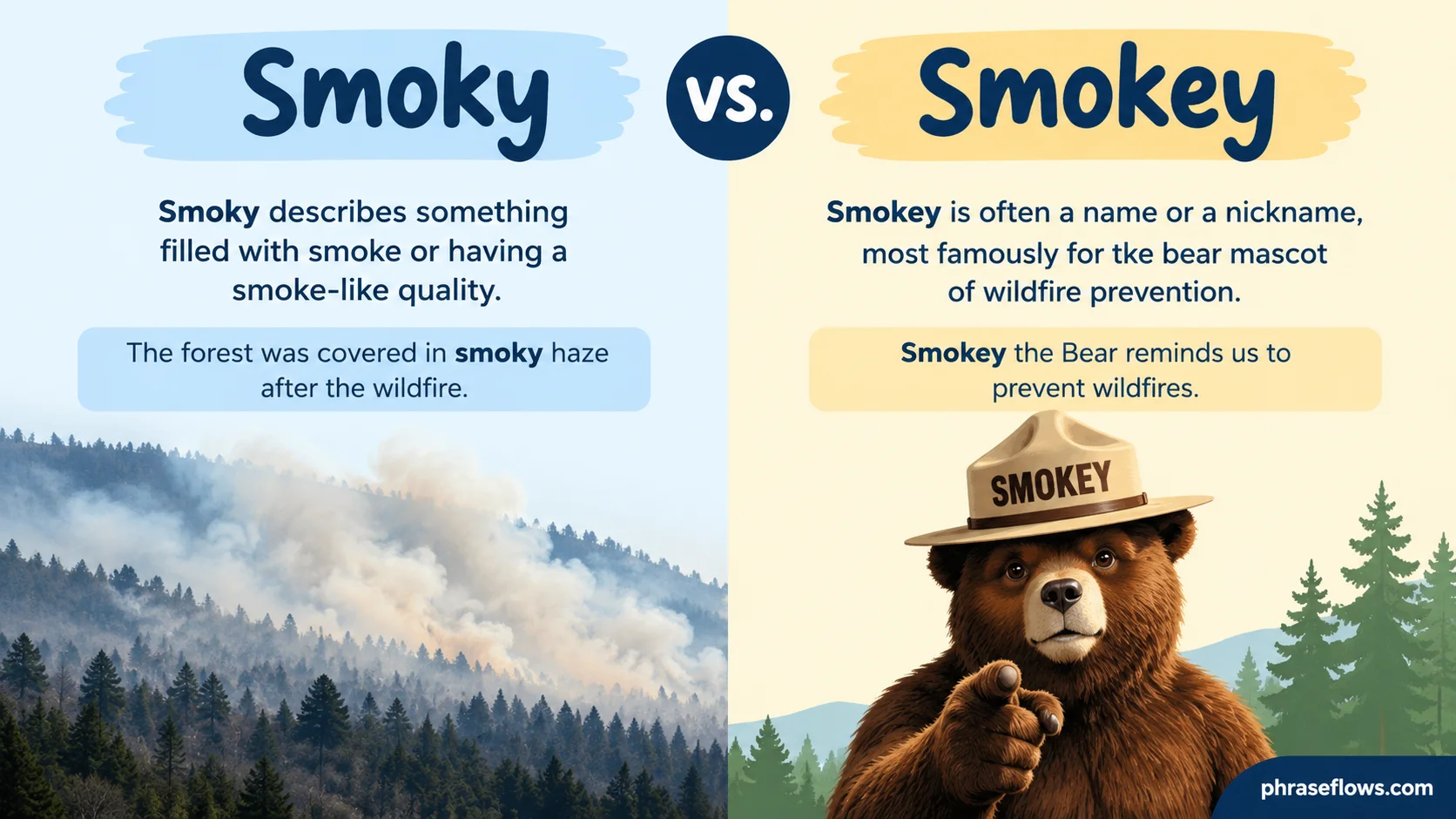

Have you ever wondered whether to write smoky vs. smokey? These two spellings look and sound almost identical, so it’s easy to mix them up. However, they aren’t always interchangeable. Choosing the wrong form can make your writing confusing, especially when you’re describing food, places, or something filled with smoke. Understanding the difference helps you use the right word and communicate clearly.
The main difference comes down to meaning and usage. Smoky is the standard adjective used to describe something that contains smoke or has a smoke-like smell or flavor. For example, you might enjoy a smoky barbecue, smoky cheese, or a room filled with smoke. Smokey, on the other hand, is commonly used as a name or part of a proper noun, such as Smokey Bear. Although it was once an accepted spelling of the adjective, it is now considered old-fashioned in that context.
In this guide, you’ll learn the difference between smoky vs. smokey, explore their meanings, and see practical examples of correct usage. We’ll also look at common spelling mistakes, simple grammar tips, and ways to remember which form to choose. By the end, you’ll know when to use each word and feel more confident using both in everyday writing.
Smoky vs. Smokey: Which Spelling Is Correct?
Smoky is the preferred spelling in standard American English. It describes something that contains smoke, produces smoke, resembles smoke, or has a smoke-like smell, taste, or appearance.
For example:
- The kitchen became smoky after dinner.
- We enjoyed the smoky flavor of the grilled vegetables.
- A smoky haze covered the distant mountains.
Smokey, on the other hand, is an accepted alternative spelling of the same adjective. Some dictionaries recognize it as a variant, but it isn’t the usual choice in formal American English.
Here is a quick comparison:
| Feature | Smoky | Smokey |
| Spelling | Standard form | Alternative form |
| Meaning | Relating to or resembling smoke | Generally the same |
| Pronunciation | /ˈsmoʊ.ki/ | /ˈsmoʊ.ki/ |
| American English | Preferred | Less common |
| Formal writing | Recommended | Usually avoid unless context requires it |
| Proper names | Used in some names | Used in established names such as Smokey Bear |
Why Is Smoky the Preferred Spelling?
The spelling smoky follows a familiar English word-formation pattern. When you add the suffix -y to the noun smoke, the final silent e disappears.
The same pattern appears in several other English adjectives:
- Smoke → Smoky
- Ice → Icy
- Shine → Shiny
- Noise → Noisy
- Spice → Spicy
This pattern explains why smoky is the conventional spelling. It also makes the word easier to remember when you’re writing.
However, English spelling includes historical variations and exceptions. That’s why smokey still appears in dictionaries and everyday communication.
Best rule: Choose smoky when writing ordinary descriptive sentences in American English. Preserve Smokey when it belongs to an established name or a specific title.
What Does Smoky Mean?
Smoky is an adjective that describes something associated with smoke. It can refer to a smoke-filled environment, a particular flavor, a hazy appearance, or even a person’s voice.
The word comes from the noun smoke, which refers to the visible mixture of gases and small particles produced when something burns.
Adding -y turns the noun into an adjective. As a result, smoky describes something that has the qualities or characteristics of smoke.
Smoky Meaning: Filled With or Producing Smoke
The most direct meaning of smoky relates to an environment containing smoke.
You can use it to describe a room, building, street, or outdoor area where smoke is visible or noticeable.
Examples:
- The fireplace made the living room slightly smoky.
- A smoky atmosphere surrounded the old building.
- The restaurant became smoky while the kitchen prepared dinner.
- We noticed a smoky smell coming from the fireplace.
In these examples, the adjective describes the presence or effect of smoke.
Smoky Meaning in Food and Flavor
Another common use appears in cooking and food descriptions. A smoky flavor refers to a taste or aroma associated with smoke, grilling, roasting, or smoking ingredients.
For instance, grilled vegetables can develop a smoky taste when their surfaces come into contact with heat and smoke. Certain spices and sauces also create a similar flavor.
Examples:
- The barbecue sauce has a rich smoky flavor.
- I added smoked paprika to give the soup a smoky taste.
- The grilled mushrooms developed a delicious smoky aroma.
- This recipe combines sweet, spicy, and smoky flavors.
Food writers often use smoky because it communicates a recognizable flavor profile without requiring a lengthy explanation.
Smoky Meaning in Colors and Appearance
The word can also describe something that looks like smoke. In this context, it often refers to muted, hazy, grayish, or slightly dark colors.
For example, smoky gray describes a shade of gray that resembles a thin layer of smoke.
Common expressions include:
- Smoky gray: A muted gray shade.
- Smoky blue: A subdued blue with a hazy appearance.
- Smoky black: A softened black shade.
- Smoky glass: Glass with a dark or tinted appearance.
Example sentences:
- She chose a smoky gray color for the bedroom walls.
- The sunset created a smoky blue appearance across the sky.
- The designer used smoky glass to give the room a softer look.
These expressions show how smoky can describe visual qualities rather than actual smoke.
Smoky Meaning When Describing a Voice
Interestingly, smoky can also describe a person’s voice.
A smoky voice usually refers to a low, slightly husky, soft, or textured vocal quality. It doesn’t mean the person has smoke in their throat. Instead, the adjective creates an impression of the voice’s sound.
For example:
- The singer has a deep, smoky voice.
- His smoky tone gave the performance a distinctive character.
- The narrator spoke in a soft, slightly smoky voice.
This figurative meaning appears frequently in music reviews, entertainment writing, and descriptions of vocal performances.
What Does Smokey Mean?
Smokey is an alternative spelling of smoky. It generally describes the same things, including smoke-filled environments, smoke-like appearances, and smoky flavors.
Although the two spellings share a meaning, smokey is less common in standard American English.
You might encounter it in casual writing, product descriptions, personal names, and established titles.
Smokey as an Alternative Adjective
Some writers use smokey instead of smoky when describing food, colors, smells, or environments.
For example:
- The restaurant served a smokey barbecue sauce.
- A smokey haze appeared over the hills.
- The painting featured a smokey gray background.
These sentences communicate essentially the same ideas as their versions using smoky.
However, if you’re writing a school assignment, professional document, article, or formal publication, smoky is generally the safer spelling.
Key Differences Between Smoky and Smokey
Although smoky and smokey have nearly identical uses, understanding their spelling conventions helps you choose the right form.
The main difference involves spelling preference rather than meaning or pronunciation. Both adjectives describe something filled with smoke or something that resembles smoke.
Let’s examine their differences more closely.
| Comparison | Smoky | Smokey |
| Word type | Adjective | Adjective |
| Meaning | Full of smoke or resembling smoke | Same general meaning |
| Pronunciation | Same | Same |
| Standard spelling | Preferred | Alternative |
| Food descriptions | Common | Also possible |
| Color descriptions | Common | Also possible |
| Formal American writing | Preferred choice | Less conventional |
| Proper names | Depends on the official name | Used in established names |
Difference in Spelling
The most noticeable difference is the final letter.
- Smoky contains five letters.
- Smokey contains six letters.
The standard adjective follows the pattern of removing the silent e from smoke before adding -y.
However, smokey has become an established alternative spelling. Therefore, you shouldn’t automatically treat every occurrence as a spelling error.
Difference in Meaning
In ordinary descriptive writing, the two spellings generally communicate the same meaning.
Consider these examples:
- The kitchen smelled smoky after cooking.
- The kitchen smelled smokey after cooking.
Both sentences describe an environment with a noticeable smoke-related smell.
The same principle applies to food, colors, and other descriptive expressions. The spelling doesn’t introduce a separate meaning.
Difference in Pronunciation
Another common question concerns pronunciation. Does the additional e change how you say the word?
No. Both spellings have the same standard pronunciation:
/ˈsmoʊ.ki/
The word contains two syllables, with stress on the first syllable. The ending sounds like the -y in words such as happy and funny.
Consequently, readers generally pronounce both spellings identically in American English.
You can confirm the pronunciation and definitions through the Cambridge Dictionary and Oxford Advanced American Dictionary.
Smoky vs. Smokey: Examples in Everyday Sentences
Examples make spelling differences easier to understand. Although both forms can describe similar things, choosing smoky usually gives your writing a more conventional appearance.
Here are practical examples from different situations.
Examples of Smoky in Sentences
Use smoky when describing smoke, flavor, appearance, or other smoke-related characteristics.
- The fireplace created a smoky atmosphere throughout the living room.
- We enjoyed the smoky flavor of the grilled vegetables.
- A smoky haze covered the distant hills.
- The chef added paprika for a deeper smoky taste.
- She selected a smoky gray shade for the office walls.
- The singer’s smoky voice made the performance memorable.
- The old photograph had a smoky appearance around its edges.
- The barbecue restaurant had a distinctive smoky aroma.
- The artist combined blue and gray to create a smoky color.
- The fire produced a thick, smoky cloud above the trees.
Notice how the adjective changes its descriptive role according to the noun it modifies.
For example, smoky flavor relates to taste while smoky atmosphere describes the surrounding environment.
Examples of Smokey in Sentences
The alternative spelling can also appear in descriptive sentences.
- The restaurant served a smokey barbecue sauce.
- A smokey mist appeared above the landscape.
- The painting featured a smokey gray background.
- The singer performed with a deep, smokey voice.
- The dish had a pleasant smokey aroma.
- The designer selected a smokey blue shade for the room.
- The photograph captured a smokey atmosphere.
- The sauce delivered a rich and slightly smokey flavor.
These examples demonstrate the accepted alternative usage. However, when writing for a general American audience, smoky remains the more conventional choice.
Smoky vs. Smokey: Side-by-Side Sentence Comparison
The following table shows how the two spellings work in similar sentences.
| Smoky | Smokey |
| The room became smoky. | The room became smokey. |
| I love smoky barbecue sauce. | I love smokey barbecue sauce. |
| She wore smoky eye makeup. | She wore smokey eye makeup. |
| The sky looked smoky. | The sky looked smokey. |
| He has a smoky voice. | He has a smokey voice. |
Writing tip: If you aren’t following a particular publication’s style guide, choose smoky for ordinary descriptive writing. It is the established standard form in American English.
When to Use Smoky
Use smoky when you need the standard adjective for something containing smoke or resembling its characteristics.
This spelling works across everyday conversations, professional documents, food descriptions, creative writing, and academic work.
Here are the main situations where smoky fits naturally.
Use Smoky for Smoke-Filled Places
When an environment contains visible smoke, smoky is the appropriate descriptive adjective.
You might use it when discussing fireplaces, kitchens, industrial environments, or outdoor areas affected by smoke.
Examples:
- The kitchen became smoky while dinner was cooking.
- Firefighters entered the smoky building with protective equipment.
- A smoky atmosphere surrounded the fireplace.
In each example, the adjective explains the condition of the environment.
Use Smoky for Food and Cooking
Food descriptions frequently use smoky to communicate a particular taste or aroma.
The word appears in restaurant menus, recipes, food reviews, and cooking instructions.
Common combinations include:
- Smoky barbecue sauce
- Smoky cheese
- Smoky vegetables
- Smoky seasoning
- Smoky flavor
- Smoky aroma
Example:
“The chef prepared a smoky tomato sauce with roasted vegetables and fresh herbs.”
Here, smoky communicates the sauce’s flavor profile rather than suggesting that the sauce contains visible smoke.
Use Smoky for Colors and Visual Effects
Artists, designers, photographers, and writers use smoky to describe colors that resemble smoke.
The adjective often suggests muted tones, softened edges, or a hazy appearance.
For example:
- Smoky gray curtains
- Smoky blue glass
- Smoky brown eyes
- Smoky black fabric
- Smoky clouds
Example:
“The designer combined smoky gray with pale blue to create a calm color scheme.”
This usage is especially common in interior design, fashion descriptions, photography, and beauty writing.
Use Smoky for Voices and Sounds
A person’s voice can also have a smoky quality.
In this context, the adjective describes a low, husky, or slightly rough vocal texture. It helps readers imagine how a singer or speaker sounds.
For example:
- The singer has a distinctive smoky voice.
- Her smoky vocal style suited the slow melody.
- The narrator used a deep, smoky tone.
This is a figurative use rather than a literal reference to smoke.
When to Use Smokey
Although smoky is the preferred standard spelling, smokey still has legitimate uses.
The important thing is to understand the context before choosing between them.
Use Smokey in Established Proper Names
Proper names deserve special attention because their spelling doesn’t always follow ordinary dictionary preferences.
For example, Smokey Bear is the established name of the well-known American wildfire prevention mascot.
Its spelling includes an e. You should preserve that spelling whenever you mention the character.
Other situations include:
- A person whose name is Smokey.
- A fictional character named Smokey.
- A company with Smokey in its official name.
- A product or brand that uses Smokey as part of its registered or established name.
Remember that proper names aren’t interchangeable with ordinary adjectives.
Use Smokey When Preserving an Original Title
Sometimes, a book, song, product, or other creative work uses Smokey in its official title.
If you’re discussing that specific work, reproduce its original spelling.
For example, if a fictional product carries the name Smokey Sauce, don’t silently change it to Smoky Sauce when writing a review.
The same principle applies to quotations and names appearing in historical documents.
Use Smokey as an Alternative Descriptive Spelling
Some writers also use smokey as an adjective.
You may encounter expressions such as:
- Smokey flavor
- Smokey appearance
- Smokey atmosphere
- Smokey gray
- Smokey aroma
These uses are understandable and supported by dictionary recognition of the variant. Nevertheless, smoky is the better default for consistent American English writing.
Smoky vs. Smokey in American and British English
English spelling can vary between regions. Some words have different accepted forms in American and British English, which sometimes creates confusion for writers.
However, the distinction between smoky and smokey isn’t a simple American-versus-British spelling rule.
Both forms appear in dictionary records covering different varieties of English.
Smoky and Smokey in American English
In American English, smoky is the conventional spelling.
The Oxford Advanced American Dictionary lists smoky as the adjective and gives its comparative and superlative forms as smokier and smokiest.
Cambridge also recognizes smokey as an alternative.
For standard American writing, these examples are preferable:
- A smoky room.
- A smoky barbecue flavor.
- A smoky gray color.
- A smoky atmosphere.
Smoky and Smokey in British English
British English also uses smoky as its standard spelling. However, smokey appears as an alternative form in major dictionaries.
The Collins English Dictionary identifies smokey as another word for smoky in British English.
The Cambridge Dictionary likewise recognizes both forms.
Therefore, you shouldn’t assume that smokey belongs exclusively to American English or that British writers must use it.
Which Spelling Should You Choose?
If you’re writing for an American audience, choose smoky for ordinary descriptive use.
If you’re writing for a British audience, smoky is also a reliable standard choice.
For both audiences, preserve Smokey when it forms part of an established proper name.
Consistency matters more than switching between spellings without a clear reason.
Common Expressions and Phrases Using Smoky
The adjective smoky appears in many everyday expressions. Learning these combinations can help you use the word naturally in conversations and writing.
Here are some common phrases and their meanings.
| Expression | Meaning | Example |
| Smoky flavor | A taste resembling smoke | The sauce has a rich smoky flavor. |
| Smoky smell | An odor associated with smoke | A smoky smell filled the kitchen. |
| Smoky atmosphere | An environment containing smoke | The fireplace created a smoky atmosphere. |
| Smoky eyes | Eye makeup featuring blended, dark shades | She wore smoky eye makeup. |
| Smoky gray | A muted shade resembling smoke | The walls were painted smoky gray. |
| Smoky voice | A low or slightly husky voice | The singer has a smoky voice. |
| Smoky haze | A layer of smoke-like mist | A smoky haze covered the valley. |
| Smoky fireplace | A fireplace producing or releasing smoke | The smoky fireplace needed attention. |
| Smoky aroma | A smell resembling smoke | The roasted vegetables had a smoky aroma. |
| Smoky glass | Glass with a dark, smoke-like appearance | The designer installed smoky glass panels. |
Understanding Smoky Eyes
Smoky eyes is a particularly common expression in beauty and fashion writing.
It describes an eye makeup style that uses blended, darker shades to create a soft, shadowed appearance. The word smoky describes the visual effect rather than actual smoke.
For example:
“She completed her evening makeup with smoky eyes and a natural lip color.”
Understanding Smoky Flavor
In cooking, smoky flavor describes a taste associated with smoked or grilled ingredients.
Foods prepared over wood or charcoal can develop this characteristic. Certain seasonings can also create a similar flavor profile.
For example:
“The roasted peppers gave the homemade sauce a naturally smoky flavor.”
These expressions demonstrate why smoky is useful across different subjects. Its meaning changes slightly with context while remaining connected to the characteristics of smoke.
Common Mistakes to Avoid When Using Smoky and Smokey
Even though these spellings are closely related, writers sometimes use them inconsistently or misunderstand their grammatical roles.
Knowing the following mistakes can help you write more clearly.
Assuming Smokey Is Always Incorrect
One common mistake is treating smokey as an entirely incorrect spelling.
However, major dictionaries recognize it as a variant of smoky. Therefore, calling every occurrence a spelling error isn’t accurate.
The better approach is to understand the difference between standard spelling preferences and accepted alternatives.
Using Smokey in Formal Writing Without a Reason
Although smokey is recognized, smoky remains the more conventional choice for formal American English.
For example:
- Preferred: The restaurant offers a smoky barbecue sauce.
- Alternative: The restaurant offers a smokey barbecue sauce.
Both communicate the same meaning. However, the first follows the standard spelling convention.
Changing the Spelling of Proper Names
Another mistake involves changing established names to match ordinary spelling preferences.
For example, Smokey Bear should retain its original spelling.
Don’t replace it with Smoky Bear simply because smoky is the preferred adjective.
The same rule applies to personal names, official titles, and brand names.
Assuming the Two Spellings Have Different Pronunciations
Some readers believe the extra e changes the pronunciation.
It doesn’t. Both forms generally have the same pronunciation in English.
The difference is visual rather than phonetic.
Mixing Both Spellings Without a Clear Reason
Consistency makes your writing easier to follow.
Imagine an article that uses smoky flavor in one paragraph and smokey flavor in the next without any reason.
Although readers can understand both, the inconsistent spelling may make the article look less carefully edited.
Better approach: Choose smoky as your default spelling and maintain it throughout the article. Use Smokey when reproducing an established name or title.
Smoky vs. Smokey: Comparative and Superlative Forms
Both smoky and its accepted alternative smokey can be used with comparative and superlative forms. However, the standard grammatical forms are generally written using smokier and smokiest.
These forms help you compare different levels of smoke, smoky flavor, or smoke-like appearance.
What Is the Comparative Form of Smoky?
The comparative form is smokier.
Use it when comparing two things and explaining that one has a stronger smoky quality than the other.
Examples:
- This barbecue sauce tastes smokier than the previous recipe.
- Today’s atmosphere feels smokier than yesterday’s.
- The darker shade looks smokier than the lighter one.
The spelling changes because the adjective ends in -y. You replace the final y with i before adding -er.
What Is the Superlative Form of Smoky?
The superlative form is smokiest.
Use it when comparing three or more things and identifying the one with the strongest smoky quality.
Examples:
- This is the smokiest barbecue sauce on the menu.
- That was the smokiest room in the building.
- The chef prepared the smokiest dish of the evening.
Smoky, Smokier, and Smokiest: Comparison Table
| Form | Grammatical use | Example |
| Smoky | Base adjective | The sauce has a smoky flavor. |
| Smokier | Comparative adjective | This sauce is smokier than that one. |
| Smokiest | Superlative adjective | This is the smokiest sauce available. |
Important: The conventional comparative and superlative spellings are smokier and smokiest. Avoid forms such as smokeyer and smokeyest.
Synonyms and Related Words for Smoky
Sometimes, using the same adjective repeatedly can make your writing sound monotonous. Fortunately, English offers several alternatives that describe different aspects of smoke.
However, not every synonym works in every situation. Choose a replacement based on the exact meaning you want to communicate.
| Synonym | Meaning | Example |
| Hazy | Slightly unclear or covered by a mist-like appearance | The mountains looked hazy. |
| Sooty | Covered with or containing black soot | The fireplace left the wall sooty. |
| Misty | Covered with fine droplets or light fog | The morning landscape looked misty. |
| Cloudy | Covered with clouds or lacking clarity | The glass had a cloudy appearance. |
| Smokelike | Resembling the appearance or behavior of smoke | A smokelike cloud drifted across the scene. |
| Charred | Burned or blackened by heat | The vegetables had charred edges. |
| Woodsy | Having a natural, woody smell or character | The seasoning had a woodsy aroma. |
When Should You Use These Synonyms?
The right synonym depends on the context.
- Use hazy when something looks unclear or slightly blurred.
- Use sooty when black residue from smoke covers a surface.
- Use misty when the atmosphere contains fine water droplets.
- Use cloudy when something lacks clarity or transparency.
- Use smokelike when describing something that resembles smoke.
- Use charred when something has become blackened through burning.
- Use woodsy when describing an earthy or wood-related smell.
For example, a fireplace can produce a smoky smell and leave sooty marks on nearby surfaces. Both adjectives describe different results.
Choosing precise words makes your writing more informative and prevents unnecessary repetition.
Read More: Treet vs. Treat: Which Spelling Is Correct? Meaning, Differences, and Examples
Smoky vs. Smokey: Practical Writing Examples
Understanding spelling rules is useful, but applying them correctly in real situations is even more important.
Consider these three practical writing situations.
Example: Writing a Food Review
Suppose you’re reviewing a restaurant that serves grilled vegetables with a distinctive barbecue sauce.
You might write:
“The restaurant’s grilled vegetables have a rich smoky flavor. The sauce combines sweet spices with a deep, wood-fired aroma.”
Here, smoky describes the flavor and aroma. It gives readers a clear impression of the food.
Using smokey would communicate the same general meaning, but smoky is the conventional choice for an American food review.
Example: Writing an Interior Design Description
Imagine describing a living room with gray furniture, tinted glass, and soft lighting.
You could write:
“The designer selected smoky gray furniture and smoky glass panels to create a muted, modern appearance.”
In this example, smoky describes the color and appearance of the materials.
It doesn’t suggest that the furniture or glass contains actual smoke.
Example: Writing About a Proper Name
Now consider an article discussing the American wildfire prevention mascot.
You should write:
“Smokey Bear is widely recognized as a symbol of wildfire prevention and public awareness.”
Here, Smokey is part of an established proper name. Changing it to Smoky would be incorrect.
These examples demonstrate an important distinction: ordinary adjectives follow standard spelling preferences, while proper names retain their established forms.
Conclusion:
Understanding the difference between smoky vs. smokey is simple once you know how each word works. Smoky is the standard adjective used to describe something filled with smoke or having a smoky smell or flavor. Smokey is mainly a proper noun or first name, as in Smokey Bear. Although both spellings have appeared in English, smoky is the better choice for everyday descriptions. Remembering this small spelling difference will help you avoid mistakes and make your writing clearer and more professional.
FAQs:
1. Is it smoky or smokey?
Smoky is the standard spelling when describing something that contains smoke or has a smoke-like smell or flavor. Smokey is generally used as a name or proper noun.
2. What does smoky mean?
Smoky is an adjective that describes something filled with smoke or having the smell, taste, or appearance of smoke. For example, The barbecue had a rich, smoky flavor.
3. Is Smokey ever a correct spelling?
Yes. Smokey is correct when used as a proper name, such as Smokey Bear. It was also historically accepted as a variant spelling of smoky, although that use is now considered old-fashioned.
4. How do you use smoky in a sentence?
You can use smoky to describe food, air, or places. For example: The restaurant served delicious ribs with a smoky flavor.
5. How can I remember the difference between smoky and smokey?
A simple way to remember is to use smoky for descriptions and Smokey for names. If you’re talking about smoke, food, or a smell, smoky is usually the right choice.

1 thought on “Smoky vs. Smokey: Differences, Meaning, Examples, and Correct Usage”