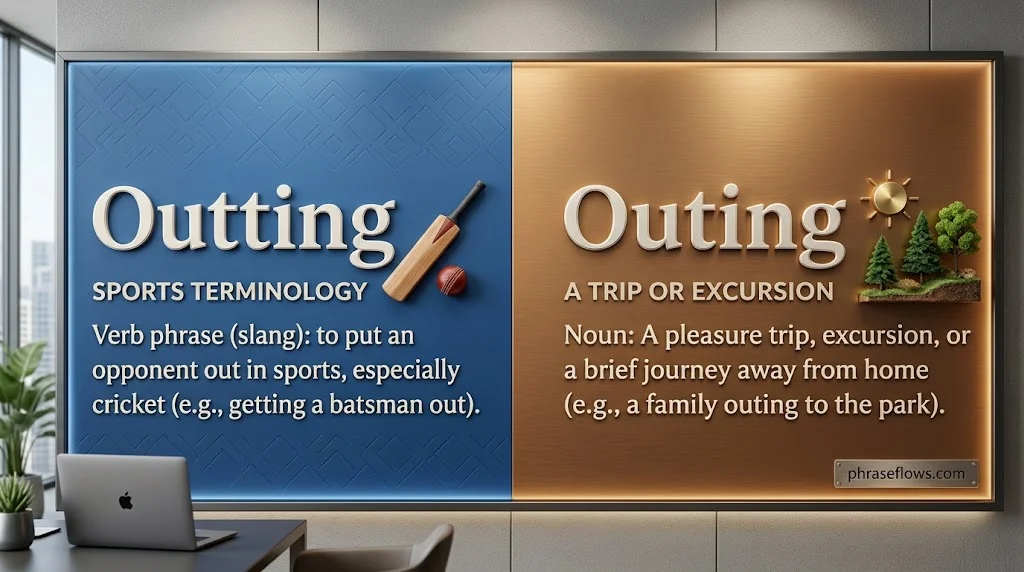

Have you ever paused while writing and wondered whether the correct spelling is outting vs. outing? These two forms look similar, so it’s easy to see why people mix them up. However, only outing, with one “t,” is correct in standard English. The other form, outting, is a common spelling mistake that can appear in everyday messages, schoolwork, and professional writing.
An outing means a short trip, excursion, or recreational activity that you enjoy with family, friends, classmates, or colleagues. For example, a visit to a park, a school trip, or a weekend activity with friends can all be called an outing. The spelling confusion often happens because some English words double their final consonant before adding “-ing,” such as sitting and running. However, that pattern doesn’t apply to outing.
Knowing the difference between outting vs. outing helps you avoid spelling errors and communicate more clearly. In this guide, you’ll learn the correct spelling, the meaning of outing, and how to use it in everyday sentences. You’ll also understand why the extra “t” is unnecessary, making it easier to use the word correctly in emails, assignments, articles, and other writing.
Outting vs. Outing: Quick Comparison
Before exploring the details, here’s a simple comparison of outting vs. outing.
| Feature | Outing | Outting |
| Correct spelling | Yes | No |
| Standard English | Yes | No |
| Number of T’s | One | Two |
| Word formation | Out + ing | Incorrect formation |
| Meaning | A short trip or excursion | No standard meaning for the intended use |
| Part of speech | Noun | Incorrect spelling |
| Example | We planned a family outing. | We planned a family outting. |
Outing is the accepted spelling in both American and British English. You can use it when describing a recreational trip, an organized school visit, or a social activity away from home.
For example:
- Correct: Our family enjoyed an outing to the beach.
- Incorrect: Our family enjoyed an outting to the beach.
The second sentence contains a spelling mistake. Replacing the double T with a single T makes it correct.
The important point is that outing isn’t a regional spelling preference. English speakers in different countries use the same spelling.
What Does Outing Mean?
An outing is a short trip or excursion that someone takes for pleasure, education, or recreation. It usually involves leaving home, school, or work to visit another place or enjoy an activity.
People commonly use this word when describing activities with family members, classmates, friends, or colleagues. An outing might involve visiting a zoo, exploring a park, attending a local attraction, or spending an afternoon at the beach.
According to the Oxford Learner’s Dictionary, an outing generally refers to a trip for pleasure or education. The word also has established meanings in sports and other contexts.
Outing as a Short Trip or Excursion
One of the most common meanings of outing is a short journey made for enjoyment. It usually involves visiting a place, participating in an activity, and returning home afterward.
Unlike a long vacation, an outing often takes only a few hours or a single day. You don’t necessarily need to travel far. Even a visit to a nearby park can count as an outing.
For example, imagine a family deciding to spend Sunday afternoon at a botanical garden. They pack some snacks, take photographs, and explore the gardens together. You could naturally describe their activity as a family outing.
Here are more examples:
- We went on an outing to the local amusement park.
- The children enjoyed a nature outing during their summer break.
- Our neighbors planned a weekend outing to the countryside.
- The museum organized an educational outing for visitors.
The word also appears in expressions such as day outing, family outing, and summer outing. These phrases help readers understand the purpose or setting of the trip.
Outing as a Social Activity
An outing doesn’t always involve sightseeing or visiting a tourist attraction. It can also describe a social activity that brings people together outside their regular environment.
For instance, friends might arrange dinner at a restaurant, colleagues could visit a recreational center, or relatives may spend an afternoon at a nearby park. These activities can all fit the meaning of a social outing.
A social outing usually emphasizes spending time with other people rather than focusing on the destination itself.
Examples include:
- Our friends planned a social outing after the final exams.
- The employees enjoyed an evening outing organized by their company.
- We arranged a group outing to celebrate a special occasion.
- Her first public outing in months attracted attention.
Notice how the word works naturally in each sentence. It identifies the activity without requiring a detailed explanation of everything the group did.
Outing in Sports and Other Contexts
The word outing has another established meaning in sports. It can describe an occasion when an athlete participates in a competition or sporting event.
Sportswriters frequently use this meaning when discussing a player’s performance, appearance, or participation.
For example:
- The young player delivered an impressive outing in his first match.
- The pitcher had a strong outing against the visiting team.
- Their previous outing ended with a narrow victory.
In this context, outing doesn’t necessarily mean a recreational trip. Instead, it refers to a sporting appearance or performance.
The word also has a more sensitive meaning: the public disclosure of someone’s private sexual orientation or gender identity without their consent. This usage appears in dictionaries and news writing. It differs from the ordinary meaning of a recreational trip.
Why Is Outing the Correct Spelling?
The correct spelling comes from the word’s original form and its standard English word formation. Outing combines the word out with the suffix -ing.
The result is straightforward:
Out + ing = Outing
You don’t need to add another T because the original word already has the correct spelling. Adding an extra consonant changes the accepted spelling without following an applicable English spelling rule.
The word outing comes from out and -ing. Understanding this formation makes the spelling easier to remember.
Understanding the Word Formation
To understand why outing has one T, it helps to examine its two parts.
- Out: The base word that expresses movement away from an inside place or position.
- -ing: A suffix that helps form words, including nouns describing activities or results.
- Outing: The established English noun referring to a trip, excursion, or other recognized activity.
When these elements come together, the spelling stays simple. The final T in out remains a single letter.
For example:
| Base word | Added element | Correct spelling |
| Out | -ing | Outing |
| Walk | -ing | Walking |
| Talk | -ing | Talking |
| Visit | -ing | Visiting |
| Help | -ing | Helping |
These examples demonstrate that adding -ing doesn’t automatically require doubling the final consonant.
Why Outting Is a Common Spelling Mistake
The spelling outting often results from confusion about English consonant-doubling rules.
Many familiar English words double their final consonants when certain suffixes appear. For example, run becomes running, sit becomes sitting, and stop becomes stopping.
Because these words are common, writers sometimes assume that every word ending in a consonant needs the same treatment. However, English spelling doesn’t work that way.
The doubling rule depends on factors such as the vowel sound, the final consonant, and the word’s spelling structure.
The word out contains the vowel combination ou before its final T. English generally doesn’t double the final consonant in this pattern when adding a suffix.
Therefore:
- Out + ing = Outing
- Not out + ting = Outting
Understanding this distinction helps prevent similar spelling mistakes in everyday writing.
Outing vs. Running, Sitting, and Stopping
At first glance, outing, running, and sitting might look like words that should follow the same pattern. However, their spelling structures differ.
The English consonant-doubling rule applies to certain short words when a suffix beginning with a vowel is added. For example, a one-syllable word ending in a single consonant often doubles that consonant when it follows a short vowel.
Compare these examples:
| Base word | Correct form | Reason |
| Run | Running | Doubles the final N |
| Sit | Sitting | Doubles the final T |
| Stop | Stopping | Doubles the final P |
| Swim | Swimming | Doubles the final M |
| Out | Outing | Keeps one T |
The key difference: In run, sit, and stop, a single vowel letter appears before the final consonant. In out, the letters O and U work together as a vowel combination.
That’s why outing doesn’t need a second T.
What Does Outting Mean?
When someone writes outting instead of outing, they’re usually making a spelling mistake rather than using a separate English word.
For example, consider this sentence:
We are planning a family outting next weekend.
The intended meaning is clear, but the spelling is incorrect. The correct version is:
We are planning a family outing next weekend.
In standard contemporary English, outing is the spelling you should use for a short recreational trip or social activity.
Here are more examples of the correction:
- Incorrect: The school arranged an educational outting.
- Correct: The school arranged an educational outing.
- Incorrect: We enjoyed our summer outting.
- Correct: We enjoyed our summer outing.
- Incorrect: Their company organized a group outting.
- Correct: Their company organized a group outing.
Remember that adding an extra T doesn’t create a recognized alternative spelling for the ordinary noun.
How to Use Outing in a Sentence
Knowing the correct spelling is only part of learning a word. You should also understand how it fits into everyday sentences.
Outing functions primarily as a countable noun. This means you can use it with articles such as a and an, numbers, and plural forms.
For example:
- We planned an outing for Saturday.
- Our family enjoyed two outings during the holidays.
- The school organized a special outing for its students.
The word also appears in several common sentence patterns:
| Expression | Example |
| Go on an outing | We went on an outing yesterday. |
| Plan an outing | They plan an outing every summer. |
| Enjoy an outing | Everyone enjoyed the family outing. |
| Organize an outing | The teacher organized an outing. |
| Return from an outing | The children returned from their outing. |
These patterns make it easier to use the word naturally in conversations, emails, stories, and articles.
Family Outing
A family outing describes a recreational activity or short trip that family members enjoy together.
It might involve visiting a zoo, exploring a nearby town, having a picnic, or spending time at a beach. The main idea is shared time away from the usual home environment.
Examples:
- We enjoyed a family outing to the national park.
- My parents planned a weekend outing for everyone.
- Our family outing included a picnic and a visit to the museum.
- The children still talk about their favorite summer outing.
A family outing doesn’t need an expensive destination. Even a simple afternoon at a local park can create an enjoyable experience.
School Outing
A school outing is an organized trip that allows students to learn, explore, or participate in activities outside their classrooms.
Teachers often arrange these visits to connect classroom lessons with real-world experiences. For example, students studying science might visit a museum or nature center.
Examples:
- Our class went on a school outing to the science museum.
- The teacher organized an educational outing for the students.
- Everyone enjoyed the annual school outing to the countryside.
- The children learned about local history during their outing.
School outings can make lessons more memorable because students experience subjects beyond textbooks and classroom discussions.
Company or Office Outing
A company outing refers to an activity organized by an employer for employees. These events often provide opportunities for coworkers to socialize outside their regular work environment.
A company might arrange a picnic, recreational visit, group lunch, or outdoor activity. The purpose is usually to encourage communication and create a shared experience.
Examples:
- Our company arranged an annual outing for its employees.
- The office outing included lunch and outdoor games.
- Everyone enjoyed the company outing last Friday.
- Management planned a special outing to celebrate the team’s achievements.
In professional writing, the word sounds natural when describing organized workplace activities.
Weekend Outing
A weekend outing is a short recreational trip or activity that takes place on Saturday or Sunday.
People often use this expression when discussing their plans with friends or family. It can describe anything from visiting a nearby attraction to spending an afternoon in another town.
Examples:
- We’re planning a weekend outing to the countryside.
- Their weekend outing included shopping and lunch.
- She invited her friends to join a weekend outing.
- A peaceful beach visit made the perfect weekend outing.
This expression works well in casual conversations, travel writing, and lifestyle articles.
Sports Outing
In sports, an outing can describe an athlete’s appearance or participation in a competition.
The expression appears frequently in sports reports, especially when discussing an individual player’s performance.
Examples:
- The goalkeeper delivered an impressive outing during the tournament.
- The team’s latest outing ended in a draw.
- The pitcher recorded an excellent outing against his opponents.
- His first international outing attracted considerable attention.
Here, the word refers to a sporting appearance rather than a recreational excursion.
Common Mistakes to Avoid When Using Outing
Even though outing is a relatively simple word, writers sometimes make mistakes when spelling or using it. Most errors happen because people apply familiar spelling patterns without checking how the original word works.
Here are some common problems and ways to correct them.
Adding an Extra T
The most obvious mistake is writing outting instead of outing.
This error often appears in informal messages, social media posts, and everyday writing. However, it can also affect professional documents if writers don’t proofread their work.
Compare these sentences:
| Incorrect sentence | Correct sentence |
| We planned a family outting. | We planned a family outing. |
| The children enjoyed their school outting. | The children enjoyed their school outing. |
| Our office arranged an annual outting. | Our office arranged an annual outing. |
| She invited me to a weekend outting. | She invited me to a weekend outing. |
Remember: The word out already has its final T. Adding another one isn’t necessary.
Confusing Outing With Running and Sitting
Another common mistake involves treating every word ending in a consonant the same way when adding -ing.
Words such as running and sitting double their final consonants because they follow a particular spelling pattern. However, outing follows a different pattern.
Consider these examples:
- Run becomes running.
- Sit becomes sitting.
- Stop becomes stopping.
- Out becomes outing.
The difference comes from the spelling and vowel structure of the base word. Learning why consonants double makes it easier to avoid errors rather than memorizing individual words without understanding them.
Using Outing for Every Situation Involving Going Outside
Although outing describes a trip away from home, it doesn’t automatically apply to every situation where someone leaves a building.
For example, walking outside to collect the mail isn’t normally called an outing. The word usually suggests a planned excursion, recreational activity, or meaningful social trip.
Compare the following examples:
- Natural: We planned an outing to the botanical garden.
- Less natural: I went on an outing to collect my newspaper from the mailbox.
The second sentence sounds unusual because collecting a newspaper is an ordinary daily task rather than a recreational excursion.
Choose words such as walk, trip, errand, or visit when they describe the situation more accurately.
Outting vs. Outing: Correct and Incorrect Examples
Examples are one of the easiest ways to remember the correct spelling. The following sentences show how outing works in different situations.
| Incorrect usage | Correct usage |
| We enjoyed a family outting yesterday. | We enjoyed a family outing yesterday. |
| The school planned an educational outting. | The school planned an educational outing. |
| Our friends arranged a weekend outting. | Our friends arranged a weekend outing. |
| The children loved their summer outting. | The children loved their summer outing. |
| They organized an office outting. | They organized an office outing. |
| We went on an outting to the beach. | We went on an outing to the beach. |
| Her parents planned a special outting. | Her parents planned a special outing. |
| The students returned from their outting. | The students returned from their outing. |
| Everyone enjoyed the company outting. | Everyone enjoyed the company outing. |
| The team had a successful outting. | The team had a successful outing. |
| Our annual outting takes place in June. | Our annual outing takes place in June. |
| They invited us to join their group outting. | They invited us to join their group outing. |
Notice that every correction requires the same simple change: remove the extra T.
A Practical Case Study: Correcting Outting in Everyday Writing
Imagine a student writing a short paragraph about a school trip.
The first draft reads:
Last Friday, our school organized an educational outting. We visited a science museum and learned about different inventions. Everyone enjoyed the trip and took pictures with their classmates.
The paragraph communicates the intended experience clearly. However, the spelling of outting needs correction.
Here’s the revised version:
Last Friday, our school organized an educational outing. We visited a science museum and learned about different inventions. Everyone enjoyed the trip and took pictures with their classmates.
The correction doesn’t change the meaning or sentence structure. It simply makes the paragraph correctly spelled and more appropriate for formal writing.
The lesson: A small spelling error can appear in otherwise excellent writing. Proofreading helps you catch these mistakes before publishing or submitting your work.
How to Remember the Correct Spelling of Outing
Remembering outing becomes easier when you connect it directly to its base word.
Use this simple formula:
OUT + ING = OUTING
Whenever you’re unsure, return to the original word out. Add -ing without changing its spelling.
Here are three practical ways to reinforce this rule:
- Remember the base word: Start with OUT before adding anything.
- Read the correct form aloud: Seeing and hearing the word can help reinforce its spelling.
- Write example sentences: Use outing in different contexts until the spelling becomes familiar.
You can also compare it with words that double their final consonants:
| Word | Correct -ing form |
| Run | Running |
| Sit | Sitting |
| Hop | Hopping |
| Swim | Swimming |
| Out | Outing |
Don’t assume that every word ending in a consonant follows the same pattern. Understanding the base word makes spelling much easier.
Read More: Genius vs. Genious: Correct Spelling, Meaning, and Usage Explained
Outting vs. Outing in American and British English
English has several spelling differences between American and British usage. For example, American English generally uses color, while British English commonly uses colour. Similarly, Americans write traveling, while British writers often use travelling.
However, the spelling of outing doesn’t change between these varieties.
Both American and British English use outing with one T. The spelling outting isn’t an accepted regional alternative for the ordinary noun.
| English variety | Correct spelling | Incorrect spelling |
| American English | Outing | Outting |
| British English | Outing | Outting |
| Canadian English | Outing | Outting |
| Australian English | Outing | Outting |
For example:
- American English: We went on a family outing to the park.
- British English: We went on a family outing to the park.
Both sentences use exactly the same spelling.
You don’t need to change the word when writing for an American, British, Canadian, or Australian audience.
Conclusion:
When comparing outting vs. outing, remember that outing is the only correct spelling in standard English. It refers to a short trip, excursion, or recreational activity with family, friends, classmates, or colleagues. Although words like sitting and running double their final consonants before adding “-ing,” outing follows a different spelling pattern and needs only one “t.” Using the correct form helps you avoid common spelling mistakes and make your writing clearer and more professional. Keep outing in mind whenever you write about a trip or social activity.
FAQs:
1. Is it outting or outing?
Outing is the correct spelling. Outting is a misspelling and isn’t accepted as the standard form in English.
2. What does outing mean?
An outing is a short trip, excursion, or recreational activity. It usually involves spending time away from home for enjoyment.
3. Why is outing spelled with one “t”?
The word outing comes from out with the suffix “-ing.” You don’t double the final “t” because the spelling doesn’t follow the consonant-doubling pattern used in words like sitting.
4. Can I use outing in formal writing?
Yes. Outing is suitable for formal and informal writing, including school assignments, emails, articles, and professional documents.
5. What are some examples of outing in a sentence?
Here are two examples:
- Our family planned an outing to the beach.
- The students enjoyed their school outing to the museum.




1 thought on “Outting vs. Outing: Which Is the Correct Spelling?”