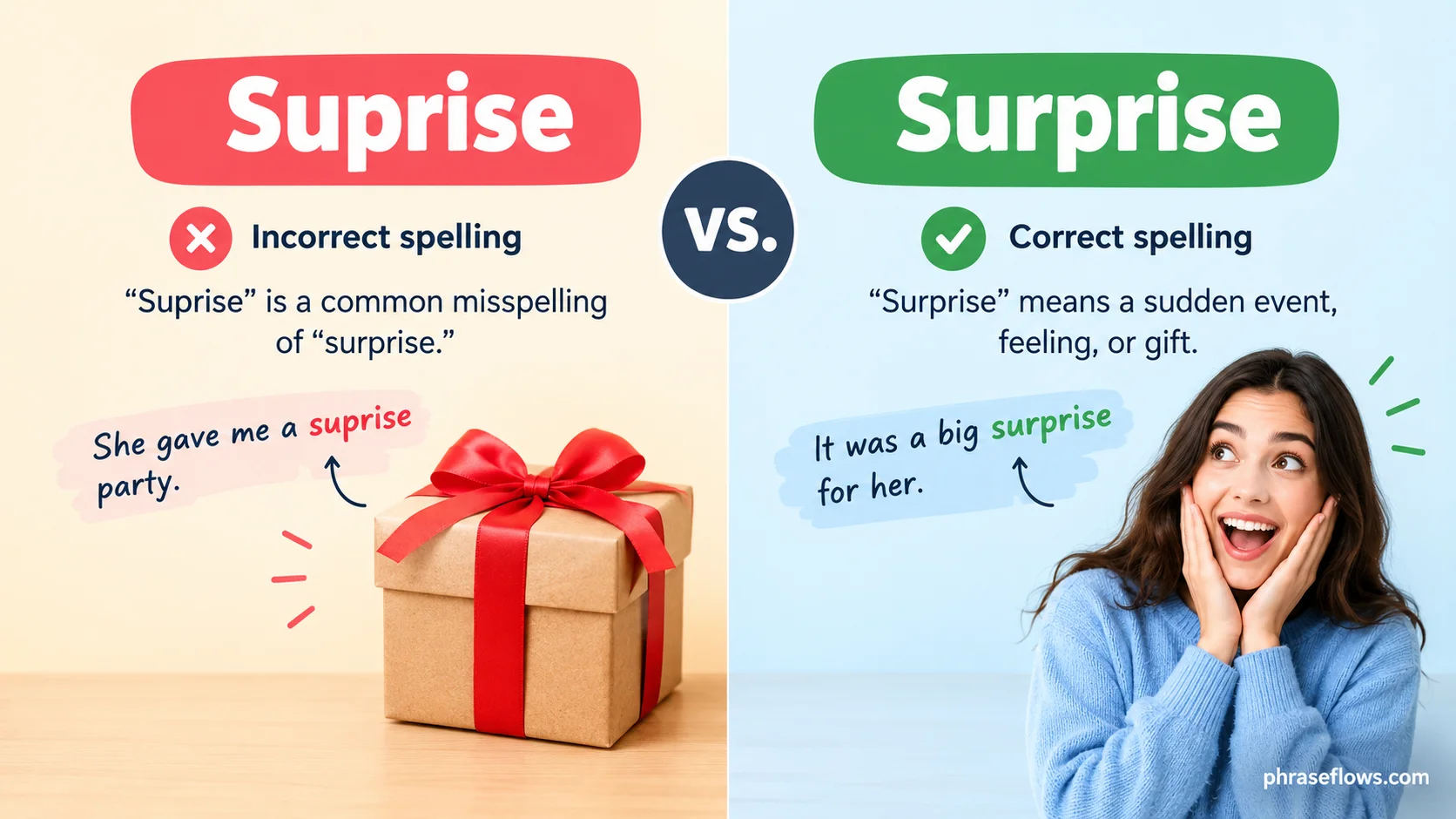

The difference between Suprise vs. Surprise may seem small, but using the wrong spelling can make your writing look less polished. Both words look almost identical, and they sound nearly the same when spoken aloud. However, only Surprise is the correct spelling in standard English. Suprise is a common spelling mistake that happens when writers accidentally leave out the second letter “r.”
The word Surprise describes something unexpected, such as a special gift, sudden event, or unusual reaction. It can work as both a noun and a verb. For example, you might receive a surprise on your birthday or surprise someone with unexpected news. Although pronunciation can sometimes make the spelling confusing, remembering the two “r” letters makes it easier to write the word correctly.
Understanding Suprise vs. Surprise helps you avoid common spelling errors in emails, articles, messages, and everyday writing. Even a small spelling mistake can affect clarity and professionalism, especially in formal or online communication. In this guide, you’ll learn the correct spelling, meaning, usage, and examples of Surprise, along with a simple way to remember its spelling and improve your English writing skills.
Suprise vs. Surprise: Which Spelling Is Correct?
The correct spelling is surprise, not suprise. The difference comes down to one small but important letter: the first r.
English spelling can be tricky because spoken words don’t always reveal every letter clearly. When people pronounce surprise quickly, the first r may receive little attention. As a result, writers sometimes leave it out when typing the word.
However, standard dictionaries list surprise as the correct spelling. The Cambridge English Dictionary recognizes it as both a noun and a verb. The Oxford Learner’s Dictionaries also uses this spelling.
Here’s a quick comparison:
| Word | Correct or incorrect? | Explanation |
| Surprise | Correct | The standard English spelling |
| Suprise | Incorrect | Omits the first r |
| Surprised | Correct | The past tense and past participle of surprise |
| Surprising | Correct | Describes something that causes surprise |
| Surprisingly | Correct | An adverb describing an unexpected result or quality |
Remember: The correct spelling contains two r’s. If you write suprise with only one r, correct it to surprise.
This rule applies in everyday conversations, academic writing, business communication, and online publishing. You don’t need a different spelling for a particular country or writing style.
What Does Surprise Mean?
The word surprise describes something unexpected or the feeling you experience when something happens that you didn’t anticipate. Depending on the sentence, it can function as a noun or a verb.
The Cambridge Dictionary explains both uses. Understanding them helps you recognize the word in different contexts and use it naturally in your writing.
Surprise as a Noun
As a noun, surprise refers to an unexpected event, discovery, gift, or feeling. It can describe a pleasant experience, an unpleasant development, or something that simply catches you off guard.
For example, imagine arriving home to find your family waiting with a birthday cake. You didn’t expect a celebration, so the gathering becomes a surprise.
Here are more examples:
- The birthday party was a wonderful surprise. The celebration happened unexpectedly.
- Her unexpected visit came as a surprise. Nobody knew she planned to arrive.
- The exam results were a complete surprise. The outcome differed from what the students expected.
- To my surprise, everyone agreed with the proposal. The speaker didn’t expect the group to agree.
- We prepared a surprise for our teacher. The teacher doesn’t know what the students have planned.
Notice that surprise can describe the unexpected event itself or the feeling that follows it. Context tells you which meaning the writer intends.
For example, in “The gift was a surprise,” the noun refers to the gift’s unexpected nature. In “She looked at him in surprise,” it describes her reaction.
Surprise as a Verb
As a verb, surprise means to make someone feel astonished or to encounter someone unexpectedly. The sentence usually identifies the person who experiences the unexpected event.
Consider a family that secretly plans a celebration for a relative. When the relative enters the room and sees everyone waiting, the family surprises them.
Here are several examples:
- The announcement surprised everyone. Nobody expected the news.
- We wanted to surprise our friend with a thoughtful gift. We planned something our friend didn’t anticipate.
- The teacher surprised the class with a short quiz. The students weren’t expecting it.
- Her excellent performance surprised the judges. The judges didn’t expect such a strong performance.
- I hope the results surprise you. The speaker hopes the results will be unexpected.
The verb also appears in different tenses. For example, you might surprise someone today, have surprised them yesterday, or be surprising them right now.
Although the form changes, the spelling pattern remains consistent.
Surprise as an Adjective
Surprise can also describe something unexpected when it appears before a noun.
Common examples include:
- A surprise party for a friend.
- A surprise visit from a relative.
- A surprise announcement at a meeting.
- A surprise winner in a competition.
In each example, surprise tells you that the party, visit, announcement, or winner wasn’t expected.
This use is especially common in everyday English and news writing. It doesn’t change the spelling: surprise remains correct.
Why Do People Spell Surprise as Suprise?
The mistake usually happens because writers overlook the first r. The word’s pronunciation, typing habits, and familiarity with other spelling patterns can all contribute to the error.
The First R Is Easy to Overlook
In American English, dictionaries commonly represent the pronunciation with forms such as /sərˈpraɪz/. The exact pronunciation varies somewhat by accent, but the first r can be less noticeable than the strongly stressed syllable that follows.
When you say the word quickly, you may focus on the sound at the beginning and the prominent prize portion. That can make it tempting to write suprise.
However, pronunciation doesn’t replace the standard spelling. The first r belongs in the written word even when you don’t consciously notice it while speaking.
Fast Typing Can Cause Spelling Errors
Typing quickly can lead to omitted letters. This happens when your fingers move faster than your attention or when you remember a word’s general shape without checking each letter.
For example, someone might type:
- “I have a suprise for you.”
- “That was a big suprise.”
- “She looked suprised by the news.”
Each sentence contains a missing r. The correct versions are surprise, surprise, and surprised.
A quick proofreading pass can catch these errors before you send a message or publish an article.
Familiarity Doesn’t Always Guarantee Accuracy
You might recognize a word instantly without remembering how to spell every part of it. This is particularly common with words that contain less noticeable letters or combinations that don’t match their pronunciation perfectly.
The solution isn’t to memorize a complicated grammar rule. Instead, learn the correct spelling as a complete unit and practice it in meaningful sentences.
The key lesson: Suprise may look familiar, but familiarity doesn’t make it correct. Standard English requires the first r.
How to Remember the Correct Spelling of Surprise
You don’t need to repeat the word dozens of times to remember it. A few simple techniques can help you recognize the correct spelling whenever you write.
Break Surprise Into Smaller Parts
One useful memory trick is to divide the word into two visual chunks:
SUR + PRISE = SURPRISE
This isn’t a formal linguistic division. It’s simply a spelling aid that helps you remember the first r before the p.
Look at the letters carefully:
- SUR contains the first r.
- PRISE contains the second r.
- Put the chunks together to spell SURPRISE.
When you remember the first chunk, you’re less likely to leave out the letter that causes the common mistake.
Count the Two Rs
Another easy method is to count the r’s in the complete word.
S-U-R-P-R-I-S-E
The first r appears after u. The second r appears after p.
If your spelling contains only one r, check it again. This small visual test can help you catch the error before submitting an assignment or sending an important email.
Connect the Word With a Memorable Example
A word becomes easier to remember when you use it in a meaningful sentence. Choose an example that makes sense to you rather than memorizing a random string of letters.
For instance:
“The surprise was a pleasant surprise.”
The sentence repeats the correct spelling in a familiar context. You could also write, “I planned a surprise for my friend’s birthday.”
Practice with different forms as well:
- Surprise: The gift was a surprise.
- Surprised: I was surprised by the result.
- Surprising: The result was surprising.
- Surprisingly: Surprisingly, the team finished early.
These examples reinforce the shared spelling pattern and show how the word works in everyday English.
Use Spell-Check as a Backup
Spell-checking tools can flag suprise as a possible error and suggest surprise. However, automated tools shouldn’t replace your own proofreading.
A spelling checker might miss mistakes when a typo resembles another valid word. It may also fail to catch errors involving the wrong word in a sentence.
For reliable results, combine spell-checking with a quick manual review. When in doubt, consult a trusted dictionary.
Suprise vs. Surprise: Examples of Correct and Incorrect Usage
Seeing the two spellings side by side makes the difference easier to recognize. In every example below, the incorrect version leaves out the first r.
| Incorrect sentence | Correct sentence |
| It was a big suprise. | It was a big surprise. |
| I have a suprise for you. | I have a surprise for you. |
| The news came as a suprise. | The news came as a surprise. |
| They planned a suprise party. | They planned a surprise party. |
| Her visit was a suprise to us. | Her visit was a surprise to us. |
| The teacher wanted to suprise the students. | The teacher wanted to surprise the students. |
| Everyone was suprised by the announcement. | Everyone was surprised by the announcement. |
These examples cover several common sentence structures. They also show that the spelling stays the same whether surprise appears as a noun, verb, or part of a related word.
Using Surprise in Everyday Writing
You can use surprise in almost any setting where you describe an unexpected event or reaction. The context may change, but the spelling doesn’t.
In a text message:
“I have a surprise for you when you get home!”
In a school assignment:
“The unexpected ending came as a surprise to the reader.”
In a professional email:
“We have a surprise announcement to share at tomorrow’s meeting.”
In a blog post:
“The results may surprise readers who expect a different outcome.”
Each sentence uses the standard spelling. In formal writing, accurate spelling helps readers focus on your message instead of distracting errors.
A Practical Editing Example
Imagine that a writer drafts the following paragraph:
“I wanted to suprise my sister with a birthday party. She was suprised when she walked through the door. Surprisingly, everyone arrived early.”
The paragraph contains two spelling mistakes and one correctly spelled word.
Here’s the corrected version:
“I wanted to surprise my sister with a birthday party. She was surprised when she walked through the door. Surprisingly, everyone arrived early.”
Notice that surprisingly was already correct. This example illustrates why you should check each word rather than assume every similar-looking form contains the same error.
The best proofreading approach is straightforward: look for the complete surpr- pattern and verify that the first r appears in every relevant form.
Read More: Intention vs. Intension: Which Is Correct?
Common Spelling Mistakes Related to Surprise
The confusion doesn’t stop with suprise. Writers sometimes omit the first r in other forms of the word, including surprised, surprising, and surprisingly.
These words share the same spelling base. Learning them together makes it easier to recognize the correct forms.
| Incorrect spelling | Correct spelling | Example |
| Suprise | Surprise | The gift was a surprise. |
| Suprised | Surprised | I was surprised by the news. |
| Suprising | Surprising | The result was surprising. |
| Suprisingly | Surprisingly | Surprisingly, we arrived early. |
Surprised vs. Suprised
Surprised is the correct spelling. It usually describes how someone feels after something unexpected happens. It can also function as the past tense or past participle of the verb surprise.
Examples:
- I was surprised by the unexpected visit.
- The announcement surprised the audience.
- She looked surprised when she opened the box.
The spelling suprised is incorrect in standard English because it drops the first r.
Surprising vs. Suprising
Surprising describes something that causes surprise or differs from what people expect.
Examples:
- The ending was surprising.
- It was surprising to see everyone agree.
- The team achieved a surprising victory.
By contrast, suprising is a misspelling. When you add -ing to surprise, you retain the first r and remove the final silent e: surprise → surprising.
This is a useful spelling detail because the word changes its ending while keeping its central spelling pattern.
Surprisingly vs. Suprisingly
Surprisingly is the correct adverb. It describes an action, result, or situation that happens in an unexpected way.
For example:
- Surprisingly, the meeting ended early.
- The new student performed surprisingly well.
- The restaurant was surprisingly quiet.
The word follows the same pattern as surprising. First, form surprising from surprise. Then add -ly to make surprisingly.
Spelling rule to remember: Keep the first r in surprise and its related forms. The final e disappears before -ing, but the first r remains.
A Quick Grammar Comparison
The related forms don’t all serve the same grammatical purpose.
| Word | Part of speech or function | What it tells you |
| Surprise | Noun or verb | An unexpected event or the act of causing surprise |
| Surprised | Adjective or verb form | How someone feels or what caused that reaction |
| Surprising | Adjective or verb form | What causes surprise or is unexpected |
| Surprisingly | Adverb | How unexpectedly something happens |
Compare these sentences:
- The result was a surprise.
- I felt surprised by the result.
- The result was surprising.
- Surprisingly, the result was correct.
All four sentences relate to the same idea, but each word performs a different job. Understanding that difference helps you choose the right form without sacrificing spelling accuracy.
Is Surprise Spelled Differently in American and British English?
No. Surprise is the standard spelling in both American and British English.
Some English words have regional spelling differences. For example, American English generally uses color, while British English commonly uses colour. However, surprise doesn’t follow that pattern.
The correct spelling remains the same in both varieties:
- American English: surprise
- British English: surprise
The same applies to the related forms surprised, surprising, and surprisingly.
Pronunciation can vary between speakers and regions, but those differences don’t make suprise acceptable as a standard spelling. If you’re writing for an American audience, a British audience, or an international readership, choose surprise.
For additional confirmation, consult the Cambridge Dictionary or Oxford Learner’s Dictionaries. Both provide the standard form and examples of its use.
Conclusion:
The correct spelling is Surprise, not Suprise. The mistake happens when you accidentally leave out the second letter “r.” Although both forms may look and sound similar, only Surprise is accepted in standard English dictionaries. It can be used as both a noun and a verb to describe something unexpected or the act of making someone feel amazed. Remembering the two “r” letters will help you avoid this common spelling error. Whether you’re writing an email, article, message, or social media post, using the correct spelling makes your communication clearer and more professional.
FAQs:
1. Is it Suprise or Surprise?
Surprise is the correct spelling. Suprise is a common misspelling because it leaves out the second letter “r.”
2. Why do people misspell Surprise as Suprise?
People often write Suprise because the pronunciation doesn’t clearly highlight both “r” sounds. As a result, they accidentally leave out one letter when writing.
3. What does Surprise mean?
Surprise means something unexpected, such as an event, gift, feeling, or reaction. It can also mean to amaze someone or catch them unaware.
4. Is Surprise a noun or a verb?
Surprise works as both a noun and a verb. As a noun, it describes something unexpected. As a verb, it means to amaze someone or do something they weren’t expecting.
5. How can I remember the correct spelling of Surprise?
Remember that Surprise contains two “r” letters. Keeping both letters in mind can help you avoid the common mistake of writing Suprise.


1 thought on “Suprise vs. Surprise: Which Is the Correct Spelling?”