
Have you ever paused while writing because you weren’t sure whether to use Treet or Treat? These two words look almost identical, and their similar pronunciation can make the choice confusing. You might notice this spelling problem while writing a text message, preparing a school assignment, or sending a professional email. Although the difference is only one letter, choosing the correct spelling matters when you want your writing to look clear and accurate.
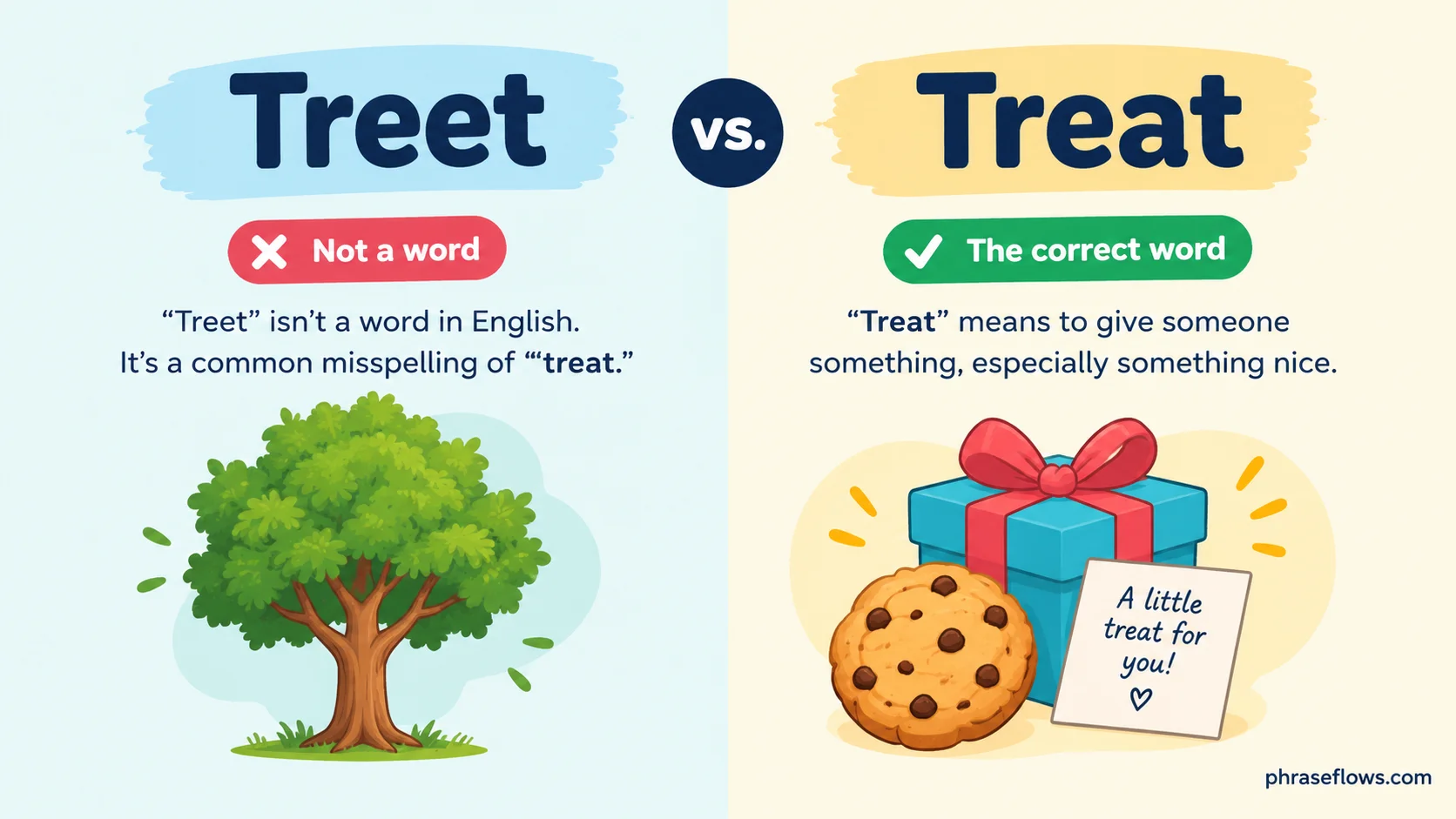
The correct spelling is Treat. It is a standard English word with several meanings. As a noun, it refers to something enjoyable, such as a sweet snack, a special meal, a gift, or a small reward. As a verb, it can mean behaving kindly toward someone, providing medical care, or handling a person or situation in a particular way. Treet, on the other hand, is not the standard spelling of this word. It may appear in brand names or other proper names, but you shouldn’t use it when you mean the ordinary English word treat.
Understanding Treet vs. Treat: Which Spelling Is Correct? Meaning, Differences, and Examples can help you avoid common spelling mistakes and improve your English writing. In this guide, you’ll learn why treat is correct, what the word means, and how to use it in everyday sentences. We’ll also look at practical examples that make the difference easier to remember. Whether you’re a student, writer, or English learner, knowing the correct spelling will help you communicate more confidently in formal and informal situations.
Treet vs. Treat: The Quick Answer
Treat is the correct standard English spelling. Treet is not the standard spelling of this word and should generally be avoided in everyday, academic, and professional writing.
The confusion often comes from pronunciation. Both spellings may look like reasonable ways to represent a similar sound, but English spelling doesn’t always follow pronunciation exactly.
Consider these examples:
- Correct: My parents bought me a special treat for my birthday.
- Incorrect: My parents bought me a special treet for my birthday.
- Correct: You should treat everyone with kindness.
- Incorrect: You should treet everyone with kindness.
In both examples, treat is the appropriate spelling.
Here is a quick comparison:
| Feature | Treet | Treat |
| Correct standard spelling | No | Yes |
| Part of speech | Not standard in this context | Noun and verb |
| Meaning | Usually a spelling error for treat | An enjoyable thing or an action |
| Common usage | Avoid in ordinary writing | Everyday and professional English |
| Example | Incorrect: A sweet treet | Correct: A sweet treat |
Remember: Whenever you mean something enjoyable or an action involving care, behavior, or attention, use treat.
What Does Treat Mean?
The word treat has several meanings depending on how you use it in a sentence. It works as both a noun and a verb, which makes it useful in everyday communication.
As a noun, it usually describes something enjoyable or special. As a verb, it can describe how someone behaves toward another person, provides medical care, or handles a particular subject or material.
Understanding these meanings will help you recognize the word in different situations.
Treat as a Noun
When you use treat as a noun, you’re referring to something enjoyable, special, or pleasant. It often describes food, gifts, experiences, or small rewards.
For example, parents might give their children a treat after a successful school performance. Similarly, friends might enjoy a special dessert together during a celebration.
Here are some common examples:
- Food: Chocolate cake is my favorite afternoon treat.
- Gift: The concert tickets were a wonderful treat.
- Experience: Spending the weekend at the beach was a real treat.
- Reward: The teacher gave the students a small treat after their activity.
- Surprise: Having breakfast prepared for me was an unexpected treat.
In these sentences, treat refers to something that brings pleasure or enjoyment.
You can also use it in expressions such as sweet treat, special treat, and a real treat. These phrases are common in conversations, restaurant descriptions, recipes, and informal writing.
Treat as a Verb
As a verb, treat describes an action. Its meaning changes according to the situation.
For instance, you can treat someone kindly, treat an illness, treat a friend to lunch, or treat an important subject in an article.
Consider these examples:
- Behavior: Always treat others with respect.
- Healthcare: Doctors treat patients who need medical attention.
- Hospitality: My sister decided to treat me to dinner.
- Handling: You should treat fragile objects carefully.
- Discussion: The article treats the subject in considerable detail.
Notice how the same word performs different functions in these sentences. The surrounding words help you understand its intended meaning.
This flexibility explains why treat appears in so many everyday conversations and written materials.
What Does Treet Mean?
Treet is generally an incorrect spelling when someone intends to write the standard English word treat.
You might see it in an informal message, a typing mistake, or a piece of writing where someone has spelled the word according to its sound. However, that doesn’t make it an acceptable replacement for treat.
For example:
- Incorrect: The children received a treet after dinner.
- Correct: The children received a treat after dinner.
Another example:
- Incorrect: We should treet our guests politely.
- Correct: We should treat our guests politely.
The distinction becomes especially important in formal communication. A spelling mistake can distract readers and make an otherwise clear sentence look less polished.
Is Treet Ever Used as a Name?
A string of letters can sometimes appear in a brand name, username, fictional name, or other proper noun. Such uses don’t establish treet as a standard alternative spelling of treat.
Therefore, context matters. If you’re writing about something enjoyable or describing an action, treat is the spelling you should choose.
Why Do People Confuse Treet and Treat?
The confusion between treet vs. treat mainly comes from the relationship between English pronunciation and spelling.
English contains many words whose sounds don’t provide a reliable guide to their written forms. As a result, people sometimes choose a spelling that looks or sounds reasonable but isn’t correct.
Several factors explain this particular mistake.
Similar Pronunciation
The word treat has a long E sound. Its standard pronunciation is /triːt/.
Because the vowel sounds like the letter E, someone unfamiliar with the spelling might write treet instead of treat.
However, English spelling doesn’t work through sound alone. The letters ea represent the vowel sound in treat, just as they do in words such as eat, seat, and meat.
Phonetic Spelling Habits
Some people spell unfamiliar words according to how they hear them. This approach can occasionally produce the correct result, but it doesn’t always work.
For example, a person who hears treat might assume that writing ee makes more sense because those letters commonly represent the long E sound.
Nevertheless, the established spelling uses ea, not ee.
Typing Mistakes
Fast typing can also lead to spelling errors. Someone might accidentally enter treet without noticing the incorrect letters.
Autocorrect doesn’t always catch every mistake. In some cases, a misspelled word may remain in a sentence if the software doesn’t recognize the intended meaning.
Reading your writing before submitting or publishing it can help prevent these errors.
Limited Exposure to Written English
People who primarily learn words through conversations may remember their sounds before they remember their spellings.
Reading books, articles, and other English-language materials helps build stronger spelling habits. Seeing treat repeatedly in different contexts makes its correct form easier to recognize.
Treet vs. Treat: Key Differences Explained
The easiest way to understand treet vs. treat is to compare their spelling, meaning, grammatical role, and everyday usage.
Although treet might look like a possible spelling based on pronunciation, it doesn’t serve as the standard spelling of the intended word. Treat, on the other hand, has several established meanings and appears in many common expressions.
Here is a closer comparison:
| Comparison | Treet | Treat |
| Spelling | Incorrect for the intended word | Correct |
| Pronunciation | Not a standard alternative pronunciation spelling | /triːt/ |
| Grammar | Not standard in this context | Noun and verb |
| Meaning | Usually a spelling error | Something enjoyable or an action |
| Written usage | Avoid in ordinary English | Common in all types of writing |
| Example | A delicious treet | A delicious treat |
Examples of Correct and Incorrect Usage
Looking at complete sentences makes the difference easier to understand.
| Incorrect sentence | Correct sentence |
| I bought a sweet treet. | I bought a sweet treat. |
| Let me treet you to lunch. | Let me treat you to lunch. |
| She received a special treet. | She received a special treat. |
| Always treet people fairly. | Always treat people fairly. |
| The doctor will treet the patient. | The doctor will treat the patient. |
The corrected sentences demonstrate how treat works in different situations. Sometimes it describes a pleasant experience. In other cases, it describes an action or a particular way of handling someone.
Treat as a Noun: Meaning and Examples
When treat functions as a noun, it usually refers to something that provides pleasure, enjoyment, or a special experience.
You might use it when discussing food, entertainment, gifts, or something unexpected that makes an ordinary day more enjoyable.
Food and Desserts
One of the most familiar uses of treat involves food. A treat is often something enjoyable that people eat outside their usual meals.
For example, cookies, cupcakes, chocolates, and ice cream can all be described as treats.
Consider these sentences:
- We made chocolate cupcakes as a weekend treat.
- My grandmother prepared a delicious treat for everyone.
- The children enjoyed their favorite sweet treats after the celebration.
- A homemade dessert can make an ordinary afternoon feel special.
The phrase sweet treat is especially common in recipes, food blogs, menus, and everyday conversations.
Special Gifts and Experiences
A treat doesn’t always involve food. It can also describe an enjoyable experience, a thoughtful gift, or an unexpected opportunity.
For instance, receiving concert tickets from a friend might feel like a real treat. Similarly, visiting a beautiful place after a busy week can be a special experience.
Examples:
- The weekend trip was a wonderful treat for our family.
- Watching the live performance was a real treat.
- Her parents planned a special birthday treat.
- Spending time with old friends is always a treat.
In these examples, the word communicates pleasure rather than referring to a particular object.
Rewards and Small Pleasures
People also use treat when discussing small rewards. These rewards might follow a completed task, a personal achievement, or a special occasion.
For example, someone might buy a favorite book after finishing an important project. A teacher might also give students small treats after completing a classroom activity.
The important point is that a treat provides an enjoyable extra. It isn’t necessarily something expensive or elaborate.
Treat as a Verb: Meaning and Examples
As a verb, treat describes what someone does or how someone handles a person, situation, subject, or material.
Its meaning depends on the words surrounding it. Understanding these different uses helps you write more accurate sentences.
Treating Someone With Kindness and Respect
One common use involves describing how people behave toward others.
You can treat someone kindly, unfairly, respectfully, or poorly. The word explains the nature of that person’s behavior.
Examples:
- Good teachers treat their students fairly.
- Everyone deserves to be treated with respect.
- She treats her younger brother with kindness.
- The company should treat its employees equally.
This usage often appears in conversations about manners, relationships, workplace behavior, and social responsibilities.
Treating an Illness or Medical Condition
In healthcare, treat refers to providing care or taking appropriate measures to improve someone’s health.
Doctors and other qualified healthcare professionals treat patients for illnesses, injuries, and other medical conditions.
Examples:
- The medical team treated the patient promptly.
- Doctors treat infections using appropriate medical care.
- The clinic treats people who need professional attention.
- The patient received treatment for the condition.
Here, treat has nothing to do with gifts or enjoyable experiences. It describes medical care.
Treating Someone to Something
Another familiar expression is treat someone to something.
It means paying for or providing an enjoyable experience, meal, or activity for another person.
For example:
- My brother decided to treat me to lunch.
- She treated her friends to ice cream.
- We treated our parents to a special dinner.
- Let me treat you to a movie this weekend.
You can also use the expression treat yourself to something. It means giving yourself something enjoyable.
Example: After completing her project, Maya treated herself to a new book.
Treating Materials and Objects
In technical and practical contexts, treat can describe applying a substance or process to an object.
For example, manufacturers may treat wood to protect it from damage. They may also treat fabrics to improve certain properties.
Other examples include:
- The factory treats the water before distribution.
- Workers treated the wooden surface to protect it.
- The manufacturer treated the fabric to improve its durability.
This meaning appears in manufacturing, construction, environmental work, and material processing.
Treating a Subject in Writing or Discussion
Writers also use treat when explaining how a particular subject is discussed or presented.
For example, an article might treat a historical event in detail. A textbook might treat two related subjects in separate chapters.
Examples:
- The book treats the subject from a historical perspective.
- The article treats the issue with considerable detail.
- The report treats each topic separately.
This use is particularly common in academic and formal writing.
How to Use Treat Correctly in Sentences
Knowing the definition is helpful, but seeing the word in realistic situations makes it easier to use correctly.
The following examples demonstrate how treat works across different settings.
| Situation | Example sentence | Meaning |
| Everyday conversation | I’ll treat you to coffee. | Pay for someone’s coffee |
| Friendship | Treat your friends with respect. | Behave kindly |
| Celebration | We prepared a birthday treat. | Something enjoyable |
| Healthcare | The doctor treated the patient. | Provided medical care |
| Education | Teachers should treat students fairly. | Behave appropriately |
| Manufacturing | Workers treated the material. | Applied a process |
| Writing | The article treats the subject carefully. | Discusses a topic |
Practical Case Study: Choosing Between Treet and Treat
Consider a student named Alex who is writing a short paragraph about a family celebration.
His original paragraph reads:
Last Sunday, my parents gave me a special treet. Later, my father decided to treet everyone to dinner. We enjoyed delicious desserts and spent the evening together.
Although readers can understand the intended message, the paragraph contains two spelling errors.
Here is the corrected version:
Last Sunday, my parents gave me a special treat. Later, my father decided to treat everyone to dinner. We enjoyed delicious desserts and spent the evening together.
Notice that the same word appears twice but performs two different grammatical functions.
- A special treat: Here, treat is a noun describing something enjoyable.
- Treat everyone to dinner: Here, treat is a verb describing an action.
This example shows why learning the correct spelling and understanding its grammatical role are both important.
Common Expressions and Phrases With Treat
The word treat appears in several familiar English expressions. Learning these phrases can improve your vocabulary and help you understand everyday conversations.
Here are some useful examples:
| Expression | Meaning | Example |
| Treat yourself | Give yourself something enjoyable | Treat yourself to a relaxing weekend. |
| My treat | I will pay for something | Don’t worry about lunch. It’s my treat. |
| Sweet treat | An enjoyable sweet food | We prepared a sweet treat for the guests. |
| Treat someone well | Behave kindly toward someone | You should treat everyone well. |
| Treat with care | Handle something carefully | Please treat these documents with care. |
| Trick or treat | A traditional Halloween expression | The children went trick-or-treating. |
| A real treat | Something especially enjoyable | The performance was a real treat. |
Understanding These Expressions in Context
Some expressions have meanings that you cannot understand simply by translating each word separately.
For example, when someone says “It’s my treat,” they usually mean they will pay for the meal, ticket, or activity.
Similarly, “treat yourself” encourages someone to enjoy something special. It doesn’t necessarily mean buying an expensive item.
These expressions are common in informal conversations, advertisements, restaurant settings, and everyday writing.
Different Forms of the Word Treat
The word treat changes its form depending on the tense and grammatical structure of a sentence. Learning these variations helps you avoid spelling mistakes and use the word naturally.
Here are its four main verb forms:
| Word form | Grammatical use | Example |
| Treat | Base form | I treat my friends with respect. |
| Treats | Present tense, third-person singular | She treats everyone fairly. |
| Treated | Simple past and past participle | They treated us to dinner. |
| Treating | Present participle and gerund | He is treating the situation seriously. |
Understanding Each Word Form
Treat: Use the base form after subjects such as I, you, we, and they. It also follows modal verbs such as can, should, and will.
Example: You should treat everyone with kindness.
Treats: Add -s when the subject is a singular third-person noun or pronoun in the simple present tense.
Example: My mother treats every guest warmly.
Treated: Add -ed to form the simple past and past participle.
Example: The teacher treated all students equally.
Treating: Add -ing when describing an ongoing action or using the word as a gerund.
Example: Treating people fairly builds trust.
Related Words Derived From Treat
Several other English words come from treat. Understanding them can help expand your vocabulary.
| Related word | Part of speech | Meaning |
| Treatment | Noun | The way someone handles something or provides care |
| Treatable | Adjective | Capable of receiving treatment |
| Untreated | Adjective | Not yet given treatment |
| Mistreatment | Noun | Unfair or harmful treatment |
| Treating | Verb form | The act of providing care or handling something |
For example, treatment can describe medical care or someone’s behavior toward another person. Meanwhile, mistreatment refers to unfair or harmful behavior.
These words share a connection with treat, but each has its own meaning and grammatical function.
Easy Ways to Remember the Correct Spelling of Treat
Remembering treat becomes easier when you connect it with familiar words and expressions.
Instead of memorizing the spelling without context, use these simple techniques.
Remember the Letters T-R-E-A-T
The correct spelling contains five letters:
T – R – E – A – T
Pay special attention to the middle two vowels, EA. They form the long E sound in this word.
Don’t replace them with EE simply because the word sounds like it contains that vowel combination.
Connect Treat With Sweet
Think about the familiar expression sweet treat.
Both words contain the vowel combination EA in their spelling. Remembering this phrase can help you recall the correct form whenever you write about desserts or enjoyable experiences.
Example: We prepared a sweet treat for the birthday party.
Use the Expression Trick or Treat
Another helpful memory trick is the popular Halloween expression trick or treat.
You might have heard this phrase in conversations, movies, books, or Halloween decorations. Repeating it mentally can reinforce the correct spelling.
Practice With Short Sentences
Writing the word in different contexts helps you remember its spelling and meaning.
Try these examples:
- I deserve a little treat.
- Please treat everyone equally.
- This dessert is a delicious treat.
- Let me treat you to lunch.
- The doctor treated the patient.
The more you encounter the correct spelling, the easier it becomes to recognize.
Read More: Tweek vs. Tweak: Difference, Meaning, and Correct Usage
Common Spelling Mistakes to Avoid
Even familiar English words can cause spelling problems when their pronunciation creates confusion. The best way to avoid mistakes is to understand the correct spelling and recognize similar-looking words.
Here are some common errors associated with treat.
Writing Treet Instead of Treat
This is the main mistake discussed in this article.
The incorrect spelling usually happens because someone associates the long E sound with the letters EE.
Incorrect: She bought a special treet for her friend.
Correct: She bought a special treat for her friend.
Always remember that the standard spelling uses EA.
Confusing Treat With Threat
Another word that looks similar to treat is threat.
However, these words have completely different meanings and pronunciations.
- Treat: Something enjoyable or an action involving behavior, care, or payment.
- Threat: A statement or situation suggesting possible harm or danger.
Examples:
- The chocolate cake was a wonderful treat.
- The storm presented a serious threat to the village.
The initial letters and vowel sounds distinguish these words. Don’t use one when you intend to communicate the meaning of the other.
Using the Wrong Verb Form
Some writers understand the spelling of treat but use the wrong grammatical form.
For example:
- Incorrect: She treat everyone kindly.
- Correct: She treats everyone kindly.
Another example:
- Incorrect: He is treat the situation seriously.
- Correct: He is treating the situation seriously.
Pay attention to the subject and tense when choosing between treat, treats, treated, and treating.
Relying Only on Pronunciation
Pronunciation can help you recognize words, but it doesn’t always reveal their spelling.
English contains many words with similar sounds but different written forms. That’s why reading, spelling practice, and checking reliable dictionaries remain useful habits.
If you’re unsure about a word, look it up rather than choosing a spelling based only on how it sounds.
Conclusion:
Understanding Treet vs. Treat is simple once you know which spelling English recognizes. Treat is the correct and commonly used word. It can describe something enjoyable, such as a gift or special meal, or refer to how you behave toward someone or provide medical care. Treet is generally a spelling mistake when used in place of treat, although it may appear in proper names or brand names. Remembering this small difference can help you avoid unnecessary spelling errors and make your writing clearer. Whenever you’re unsure, choose treat for the ordinary English word.
FAQs:
1. Is it Treet or Treat?
Treat is the correct spelling of the standard English word. Treet is not the standard spelling when you mean treat.
2. What does the word Treat mean?
Treat can mean something enjoyable, such as a sweet snack, gift, or special experience. As a verb, it can mean behaving toward someone in a certain way, providing medical care, or dealing with a situation.
3. Is Treet a real English word?
Treet is not a standard English word with the ordinary meanings of treat. However, it may appear as a proper name, brand name, or place name.
4. Why do people confuse Treet and Treat?
People often confuse these spellings because they look similar and may sound alike in speech. Fast typing and relying on pronunciation instead of checking spelling can also cause mistakes.
5. How can I remember the correct spelling of Treat?
Remember that treat contains the letter A. Use it when talking about a reward, kind behavior, medical care, or handling a situation. If you mean the ordinary English word, avoid spelling it as treet.


1 thought on “Treet vs. Treat: Which Spelling Is Correct? Meaning, Differences, and Examples”