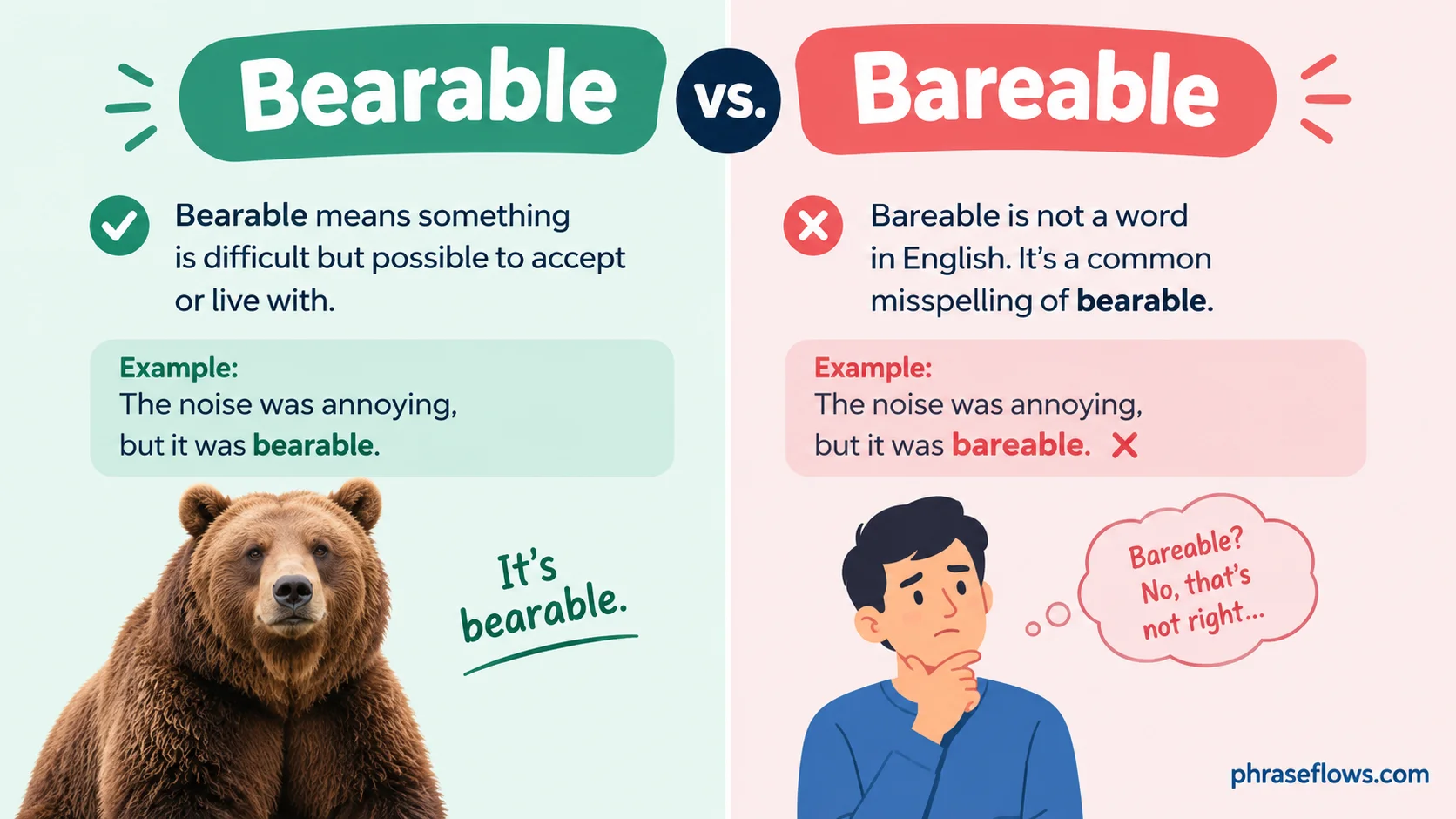

Have you ever stopped while writing because you weren’t sure whether to use bearable or bareable? These words look and sound almost identical, so it’s easy to mix them up. However, only bearable is the correct spelling in standard English. Whether you’re writing a school assignment, an email, or a professional document, knowing the right spelling helps you avoid common mistakes and express your ideas clearly.
The word bearable means something that you can endure, tolerate, or manage without too much difficulty. You might use it to describe pain, stress, heat, noise, or a difficult situation that becomes easier to handle with time, rest, or support. For example, you could say, “The pain was bearable after taking some rest.” The word comes from the verb bear, which means to endure or carry a burden. In contrast, bare means uncovered or empty, so bareable is not the accepted spelling of the word you need.
Understanding Bearable vs. Bareable: Which Spelling Is Correct? can help you improve your English spelling, grammar, and vocabulary. The confusion often happens because people rely on how a word sounds instead of considering its spelling and origin. Once you understand the connection between bear and bearable, remembering the correct form becomes much easier. In this guide, you’ll learn the meaning of bearable, see examples of its correct usage, and discover simple tips to avoid this common spelling mistake.
Bearable vs. Bareable: Which Spelling Is Correct?
Bearable is the correct spelling when you mean that something can be tolerated, accepted, or endured. You can use it to describe uncomfortable weather, a difficult task, a stressful day, or an unpleasant experience that remains manageable.
The confusion comes from the words bear and bare. In standard American English, they sound alike but have different meanings. Since bearable comes from the verb bear, its spelling retains the letters b-e-a-r.
Here’s a quick comparison:
| Word | Is It Correct? | Meaning | Example |
| Bearable | Yes | Possible to tolerate or endure | The heat became bearable after sunset. |
| Bareable | No, not for this meaning | Nonstandard spelling of bearable | The heat became bareable after sunset. |
| Bare | Yes | Uncovered, exposed, or plain | He walked across the grass with bare feet. |
| Bear | Yes | To carry, support, or endure | I can’t bear this constant noise. |
Notice that bareable may look reasonable if you think of the word bare. However, the spelling doesn’t follow the word’s actual origin. When you mean something is tolerable, always choose bearable.
Remember this simple rule: If you can bear something, that experience is bearable.
Why Is Bareable Considered a Spelling Mistake?
English contains many words that sound alike but use different spellings. These words are called homophones. For example, their and there sound alike, yet each serves a different purpose in a sentence.
The same confusion occurs with bear and bare. Because they share the same pronunciation in standard American English, writers sometimes choose the wrong spelling when they rely on sound alone.
However, spelling depends on meaning and word formation, not pronunciation alone. The adjective bearable comes from bear, meaning to endure or tolerate, plus the suffix -able. Adding this suffix creates a word that describes something you can endure.
Therefore, write bearable, not bareable, when describing a difficult situation that you can handle.
What Does Bearable Mean?
The word bearable is an adjective that describes something you can tolerate, accept, or deal with despite its unpleasant qualities. It doesn’t necessarily mean that something feels good. Instead, it means the experience remains manageable enough to endure.
According to Cambridge Dictionary, a situation is bearable when you can accept it or deal with it. The word often appears in conversations about discomfort, inconvenience, pressure, and challenging circumstances.
Consider a long flight with limited legroom. You might feel uncomfortable throughout the journey, but watching a movie and taking occasional breaks from sitting can make the experience bearable. The flight hasn’t become perfect; it has simply become easier to tolerate.
Here are several examples that show how people use the word in everyday English:
- Weather: The afternoon heat became bearable when a cool breeze arrived.
- Work: Short breaks made the long workday more bearable.
- Travel: Listening to music made the traffic jam bearable.
- School: Studying with a friend made the challenging assignment more bearable.
- Noise: Closing the window made the street noise bearable.
- Waiting: Having a book to read made the long wait bearable.
Each example describes an unpleasant or demanding experience that someone can still manage.
Does Bearable Mean Enjoyable?
No. Bearable and enjoyable have different meanings.
Something enjoyable gives you pleasure or satisfaction. Something bearable may remain uncomfortable, boring, or frustrating, but you can tolerate it.
For example, imagine waiting two hours at a crowded airport. You probably wouldn’t describe the delay as enjoyable. However, if you have a comfortable seat, a book, and something to drink, you might find the wait bearable.
This distinction matters because bearable describes the level of difficulty you can tolerate rather than the amount of pleasure you experience.
Compare these sentences:
- “The lecture was enjoyable.” You liked the experience.
- “The lecture was bearable.” You managed to sit through it despite finding it dull or difficult.
- “The lecture was unbearable.” You found it too unpleasant or difficult to tolerate.
Choosing the right word helps readers understand exactly how you felt about an experience.
Why Is Bearable Spelled With “Bear” Instead of “Bare”?
The spelling becomes easier to remember when you understand how the word developed. Bearable comes from the verb bear, which can mean to carry, support, or endure something. The suffix -able adds the sense of being capable of an action.
The Online Etymology Dictionary traces bearable to the verb bear and the suffix -able. It records the adjective as dating to the mid-15th century.
The word follows a straightforward pattern:
Bear + -able = Bearable
In this construction, bear means to endure or tolerate. The suffix -able means capable of being or doing something. Together, they form an adjective that means capable of being endured.
You can see the same general pattern in other English words:
| Root Word | Suffix | Result | Meaning |
| Read | -able | Readable | Easy or possible to read |
| Wash | -able | Washable | Able to be washed |
| Manage | -able | Manageable | Possible to manage |
| Accept | -able | Acceptable | Suitable or able to be accepted |
| Bear | -able | Bearable | Possible to endure |
These examples show how the suffix -able helps form adjectives. However, English spelling doesn’t always follow one simple rule, so it’s useful to learn common words in their established forms.
How the Root Word Helps You Remember the Spelling
Think about the sentence, “I can bear the pressure.” Here, bear means to endure or withstand something difficult.
Now change the sentence slightly: “The pressure is bearable.”
The two sentences express a related idea. In the first, you describe your ability to endure the pressure. In the second, you describe the pressure itself as something you can endure.
This connection provides a reliable spelling trick. Whenever you need the adjective, think of the verb first:
- I can bear the workload.
- The workload is bearable.
- I cannot bear the noise.
- The noise is unbearable.
Once you connect bearable with bear, there’s little reason to confuse it with bareable.
What Is the Difference Between Bear and Bare?
Although bear and bare sound alike in American English, they have distinct meanings. Understanding those meanings helps you choose the correct word in other sentences, too.
What Does Bear Mean?
The word bear has several meanings. As a verb, it can describe carrying a load, supporting a responsibility, producing something, or enduring an unpleasant experience. It can also refer to the large mammal called a bear.
For example:
- “She helped bear the cost of the repairs.” She shared the financial responsibility.
- “I can’t bear the noise.” The noise is difficult to tolerate.
- “The tree will bear fruit in summer.” The tree will produce fruit.
- “We saw a bear near the forest.” The word refers to an animal.
The intended meaning depends on context. In bearable, the relevant meaning is to endure or tolerate.
What Does Bare Mean?
The word bare usually means uncovered, exposed, or lacking something. It can describe a body part without clothing, a surface without decoration, or a space with very few objects. As a verb, bare can also mean to uncover or reveal something.
For example:
- “He walked across the room with bare feet.” His feet were uncovered.
- “The apartment had bare walls.” The walls lacked decorations.
- “The trees were bare in winter.” They had lost their leaves.
- “She decided to bare her feelings.” She chose to reveal her feelings.
These meanings have nothing to do with tolerating discomfort. That’s why bareable isn’t the correct spelling for the adjective meaning tolerable.
Bear vs. Bare: A Quick Comparison
| Feature | Bear | Bare |
| Main verb meaning | Carry, support, or endure | Uncover or reveal |
| Common adjective meaning | Relating to a bear, as in bear market | Uncovered or exposed |
| Example | I can’t bear the delay. | The floor was bare. |
| Related word | Bearable | Barefoot |
| Connection to tolerating something | Yes | No |
A helpful way to distinguish the words is to associate bear with carrying a burden and bare with having nothing covering a surface.
When you remember that connection, you can distinguish the words in most everyday contexts.
How to Use Bearable in a Sentence
Bearable usually appears after a linking verb or before a noun. It describes a condition, experience, or situation that someone can tolerate.
For example, you can say, “The weather is bearable,” or “We had a bearable journey.” In the first sentence, the adjective follows the verb is. In the second, it describes the noun journey.
Here are some common sentence patterns.
Something Is Bearable
Use this structure when you want to describe an experience as tolerable.
- The room became bearable after we opened the windows.
- The delay was bearable because we had enough food.
- The assignment seemed bearable once I understood the instructions.
In each example, bearable describes the experience rather than the person experiencing it.
Something Becomes More Bearable
The comparative phrase more bearable describes a situation that has become easier to tolerate.
- A comfortable chair made the long meeting more bearable.
- Her encouraging words made the difficult day more bearable.
- Taking regular breaks made the demanding project more bearable.
This construction works well when you want to explain how a change improves an unpleasant experience without suggesting that the problem has disappeared completely.
Something Is Barely Bearable
The phrase barely bearable means that something is only just tolerable. The experience is close to becoming too unpleasant to endure.
- The noise from the construction site was barely bearable.
- After several hours, the cramped seating became barely bearable.
- The heat was barely bearable without air conditioning.
The word barely is important here. It indicates that the experience remains tolerable by only a small margin.
Something Makes a Situation Bearable
You can also use bearable to explain what helps someone handle a difficult experience.
- A good book made the long journey bearable.
- Friendly coworkers made the busy season bearable.
- A cool breeze made the afternoon heat bearable.
This pattern emphasizes the factor that helps reduce discomfort.
Common Grammar Patterns With Bearable
| Pattern | Example | Purpose |
| Be + bearable | The wait is bearable. | Describes a current condition |
| Become + bearable | The room became bearable. | Shows a change |
| Make + object + bearable | Music made the journey bearable. | Identifies what helps |
| More + bearable | The work became more bearable. | Compares levels of difficulty |
| Barely + bearable | The noise was barely bearable. | Shows a very low level of tolerance |
| Quite + bearable | The trip was quite bearable. | Emphasizes reasonable tolerability |
These patterns cover most everyday uses of the adjective. Pay attention to the surrounding words because they can change the strength of the meaning.
Bearable vs. Unbearable: What’s the Difference?
The words bearable and unbearable express opposite ideas. Something bearable remains possible to tolerate, while something unbearable is too unpleasant, difficult, or painful to tolerate.
The prefix un- often creates a negative or opposite meaning in English. In this case, adding un- changes bearable into unbearable.
Compare the following examples:
| Word | Meaning | Example |
| Bearable | Possible to tolerate | The traffic was bearable early in the morning. |
| More bearable | Easier to tolerate than before | Leaving earlier made the traffic more bearable. |
| Barely bearable | Only just tolerable | The constant noise was barely bearable. |
| Unbearable | Too difficult or unpleasant to tolerate | The noise became unbearable during the night. |
The distinction is useful when describing degrees of discomfort. For instance, a long meeting might be bearable at first, become barely bearable after several hours, and eventually feel unbearable if it continues.
You can also use the words in figurative situations. A stressful deadline, an awkward conversation, or an overwhelming workload may become more or less bearable depending on the circumstances.
For further examples and definitions, consult the Oxford Advanced Learner’s Dictionary entry for bearable.
Common Synonyms for Bearable
Several English words share part of bearable’s meaning. However, each has a slightly different emphasis, so you should choose a synonym that fits the situation.
Tolerable
Tolerable means acceptable or possible to endure, especially when something isn’t ideal.
Example: “The temperature was tolerable once the sun went down.”
This is one of the closest synonyms for bearable. Both words describe situations that someone can manage despite discomfort.
Endurable
Endurable emphasizes the ability to withstand a difficult experience over a period of time.
Example: “The long wait was endurable because we knew our turn was coming.”
This word is suitable when you want to highlight endurance rather than comfort.
Manageable
Manageable describes something that you can handle or control successfully. It often applies to workloads, responsibilities, schedules, and practical problems.
Example: “Breaking the assignment into smaller tasks made it manageable.”
Unlike bearable, which focuses on tolerating discomfort, manageable often suggests that you can take useful action.
Acceptable
Acceptable means satisfactory or good enough according to a particular standard.
Example: “The delay was acceptable because the company explained the reason.”
This word focuses on whether something meets expectations rather than whether you can endure it.
Supportable
Supportable can mean capable of being maintained, sustained, or supported. In the sense of tolerating difficulty, it is more formal and less common than bearable.
Example: “The proposed schedule created a supportable workload for the team.”
Choose this word carefully because its meaning depends on context. It doesn’t always work as a direct substitute for bearable.
Bearable Synonyms at a Glance
| Synonym | Main Emphasis | Best Used For |
| Tolerable | Able to be endured | Discomfort and inconvenience |
| Endurable | Able to be withstood | Difficult or prolonged experiences |
| Manageable | Possible to handle | Workloads and practical problems |
| Acceptable | Good enough or satisfactory | Decisions, standards, and outcomes |
| Supportable | Able to be sustained or justified | Formal, technical, or professional contexts |
Although these words overlap, they aren’t interchangeable in every sentence. Choose the synonym that conveys your intended meaning most accurately.
Read More : Natzi vs. Nazi: Which Is the Correct Spelling?
How to Remember the Correct Spelling of Bearable
The easiest way to remember bearable is to connect it with the verb bear, meaning to endure or tolerate something.
Use this simple memory trick:
If you can bear it, it’s bearable.
The trick works because it connects the spelling directly to the meaning. You don’t need to memorize a complicated rule or rely on how the word sounds.
Here are a few additional ways to reinforce the spelling.
- Remember the root: Bearable contains bear, not bare.
- Think about the meaning: If the sentence concerns enduring discomfort, choose bearable.
- Use related words: Bearable and unbearable share the same root.
- Read your sentence aloud: Check the intended meaning, then confirm the spelling rather than relying on pronunciation alone.
- Keep a correct example: “The long wait was bearable because I had a book.”
A quick comparison can also help:
- Correct: The workload was bearable.
- Incorrect: The workload was bareable.
- Correct: His bare feet touched the floor.
- Incorrect for the intended meaning: His bear feet touched the floor.
The last pair demonstrates why meaning matters. Both words sound alike, but their spellings reflect different definitions.
A Practical Example: Bearable vs. Bareable in Everyday Writing
Imagine a student writing about a difficult week at school. The student wants to explain that several deadlines made the week stressful, but support from friends helped.
The first draft reads:
“The week was barely bareable because I had three assignments due.”
Although readers may understand the intended meaning, the spelling is incorrect. The revised sentence should read:
“The week was barely bearable because I had three assignments due.”
Now consider a second sentence:
“Working with my classmates made the workload more bearable.”
This sentence uses bearable correctly because it describes a workload that remains difficult but has become easier to manage.
What This Example Teaches
The distinction isn’t merely about choosing the spelling that looks familiar. You need to identify the intended meaning and connect it to the correct root word.
In this example, the writer means that the workload was difficult to endure. Therefore, bearable is the correct choice.
The same principle applies to professional emails, online articles, school assignments, and personal messages. A quick spelling check can help you avoid the mistake without changing your intended message.
How Do You Pronounce Bearable?
In standard American English, bearable is pronounced /ˈber.ə.bəl/. The pronunciation begins with the same sound as bear or bare, followed by two unstressed syllables.
The Cambridge Dictionary pronunciation guide provides both US and UK pronunciations.
The important point is that bearable and bareable sound alike, so pronunciation alone won’t tell you which spelling is correct. You must consider the meaning and the word’s formation.
When describing something that can be tolerated, use bearable regardless of whether the pronunciation sounds closer to bear or bare in your accent.
Conclusion:
Choosing between bearable and bareable becomes easy once you understand their spelling and meaning. Bearable is the correct spelling in standard English, and it describes something you can endure, tolerate, or manage without too much difficulty. In contrast, bareable is a common spelling mistake because people often connect it with the word bare, which means uncovered or empty. Remember that bearable comes from the verb bear, meaning to endure or carry a burden. By learning this simple difference and checking unfamiliar words when needed, you can improve your spelling accuracy, strengthen your English vocabulary, and communicate more clearly in everyday conversations and professional writing.
FAQs:
Is bearable or bareable the correct spelling?
Bearable is the correct spelling in standard English. Bareable is a misspelling and is not accepted as the standard form of the word.
What does bearable mean?
Bearable means tolerable or manageable. It describes something unpleasant or difficult that you can endure without too much trouble, such as pain, stress, heat, or discomfort.
Why do people confuse bearable and bareable?
People often confuse these words because they look and sound similar. They may also connect bareable with bare, which means uncovered or empty. However, the correct word comes from bear, meaning to endure or carry a burden.
How do you use bearable in a sentence?
You can use bearable to describe a situation or experience that you can manage. For example, “The heat became bearable after the sun went down.” Another example is, “With support from her friends, the difficult situation became more bearable.”
What is an easy way to remember the spelling of bearable?
Connect bearable with the verb bear, which means to endure something difficult. Remember that you can bear a burden, and that burden can be bearable. This connection can help you remember the correct spelling and avoid writing bareable.




1 thought on “Bearable vs. Bareable: Which Spelling Is Correct?”