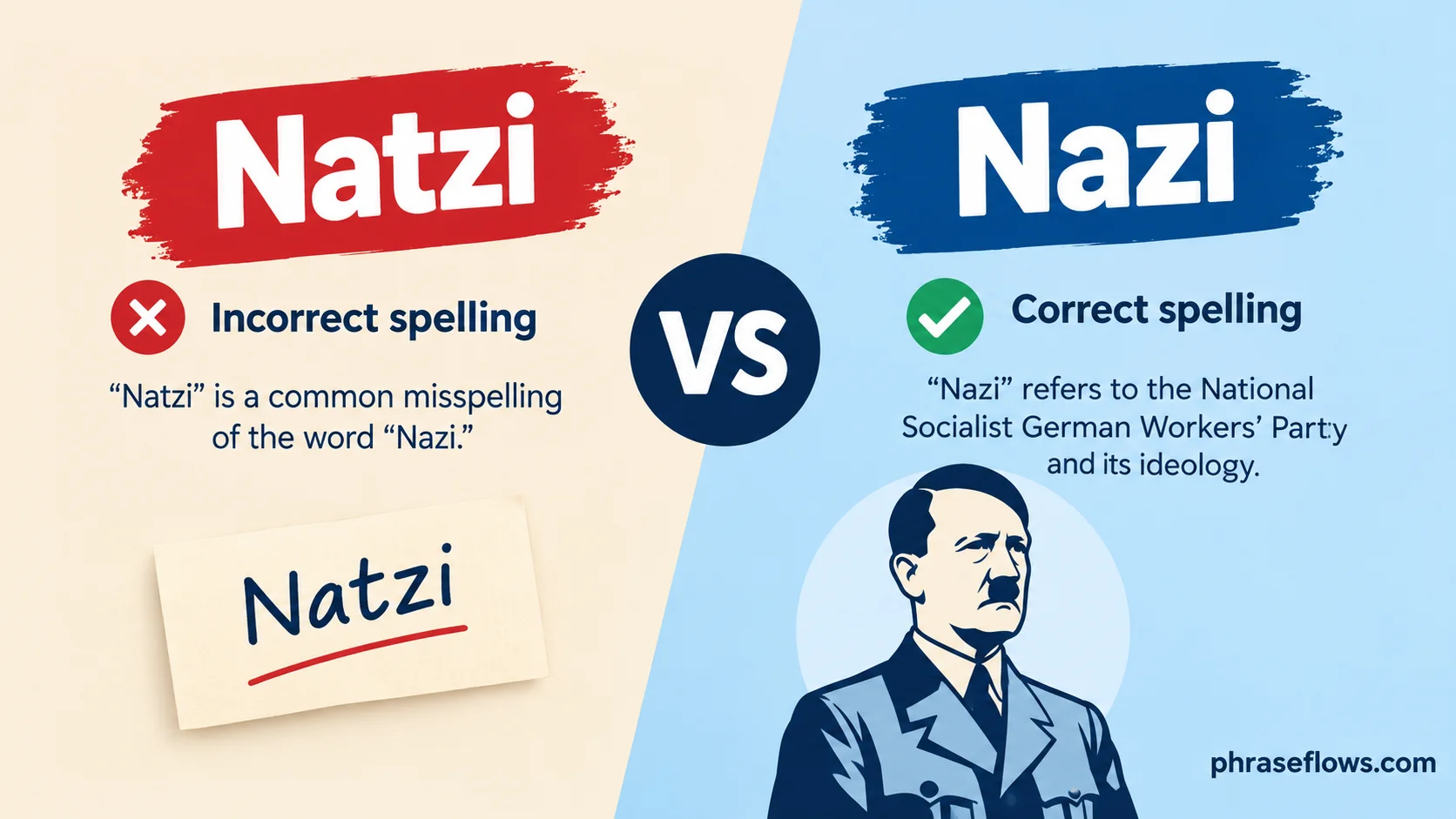

Have you ever wondered whether to write Natzi or Nazi? The correct spelling is Nazi, while Natzi is a common misspelling. This confusion often happens because people rely on pronunciation or add an extra letter when typing unfamiliar words. Understanding the difference helps you avoid spelling mistakes and communicate more clearly in school assignments, articles, and everyday writing.
The word Nazi refers to a member or supporter of the National Socialist German Workers’ Party, which Adolf Hitler led in Germany. It can also describe the party’s ideology, movement, or government. The term is closely associated with Nazi Germany, World War II, and the Holocaust, so using the correct spelling is especially important when discussing history or related political topics. Writing the word accurately also helps readers understand your meaning without confusion.
In this guide to Natzi vs. Nazi: Which Is the Correct Spelling?, you’ll learn why Nazi is the accepted English form, what the word means, and why Natzi is incorrect. You’ll also find practical examples to help you recognize the correct spelling in different contexts. Whether you’re preparing a school paper, writing a historical article, or improving your English spelling, this explanation will help you use the term accurately and confidently.
Natzi vs. Nazi: Which Spelling Is Correct?
Nazi is the correct spelling, while Natzi is incorrect when referring to the historical political party or its ideology. Standard English dictionaries recognize Nazi, not Natzi, as the accepted spelling for this meaning.
English meaning – Cambridge Dictionary
+1
The word refers to a member or supporter of the National Socialist German Workers’ Party, which Adolf Hitler led. It can also function as an adjective describing something connected with that party or its rule in Germany.
The spelling Natzi adds an unnecessary letter t. Although the pronunciation may contribute to this mistake, the written form doesn’t include that extra letter.
Quick Comparison of Natzi and Nazi
| Feature | Nazi | Natzi |
| Standard English spelling | Correct | Incorrect for the historical term |
| Meaning | A member of the Nazi Party or something related to it | No standard alternative meaning in this context |
| Part of speech | Noun and adjective | Not a standard spelling of the term |
| Plural form | Nazis | Not the standard plural |
| Example | Nazi Germany | Natzi Germany (incorrect) |
For example, if you’re writing a history assignment, use this sentence:
- Correct: The Nazi Party controlled Germany from 1933 to 1945.
- Incorrect: The Natzi Party controlled Germany from 1933 to 1945.
The first sentence uses the accepted spelling. The second contains a spelling error.
Which Spelling Should You Use?
Choose Nazi whenever you refer to the historical party, its members, its government, or its ideology. This spelling is appropriate for school assignments, research papers, news articles, historical discussions, and everyday writing.
Here are a few correct examples:
- Historians study Nazi Germany to understand the events leading up to World War II.
- The museum displays documents from the Nazi era.
- Students learned about Nazi propaganda and its role in spreading antisemitism.
- The book examines the rise of the Nazi Party in Germany.
Remember one simple rule: Use Nazi, not Natzi, for the historical term.
What Does Nazi Mean?
The word Nazi refers primarily to a member or supporter of the National Socialist German Workers’ Party, a far-right, racist, and antisemitic political party led by Adolf Hitler. The party came to power in Germany in 1933 and established a dictatorship that lasted until 1945.
Holocaust Encyclopedia
+1
The term carries significant historical weight because the Nazi regime persecuted millions of people and carried out the Holocaust, the systematic, state-sponsored persecution and murder of approximately six million European Jews. The regime also persecuted and murdered millions of other victims.
Holocaust Encyclopedia
In modern English, the word has two main grammatical uses. You can use it as a noun to refer to a person associated with the historical movement or as an adjective to describe something connected with the party or its government.
Examples of Nazi in a Sentence
Seeing the word in context makes its meaning easier to understand.
As a noun:
- The historian examined how the Nazis gained political power in Germany.
- The documentary explains how Nazi leaders used propaganda to influence public opinion.
- The book discusses the persecution carried out by the Nazis.
As an adjective:
- The students studied Nazi Germany during their history lesson.
- Researchers examined Nazi policies and their consequences.
- The archive contains Nazi-era documents and photographs.
Notice that the word’s role changes depending on the sentence. In the first set, Nazi or Nazis refers to people. In the second, it describes a historical period, government, or related subject.
What Is the Difference Between Nazi and Nazism?
Although Nazi and Nazism share the same historical roots, they don’t mean exactly the same thing.
Nazi refers to a person associated with the Nazi Party or describes something connected with that movement. Nazism refers to the ideology, beliefs, and political system associated with the party led by Hitler.
English meaning – Cambridge Dictionary
+1
| Word | Meaning | Example |
| Nazi | A member of the Nazi Party or an adjective related to it | The historian studied Nazi Germany. |
| Nazis | The plural form of Nazi | The Nazis ruled Germany from 1933 to 1945. |
| Nazism | The ideology and political system associated with the Nazi movement | The book examines the rise of Nazism. |
| Nazi Party | The political organization led by Adolf Hitler | The Nazi Party came to power in 1933. |
Consider these sentences:
- Nazi: The researcher studied Nazi policies.
- Nazism: The researcher studied the ideology of Nazism.
Both sentences are correct, but they emphasize different things. The first focuses on policies associated with the movement. The second focuses on its broader ideology.
Why Do People Spell Nazi as Natzi?
The confusion between Natzi and Nazi often comes from the relationship between pronunciation and spelling. When people hear an unfamiliar word, they sometimes write the sounds they perceive instead of checking the established spelling.
In this case, the pronunciation of Nazi contains a sequence of sounds that may lead some writers to insert an extra t. However, the spelling doesn’t change to match that guess.
Pronunciation Can Influence Spelling
English spelling can be unpredictable. Some words sound different from what their letters might suggest, while others contain letter combinations that learners find difficult to remember.
For example, people sometimes confuse these words:
- Definitely and definately
- Separate and seperate
- Receive and recieve
- Nazi and Natzi
In each case, one spelling is standard and the other is a common error. Recognizing the correct form helps you avoid repeating the mistake.
Is Natzi a Phonetic Spelling?
Not in standard English. Although Natzi might look like an attempt to represent a perceived sound, it isn’t the accepted spelling of the historical term.
The Cambridge Dictionary gives the American and British English pronunciation of Nazi as /ˈnɑːt.si/. This notation represents the word’s sounds, not an instruction to add a t to its spelling.
Pronunciation in English
+1
The key distinction is simple: pronunciation describes how a word sounds, while spelling describes how you write it. These systems don’t always match letter for letter.
Where Does the Word Nazi Come From?
The word Nazi originated as a shortened form associated with the German word Nationalsozialist, meaning “National Socialist.” It became the familiar name for members of the National Socialist German Workers’ Party, whose formal German name was Nationalsozialistische Deutsche Arbeiterpartei, abbreviated as NSDAP.
Holocaust Encyclopedia
+1
Understanding this origin helps explain why Nazi became the established English spelling. It wasn’t created by adding letters to represent an English pronunciation. Instead, it developed from a German political term that entered wider international use.
How the Term Became Historically Significant
The Nazi Party emerged in the aftermath of World War I, during a period of political and economic instability in Germany. Adolf Hitler joined the party’s predecessor in 1919 and became its dominant leader. In 1920, the organization adopted the name National Socialist German Workers’ Party.
Holocaust Encyclopedia
+1
Several major events explain the term’s place in modern history:
- 1920: The party adopted the name National Socialist German Workers’ Party.
- January 30, 1933: German President Paul von Hindenburg appointed Hitler chancellor.
- 1933–1945: The Nazis established and maintained a dictatorship in Germany.
- 1939–1945: Nazi Germany waged war across Europe during World War II.
- 1945: Nazi rule ended with Germany’s defeat in the war.
These dates provide useful context when the word appears in historical writing. The United States Holocaust Memorial Museum offers a detailed account of the party’s development, ideology, and rise to power in its Holocaust Encyclopedia entry on the Nazi Party.
Holocaust Encyclopedia
+1
Why the Historical Context Matters
The word Nazi isn’t merely a spelling challenge. It identifies a specific political movement responsible for dictatorship, aggressive war, systematic persecution, and genocide.
The Holocaust, in particular, remains central to understanding the Nazi regime. The regime and its collaborators murdered approximately six million European Jews and persecuted other groups as well.
Holocaust Encyclopedia
When writing about this period, accurate spelling supports accurate historical communication. It also helps readers find reliable sources, understand the subject, and distinguish established historical terminology from errors.
How Do You Pronounce Nazi?
The word Nazi is pronounced /ˈnɑːt.si/ in the Cambridge Dictionary’s American and British English entries. The first syllable carries the stress, followed by the second syllable.
Pronunciation in English
+1
A pronunciation guide can help you recognize the word when you hear it and remember its standard spelling.
PRONUNCIATION GUIDE
Nazi
IPA: /ˈnɑːt.si/
- Syllables: Two
- Stress: First syllable
- English variety: American and British English
Pronunciation reference: Cambridge Dictionary
Why Pronunciation Doesn’t Change the Spelling
A spoken word doesn’t always reveal its spelling perfectly. English borrows words from other languages and often retains established spellings even when speakers adapt their pronunciation.
In this case, the pronunciation contains a /t/ sound, but that doesn’t make Natzi a correct spelling. The standard written form remains Nazi.
When you’re unsure about a word, check a dictionary rather than relying on sound alone. This habit is especially useful when writing unfamiliar names, historical terms, and words borrowed from other languages.
Common Spelling and Usage Mistakes
Knowing the correct spelling is only the first step. You should also understand the word’s plural form, capitalization, and grammatical use.
Adding an Extra T to Nazi
The most direct mistake is inserting a t into the written word.
- Incorrect: The Natzi Party ruled Germany.
- Correct: The Nazi Party ruled Germany.
The same rule applies to related expressions:
| Incorrect | Correct |
| Natzi Germany | Nazi Germany |
| Natzi ideology | Nazi ideology |
| Natzi officer | Nazi officer |
| Natzi propaganda | Nazi propaganda |
Use the standard spelling consistently throughout your writing.
Using the Wrong Plural
The standard plural of Nazi is Nazis. You form it by adding an s, not by changing the word’s spelling.
Examples:
- Singular: The Nazi was a member of the Nazi Party.
- Plural: The Nazis were members of the Nazi Party.
For historical writing, make sure the plural agrees with the rest of the sentence.
For example:
- Incorrect: The Nazis was responsible for the policy.
- Correct: The Nazis were responsible for the policy.
The spelling is only one part of correct usage. Grammar matters, too.
Confusing Nazi With Nazism
Another common error is using Nazi when you mean Nazism.
Compare these examples:
- Correct: The historian researched Nazi Germany.
- Correct: The historian researched Nazism.
- Awkward: The historian researched the Nazi of Germany.
The first sentence refers to a historical state. The second refers to the political ideology. The third misuses the word because Nazi doesn’t function as the name of the ideology in that construction.
Remember that Nazi describes a person or something associated with the movement, while Nazism names the ideology.
Using Nazi as a Casual Insult
In informal English, some people use Nazi figuratively to describe someone they consider excessively strict or controlling. Dictionaries recognize this broader, disapproving use. However, the expression can trivialize the historical meaning when it replaces a more accurate description.
English meaning – Cambridge Dictionary
For example, calling someone a “homework Nazi” might be intended as a joke. Yet the comparison invokes a movement associated with dictatorship, persecution, and genocide.
If you simply mean that someone enforces rules too strictly, more precise alternatives include:
- Overly strict: Someone who applies rules rigidly.
- Controlling: Someone who tries to direct other people’s behavior.
- Authoritarian: Someone who expects obedience and gives little room for disagreement.
- Perfectionistic: Someone who places unusually high standards on work or performance.
Choose the word that describes the behavior accurately. Doing so makes your writing clearer and avoids unnecessary historical comparisons.
Read More: Noisy vs. Noisey: Which Is Correct and How to Use It?
Is Natzi Ever a Correct Word?
Natzi isn’t a standard alternative spelling of Nazi when the subject is Hitler’s political party or the historical period associated with it.
However, an unusual spelling can appear in other contexts. For example, a person might use Natzi as a username, a fictional character’s name, or part of a specific brand or proper name. In such cases, you need to consider the context rather than automatically treating every occurrence as a reference to the historical term.
Here are three useful distinctions:
- Historical writing: Use Nazi when referring to the political movement.
- Direct quotations: Preserve the original wording when accuracy requires an exact quotation. If the source contains an apparent error, explain it when necessary.
- Names and usernames: Check whether Natzi is an intentionally chosen name rather than a misspelling.
For example, if a historical document contains the word Natzi because of a transcription error, a writer shouldn’t silently change the quotation while claiming to reproduce it exactly. Instead, the writer can preserve the original and clarify the error in an editorial note.
The practical rule remains straightforward: Use Nazi for the historical term unless the context clearly establishes a different, intentional use of Natzi.
American vs. British English: Is the Spelling Different?
No. Nazi is the standard spelling in both American and British English. You don’t need to change the spelling when writing for readers in the United States or the United Kingdom. Cambridge Dictionary lists the same written form for both varieties.
Pronunciation in English
+1
This matters because some English words do have regional spelling differences. For example, American English generally uses color, while British English uses colour. Likewise, organize and organise are common American and British forms, respectively.
Nazi doesn’t follow that pattern.
| Writing context | Correct spelling |
| American English | Nazi |
| British English | Nazi |
| Academic writing | Nazi |
| Historical research | Nazi |
| General English writing | Nazi |
If you see Natzi in an American or British text, don’t assume it’s a regional spelling. Unless it serves as a distinct name or appears intentionally in a quotation, it’s generally a spelling mistake.
Conclusion:
When comparing Natzi vs. Nazi, the correct spelling in standard English is Nazi. The spelling Natzi is incorrect and should be avoided in formal writing, school assignments, historical articles, and everyday communication. Since the word refers to a specific political movement associated with Adolf Hitler and Nazi Germany, using the accepted spelling is important for clarity and historical accuracy. Remember to write Nazi, check your spelling when editing, and provide appropriate context whenever you discuss this sensitive period in history.
FAQs:
Is Natzi or Nazi the correct spelling?
Nazi is the correct spelling in standard English. Natzi is a misspelling and isn’t the accepted written form.
What does the word Nazi mean?
The word Nazi refers to a member or supporter of the National Socialist German Workers’ Party, led by Adolf Hitler. It can also describe the party’s ideology, movement, or government.
Why do people spell Nazi as Natzi?
People may write Natzi because of pronunciation confusion, typing errors, or uncertainty about the word’s spelling. However, the standard English spelling is Nazi, without a t.
Is Natzi a real word?
Natzi isn’t the standard English spelling of the historical and political term Nazi. In this context, it’s considered a spelling mistake rather than an accepted alternative.
How can I remember the correct spelling of Nazi?
Remember that Nazi contains four letters: N-A-Z-I. It has no t between the a and z. Checking a reliable dictionary can also help you confirm the spelling when writing about history or politics.




1 thought on “Natzi vs. Nazi: Which Is the Correct Spelling?”