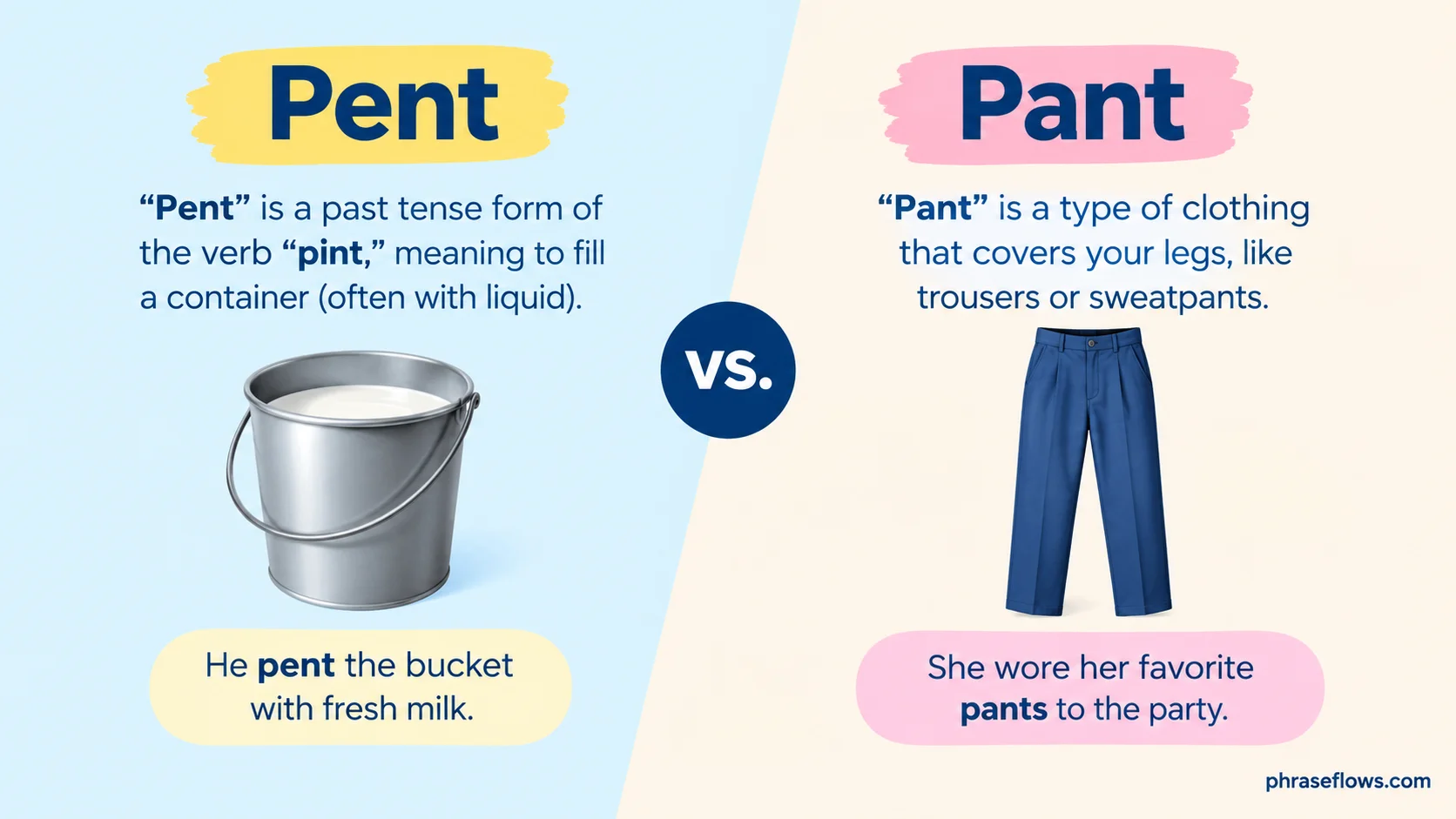

Have you ever confused pent with pant while writing in English? These words look similar, but they have different meanings and uses. Understanding Pent vs. Pant helps you avoid spelling mistakes and choose the correct word in everyday conversations, school assignments, and professional writing. Although a small spelling difference separates them, their meanings are not interchangeable.
The word pent means confined, shut in, or held back. It often appears in the expression pent-up emotions, which describes feelings that someone has kept inside. For example, “She finally expressed her pent-up frustration.” In contrast, pant is a verb that means to breathe quickly and heavily, usually after exercise, excitement, or physical effort. For example, “The runner began to pant after the race.” These examples show why context matters when deciding which word to use.
Another source of confusion is pants, which refers to clothing that covers the body from the waist down in American English. While pent relates to something being held back, pant describes heavy breathing, and pants refers to clothing. Learning these differences, along with their meanings, pronunciation, and sentence examples, can strengthen your English vocabulary. Whether you’re a student, writer, or English learner, knowing how to use each word correctly will help you communicate clearly and write with confidence.
Pent vs. Pant: What’s the Difference?
The easiest way to distinguish pent vs. pant is to look at what each word describes. Pent refers to confinement or restraint, whereas pant usually refers to heavy breathing.
According to Dictionary.com, pent is a form of the verb pen, which means to confine. Meanwhile, pant is a separate verb that describes breathing rapidly and heavily.
Here is a quick comparison of their main features.
| Feature | Pent | Pant |
| Meaning | Confined, enclosed, or held back | To breathe rapidly and heavily |
| Part of speech | Verb form or adjective | Verb or noun |
| Related verb | Pen | Pant |
| Common expression | Pent-up emotions | Pant after running |
| Past tense or participle | Pent | Panted |
| Present participle | Not commonly used independently in everyday English | Panting |
| Example | She struggled with pent-up frustration. | The dog began to pant. |
| Common usage | Describing restraint or confinement | Describing heavy breathing |
Remember this distinction: pent is associated with something being held in, while pant is associated with the act of breathing heavily.
For example, someone might feel pent-up frustration after keeping their feelings to themselves. After a long run, that same person might pant while catching their breath. The words describe entirely different situations.
What Does Pent Mean?
Pent is a valid English word that means confined, enclosed, or restrained. It can function as the past tense or past participle of pen, a verb that means to keep someone or something within a limited space.
However, you’ll rarely see pent used by itself in everyday conversation. It appears much more often in pent-up, an adjective that describes something held back or prevented from being expressed or released. Collins Dictionary confirms both the verb form and the related meaning of confinement.
Consider these examples:
- The animals were pent inside a small enclosure.
- Years of pent-up frustration finally came to the surface.
- She struggled to express her pent-up emotions.
In the first sentence, pent describes confinement. In the other two, pent-up describes feelings that have remained unexpressed.
Meaning of Pent-Up
The expression pent-up means held back, restrained, or not released. It often describes emotions and feelings, but it can also refer to energy, pressure, demand, or other forces that have built up without an outlet.
The Cambridge Dictionary defines pent-up feelings as feelings that people don’t express or release. The expression is useful when something has accumulated but hasn’t had a chance to come out.
For example, imagine a student who feels frustrated about a difficult assignment but keeps those feelings to themselves. Later, when the student finally talks about the problem, you might describe the frustration as pent-up.
The same expression works in other situations:
- Pent-up anger: Anger that someone has kept inside rather than expressed.
- Pent-up excitement: Excitement that a person has struggled to contain.
- Pent-up energy: Energy that hasn’t been used or released.
- Pent-up demand: Demand that has built up because people haven’t had the opportunity to buy or access something.
- Pent-up pressure: Pressure that has accumulated without being released.
Notice that pent-up doesn’t always describe emotions. In business, for example, pent-up demand can describe customers who have postponed purchases and are now ready to buy.
Examples of Pent in Sentences
These examples show how pent and pent-up work in different contexts.
| Sentence | Explanation |
| The animals were pent inside the enclosure. | Pent means confined. |
| She felt a wave of pent-up anger. | Her anger had been held back. |
| The children released their pent-up energy at the playground. | They finally had an opportunity to use their stored energy. |
| The company anticipated pent-up demand after delaying its product launch. | Customers had postponed purchases. |
| He struggled to express his pent-up disappointment. | He had kept his disappointment to himself. |
Grammar tip: Use pent-up when describing a feeling, force, or demand that has been held back. In ordinary American English, this is the form most readers will recognize immediately.
What Does Pant Mean?
Pant means to breathe quickly and heavily, often after physical activity, in hot weather, or when someone feels out of breath. Unlike pent, which relates to confinement, pant describes breathing.
You might hear a dog panting after chasing a ball or see a runner panting after completing a race. The word can describe people and animals, and writers sometimes use it to convey urgency, exhaustion, or physical effort.
For example:
- The dog began to pant after running across the yard.
- She had to pant as she climbed the steep hill.
- The runner was panting when he crossed the finish line.
In each sentence, the word describes rapid or heavy breathing.
Pant as a Verb
The verb pant describes the action of breathing heavily. It can appear in different tenses depending on when the action takes place.
Here are the main forms of the verb:
| Verb form | Example | Usage |
| Pant | Dogs pant in hot weather. | Base form |
| Pants | The dog pants after running. | Present tense with a singular third-person subject |
| Panted | The runner panted after the race. | Simple past tense |
| Panting | The puppy was panting in the sunshine. | Present participle or gerund |
| Has panted | The dog has panted after intense exercise before. | Present perfect construction |
The most important form to remember is panted, the standard simple past tense of pant.
For instance, you might write, “The exhausted hiker panted as he reached the summit.” Because the action happened in the past, panted is the correct choice.
By contrast, “The exhausted hiker pent as he reached the summit” is incorrect if you mean that the hiker was breathing heavily.
Pant as a Noun
Although pant most commonly appears as a verb, it can also function as a noun. As a noun, it can describe a single breath or a short episode of heavy breathing, especially in literary writing.
For example:
- With a final pant, the runner dropped onto the bench.
- The dog let out a short pant before drinking water.
In these sentences, pant refers to an instance of heavy breathing rather than the action in general.
However, the noun form is less common in everyday American English than the verb. Most people would naturally say, “The dog was panting” rather than “The dog gave a pant.”
One additional detail matters for American readers: pants usually means trousers in everyday US English. Context makes the difference clear. In “The dog pants after running,” pants is a verb. In “He bought a new pair of pants,” it is a noun referring to clothing.
Examples of Pant in Sentences
The following examples demonstrate the word’s most common uses.
- The puppy started to pant in the heat. The puppy breathed rapidly.
- He panted as he climbed the stairs. His breathing became heavy during the climb.
- The athlete was panting after the race. The athlete was breathing hard.
- The dog pants whenever it chases a ball. The sentence describes a repeated action.
- She paused for a moment to catch her breath instead of continuing to pant. The sentence contrasts heavy breathing with recovering normal breathing.
These examples show why pant fits situations involving breathing. Replacing it with pent would change the meaning or make the sentence incorrect.
Key Differences Between Pent and Pant
The difference between pent vs. pant becomes clearer when you compare their meanings, grammar, pronunciation, and everyday usage.
Difference in Meaning
The two words describe different ideas.
Pent relates to being confined or held back. It often appears in pent-up, which describes something that hasn’t been expressed or released.
Pant relates to rapid, heavy breathing. It can describe what happens after physical exertion or in hot conditions.
Compare these sentences:
- She felt pent-up frustration after the disagreement.
- She began to pant after running up the stairs.
The first sentence describes an emotion that has been held back. The second describes a physical response to exertion.
Difference in Grammar
The words also differ in how they function grammatically.
Pent is a past tense and past participle of pen in the sense of confining. It can also act as an adjective meaning confined. In everyday English, you’ll most often see it in the adjective pent-up.
Pant is a verb in its base form and can also function as a noun. Its standard verb forms include pants, panted, and panting.
Compare the patterns below:
- Pen → pent: The farmer penned the animals inside the enclosure. The animals were pent inside.
- Pant → panted: The dog began to pant. After running, it panted heavily.
Don’t treat pent as the past tense of pant. They belong to different verbs and follow different grammatical patterns.
Difference in Pronunciation
In standard American English, pent and pant have different vowel sounds.
- Pent: /pɛnt/, with the vowel sound found in sent and went.
- Pant: /pænt/, with the vowel sound found in ant and hand.
The first word uses the short e sound, while the second uses the short a sound.
To practice the distinction, say these pairs aloud:
- Pent — sent
- Pant — ant
- Pent — went
- Pant — hand
American accents vary, and some speakers pronounce particular vowel sounds differently. Still, the contrast between the usual vowel sounds in pent and pant is an effective starting point.
Difference in Everyday Usage
Frequency and context offer another useful clue.
You’ll commonly encounter pent-up in descriptions of feelings, energy, pressure, or demand. For example, a writer might describe pent-up anger after an argument or pent-up demand after a period of limited availability.
By comparison, pant appears frequently in everyday descriptions of breathing. People use it to describe dogs after exercise, runners after a race, and hikers climbing steep trails.
| Context | Correct word | Example |
| Feelings that haven’t been expressed | Pent-up | He struggled with pent-up frustration. |
| Heavy breathing after exercise | Pant | She began to pant after running. |
| Past action involving heavy breathing | Panted | The dog panted in the heat. |
| Something kept within a space | Pent | The animals were pent inside the enclosure. |
Quick rule: If the sentence describes restraint, consider pent or pent-up. If it describes heavy breathing, choose pant or one of its verb forms.
Pent vs. Pant: Examples in Everyday English
Sometimes, the fastest way to understand two similar words is to compare them in realistic situations. The following examples show how context determines which word belongs in a sentence.
| Example | Correct usage | Why it works |
| She finally spoke about her ___ anger. | Pent-up | The anger had been held back. |
| The dog began to ___ after chasing the ball. | Pant | The dog was breathing heavily. |
| The runner ___ as he reached the finish line. | Panted | The sentence describes heavy breathing in the past. |
| The children released their ___ energy outdoors. | Pent-up | Their energy had been held back. |
| The puppy was ___ after playing in the yard. | Panting | The sentence describes ongoing heavy breathing. |
| The animals were ___ inside the enclosure. | Pent | The word describes confinement. |
A Practical Case Study: Choosing the Right Word
Imagine you’re writing a short story about a runner who has spent a frustrating day at work before heading out for exercise.
You might write:
After a difficult day at work, Daniel carried a great deal of pent-up frustration. He decided to go for a run. By the time he reached the top of the hill, he was panting heavily.
Both words fit naturally, but they describe different things. Pent-up explains Daniel’s restrained feelings, while panting describes his physical response to running.
Now consider what happens if you switch the words:
- Incorrect: Daniel carried a great deal of pant-up frustration.
- Incorrect: By the time he reached the top of the hill, he was penting heavily.
Neither sentence expresses the intended meaning in standard English. The first needs pent-up, while the second needs panting.
This example illustrates an important principle: Choose words according to their meaning and grammatical role, not simply because their spelling looks similar.
Common Mistakes When Using Pent and Pant
Even experienced writers sometimes mix up similar-looking words. Understanding the mistakes below will help you choose the correct form more confidently.
Using Pent Instead of Pant
The most common error is using pent to describe heavy breathing.
Incorrect: The dog began to pent after running around the park.
Correct: The dog began to pant after running around the park.
The corrected sentence uses pant because the dog is breathing heavily. Pent doesn’t serve as the standard verb for this action.
Using Pant Instead of Pent-Up
Another mistake involves writing pant-up instead of pent-up.
Incorrect: She had years of pant-up anger.
Correct: She had years of pent-up anger.
The expression pent-up describes feelings that have been restrained or left unexpressed. The word pant has no such meaning in this phrase.
When writing about frustration, excitement, disappointment, or suppressed feelings, use pent-up emotions or another suitable pent-up expression.
Confusing Pant With Panted
Writers sometimes forget to change the verb when describing a completed action.
Incorrect: The athlete pant after finishing the race.
Correct: The athlete panted after finishing the race.
The simple past tense requires panted because the race and the associated heavy breathing occurred in the past.
However, if you’re describing a habitual action, the present tense works:
- The athlete pants after every sprint.
- The athlete panted after yesterday’s race.
- The athlete was panting when the coach arrived.
Each form serves a different purpose. Choose the one that matches the sentence’s time and structure.
Assuming Pent Is the Past Tense of Pant
This mistake is easy to make because many English verbs form their past tense irregularly. However, pent is not the standard past tense of pant.
The correct verb forms are:
- Present: pant
- Simple past: panted
- Past participle: panted
- Present participle: panting
For example, “The dog has panted heavily during previous runs” uses the past participle panted. By contrast, pent relates to pen, meaning to confine.
Read More: Bearable vs. Bareable: Which Spelling Is Correct?
How to Remember the Difference Between Pent and Pant
A simple memory trick can help you choose the correct word without checking a dictionary every time.
Associate pent with something kept in and pant with breathing.
Pent = Held in
Think of a feeling that’s been kept inside. The phrase pent-up frustration describes frustration that hasn’t been expressed.
Pant = Heavy breathing
Picture a dog returning from a long run. It begins to pant as it catches its breath.
You can also remember the words through short sentences:
- Pent: He struggled to release his pent-up emotions.
- Pant: The dog began to pant after chasing the ball.
These examples connect each word with a clear image. With practice, the difference becomes easier to recognize.
Conclusion:
Understanding Pent vs. Pant becomes easier when you know what each word means and how to use it in a sentence. Pent refers to something confined or held back and often appears in the phrase “pent-up emotions.” Pant means to breathe quickly and heavily, while pants refers to clothing that covers the body from the waist down in American English. Although these words look similar, their meanings and grammatical roles are different. By learning their definitions and practicing examples, you can avoid common spelling mistakes, improve your English vocabulary, and use the correct word confidently in everyday conversations and professional writing.
FAQs:
What is the difference between pent and pant?
Pent means confined, restricted, or held back, while pant means to breathe quickly and heavily. For example, “pent-up anger” describes restrained emotion, whereas “the dog began to pant” describes heavy breathing.
Is pent a real word in English?
Yes, pent is a real English word. It is the past participle of pen, meaning to confine or shut something in. It commonly appears in the expression “pent-up feelings.”
What does pant mean?
Pant usually means to breathe quickly and heavily, often after exercise, physical effort, or excitement. For example, “The runner began to pant after climbing the hill.”
Are pent and pants the same word?
No, pent and pants have different meanings. Pent refers to something confined or held back, while pants is a noun for clothing that covers the body from the waist down in American English.
How can I remember when to use pent or pant?
Remember that pent is associated with things being held back, as in “pent-up emotions.” Pant describes heavy breathing, as in “panting after a run.” If you mean clothing, use pants. Checking the sentence’s meaning will help you choose the correct word.



1 thought on “Pent vs. Pant: Meaning, Differences, Usage, and Examples Explained”