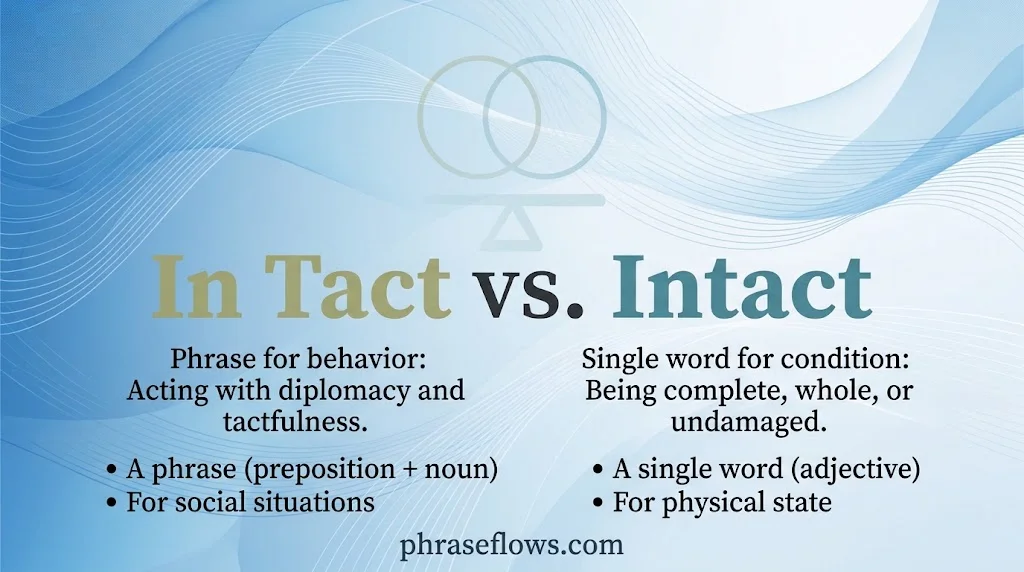

Have you ever wondered whether to write in tact or intact? These two forms look similar and sound almost identical, which makes them confusing for many English learners and writers. However, when you want to describe something that remains whole, complete, or undamaged, intact is the correct spelling. Using the wrong form may seem like a small mistake, but it can affect the clarity and accuracy of your writing.
The word intact means that something has stayed unchanged, unbroken, or free from damage. For example, you might say, “The package arrived intact,” to explain that it reached its destination without damage. In contrast, tact is a separate English noun that refers to diplomacy, sensitivity, and the ability to communicate carefully with others. Therefore, in tact is generally considered incorrect when you intend to describe something as whole or undamaged.
Understanding the difference between in tact vs. intact can help you avoid common spelling mistakes and improve your English grammar. Whether you’re writing an email, preparing an academic assignment, or creating a professional blog post, choosing the correct spelling makes your sentences clearer and more polished. In this guide, you’ll learn the meaning of intact, explore the difference between these two forms, review practical examples, and discover simple tips for remembering the correct usage.
In Tact vs. Intact: The Quick Answer
Intact is the correct word when something remains whole, complete, or undamaged. Always write it as one word when you want to express this meaning.
Here’s a quick comparison:
| Word or phrase | Correct? | Meaning | Example |
| Intact | Yes | Whole or undamaged | The vase remained intact. |
| In tact | No, not for this meaning | Incorrect separation of intact | The vase remained in tact. |
| Tact | Yes | Sensitivity and good judgment when communicating | She handled the complaint with tact. |
The easiest way to remember the rule is to focus on the meaning. If you can replace the word with whole, complete, or undamaged, then intact is almost certainly the word you need.
For example:
- Correct: The original painting remained intact.
- Incorrect: The original painting remained in tact.
- Correct: The manager discussed the problem with tact.
Notice that intact describes the painting’s condition, while tact describes how the manager handles a conversation. The words have different meanings and serve different purposes in a sentence.
What Does Intact Mean?
According to Cambridge Dictionary, intact is an adjective that describes something complete and in its original state or something that has not been damaged or destroyed.
definition in the Cambridge English Dictionary
In everyday English, the word often suggests that something has survived a situation without losing its essential parts, structure, or condition. The object might have faced a challenge, but it remains whole.
For example, imagine ordering a delicate ceramic bowl online. The delivery driver brings the package to your door, and you open it to discover that the bowl has no cracks or broken pieces. You could say, “The bowl arrived intact.”
The word also applies to things you cannot physically touch. A person’s reputation, a team’s winning record, or an agreement between two companies can remain intact even after a difficult situation.
Intact for Physical Objects
One of the most common uses of intact involves physical objects that remain whole or undamaged. You might use it when discussing furniture, glassware, electronics, buildings, documents, or historical artifacts.
For example:
- The glass bottle remained intact during shipping.
- Despite the storm, the garden shed was still intact.
- The museum received the ancient pottery intact.
- She checked the box to make sure the seal was intact.
- The mechanic confirmed that the main frame remained intact after the inspection.
In each example, the word emphasizes preservation. Something could have been damaged, broken, or altered, but it wasn’t.
This makes intact especially useful in shipping reports, product descriptions, restoration projects, and conversations about the condition of valuable objects.
However, intact doesn’t automatically mean perfect. An old building may have faded paint or worn flooring while keeping its original structure intact. The word focuses on what remains whole or preserved rather than claiming that every detail looks new.
Intact for Ideas, Relationships, and Conditions
The meaning of intact extends beyond physical objects. English speakers also use it to describe something abstract that remains preserved, undamaged, or unaffected.
Consider these examples:
- Their friendship remained intact after the disagreement.
- The company kept its original agreement intact.
- Her reputation emerged from the investigation largely intact.
- The team returned for the next season with its core lineup intact.
- Despite several revisions, the central message of the speech remained intact.
In these sentences, the word refers to something that doesn’t have a physical shape. A friendship cannot crack like glass, and a reputation cannot break into pieces. Still, both can suffer damage in a figurative sense.
Using intact helps communicate that an important quality, connection, or arrangement has survived a challenge.
For example, two business partners might disagree about a project’s direction. If they resolve the disagreement without changing their original contract, they can say that the agreement remains intact.
The key idea is preservation: whether you’re discussing an object, a relationship, or an arrangement, intact indicates that something important remains whole.
What Does In Tact Mean?
The phrase in tact is not the standard spelling when you want to describe something as whole, complete, or undamaged. In that situation, you should use intact as one word.
The confusion often happens because English contains many expressions made from two separate words. Writers may assume that intact should also be split into in tact. However, the correct spelling doesn’t depend on how the word looks or sounds.
For example:
- Incorrect: The original painting survived the fire in tact.
- Correct: The original painting survived the fire intact.
- Incorrect: We received the documents in tact.
- Correct: We received the documents intact.
In each pair, the corrected sentence uses the adjective intact to describe something that remained undamaged.
Why Do Writers Confuse In Tact With Intact?
Several factors contribute to this common spelling mistake.
Similar pronunciation: Both forms sound alike in ordinary speech. Because the difference is mainly visible in writing, readers may not notice the error when speaking.
Confusion about word boundaries: Writers sometimes assume that a longer word must be a combination of shorter, independent words. Although English contains many compounds, that assumption doesn’t work for every word.
The existence of the word tact: Tact is a genuine English word. It refers to the ability to communicate with sensitivity and good judgment. However, that meaning doesn’t make in tact a standard spelling of the adjective intact.
English meaning – Cambridge Dictionary
+1
A useful rule is to check the meaning before deciding how to spell a word. If you mean that something remains whole or undamaged, use intact.
Intact vs. In Tact: Key Differences
The main difference between intact and in tact is spelling. The former is the standard adjective for describing something whole or undamaged, while the latter is an incorrect form when used with that intended meaning.
| Feature | Intact | In tact |
| Spelling | One word | Two words |
| Standard usage for this meaning | Correct | Incorrect |
| Grammatical role | Adjective | Not a standard adjective in this context |
| Meaning | Whole, complete, or undamaged | No standard equivalent meaning |
| Example | The package arrived intact. | The package arrived in tact. |
The distinction matters in school assignments, workplace emails, product descriptions, and published articles. A spelling mistake can distract readers from your message, even when they understand what you intended to say.
Intact vs. In Tact in Everyday Sentences
The easiest way to understand the difference is to compare sentences that describe similar situations.
| Incorrect sentence | Correct sentence |
| The box arrived in tact. | The box arrived intact. |
| The old building remained in tact. | The old building remained intact. |
| The original design is still in tact. | The original design is still intact. |
| The team returned with its lineup in tact. | The team returned with its lineup intact. |
| The seal was left in tact. | The seal was left intact. |
Each corrected sentence uses intact to communicate that something remains whole or preserved.
Remember: Don’t split intact into two words just because the spelling looks as though it could contain a separate preposition.
When Should You Use Intact?
Use intact when you want to emphasize that something remains complete, undamaged, or preserved. The word fits naturally into everyday conversations and formal writing.
Its exact meaning depends on the context. A package might remain physically undamaged, while a relationship might remain emotionally strong despite a disagreement.
Use Intact When Something Remains Undamaged
When an object survives an event without being broken or harmed, intact is often an appropriate choice.
For example:
- The package arrived intact despite the long journey.
- The technician found the device intact after the inspection.
- The glass panel remained intact during transportation.
- The historical monument stood intact after the storm.
In practical situations, this word can communicate an important detail about an object’s condition. A customer reporting a delivery might use it to confirm that an item arrived without damage.
Likewise, a museum curator might describe an artifact as intact to indicate that its essential physical structure remains preserved. The word doesn’t necessarily mean the artifact looks brand-new. It means that it has remained whole in the relevant sense.
Use Intact When Something Remains Complete
Intact can also describe something that retains all its important parts or elements.
For example:
- The archive preserved the original collection intact.
- The editor kept the complete quotation intact.
- The research team stored the original dataset intact.
- The contractor left the existing structure intact during the renovation.
This usage is especially helpful when discussing documents, collections, records, and structures. It emphasizes completeness rather than appearance.
Imagine an editor reviewing a historical letter. The editor may correct a note elsewhere in the publication while leaving the original letter unchanged. In that case, the letter remains intact because its original content has been preserved.
The same principle applies to a dataset. Researchers might analyze selected entries while keeping the original data available without alteration. Describing the source dataset as intact emphasizes that its original form remains preserved.
Use Intact When Something Remains Unchanged or Preserved
The word also works well when discussing abstract things that survive a change or challenge.
Examples include:
- Their working relationship remained intact after the merger.
- The organization kept its core values intact during the transition.
- The original terms of the agreement remained intact.
- She managed to keep her dignity intact during the difficult conversation.
In these examples, intact describes continuity. Something important remains in place despite circumstances that could have changed or weakened it.
However, context matters. If a contract remains legally unchanged, intact may fit well. If a friendship continues but has become strained, the word might describe the survival of the relationship without suggesting that everything between the friends is perfect.
A good writing tip: Use intact when preservation is the main point. Choose a more precise word when you need to describe a particular quality, such as trust, accuracy, strength, or completeness.
Intact vs. Tact: What’s the Difference?
Although intact and tact look similar, they have different meanings and grammatical roles.
According to Cambridge Dictionary’s definition of tact, tact is the ability to say or do the right thing without upsetting or offending people unnecessarily. It is a noun associated with sensitivity, diplomacy, and good judgment.
definition in the Cambridge English Dictionary
By contrast, intact is an adjective that describes something whole, complete, or undamaged.
Compare these sentences:
- Intact: The original document remained intact after the move.
- Tact: The manager discussed the mistake with tact.
- Tactful: The manager gave a tactful explanation.
- Tactfully: The manager tactfully explained what had gone wrong.
The distinction becomes clear when you focus on what each word describes. Intact refers to the condition of something. Tact refers to the way a person handles a situation or communicates with others.
What Does Tact Mean in a Sentence?
People use tact when discussing conversations that require care, such as offering criticism, resolving disagreements, or addressing sensitive subjects.
For example, imagine that a colleague submits a report containing several errors. You need to explain the problem without embarrassing the colleague in front of the entire team.
You might say:
“The supervisor handled the feedback with tact.”
Here, tact describes the supervisor’s thoughtful approach. It doesn’t describe the report’s physical condition or completeness.
Other examples include:
- She showed tact when discussing the disappointing results.
- A little tact can make difficult conversations easier.
- He answered the question with remarkable tact.
- The teacher used tact when correcting the student’s mistake.
What Is the Difference Between Tactful and Intact?
Tactful is an adjective derived from tact. It describes someone or something that shows sensitivity and good judgment.
Intact, on the other hand, describes a condition in which something remains whole or undamaged.
| Word | Part of speech | Meaning | Example |
| Intact | Adjective | Whole or undamaged | The seal remained intact. |
| Tact | Noun | Sensitivity in communication | She responded with tact. |
| Tactful | Adjective | Showing sensitivity | He gave a tactful reply. |
| Tactfully | Adverb | In a sensitive manner | She tactfully raised the concern. |
These words are not interchangeable. You can preserve a document intact and discuss its contents tactfully. Each word serves a different purpose.
Common Mistakes to Avoid When Using Intact
Even experienced writers can mix up similar-looking words. Fortunately, a few simple checks can help you avoid the most common errors.
Writing In Tact Instead of Intact
This is the main mistake addressed in this guide. Writers separate the word into two parts even when the sentence needs the adjective intact.
Incorrect: The original records remained in tact after the office moved.
Correct: The original records remained intact after the office moved.
The corrected sentence uses one word because it describes the records as remaining complete and undamaged.
When proofreading, look for in tact in sentences about objects, documents, agreements, relationships, and other things that can remain whole or preserved.
Using In-Tact With a Hyphen
Adding a hyphen doesn’t solve the problem.
Incorrect: The original structure remained in-tact.
Correct: The original structure remained intact.
The standard spelling is one word without a hyphen. You don’t need punctuation to connect the letters.
This is a useful detail to remember when editing website content, academic assignments, business reports, and product descriptions.
Confusing Intact With Tactful
These words may look related, but they describe different things.
Incorrect: She gave an intact response to the customer’s complaint.
Better: She gave a tactful response to the customer’s complaint.
The second sentence makes sense because tactful describes a thoughtful and sensitive way of responding. Intact wouldn’t communicate that meaning.
Consider another comparison:
- The original document remained intact.
- The editor responded tactfully to the author’s concerns.
The first sentence concerns preservation. The second concerns communication.
Assuming Intact Always Means Perfectly Unchanged
Although intact often suggests that something remains in its original condition, it doesn’t always mean that every detail is untouched or flawless.
For example, an old building might undergo repairs while retaining its original structure. A team might change a few players while keeping its core lineup together.
In such situations, writers can use phrases like largely intact or mostly intact to express that the essential parts remain preserved even though some changes have occurred.
Compare:
- The historic building remained largely intact after the renovation.
- The original plan remained mostly intact despite several minor adjustments.
These expressions give readers a more accurate picture than an absolute statement would.
How to Remember the Correct Spelling of Intact
A simple memory trick can help you avoid the in tact spelling mistake.
Think of intact as one complete word describing something whole. Keep the spelling together when the meaning involves preservation, completeness, or a lack of damage.
You can also use a substitution test. Replace the word with whole, complete, or undamaged. If the sentence still makes sense, intact is probably the right choice.
For example:
- The package arrived undamaged. → The package arrived intact.
- The original agreement remained unchanged. → The original agreement remained intact.
- The collection stayed complete. → The collection stayed intact.
The substitutions won’t work perfectly in every sentence, but they provide a useful starting point.
Quick Examples to Reinforce the Rule
Read these examples to see how intact works in different contexts.
- Shipping: The customer confirmed that the product arrived intact.
- History: Researchers discovered an intact section of the ancient wall.
- Business: The original terms of the agreement remained intact.
- Relationships: Their friendship stayed intact despite the disagreement.
- Education: The teacher kept the original meaning of the passage intact.
- Sports: The team returned with its championship lineup largely intact.
Each example uses intact as one word. The context changes, but the central idea of preservation remains.
A Practical Case Study: Choosing Intact in Professional Writing
Imagine a small business that ships handmade ceramic products to customers across the country. After a delivery, a customer emails the company to confirm that the order arrived safely.
The customer writes:
“The package arrived in tact, and none of the items were broken.”
The intended meaning is clear, but the spelling is incorrect. A polished version would read:
“The package arrived intact, and none of the items were broken.”
Why does this correction matter? Professional writing should make information easy to understand while maintaining consistent spelling and grammar. Although a single typo may not change the message, repeated mistakes can make a business appear less careful.
Now consider a different situation. A customer service representative needs to respond politely to a complaint about delayed shipping. In that case, the representative might write:
“We appreciate your patience and will handle your concern with tact.”
Here, tact is correct because the sentence describes a sensitive approach to communication rather than the condition of a package.
The two examples show why meaning matters more than appearance. Intact describes preservation, while tact describes diplomacy.
This distinction is useful in many settings, from customer service and business communication to schoolwork and everyday messages.
Conclusion:
Choosing between in tact vs. intact is simple once you understand their meanings. Intact is the correct one-word spelling when you want to describe something that remains whole, complete, unchanged, or undamaged. For example, you can say, “The package arrived intact.” On the other hand, tact is a separate noun that refers to diplomacy, sensitivity, and careful communication. The phrase “in tact” is generally incorrect when used to mean whole or undamaged. By remembering this distinction and proofreading your writing, you can avoid common spelling mistakes and communicate more clearly in everyday, academic, and professional situations.
FAQs:
Is “in tact” or “intact” the correct spelling?
Intact is the correct spelling when you mean whole, complete, or undamaged. “In tact” is generally a misspelling when used with this meaning.
What does the word “intact” mean?
Intact means that something remains whole, complete, unchanged, or free from damage. For example, “The vase remained intact after the move.”
Is “in tact” ever grammatically correct?
The phrase “in tact” is not the standard form for describing something undamaged. However, the words in and tact could appear separately in an unusual sentence where their individual meanings fit the context.
What is the difference between “intact” and “tact”?
Intact is an adjective that describes something whole or undamaged. Tact is a noun that means diplomacy or sensitivity when dealing with people. For example, “The document remained intact” and “She handled the disagreement with tact.”
How can I remember the correct spelling of “intact”?
Remember that intact is one word when you mean something is whole or undamaged. You can also connect it with the phrase “still intact,” which describes something that has remained complete or unchanged.


1 thought on “In Tact vs. Intact: Which Spelling Is Correct in English?”