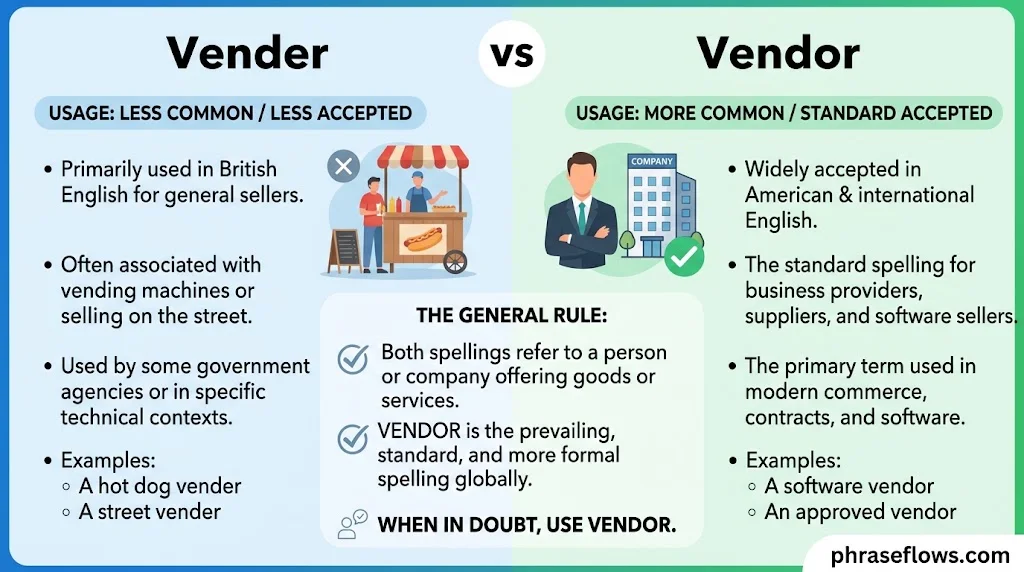

When comparing Vender vs. Vendor: Which Spelling Is Correct?, many writers wonder which spelling they should use in modern English. Vendor is the standard and widely accepted spelling for a person, company, or business that sells goods or provides services. Although vender is a recognized spelling variant, it is much less common today and may look unusual in everyday writing.
The word vendor appears frequently in American English and British English, especially in business, retail, e-commerce, procurement, and legal documents. For example, a company may work with several vendors to purchase office supplies, obtain technical services, or manage business contracts. Understanding the difference between these spellings helps you avoid common spelling mistakes and communicate clearly in professional, academic, and everyday situations.
In this guide, you’ll learn the definitions, meanings, pronunciation, and origins of vendor and vender. We’ll explore why vendor is the preferred spelling, whether vender is still considered correct, and how both forms appear in different contexts. By looking at practical examples, you’ll understand which word to use in emails, business reports, contracts, and everyday conversations to keep your writing clear, professional, and grammatically correct.
Vender vs. Vendor: Which Spelling Is Correct?
Vendor is the correct default choice for modern American English. Although vender exists as a dictionary-recognized variant, it isn’t the usual spelling in contemporary writing.
Both forms refer to someone who sells goods or services. The difference isn’t a change in meaning. Instead, it involves spelling preference, familiarity, and common usage.
Collins English Dictionary
+1
Consider these examples:
- Correct and preferred: The company hired a new software vendor.
- Correct and preferred: Several food vendors set up stalls at the festival.
- Recognized but uncommon: The company hired a new software vender.
The third sentence communicates the same idea, but most writers should choose vendor for a polished, familiar result.
Here’s a quick comparison:
| Feature | Vendor | Vender |
| Meaning | A person or business that sells goods or services | Generally the same meaning |
| Dictionary status | Standard spelling | Recognized variant in some dictionaries |
| Modern usage | Common | Much less common |
| Professional writing | Recommended | Usually avoid |
| Plural form | Vendors | Venders |
| Best choice for US English | Yes | Rarely needed |
The simple rule: Write vendor unless you’re preserving an original spelling in a quotation, historical document, or official name.
What Does Vendor Mean?
A vendor is a person, business, or organization that sells products or services. The term covers everything from someone selling handmade crafts at a local market to a company providing software for a large corporation.
According to Collins English Dictionary’s definition of vendor, the word describes someone who sells goods, often from a stall or cart, as well as a company or person that supplies products or services.
Collins English Dictionary
For example, imagine a bakery that buys flour from a wholesale business. The wholesale business acts as a vendor because it sells supplies to the bakery. If the bakery sells bread directly to customers, the bakery becomes a vendor in that transaction.
The word’s meaning depends on the relationship between the buyer and the seller. A business can purchase goods from one vendor and sell those goods to its own customers.
Common Types of Vendors
You’ll encounter the word vendor in many settings. Here are some common examples:
- Food vendor: Someone who sells meals, snacks, drinks, or other food items.
- Street vendor: A person who sells products from a cart, stall, or roadside location.
- Software vendor: A company that develops or sells software.
- Retail vendor: A business that sells products to customers or retailers.
- Event vendor: A business that provides catering, decorations, photography, or other event services.
- Service vendor: A person or company that provides services such as cleaning, maintenance, or technical support.
- Approved vendor: A supplier that an organization has reviewed and authorized to do business with.
These phrases show how flexible the word is. Whether someone sells a sandwich or provides a company’s accounting software, vendor can describe the seller.
Examples of Vendor in Sentences
The easiest way to understand a word is to see how it works in context. These examples demonstrate natural uses of vendor in everyday and professional writing.
| Example sentence | Context |
| The vendor sold fresh fruit at the farmers market. | Local retail |
| We contacted the vendor about our delayed order. | Customer service |
| The company selected a new software vendor. | Technology |
| Each vendor must register before the event begins. | Event planning |
| Our purchasing department compared three vendors. | Procurement |
| The vendor sent the invoice by email. | Accounting |
| Several vendors displayed handmade jewelry at the fair. | Small business |
| The school hired a vendor to maintain its computers. | Services |
Notice that vendor works as a singular noun when you refer to one seller. When you refer to more than one, use vendors.
What Does Vender Mean?
Although vendor is the preferred spelling, vender isn’t simply an invented word. Some dictionaries recognize it as a variant spelling of vendor.
For example, Collins lists vender as an alternative spelling and traces its recorded use to the late 16th century. This historical record shows that the spelling has existed in English for centuries.
Collins English Dictionary
However, a word’s existence doesn’t mean it’s the best choice for every situation. In modern American English, vendor is the more familiar form and the safer option for everyday writing.
Consider this example:
The vendor delivered the office supplies before noon.
The sentence sounds natural and follows standard contemporary usage. Replacing vendor with vender wouldn’t change the intended meaning, but it could make the sentence look unusual to readers.
Is Vender a Misspelling or a Real Word?
The answer requires a little nuance. Vender is a recognized spelling variant in some dictionaries, so calling it universally incorrect would overlook its documented use. At the same time, vendor remains the standard choice for most modern writing.
Think of it this way: a dictionary may record several forms of a word, but writers still need to know which form readers commonly expect.
Use vendor when writing:
- Business emails and reports
- School assignments and essays
- Website content and product descriptions
- Invoices and purchase orders
- Professional proposals and presentations
- General articles written in American English
You may retain vender when reproducing a historical document, quoting a source exactly, or preserving an official name that uses that spelling. Otherwise, vendor is the practical choice.
Vender vs. Vendor: Why Do People Confuse Them?
The confusion between vender and vendor is understandable. The words differ by just one letter, share the same basic meaning, and can sound alike in ordinary speech.
Still, several factors explain why writers hesitate between them.
The Endings Look Equally Plausible
English uses both -er and -or to form nouns that describe people or things associated with an action. For example, we write teacher and editor, even though the endings differ.
Because seller and buyer end in -er, some writers assume that a person who sells should also be a vender. The spelling seems logical, but English doesn’t apply one ending consistently to every word.
The established spelling is vendor. Memorizing the complete word is more reliable than trying to work out its ending from a general rule.
Pronunciation Doesn’t Always Help
In many American English accents, vender and vendor sound the same or nearly the same. When two spellings share a pronunciation, listening alone won’t reliably tell you which one to write.
For that reason, checking the word’s written form is more useful than saying it aloud.
Spell-Checkers May Miss the Difference
Spell-checking tools don’t always flag a rare variant if a dictionary recognizes it. As a result, a sentence containing vender might pass a basic spelling check even when vendor would be the better editorial choice.
For important documents, don’t rely entirely on automated corrections. Read the sentence again and consider whether the word matches standard usage.
Online Examples Can Cause Confusion
Writers sometimes encounter vender on websites, in older publications, or in copied material. Seeing a spelling in print can make it appear more common than it actually is.
Instead of judging a word by one example, check a reputable dictionary and consider the needs of your audience.
Vender vs. Vendor in American and British English
Some English words have different standard spellings in the United States and the United Kingdom. For example, American writers usually use color, while British writers typically use colour.
The distinction between vender and vendor is different. Vendor is the safest standard spelling for modern American English, and it is also the usual choice in general British business writing.
Collins records vender as an alternative form in its entries, including a British English entry, so the variant isn’t limited to one historical context. However, that doesn’t make it the preferred spelling for contemporary professional communication.
Collins English Dictionary
+1
If you’re writing for an international audience, choose vendor. It is widely recognized and avoids an unnecessary spelling distraction.
| Writing situation | Recommended spelling |
| American English article | Vendor |
| British English business report | Vendor |
| International website | Vendor |
| School assignment | Vendor |
| Formal company email | Vendor |
| Historical quotation using vender | Preserve the original spelling |
The key is consistency. Unless you have a specific reason to retain the alternative form, use vendor throughout your document.
Vendor vs. Seller vs. Supplier: What’s the Difference?
Although vendor, seller, and supplier often describe businesses involved in selling products, they don’t always mean precisely the same thing. Choosing the right term can make your writing clearer, especially when you discuss business relationships.
| Word | Meaning | Example |
| Vendor | A person or business that sells goods or services | We hired a vendor to install new software. |
| Seller | A person or business that sells something | The seller accepted our offer. |
| Supplier | A business or person that provides goods or materials | Our supplier delivers flour every Monday. |
| Retailer | A business that sells goods directly to consumers | The retailer sells clothing online. |
| Wholesaler | A business that sells goods in bulk, often to other businesses | The wholesaler supplies products to local stores. |
| Contractor | A person or company hired to complete specific work | The contractor repaired the office roof. |
These terms can overlap. For example, a company that supplies office furniture to businesses can be both a vendor and a supplier.
The distinction often depends on context. Vendor is common in procurement, contracts, and business systems. Supplier emphasizes the provision of goods or materials, while seller is a broader, everyday term.
Choose the word that best describes the relationship you’re discussing rather than treating every term as interchangeable.
How to Remember the Correct Spelling of Vendor
A simple memory trick can save you from second-guessing yourself whenever you write vender or vendor.
Remember the O in vendor. Associate it with familiar business phrases such as vendor agreement, vendor list, and vendor management. These common expressions reinforce the preferred spelling.
You can also use the following techniques:
- Memorize a familiar phrase: Think of food vendor whenever you need to recall the spelling.
- Connect it with business writing: Remember that companies maintain vendor records and approve vendor invoices.
- Use a proofreading shortcut: Search your document for vender and check whether you intended to write vendor.
- Add it to your personal word list: If you frequently make this mistake, save the correct spelling in your notes.
- Check a reliable dictionary: Consult Collins English Dictionary when you’re unsure.
The goal isn’t to memorize a complicated grammar rule. It’s to recognize the standard spelling so quickly that you no longer need to pause.
Read More: Contractor vs. Contractee: Usage, Meanings, and Key Differences Explained
Vendor vs. Vender in Business Writing
A spelling choice might seem minor, but consistent terminology helps business documents look polished and professional. When you communicate with customers, suppliers, or colleagues, familiar wording makes your message easier to understand.
Consider a company that purchases equipment from several businesses. Its purchasing team might maintain a vendor list, compare vendor proposals, approve vendor invoices, and renew vendor agreements.
Using vendor consistently keeps these documents clear. Although the rare variant vender may still communicate the intended meaning, it can distract readers who expect the standard form.
Examples of Correct Vendor Usage in Business Documents
Please contact the vendor to confirm the delivery date.
Invoice
The vendor must include the purchase order number on the invoice.
Contract
The vendor agrees to provide the services described in this agreement.
Procurement report
The purchasing team evaluated three vendors before selecting a provider.
Customer service message
We’ll contact the vendor to investigate the missing item.
Each example uses vendor naturally. You can apply the same spelling in reports, proposals, accounting records, and other professional documents.
A Practical Case Study: Correcting a Vendor Record
Imagine a small business that maintains a spreadsheet of its suppliers. An employee enters one company as “Northside Office Vender” instead of “Northside Office Vendor.”
Later, another employee searches for the company using the standard spelling. Depending on the spreadsheet or database, the search may fail to return the incorrectly entered record.
This example illustrates a possible problem with inconsistent spelling in business records. It doesn’t mean every instance of vender will cause a technical issue. Rather, inconsistent names can make records harder to search, review, and maintain.
A simple correction process can help:
- Standardize the spelling: Use vendor in general business records.
- Check duplicate entries: Make sure one company doesn’t appear under multiple spellings.
- Review official names: Preserve a registered or branded name when it genuinely uses a different form.
- Proofread templates: Check recurring documents, forms, and spreadsheets for inconsistent terminology.
The broader lesson is straightforward: consistent spelling supports clear communication and orderly records.
Common Mistakes When Using Vender and Vendor
Even experienced writers can make small spelling mistakes. The best way to avoid them is to understand which assumptions lead to confusion.
Assuming Both Spellings Are Equally Common
Both forms appear in dictionary records, but they don’t have the same standing in everyday writing. Because vender is a recognized variant, it isn’t accurate to say that the spelling has never existed.
However, vendor remains the preferred modern form. Use it unless you have a clear reason to retain the alternative.
Believing the Words Have Different Meanings
Some writers assume that vender describes an individual while vendor refers to a company. That distinction isn’t supported by their general dictionary meanings.
Both forms can refer to a person or business that sells something. The difference is primarily spelling preference, not the type of seller.
Using the Wrong Plural
The standard plural of vendor is vendors.
For example:
- Singular: The vendor delivered the order.
- Plural: The vendors delivered their orders.
Although venders can be formed from the variant spelling, vendors is the appropriate choice for standard contemporary writing.
Conclusion:
Choosing between vender vs. vendor is simple once you understand their modern usage. Vendor is the standard and widely accepted spelling for a person, company, or business that sells goods or provides services. Although vender is a recognized but uncommon spelling variant, it may look outdated or unusual in modern writing. For professional documents, academic work, business reports, and everyday conversations, vendor is the safest choice. By using the correct spelling consistently, you can avoid unnecessary spelling mistakes and make your communication clearer and more professional.
FAQs:
Is vender or vendor the correct spelling?
Vendor is the standard spelling in modern English. It refers to a person or business that sells goods or provides services. Vender is a less common spelling variant, so vendor is the better choice for most writing.
What does the word vendor mean?
A vendor is a person, company, or business that sells products or provides services to customers. For example, a company may hire a software vendor to provide technical support.
Is vender a real word?
Yes, vender is a recognized spelling variant of vendor in some dictionaries. However, it is much less common in modern English and may appear unusual to many readers.
Is vendor used in both American and British English?
Yes, vendor is commonly used in both American and British English. It appears in business, retail, e-commerce, procurement, and legal documents.
How do you use vendor in a sentence?
You can use vendor when referring to a person or business that supplies goods or services. For example: “The company selected a reliable vendor to supply office equipment.



1 thought on “Vender vs. Vendor: Which Spelling Is Correct?”