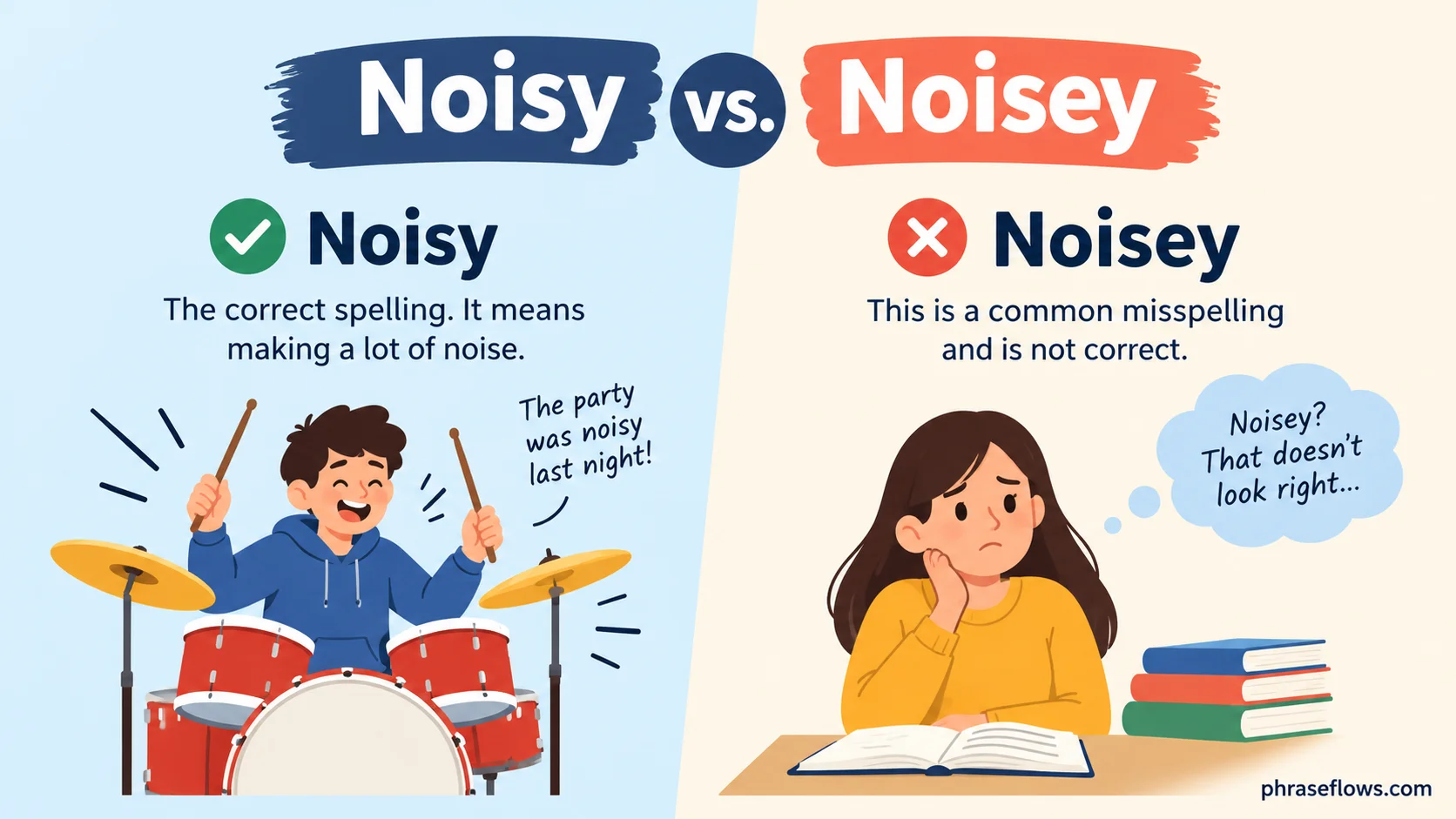

English spelling can be confusing, especially when two words look almost the same. Noisy vs. Noisey: Which Is Correct and How to Use It? is a common question for English learners and writers. Although both spellings may look correct at first glance, only one is accepted in standard English. Knowing the difference can help you avoid common spelling mistakes and improve your writing.
The correct spelling is noisy, which means loud, full of noise, or making a lot of noise. You can use this adjective to describe a crowded street, a busy classroom, a barking dog, or a restaurant where people are talking loudly. For example, you might say, “The restaurant was too noisy” or “The street is noisy at night.” These everyday examples show how to use the word naturally in different situations.
On the other hand, noisey is a nonstandard spelling and is generally considered incorrect in modern English. The confusion often comes from English spelling patterns, as some words use the ending -ey. However, the word noisy follows a simple rule: when you add -y to noise, the final e drops. Understanding this spelling rule will help you remember the correct form and use noisy confidently in school assignments, professional emails, and everyday writing.
Noisy vs. Noisey: What’s the Difference?
The main difference between noisy vs. noisey comes down to standard spelling. Noisy is an established English adjective, while noisey is a nonstandard spelling when someone intends to describe something loud or full of noise.
According to the Cambridge Dictionary, noisy describes people or things that make a lot of noise. The word also appears in technical contexts, where it can describe an electronic signal containing unwanted interference or data containing irrelevant information.
Here’s a quick comparison:
| Word | Is it standard? | Meaning or use | Example |
| Noisy | Yes | Making or containing a lot of noise | The noisy traffic kept us awake. |
| Noisey | No, not for the ordinary adjective | Usually an incorrect spelling of noisy | The noisey traffic kept us awake. |
| Noisey | Sometimes, as a proper name | May appear in a brand, title, or username | Use the official spelling of the name. |
The distinction matters because spell-checkers, teachers, and editors generally expect the standard spelling noisy. If you’re describing a loud room, a busy street, or a group of excited children, choose noisy.
Noisy vs. Noisey: A Quick Example
Consider these two sentences:
- Correct: The neighbors were noisy last night.
- Incorrect: The neighbors were noisey last night.
The first sentence follows standard English spelling. The second uses an extra letter that doesn’t belong in the ordinary adjective.
Remember this simple rule: noise + y = noisy. Once you recognize that pattern, choosing the correct spelling becomes much easier.
What Does Noisy Mean?
The adjective noisy describes someone or something that makes a lot of sound or creates an environment filled with noise. Depending on the context, the word can suggest anything from cheerful excitement to an unpleasant disturbance.
For example, children playing in a schoolyard may be noisy because they’re laughing, talking, and shouting. A construction site may be noisy because workers operate machinery. In both cases, the word describes a high level of sound, although the source and purpose differ.
The word can also describe something that produces more sound than you expect. A refrigerator that hums loudly, a car engine that rattles, or a computer fan that makes an unusual buzzing sound may all be described as noisy.
The Oxford Learner’s Dictionaries lists noisy as an adjective and identifies noisier and noisiest as its comparative and superlative forms.
Examples of Noisy in Sentences
Examples make it easier to understand how the word works in everyday writing.
- The classroom became noisy when the teacher left the room.
- We moved to a quieter apartment because our street was too noisy.
- The children were noisy during the birthday party.
- My old washing machine becomes noisy during the spin cycle.
- The restaurant was so noisy that we struggled to hear one another.
- The fans grew noisy as their team approached the goal.
- A noisy air conditioner interrupted my concentration.
- The construction workers started early, making the neighborhood noisy.
Notice that noisy can describe people, places, machines, and events. You don’t need a different spelling for each situation.
What Does Noisy Mean in Technical Writing?
The word has useful meanings beyond everyday sounds. In electronics, a noisy signal contains unwanted fluctuations or interference that can make the intended information harder to detect.
For instance, a microphone may pick up background traffic along with a person’s voice. The recording contains the desired speech, but unwanted sounds interfere with its clarity.
In data analysis, noisy data contains irrelevant variation, errors, or information that makes meaningful patterns harder to identify. A researcher studying customer behavior might encounter incomplete records or inconsistent measurements that complicate the analysis.
These technical uses follow the same spelling rule. Whether you’re describing a loud crowd or unreliable data, write noisy, not noisey.
Why Is Noisy the Correct Spelling?
The spelling becomes easier to remember when you look at how English forms adjectives. The word noisy comes from the noun noise combined with the suffix -y, which can mean “characterized by” or “full of.”
The transformation looks like this:
noise + y → noisy
When English adds the suffix -y to noise, the final e drops out. The resulting word keeps the original pronunciation pattern while following the conventional spelling.
The same pattern appears in several familiar words:
| Noun | Correct adjective | Example |
| Ice | Icy | The road became icy overnight. |
| Spice | Spicy | We ordered a spicy meal. |
| Grease | Greasy | The mechanic wiped his greasy hands. |
| Noise | Noisy | The noisy engine needs attention. |
These examples provide a useful memory aid. You wouldn’t normally write icey, spicey, or greasey in standard English. In the same way, you should write noisy rather than noisey.
However, English spelling patterns have exceptions. Don’t assume that every word ending in e follows exactly the same rule. When you’re uncertain, check a reliable dictionary.
Why Does Noisey Look Correct to Some Writers?
The spelling noisey may seem logical because English often uses -ey or -y in different words. Writers sometimes preserve the final e because they can still see it in the original noun noise.
Pronunciation can add to the confusion. In ordinary speech, noisy and the nonstandard spelling noisey would generally represent the same intended sound. Because the extra letter doesn’t create an obvious pronunciation difference, the spelling mistake can go unnoticed.
Still, English spelling depends on established written conventions rather than sound alone. The fact that an incorrect form looks reasonable doesn’t make it standard.
The easiest solution is to remember the word family: noise, noisy, noisier, and noisiest.
Is Noisey Ever Correct?
Although noisy is the correct spelling of the ordinary adjective, you may encounter Noisey in other contexts. The important distinction is whether the word describes sound or forms part of an official name.
For example, a person might choose Noisey as a username, an artist might use it in a creative title, or a company might adopt it as a brand name. Such uses don’t automatically make it the standard spelling of the adjective.
Proper names can follow their own conventions. If an organization officially spells its name Noisey, preserve that spelling when referring to the organization. Changing it to Noisy could mean you’ve written a different name.
Use these guidelines:
- Ordinary adjective: Write noisy.
- School assignment: Use noisy unless you’re quoting a source that uses another spelling.
- Creative title or username: Follow the creator’s chosen spelling.
- Official brand or organization: Check the official name before writing it.
- Direct quotation: Preserve the original spelling when accuracy requires an exact quotation.
The key point is that a nonstandard spelling can appear intentionally in a name without becoming the standard spelling for general writing.
Read More: In Tact vs. Intact: Which Spelling Is Correct in English?
How to Use Noisy Correctly in a Sentence
Once you’ve learned the spelling, the next step is using noisy naturally. Because it is an adjective, it describes a noun or gives information about a subject through a linking verb.
You can use it before a noun, after a linking verb, or in a sentence that compares two or more things.
Noisy Before a Noun
English speakers often place adjectives directly before the nouns they describe. This position lets readers understand the quality of something immediately.
Examples include:
- We found a noisy restaurant near the train station.
- The noisy children ran across the playground.
- A noisy engine can signal a mechanical problem.
- She moved away from the noisy street.
- The noisy crowd cheered for the winning team.
In each sentence, noisy describes a person, place, or object. The adjective doesn’t change its spelling based on whether the noun is singular or plural.
For example, you can write “a noisy classroom” or “several noisy classrooms.” The adjective stays the same.
Noisy After a Linking Verb
You can also place noisy after linking verbs such as become, seem, look, and sound when the adjective describes the subject.
Consider these examples:
- The classroom became noisy after lunch.
- The old refrigerator is noisy at night.
- The neighbors seem noisy whenever they host a party.
- The engine sounds noisy when the car accelerates.
- The office grew noisy as more people arrived.
In these sentences, the adjective describes the subject rather than an action. This is why “The engine sounds noisy” is correct.
Compare it with “The engine runs noisily.” In the second sentence, noisily is an adverb describing how the engine runs.
Noisy in Technical Contexts
Technical writing uses the adjective in much the same way as everyday English. The difference lies in what creates the unwanted sound or variation.
Examples include:
- The technician detected a noisy electrical signal.
- Background traffic produced a noisy audio recording.
- The research team removed several noisy observations from its dataset.
- A noisy sensor can make measurements less reliable.
- The analyst compared noisy data with a cleaner version.
When writing for a technical audience, explain what makes the signal or data noisy. That extra detail helps readers understand the problem rather than merely labeling it.
Noisy, Noisier, and Noisiest: What’s the Difference?
English uses three common forms of this adjective to express different levels of noise. Noisy describes a quality, noisier compares two things, and noisiest identifies the one with the greatest degree of that quality within a group.
These forms follow a spelling pattern in which the final y changes to i before the endings -er and -est.
| Form | Grammatical use | Example |
| Noisy | Positive form | The classroom is noisy. |
| Noisier | Comparative form | This classroom is noisier than the library. |
| Noisiest | Superlative form | This is the noisiest classroom in the school. |
The same pattern appears in adjectives such as happy, happier, happiest and easy, easier, easiest.
When Should You Use Noisy?
Use noisy when you describe a person, place, or object without making a direct comparison.
For example: “The city is noisy during rush hour.”
The sentence tells readers about the city’s sound level. It doesn’t claim that the city is louder than another place.
When Should You Use Noisier?
Use noisier when comparing two people, places, objects, or situations.
For example: “The highway is noisier than the residential street.”
The comparison indicates that the highway produces more noise than the residential street. The word than often appears in comparative sentences, although context can sometimes make the comparison clear without it.
When Should You Use Noisiest?
Use noisiest when identifying the loudest member of a group of three or more, or the loudest within a defined set.
For example: “Of all the rooms in the building, the cafeteria is the noisiest.”
The sentence identifies the cafeteria as having the greatest level of noise among the rooms being considered.
Remember the correct sequence:
Noisy → Noisier → Noisiest
Avoid forms such as noiseyer and noiseyest. They don’t follow the standard spelling pattern.
Conclusion:
The difference between noisy and noisey is simple once you understand the spelling rule. Noisy is the correct spelling in standard English, while noisey is a common misspelling. The word noisy describes something loud, full of noise, or making a lot of noise. Remember that the base word noise drops its final e when you add -y, giving you noisy. Whether you’re writing a school assignment, a professional email, or a website article, using the correct spelling will help you communicate clearly and improve your English writing skills.
FAQs:
1. Is it noisy or noisey?
Noisy is the correct spelling. Noisey is considered a misspelling in standard English.
2. What does noisy mean?
Noisy is an adjective that describes something loud, full of noise, or making a lot of noise. For example, a crowded street or a busy classroom can be noisy.
3. Why is noisey incorrect?
Noisey is incorrect because the standard spelling follows the pattern of adding -y to noise and dropping the final e. This creates noisy, not noisey.
4. How do you use noisy in a sentence?
You can use noisy to describe people, places, animals, or situations that produce a lot of sound. For example: “The children became noisy during the game.”
5. Is noisy the correct spelling in American and British English?
Yes. Noisy is the standard spelling in both American and British English. Noisey is generally considered a spelling error in both varieties.




1 thought on “Noisy vs. Noisey: Which Is Correct and How to Use It?”