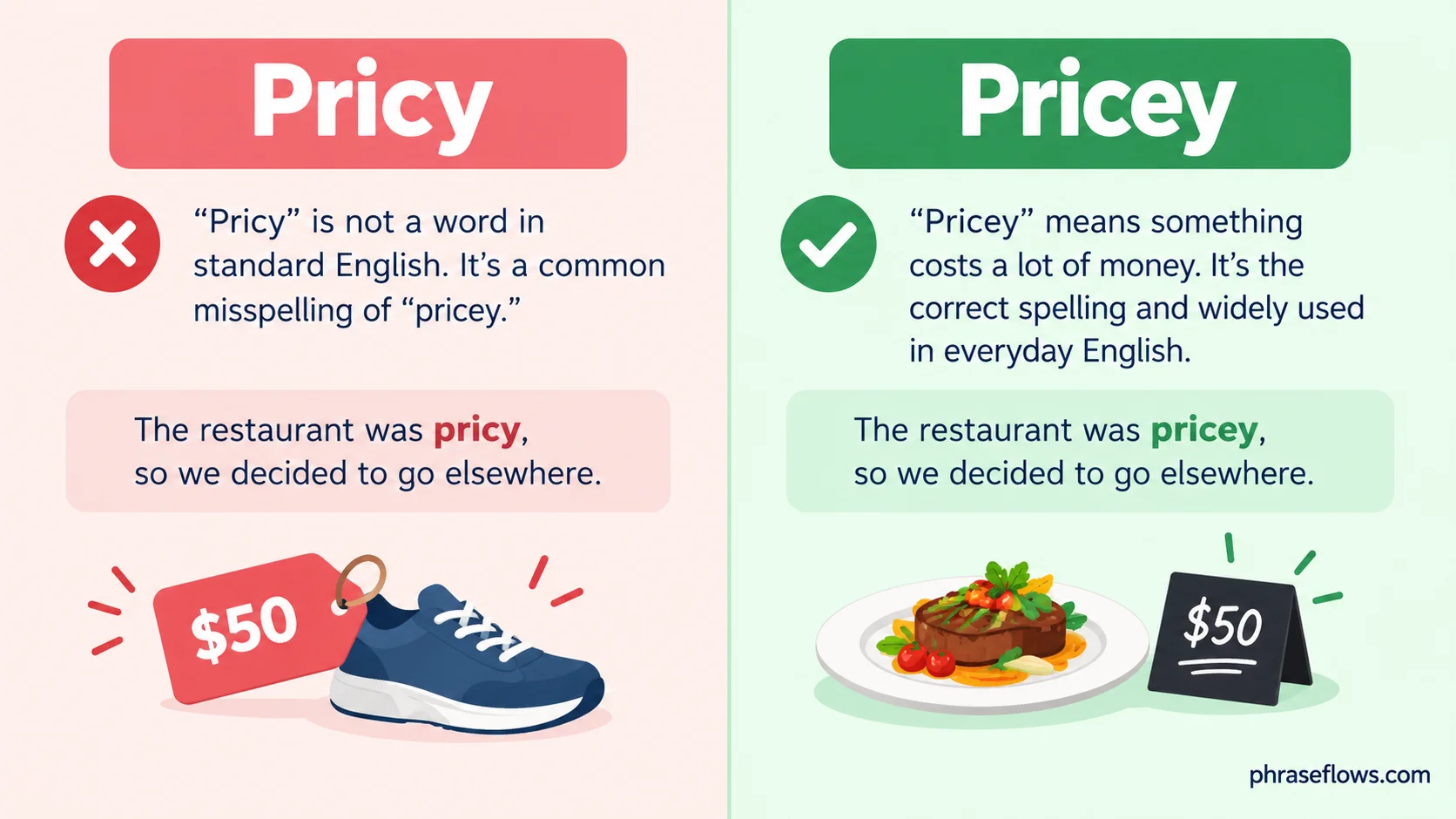

Have you ever paused while writing because you weren’t sure whether to use pricy vs. pricey? You’re not alone. Both spellings look correct at first glance, and they share the same meaning: expensive. However, one spelling is much more common in modern English, while the other is less frequently used. Knowing the difference can help you avoid spelling confusion and write with confidence.
The good news is that both pricy and pricey are accepted English spellings. They describe something that costs more than expected or seems expensive. However, pricey is the preferred spelling in everyday and professional writing. You’ll see it more often in product reviews, online discussions, articles, and general communication. Although pricy isn’t necessarily wrong, it may look less familiar to some readers.
Understanding pricy vs. pricey can make your writing clearer and more consistent. Whether you’re describing an expensive restaurant, reviewing a product, or writing a business email, choosing the right spelling helps your message look polished. In this guide, we’ll explore the meaning of both words, explain their usage, and share simple tips to help you remember which spelling to choose.
Pricy vs. Pricey: Which Spelling Is Correct?
Both pricy and pricey are correct spellings. Neither is automatically a spelling mistake. Major dictionaries recognize pricey and list pricy as an alternative spelling. Both describe something that costs more than you might want to pay.
definition in the Cambridge English Dictionary
+1
For most American English writing, pricey is the recommended choice because readers commonly recognize this spelling. You can use pricy when it matches a publication’s preferred style or when you want to preserve the spelling in a quotation.
Consider these examples:
- The new restaurant is pricey, but the food is excellent.
- The new restaurant is pricy, but the food is excellent.
Both sentences communicate the same message. The spelling changes, but the meaning stays the same.
Here’s a quick comparison:
| Feature | Pricey | Pricy |
| Correct spelling | Yes | Yes |
| Meaning | Expensive | Expensive |
| Part of speech | Adjective | Adjective |
| Pronunciation | Generally /ˈpraɪ.si/ | Generally /ˈpraɪ.si/ |
| Common use | More familiar | Alternative spelling |
| Best choice for general US writing | Recommended | Acceptable |
The simple rule: Choose pricey unless you have a specific reason to use pricy. If you already use pricy in a consistent style, you don’t need to treat it as an error.
What Does Pricey Mean?
Pricey is an informal adjective that means expensive or costing a lot of money. People often use it in everyday conversations when a product, service, meal, or experience costs more than they expected or would prefer to spend.
For example, imagine that you visit a restaurant with a menu full of appealing dishes. The food looks delicious, but the prices seem higher than those at similar restaurants nearby. You might say, “This place is a little pricey.”
That statement doesn’t necessarily mean the restaurant charges unfair prices. It simply expresses your opinion that the cost feels high. The same meal might seem affordable to someone with a larger budget.
The word also works well in product reviews and travel discussions. You might describe a laptop as pricey because it costs more than competing models, or call a hotel pricey because its nightly rate stretches your travel budget.
Cambridge Dictionary identifies pricey as an informal word for expensive and lists pricier and priciest as its comparative and superlative forms.
definition in the Cambridge English Dictionary
+1
Examples of Pricey in Sentences
Here are several examples that show how to use pricey naturally:
- Shopping: Those designer shoes are too pricey for my budget.
- Dining: The restaurant serves excellent food, but its lunch menu is pricey.
- Travel: We found a beautiful hotel near the beach, although it was quite pricey.
- Technology: The latest smartphone looks impressive, but it’s pricey compared with last year’s model.
- Housing: Apartments in that neighborhood are becoming increasingly pricey.
- Education: The specialized course is pricey, so students should compare its benefits with other options.
- Home improvement: Replacing the kitchen cabinets could be pricey if we hire a professional team.
Notice that pricey usually appears before a noun or after a linking verb.
Before a noun: “They purchased a pricey camera.”
After a linking verb: “The camera seems pricey.”
Both sentence structures are grammatically correct. The adjective describes the camera’s cost in each example.
What Does Pricy Mean?
Pricy is an alternative spelling of pricey. It carries the same meaning and serves the same grammatical purpose. If you describe a pair of shoes as pricy, you’re saying that the shoes cost a lot of money.
The spelling may look unusual because it removes the letter e from price before adding y. However, that difference doesn’t create a new meaning or change how the word functions.
For example:
- The concert tickets were pricy.
- We avoided the pricy shops near the tourist attractions.
- Buying a new computer can be pricy.
- Their vacation became pricy after they added several extra activities.
Each sentence works just as well with pricey.
Dictionary.com recognizes pricy as an alternative form of pricey, while Cambridge Dictionary identifies pricey and notes the alternative spelling in its entry.
Dictionary.com
+1
Examples of Pricy in Everyday Writing
Here are more examples showing how pricy works in different contexts:
| Context | Example sentence |
| Shopping | The leather jacket was pricy, so I waited for a sale. |
| Restaurants | We enjoyed the meal, although the desserts were pricy. |
| Travel | Flights during the holiday season can be pricy. |
| Technology | That gaming computer is pricy for a first-time buyer. |
| Housing | They moved away from the pricy downtown area. |
| Repairs | Fixing the old plumbing system could become pricy. |
These examples illustrate an important point: you don’t need a different sentence structure for pricy. Use it wherever pricey would fit grammatically.
For general American English content, however, pricey remains the more familiar choice. Selecting the familiar spelling can make your writing feel more consistent and immediately recognizable to readers.
What Is the Difference Between Pricy and Pricey?
The main difference between pricy vs. pricey is the spelling, not the meaning. Both words describe something expensive, and neither spelling changes the sentence’s grammar.
Still, understanding how people use these words can help you make better writing choices. Pricey is generally the more familiar form, while pricy remains an accepted alternative.
Here are the main points to remember:
- Meaning: Both words mean expensive.
- Pronunciation: Both generally sound the same.
- Grammar: Both function as adjectives.
- Tone: Both have an informal, conversational feel.
- Spelling preference: Pricey is the safer choice for most everyday American English writing.
Consider this example:
The hotel was pricey, but its location made the extra cost worthwhile.
You could replace pricey with pricy without changing the sentence’s meaning. However, you don’t gain anything by switching spellings halfway through an article.
Pricey vs. Pricy: A Quick Comparison
| Question | Answer |
| Are both spellings correct? | Yes. |
| Do they mean different things? | No. |
| Can you use both in a sentence? | Grammatically, yes, but consistent spelling is better. |
| Which spelling should you use in a US blog post? | Pricey. |
| Does pricy mean more expensive than pricey? | No. |
| Is either spelling a verb? | No. Both are adjectives. |
Remember: A spelling variation doesn’t automatically create a difference in meaning. In this case, both forms communicate the same idea.
Why Are There Two Spellings: Pricy or Pricey?
English contains many words with alternative spellings. Sometimes, these differences develop through changes in usage, regional preferences, or the way writers form new words.
The words pricy and pricey illustrate a spelling variation built around the noun price and the suffix -y.
The suffix -y often helps form adjectives that describe a quality or characteristic. For example, cloud becomes cloudy, and rain becomes rainy. Similarly, price gives us pricey, meaning expensive.
The spelling pricy drops the letter e before adding the suffix. English spelling doesn’t follow one perfectly uniform rule for every word, so alternative forms can become established through usage.
Is Pricey or Pricy the Original Spelling?
Dictionary.com dates the first recorded use of pricey to approximately 1930–1935 and traces its formation to price plus -y. It also recognizes pricy as an alternative spelling.
Dictionary.com
This information helps explain the word’s formation, but it doesn’t mean that every writer must use the same spelling in every situation.
The practical takeaway is straightforward: both forms are recognized, but pricey is the more useful default for most modern writing.
When Should You Use Pricey or Pricy?
Choosing between pricy and pricey doesn’t require a complicated grammar rule. In most situations, you can use either spelling without changing your message.
However, your audience and the type of writing still matter.
Use Pricey in General American English Writing
If you’re writing a blog post, product review, email, or article for an American audience, choose pricey.
It’s a familiar spelling that readers can recognize quickly. It also matches the form used as the main dictionary entry in sources such as Cambridge Dictionary and Oxford Learner’s Dictionaries.
definition in the Cambridge English Dictionary
+1
For example:
- This laptop is too pricey for everyday use.
- We found a pricey restaurant near the hotel.
- The repair bill was surprisingly pricey.
You can use pricey in casual writing and general published content. Just remember that it has a more conversational tone than words such as expensive or costly.
Use Pricy When Your Preferred Style Calls for It
Although pricey is the recommended default, pricy isn’t inherently wrong.
You might use pricy when following an established editorial style, maintaining a writer’s original wording, or keeping spelling consistent with an existing publication.
For instance, if a publication consistently uses pricy throughout its articles, you can follow that preference. There’s no need to change every occurrence merely because another spelling is more familiar.
The important thing is to follow your chosen style consistently.
Pricey vs. Pricy in Formal Writing
Both spellings can appear in written content, but the word itself is generally informal.
If you’re preparing an academic paper, legal document, formal business report, or professional proposal, consider whether expensive or costly better suits the tone.
Compare these examples:
- Conversational: The proposed software is pricey.
- Neutral: The proposed software is expensive.
- More formal: The proposed software represents a substantial expense.
Each version communicates a similar idea, but the tone changes.
You don’t have to avoid pricey in every professional setting. Choose the word that best fits your audience, purpose, and preferred level of formality.
Common Mistakes to Avoid When Using Pricy and Pricey
Even though this spelling question is simple, a few misunderstandings can lead to unnecessary corrections.
Assuming Pricy Is Always Wrong
The most common mistake is treating pricy as a misspelling in every situation.
That isn’t accurate. Dictionaries recognize it as an alternative spelling of pricey. If you encounter it in a sentence, you shouldn’t automatically assume the writer made an error.
definition in the Cambridge English Dictionary
+1
Thinking Pricey Means More Expensive Than Pricy
Neither word describes a higher price than the other.
For example, “The first jacket is pricey” and “The second jacket is pricy” don’t tell you which jacket costs more. You need additional information to compare their prices.
The spelling alone doesn’t communicate a price difference.
Switching Between Both Spellings Unnecessarily
Imagine reading a blog post that uses pricey in one paragraph and pricy in the next. The reader will probably understand both, but the inconsistency may look like an editing oversight.
Choose one spelling and use it throughout the article.
Treating Pricey as a Synonym for Overpriced
This mistake involves meaning rather than spelling.
Pricey means expensive. Overpriced suggests that something costs more than it’s worth or more than a reasonable price for it.
For example, a high-quality laptop may be pricey because it includes advanced features. A similar laptop might be overpriced if its seller charges far more than comparable products justify.
The distinction matters because a high price doesn’t automatically mean poor value.
Pricey vs. Pricy: Examples in Everyday Situations
Examples make the difference easier to understand. In each pair below, both spellings communicate the same idea.
| Situation | Using Pricey | Using Pricy |
| Shopping | These shoes are pricey. | These shoes are pricy. |
| Dining | That café serves pricey meals. | That café serves pricy meals. |
| Travel | We booked a pricey flight. | We booked a pricy flight. |
| Technology | The latest phone is pricey. | The latest phone is pricy. |
| Housing | They live in a pricey neighborhood. | They live in a pricy neighborhood. |
| Home repairs | The renovation could be pricey. | The renovation could be pricy. |
A Practical Case Study: Choosing a Word for a Product Review
Suppose you’re writing a review of a new laptop. The device performs well, has a bright screen, and offers excellent battery life. However, its price is higher than that of several competing models.
You could write:
“The laptop is pricey, but its performance and battery life may justify the extra cost.”
This sentence works because pricey describes the laptop’s high cost without automatically suggesting that the purchase is a bad decision.
You could replace pricey with pricy and preserve the meaning. Nevertheless, choosing pricey keeps the spelling familiar and consistent with common dictionary usage.
The lesson: Select your spelling based on clarity and consistency. Select your adjective based on the point you want to make.
Read More: Suprise vs. Surprise: Which Is the Correct Spelling?
Synonyms for Pricey and Pricy
Sometimes, the best way to improve your writing is to choose a more precise word. Although pricey and pricy work well in conversation, other adjectives can communicate a slightly different meaning.
Cambridge Dictionary and Oxford Learner’s Dictionaries list alternatives such as expensive and costly, while Oxford also distinguishes overpriced from the more general meaning of pricey.
definition in the Cambridge English Dictionary
+1
| Synonym | Meaning | Example |
| Expensive | Costing a lot of money; a neutral, general term | The computer is expensive. |
| Costly | Involving a high cost, sometimes with emphasis on the burden or consequences | The repair proved costly. |
| Overpriced | More expensive than seems justified by its value | The headphones are overpriced. |
| High-priced | Sold at a high price | The store specializes in high-priced furniture. |
| Exorbitant | Extremely expensive, often unreasonably so | The hotel charged exorbitant fees. |
| Affordable | Priced within someone’s available budget | We found an affordable apartment. |
| Inexpensive | Not costing much money | This is an inexpensive way to decorate a room. |
How to Choose the Best Synonym
The right word depends on what you want to communicate.
Use expensive when you simply want to describe a high price. Choose costly when the expense feels significant or creates a financial burden.
Use overpriced when you believe the price exceeds the item’s value. Choose exorbitant when the cost seems exceptionally high or unreasonable.
Finally, use affordable or inexpensive when you want to emphasize a lower cost.
These distinctions help your writing become more precise without making it unnecessarily complicated.
Conclusion:
Both pricy and pricey are accepted spellings, and they have the same meaning: expensive. However, pricey is the more common and preferred form in modern British and American English. While you can use either spelling, choosing pricey is usually the better option for everyday and professional writing. Remembering this preference will help you avoid spelling confusion and keep your writing clear, natural, and consistent.
FAQs:
1. Is it pricy or pricey?
Both pricy and pricey are correct English spellings. However, pricey is more widely used and is generally the preferred choice.
2. What is the meaning of pricey?
Pricey means expensive or costing more than you might expect. For example, a restaurant with high menu prices can be described as pricey.
3. Is pricy considered a misspelling?
No. Pricy is an accepted spelling, not a misspelling. However, it is less common than pricey in modern English.
4. Do pricy and pricey have different meanings?
No. Both words have exactly the same meaning. They describe something expensive or costly. The only difference is their spelling and frequency of use.
5. Which spelling should I use in professional writing?
Use pricey in most professional writing. It is more familiar to readers and appears more frequently in modern English.


1 thought on “Pricy vs. Pricey: Which Spelling Is Correct?”