
Have you ever stopped while writing because you weren’t sure whether to spell the word until vs. untill? You’re not alone. This small spelling mistake is common among English learners and native speakers alike. Both forms look almost identical, but only one is accepted in standard English. Knowing the correct spelling can help you avoid errors in emails, school assignments, blog posts, and everyday messages.
The correct spelling is until, with just one L at the end. Untill is a misspelling and shouldn’t appear in polished or professional writing. The confusion often happens because people associate the word with till, which is also correct and has a similar meaning. Although these words are closely related in everyday usage, understanding their spelling and meaning will help you choose the right form.
Learning the difference between until vs. untill doesn’t take much time. In this guide, you’ll discover what until means, how to use it correctly in sentences, and how it compares with till and by. You’ll also see practical examples and common mistakes to avoid. Whether you’re writing a professional email, completing an assignment, or improving your English grammar, these simple explanations will help you write with greater confidence.
Until vs. Untill: Which Spelling Is Correct?
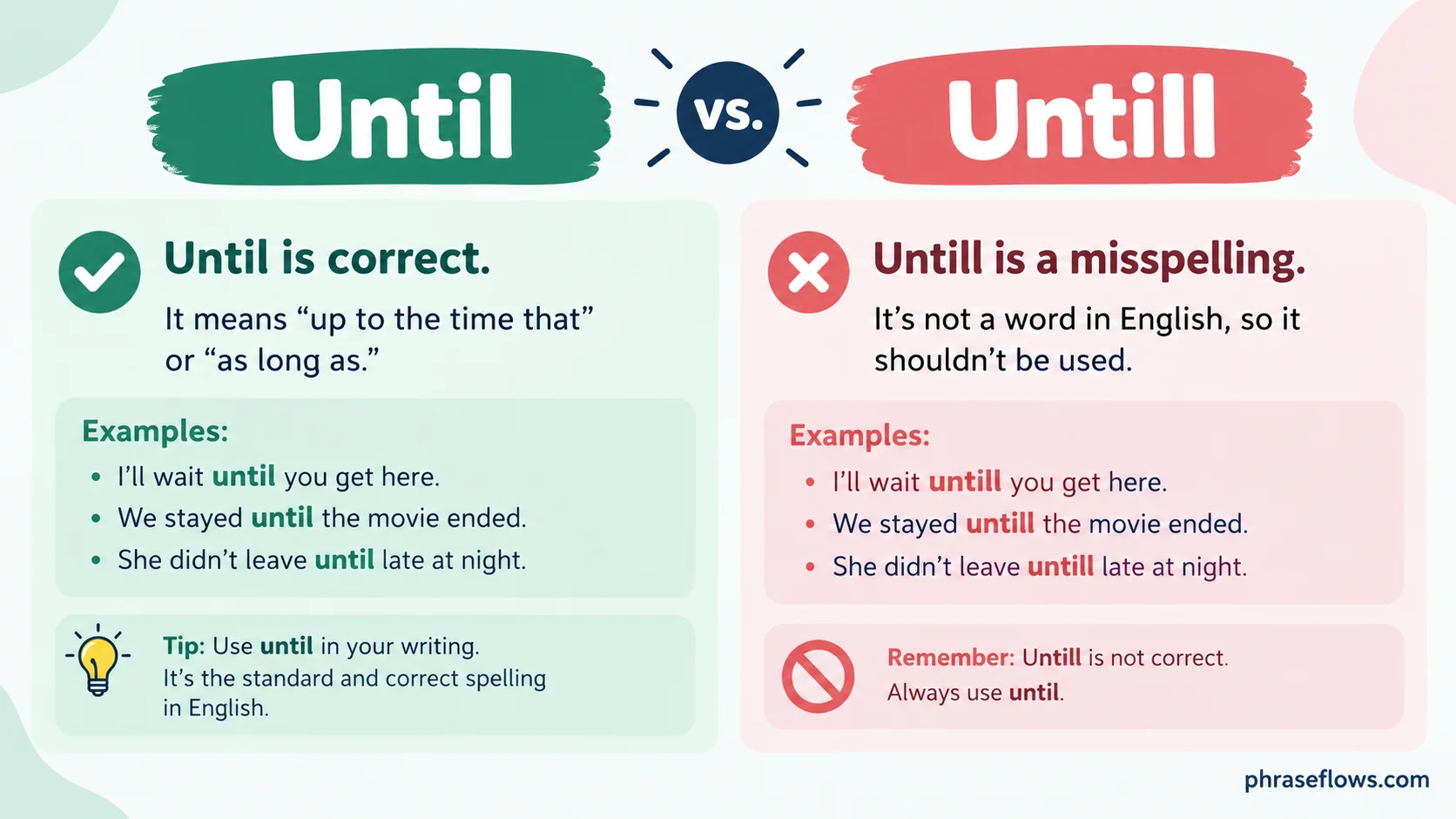
Until is correct, while untill is incorrect in standard English. The word until ends with a single l, not two. Adding another l creates a spelling error rather than a different word with its own meaning.
Cambridge Dictionary
+1
Consider these examples:
- Correct: I’ll wait until Monday to call the office.
- Incorrect: I’ll wait untill Monday to call the office.
- Correct: The store remains open until 9 p.m.
- Incorrect: The store remains open untill 9 p.m.
Notice that the sentences communicate the same intended message. The problem lies entirely in the spelling of untill.
| Feature | Until | Untill |
| Spelling | Correct | Incorrect |
| Number of final l’s | One | Two |
| Accepted in standard modern English | Yes | No |
| Meaning | Up to a particular time or point | No separate standard meaning |
| Suitable for formal writing | Yes | No |
The easiest rule to remember is simple: Always spell the word until with one l at the end.
Why Is “Until” the Correct Spelling?
English dictionaries recognize until as a standard word that functions as both a preposition and a conjunction. It describes the point up to which an action continues or a situation remains true.
English meaning – Cambridge Dictionary
+1
For example, consider the sentence, “We stayed at the beach until sunset.” The word until tells you when the stay ended. It connects the activity of staying at the beach with a specific point in time.
The spelling doesn’t change when you use the word in a different sentence. Whether you’re discussing a deadline, describing a daily routine, or explaining when something happened, the correct form remains until.
For a dictionary definition and additional examples, consult the Cambridge Dictionary’s entry for until.
Is “Untill” Ever Correct?
In standard modern English, untill is a misspelling of until. You might encounter it in an old document, an unedited online post, or a message containing a typing error. However, seeing a spelling mistake in published material doesn’t make it an accepted alternative.
When proofreading your work, replace untill with until. This small correction makes your writing clearer and helps you maintain a professional standard.
For example:
- Incorrect: Please remain here untill the manager returns.
- Correct: Please remain here until the manager returns.
The second sentence uses the standard spelling and communicates the intended meaning without distraction.
What Does “Until” Mean?
The word until means up to a particular time or event. It identifies the point at which an action stops, a situation changes, or a period of waiting ends.
Cambridge Dictionary
+1
Imagine that you start studying at 6 p.m. and stop at 9 p.m. You could say, “I studied until 9 p.m.” The word until connects your activity with its endpoint.
Here are several everyday examples:
- I worked until midnight.
- The museum stays open until Saturday.
- Wait until your name appears on the screen.
- She lived in Chicago until 2024.
- We can’t leave until everyone arrives.
In each sentence, until identifies a time or event that marks a boundary. Sometimes that boundary is a clock time. In other cases, it depends on something happening.
Examples of “Until” in Everyday Sentences
The meaning becomes easier to understand when you see how people use until in different situations.
Daily routines: “He sleeps until 7 a.m.” This sentence tells you when his sleeping period ends.
Work and deadlines: “The office remains open until 6 p.m.” The office continues operating up to the stated closing time.
Waiting for an event: “Wait until the traffic light turns green.” The instruction tells someone to wait for a specific event before proceeding.
Past situations: “They lived in the apartment until 2022.” The word identifies the point when their time living there ended.
Future plans: “I’ll stay here until you return.” The speaker plans to remain in the same place up to the other person’s return.
These examples show why until is useful. It links an action or situation to a clear endpoint without requiring a long explanation.
How “Until” Works in a Sentence
The word until has two main grammatical roles: preposition and subordinating conjunction. Its role depends on what follows it.
Cambridge Dictionary
+1
Until as a preposition
A preposition introduces a time expression or noun phrase.
Examples:
- We played cards until midnight.
- The exhibition runs until Friday.
- She waited until lunchtime.
In these sentences, midnight, Friday, and lunchtime identify the endpoint.
Until as a conjunction
A conjunction can introduce a clause containing a subject and a verb.
Examples:
- We waited until the rain stopped.
- Don’t leave until the teacher arrives.
- He continued practicing until he learned the song.
In the first example, “the rain stopped” forms a clause because it contains a subject (the rain) and a verb (stopped). The word until connects that event with the main action.
Knowing these two patterns helps you build sentences that sound natural and communicate exactly when something happens or ends.
Until vs. Untill: Key Differences Explained
The main difference between until and untill is spelling, not meaning. The first is the accepted English word, while the second is an error. However, comparing until with related words such as till and by helps explain how to use it accurately.
| Word or phrase | Correct? | Main use | Example |
| Until | Yes | Shows how long something continues | I’ll work until 5 p.m. |
| Untill | No | Misspelling of until | I’ll work untill 5 p.m. |
| Till | Yes | Expresses the same basic time relationship as until | I’ll work till 5 p.m. |
| By | Yes | Sets a deadline for completion | I’ll finish the report by 5 p.m. |
| Before | Yes | Places something earlier than a time or event | I’ll finish before 5 p.m. |
The distinction matters because correct spelling and correct word choice are two different things. You can spell until correctly but still use it in a sentence where by or before would communicate your meaning more accurately.
Why Do People Confuse “Until” and “Untill”?
English spelling contains many patterns that seem predictable until you encounter an exception. The confusion between until and untill often develops because writers recognize till as a legitimate word and assume that until should contain the same double-l ending.
That assumption is understandable, but it leads to the wrong spelling. The words until and till are both correct, yet until does not need an additional l at the end.
Several factors can contribute to this mistake:
- Word association: Writers connect until with till and mistakenly transfer the double-l spelling.
- Typing errors: Repeated letters can slip into a word when someone types quickly.
- Uncertain spelling patterns: English doesn’t follow one simple rule for every word ending in a particular sound.
- Lack of proofreading: Writers sometimes overlook small errors while concentrating on the meaning of a sentence.
For example, someone might write, “I’ll wait untill the meeting ends” because the word looks familiar. A quick spelling check would reveal the error.
The practical solution is to remember until as a complete word rather than trying to build its spelling from another word.
Does “Till” Make “Untill” Correct?
No. Till is a correct word, but its spelling doesn’t make untill acceptable.
Both until and till can describe an action or situation that continues up to a particular time. The Cambridge Dictionary recognizes both forms.
English meaning – Cambridge Dictionary
+1
Compare these sentences:
- Correct: We waited until noon.
- Correct: We waited till noon.
- Incorrect: We waited untill noon.
The first two sentences express the same basic idea. The third contains a spelling error.
Think of until and till as two valid routes to the same destination. You can choose either route when the sentence calls for that meaning, but you shouldn’t create a third spelling by combining parts of the two words.
Until vs. Till: Are They the Same?
Yes. When they refer to time, until and till generally have the same meaning. Both indicate that an action or situation continues up to a particular point.
Cambridge Dictionary
+1
For example:
- I’ll stay until Friday.
- I’ll stay till Friday.
Both sentences communicate the speaker’s plan to stay up to the stated point.
Writers sometimes assume that till is incorrect because it looks shorter than until. In fact, till is an established English word, not merely a shortened form of until. It predates until historically.
Grammarly
+1
When Should You Use “Until” Instead of “Till”?
Although both words are correct, your choice can depend on tone, audience, and context.
Choose until when:
- You’re writing a formal report or professional email.
- You want a neutral word that fits almost any situation.
- You’re writing educational content and want to avoid unnecessary style questions.
- You prefer the more familiar choice for general readers.
Choose till when:
- You’re writing a casual message or conversational dialogue.
- You want a shorter expression that fits the rhythm of your sentence.
- You’re using a natural, informal voice.
For example, a formal email might say, “Please remain available until the review is complete.” A text message to a friend could say, “I’ll be here till you get back.”
Both are grammatically acceptable. The difference is mainly stylistic rather than grammatical.
What About “‘Til”?
You might also encounter ’til, especially in song titles, informal messages, and creative writing. However, it’s not the same spelling as till.
For the safest choice in standard writing, use until or till. Grammarly’s discussion of these forms explains that till is an established word and that the apostrophe in ’til is generally unnecessary.
Grammarly
Examples:
- Standard: I’ll wait until tomorrow.
- Standard: I’ll wait till tomorrow.
- Informal form sometimes seen: I’ll wait ’til tomorrow.
- Incorrect: I’ll wait untill tomorrow.
If you’re unsure which version your audience expects, until is the simplest choice.
How to Use “Until” Correctly
Once you’ve learned the spelling, the next step is choosing the right sentence structure. You can use until with a clock time, a date, or an event that marks the end of an activity or situation.
Using “Until” With a Specific Time
Use until when an activity or condition continues up to a stated time.
Examples:
- The café stays open until 10 p.m.
- I studied until midnight.
- The road will remain closed until Monday morning.
- She worked until 6:30 p.m.
In each example, the time expression establishes the endpoint. The sentence describes what continues up to that point.
Writing tip: When you include a specific clock time, make sure the surrounding sentence clearly describes an ongoing action or situation. For example, “The shop stays open until 8 p.m.” works because the shop’s opening status continues through a period.
Using “Until” With an Event
You don’t always need a clock or calendar date. Sometimes, an event determines when an action ends.
Examples:
- Wait until your name is called.
- She practiced until she could play the song confidently.
- Don’t open the package until your birthday.
- We’ll remain here until the rain stops.
In these sentences, the endpoint depends on an event rather than a fixed time.
Notice the structure in “Wait until your name is called.” The phrase after until identifies the event that must occur before the waiting ends.
Using “Until” in Negative Sentences
Negative sentences are especially common with until. The phrase not until emphasizes that something did not happen before a particular point.
Examples:
- I didn’t eat until noon.
- He didn’t understand the instructions until the teacher explained them.
- We can’t leave until everyone arrives.
- She didn’t discover the error until the next morning.
Consider the sentence, “I didn’t eat until noon.” It means the speaker did not eat before noon. It does not mean that the speaker continued eating throughout the morning.
The same pattern works in the present and future:
- I don’t start work until 9 a.m.
- We won’t make a decision until Friday.
- They can’t begin until the equipment arrives.
These constructions help you express delays, conditions, and actions that depend on something else happening.
Can “Until” Start a Sentence?
Yes. You can place an until-clause at the beginning of a sentence when it creates a clear and natural structure.
For example:
- Until the rain stops, we’ll stay inside.
- Until the manager arrives, please wait in the lobby.
These sentences are grammatically acceptable. However, the Cambridge Dictionary’s grammar guide notes that English speakers do not normally place an until-clause before the main clause in many common constructions. A more natural option in those cases is to put the main clause first.
Cambridge Dictionary
For example:
- More natural in ordinary usage: We didn’t leave until the meeting ended.
- Less natural in ordinary usage: Until the meeting ended, we didn’t leave.
The second sentence isn’t automatically wrong in every context. The first simply follows the more common pattern for this meaning.
Which Verb Tense Follows “Until”?
When until refers to the future, English generally uses the present tense in the clause it introduces rather than will.
Correct: I’ll wait until she arrives.
Incorrect in standard usage: I’ll wait until she will arrive.
The same principle applies to many other future situations:
- We’ll stay here until the bus comes.
- Don’t begin until everyone is ready.
- I’ll keep reading until the library closes.
For events that will continue up to the completion of another action, the present perfect can also work.
For example: “We’ll wait until she has finished her presentation.”
Cambridge Dictionary
This pattern helps keep your sentences natural when you’re talking about future events.
Until vs. By: What’s the Difference?
The distinction between until and by is more important than it might seem. Both words can refer to a time limit, but they describe different relationships between an action and that time.
Until emphasizes how long an action or situation continues. By identifies a deadline by which something must happen or be completed.
Cambridge Dictionary
+1
Compare these examples:
| Sentence | Meaning |
| I’ll work until 5 p.m. | The work continues up to 5 p.m. |
| I’ll finish the report by 5 p.m. | The report must be finished no later than 5 p.m. |
| The office stays open until 5 p.m. | The office remains open up to the stated time. |
| Please submit the form by Friday. | Friday is the latest acceptable submission time. |
| We waited until the bus arrived. | The waiting continued up to the bus’s arrival. |
| Please arrive by noon. | You should arrive no later than noon. |
A simple way to remember the distinction is to ask yourself what you want to emphasize.
If you’re describing the duration of an activity, use until. If you’re setting a deadline for completing something, use by.
For example, “Please send me the file by Thursday” means you can send it earlier. “I’ll be away until Thursday” describes how long your absence lasts.
Using the wrong word can change the meaning of a sentence, even when both words are spelled correctly.
Common Mistakes to Avoid When Using “Until”
Even when you know the correct spelling, a few common mistakes can make your writing less precise. Fortunately, you can avoid them by checking the spelling and making sure the word fits the meaning of your sentence.
Adding an Extra “L”
This is the main mistake addressed in the until vs. untill debate.
- Incorrect: The event continues untill Friday.
- Correct: The event continues until Friday.
Remember that until has one l at the end. You don’t need to double the letter.
Confusing “Until” With “By”
Use until for continuation and by for a deadline.
- Incorrect: Please complete the assignment until Friday.
- Correct: Please complete the assignment by Friday.
The first sentence doesn’t express the intended deadline naturally. The second clearly states when the assignment must be finished.
However, this sentence is correct: “I’ll work on the assignment until Friday.” It describes how long the work will continue rather than setting a completion deadline.
Using “Until” Instead of “Before”
Although until and before can refer to time, they don’t always mean the same thing.
- Incorrect for the intended meaning: Please submit the form until you leave.
- Correct: Please submit the form before you leave.
Use before when an action must happen earlier than another event. Use until when a situation continues up to a particular point.
Cambridge Dictionary
Using “Until” for Quantities
The word until doesn’t normally describe a maximum quantity.
- Incorrect: The hall can accommodate until 300 people.
- Correct: The hall can accommodate up to 300 people.
The phrase up to expresses the maximum number. Similarly, use expressions such as as far as when describing distance in contexts where until doesn’t fit.
Cambridge Dictionary
Assuming “Till” Is Incorrect
Another common misconception is that till is an informal spelling mistake.
- Incorrect assumption: Only until is correct.
- Correct understanding: Both until and till are established English words.
You can use either word when referring to time. The choice depends on style and context, not on whether the word is grammatically valid.
Read More: Pricy vs. Pricey: Which Spelling Is Correct?
How to Remember the Correct Spelling of “Until”
The best spelling trick is also the simplest: Until has one L at the end.
You don’t need a complicated mnemonic or a long grammar rule. A few practical habits can help you remember the correct spelling whenever you write.
- Memorize the complete word: Learn until as one unit rather than building it from un and till.
- Read your sentence aloud: Hearing the sentence can help you spot awkward wording, although it won’t always reveal a spelling error.
- Use a spelling checker: A reliable checker can flag untill and suggest the correct form.
- Proofread repeated words: Small errors often survive when you concentrate on the larger message.
- Practice with examples: Writing a few sentences with until reinforces the correct spelling.
For instance, remember this sentence: “I’ll wait until the end of the day.”
You can adapt it to different situations without changing the spelling:
- I’ll wait until Monday.
- I’ll wait until the meeting ends.
- I’ll wait until you call.
- I’ll wait until the store opens.
The word remains the same in every example.
Quick Practice: Until or Untill?
Test your understanding by choosing the correct spelling in each sentence.
1. I’ll stay here ___ the bus arrives.
until
untill
2. The shop remains open ___ 8 p.m.
untill
until
3. We waited ___ the rain stopped.
until
untill
Check answers
Conclusion:
When comparing until vs. untill, the correct spelling is always until, with just one L at the end. Untill is a common spelling mistake and isn’t accepted in standard English. Although till is also correct and has a similar meaning, it’s important to understand how these words work in different sentences. Remembering the simple spelling rule will help you avoid confusion and improve your everyday, academic, and professional writing. Whenever you’re unsure, choose until to keep your writing clear and accurate.
FAQs:
1. Is it until or untill?
Until is the correct spelling in standard English. Untill is a misspelling because the word ends with only one L.
2. Why do people spell until as untill?
People often add an extra L because they confuse until with other words or spelling patterns. However, the correct form always has one L at the end.
3. Does until have the same meaning as till?
Yes. Until and till can both refer to the time when an action or situation ends. For example, “I’ll wait until Friday” and “I’ll wait till Friday” have the same basic meaning.
4. What is the difference between until and by?
Until describes how long something continues, while by usually sets a deadline. For example, “I’ll work until 5 p.m.” describes when the work ends, whereas “Finish the task by 5 p.m.” gives a deadline.
5. Is until one word or two words?
Until is always written as one word. It doesn’t need a hyphen, space, or extra letter.


1 thought on “Until vs. Untill: Which Spelling Is Correct and What’s the Difference?”