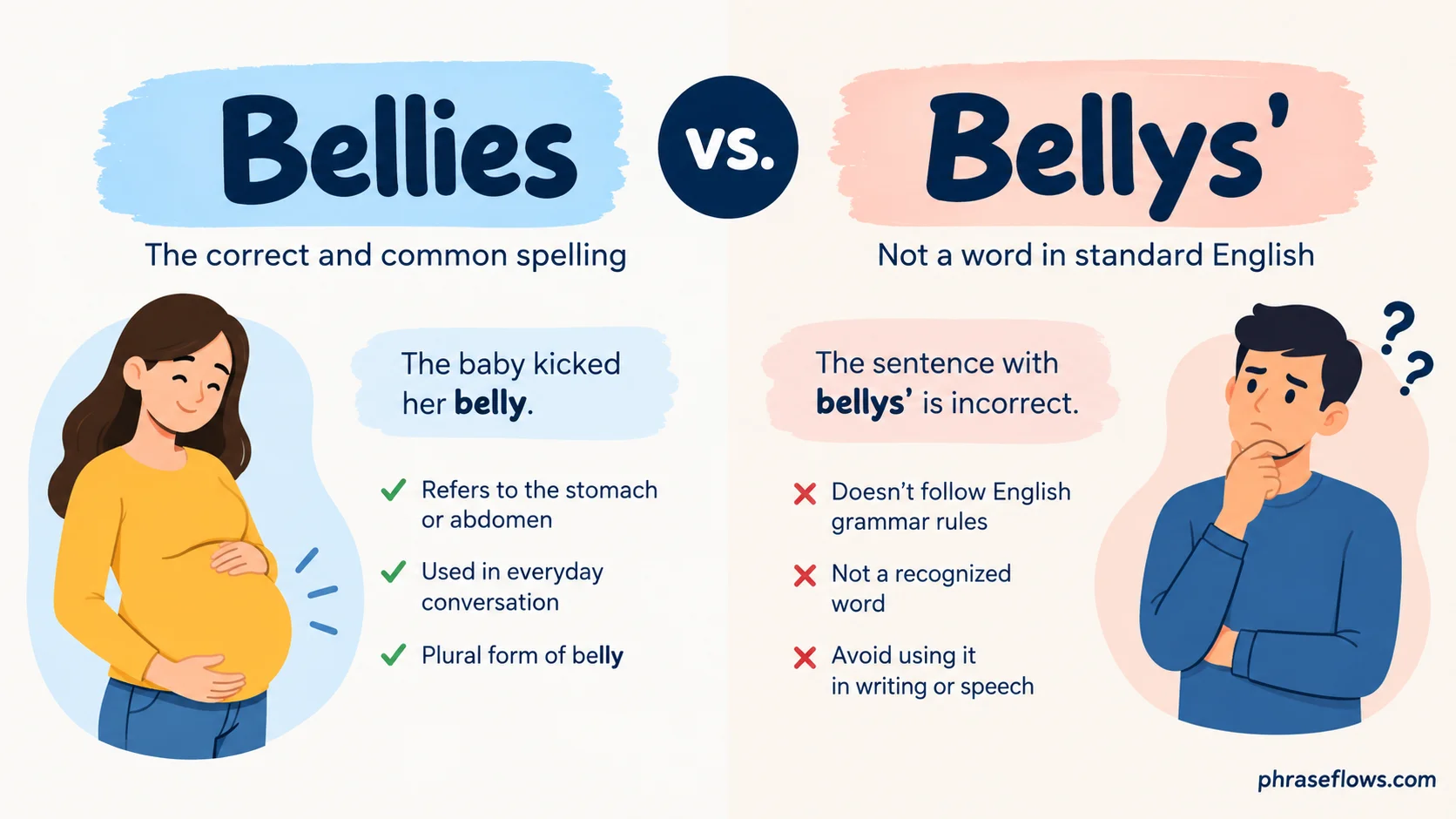

Have you ever wondered whether bellies vs. bellys is the correct spelling? These two forms may look similar and sound the same, which makes them a common source of confusion in English writing. Although adding s works for many English nouns, some words follow different spelling rules when forming their plurals. Knowing these rules helps you avoid common spelling mistakes and communicate more clearly.
The correct spelling is bellies, while bellys is incorrect in standard English. The word belly becomes bellies because it ends in a consonant followed by y. According to this pluralization rule, you change the final y to ies. For example, baby becomes babies, and city becomes cities. This simple rule explains why you should write “The children have full bellies” rather than “The children have full bellys.”
Understanding Bellies vs. Bellys: Which Spelling Is Correct? can improve your grammar, spelling, and overall writing skills. Whether you’re writing emails, completing school assignments, creating social media posts, or preparing professional documents, using the correct plural form makes your writing more accurate. In this guide, you’ll learn the spelling rule, see practical sentence examples, and discover how to avoid this common English mistake with confidence.
Bellies vs. Bellys: Which One Is Correct?
Bellies is the correct spelling when you want to refer to more than one belly. The word bellys is a common spelling mistake when used as the ordinary plural of belly. The distinction comes from the way English forms plurals of nouns ending in a consonant and y.
Consider a simple example. If one puppy has a belly and three puppies have three bellies, you would write, “The puppies rolled onto their bellies.” Writing “The puppies rolled onto their bellys” would introduce a spelling error.
Here’s a quick comparison of the most relevant forms:
| Word | Correct? | Meaning or use | Example |
| Belly | Yes | Singular noun | The baby rested on her belly. |
| Bellies | Yes | Plural noun | The puppies had full bellies. |
| Bellys | No, as a standard plural | Incorrect spelling of the plural | Write bellies instead. |
| Belly’s | Yes | Singular possessive or contraction | The baby’s belly’s shape was unusual. |
| Bellies’ | Yes | Plural possessive | The illustrations showed the bellies’ different shapes. |
The key is to identify what you want the word to express. If you’re talking about multiple stomach areas, use bellies. If you’re showing ownership or forming a contraction, an apostrophe may be necessary.
Why Do People Confuse Bellies and Bellys?
English spelling can be tricky because many nouns form plurals by simply adding -s. For example, book becomes books, and chair becomes chairs. This familiar pattern encourages writers to apply the same rule to every noun.
However, nouns ending in a consonant followed by y generally follow a different pattern. The final y changes to i before you add -es. Because belly ends in l followed by y, its plural becomes bellies.
The mistake is understandable, but the correction is straightforward: remember the letter immediately before the final y. That letter helps you determine which plural pattern to use.
What Does Bellies Mean?
The word bellies is the plural of belly. It commonly refers to the abdominal area of people or animals. In everyday English, people often use belly as a casual alternative to stomach, tummy, or abdomen, although these terms aren’t always exact medical equivalents.
For example, a parent might say that a baby has a full belly after a meal. A veterinarian might describe an animal’s belly during an examination. In both situations, belly refers to a part of the body, and bellies refers to more than one.
The word also has meanings beyond the human or animal body. English speakers sometimes use belly to describe a rounded, bulging, or curved part of an object. The phrase “the belly of an aircraft,” for instance, refers to its underside. The plural bellies can describe several such parts.
The Cambridge Dictionary recognizes both the body-related meaning and the rounded part of an object. Understanding these uses helps you recognize the word in different contexts.
Examples of Bellies in Sentences
Examples make the meaning and spelling easier to remember. Notice how bellies refers to multiple people, animals, or objects in the following sentences.
- The puppies rolled onto their bellies while playing in the yard.
- The children held their bellies after laughing at a funny story.
- The fish had silver bellies that reflected the light.
- The kittens rested with their bellies facing upward.
- The aircraft’s bellies appeared dark against the bright sky.
- The illustrations showed animals with different body shapes and rounded bellies.
Each sentence uses bellies as a plural noun. None requires the spelling bellys.
Is Bellies Always About the Stomach?
No. Although the word most often refers to a body part, its meaning depends on the context. A belly can describe the curved underside of an object or the thick, rounded section of something.
For instance, a writer might describe the belly of a ship when discussing its lower or curved portion. In a musical context, the belly of a string instrument can refer to its front surface. In these examples, the word doesn’t refer to a person’s digestive system.
The plural follows the same spelling rule regardless of meaning. Whether you’re describing people, animals, ships, or instruments, the standard plural of belly remains bellies.
Why Is Bellies the Correct Spelling?
The reason is a standard English pluralization rule. When a noun ends in a consonant + y, you generally replace the final y with i and add -es. This creates the plural form without leaving the original y in place.
The word belly ends with the letters l and y. Since l is a consonant, the word follows the consonant-plus-y pattern.
Here’s how the transformation works:
- Start with the singular noun: belly
- Identify the final two letters: ly
- Recognize that l is a consonant.
- Change the final y to i.
- Add -es to form the plural: bellies.
The spelling rule is consistent with many familiar English words. According to Merriam-Webster’s guide to plural -s and -es, nouns ending in a consonant followed by y generally form their plurals by changing y to i and adding -es.
The Consonant + Y Rule Explained
The simplest way to remember the rule is:
Consonant + y → change y to i + es
Here are several examples:
| Singular noun | Correct plural | Spelling change |
| Belly | Bellies | y → ies |
| Baby | Babies | y → ies |
| Puppy | Puppies | y → ies |
| City | Cities | y → ies |
| Family | Families | y → ies |
| Story | Stories | y → ies |
| Party | Parties | y → ies |
| Lady | Ladies | y → ies |
Look at the letter before the final y in each singular word. In belly, baby, puppy, and city, that letter is a consonant. The same spelling pattern applies to each noun.
This rule is especially useful when writing quickly. Rather than memorizing every plural separately, you can recognize the pattern and apply it to familiar words. When you encounter an unfamiliar noun, a dictionary can confirm whether it follows the usual rule or has an established exception.
When Do You Keep the Y and Add S?
Not every noun ending in y changes its final letter. If a noun ends in a vowel followed by y, you generally keep the y and add -s.
Compare these examples:
| Singular noun | Correct plural | Letter before y |
| Boy | Boys | o (vowel) |
| Toy | Toys | o (vowel) |
| Key | Keys | e (vowel) |
| Day | Days | a (vowel) |
| Monkey | Monkeys | e (vowel) |
| Donkey | Donkeys | e (vowel) |
The difference becomes clear when you compare belly with boy. In belly, the final y follows the consonant l, so the plural is bellies. In boy, the final y follows the vowel o, so the plural is boys.
The letter before y matters more than the final y itself. That small detail explains why some nouns change to -ies while others simply take -s.
There are exceptions elsewhere in English spelling, particularly with certain proper names and less common word endings. Still, the consonant-plus-y rule provides a reliable starting point for ordinary nouns such as belly.
Why Is Bellys Incorrect?
The spelling bellys doesn’t follow the standard plural rule for belly. It keeps the final y and adds -s, even though the word ends in a consonant followed by y.
A reader would probably understand what someone meant by bellys in an informal message. However, understanding a word doesn’t make its spelling standard. In school assignments, professional writing, website content, and edited publications, bellies is the form you should use.
Consider these examples:
| Incorrect sentence | Correct sentence |
| The puppies have round bellys. | The puppies have round bellies. |
| The babies rested on their bellys. | The babies rested on their bellies. |
| The fish had pale bellys. | The fish had pale bellies. |
| The children held their bellys while laughing. | The children held their bellies while laughing. |
Each correction follows the same rule. You don’t need a different explanation for every sentence; once you understand the spelling pattern, you can apply it consistently.
Can Bellys Ever Be Correct?
The answer depends on how the word is being used. Bellys is not the standard plural of belly, but a person or business might deliberately use Bellys as a stylized name, brand, username, or fictional name.
Proper names don’t always follow ordinary spelling conventions. A company might choose an unusual spelling to create a distinctive identity. In that case, you should preserve the official name when referring to it.
That exception doesn’t change the general grammar rule. If you simply want to refer to more than one belly, write bellies. Don’t use bellys merely because it seems shorter or easier to type.
Bellies vs. Belly’s vs. Bellies’: What’s the Difference?
Although bellies, belly’s, and bellies’ look similar, they serve different grammatical purposes. The difference involves number, possession, and apostrophe placement.
Use bellies for the ordinary plural. Use belly’s to show possession by one belly or to form a contraction. Use bellies’ to show possession by multiple bellies.
Understanding these distinctions prevents a common editing mistake: adding an apostrophe whenever a word ends in s or ies. Apostrophes don’t normally form plurals in English.
When to Use Bellies
Use bellies when you mean more than one belly and aren’t showing possession.
Examples:
- The puppies had full bellies after dinner.
- The children lay on their bellies to watch the ants.
- The fish displayed bright, silver bellies.
- Several animals rested on their bellies in the shade.
In each sentence, bellies simply identifies multiple body parts. No apostrophe is necessary.
A helpful test is to ask whether you’re talking about quantity. If you mean two or more bellies, the ordinary plural is bellies.
When to Use Belly’s
The form belly’s usually serves one of two purposes: it can show possession by a singular belly, or it can represent a contraction of belly is or belly has when the sentence supports that meaning.
For singular possession, consider this example:
“The baby’s belly’s shape changed as the baby moved.”
Here, belly’s indicates that the shape belongs to the baby’s belly. Although the sentence is grammatically possible, a clearer version would be, “The shape of the baby’s belly changed as the baby moved.” Rephrasing helps avoid two possessive constructions close together.
The contraction works differently:
- The belly’s getting bigger. This means “The belly is getting bigger.”
- The belly’s changed since yesterday. This means “The belly has changed since yesterday.”
Context determines whether belly’s means belly is, belly has, or possession. When the meaning isn’t clear, writing the full phrase can make the sentence easier to understand.
When to Use Bellies’
Use bellies’ to show possession by multiple bellies. The apostrophe comes after the final s because the plural noun already ends in s.
For example:
“The illustrations showed the bellies’ different shapes.”
The sentence indicates that the shapes belong to several bellies. The plural noun comes first, followed by an apostrophe to mark possession.
Compare the three forms:
- The belly: one belly, with no possession.
- The belly’s shape: the shape of one belly.
- The bellies’ shapes: the shapes of multiple bellies.
This pattern applies to many other English nouns. For instance, the dog’s toy shows possession by one dog, while the dogs’ toys shows possession by multiple dogs.
The most important distinction is simple: the plural doesn’t need an apostrophe, but the plural possessive does.
Common Mistakes to Avoid When Using Bellies
The spelling difference between bellies and bellys is only one potential source of confusion. Writers also make mistakes with apostrophes, singular and plural agreement, and nouns that follow different spelling patterns.
Here are the errors worth watching for.
Adding S Without Changing Y
The most obvious mistake is writing bellys instead of bellies. This happens when someone applies the standard -s plural pattern without checking the letters at the end of the noun.
Incorrect: The puppies have full bellys.
Correct: The puppies have full bellies.
Remember that belly ends in a consonant followed by y. Change the y to i and add -es.
Adding an Apostrophe to an Ordinary Plural
Some writers add an apostrophe because the word ends in s or ies. However, an apostrophe doesn’t belong in an ordinary plural.
Incorrect: The babies’ are sleeping.
Correct: The babies are sleeping.
The first sentence uses an apostrophe incorrectly if the writer simply means several babies are sleeping. The apostrophe would only be appropriate if the sentence expressed possession, as in “The babies’ blankets are clean.”
The same principle applies to bellies. Write bellies for the plural and reserve bellies’ for possession.
Forgetting Subject-Verb Agreement
A plural noun usually takes a plural verb when it serves as the subject of a sentence.
Incorrect: The puppies’ bellies is full.
Correct: The puppies’ bellies are full.
In the corrected sentence, bellies is plural, so the verb are agrees with it. The apostrophe in puppies’ shows that the bellies belong to the puppies.
Grammar works best when spelling, punctuation, and sentence structure support one another.
Assuming Every Word Ending in Y Follows the Same Rule
The final y alone doesn’t determine the plural spelling. You must check the letter immediately before it.
- Consonant + y: baby → babies
- Vowel + y: boy → boys
This comparison prevents overgeneralization. If you remember only one detail, remember to check the letter before the y.
Is Bellies Spelled Differently in American and British English?
No. American and British English both use bellies as the standard plural of belly. You don’t need to change the spelling when writing for readers in the United States or the United Kingdom.
Some English words have different American and British spellings. For example, color is common in American English, while colour is standard in British English. The plural of belly doesn’t follow that regional pattern.
The same spelling rule applies in both varieties:
- American English: The puppies rested on their bellies.
- British English: The puppies rested on their bellies.
The spelling remains the same even when pronunciation, vocabulary, or other spelling conventions differ between regions.
Is Belly the Same as Abdomen?
The words belly and abdomen overlap in meaning, but they don’t always suit the same situations. Belly is an everyday, informal term for the front part of the body between the chest and the legs. Abdomen is the more formal anatomical term.
For example, a parent might say, “The baby is lying on her belly.” In a medical report, a healthcare professional would be more likely to use abdomen when describing the relevant body region.
The choice depends on your audience and purpose. For a conversational blog post, belly often sounds natural. For medical or scientific writing, abdomen may offer greater precision.
Either way, when you need the plural of belly, the correct spelling remains bellies.
Read More: All-Time Favorite vs. All Times Favorite: Which Is Correct?
A Simple Way to Remember Bellies vs. Bellys
If you frequently confuse these spellings, use a short comparison to reinforce the rule. You don’t need to memorize a long list of grammar terms to get this word right.
Remember the pattern:
Belly → Bellies
Then compare it with two familiar examples:
- Baby → Babies
- City → Cities
All three singular nouns end in a consonant followed by y. Therefore, each changes its final y to i before adding -es.
Now compare them with these words:
- Boy → Boys
- Toy → Toys
- Day → Days
These nouns end in a vowel followed by y, so they generally keep the y and add -s.
A Quick Practice Test
Choose the correct spelling in each sentence before checking the answers.
- The puppies curled up on their (bellys / bellies).
- The (babys / babies) slept peacefully.
- The children played with their (toies / toys).
- The (citys / cities) attracted many visitors.
- The fish had shiny (bellys / bellies).
Answers: Bellies, babies, toys, cities, bellies.
These examples reinforce the difference between consonant-plus-y and vowel-plus-y endings. Once you recognize the pattern, choosing the correct plural becomes much easier.
Conclusion:
Understanding Bellies vs. Bellys: Which Spelling Is Correct? becomes easy once you learn the basic English pluralization rule. Bellies is the correct spelling, while bellys is a spelling mistake in standard English. When a noun ends in a consonant followed by y, you usually change the y to ies to make it plural. For example, baby becomes babies, and city becomes cities. Remembering this pattern can help you avoid common spelling errors and improve your writing. Whether you’re writing emails, school assignments, social media posts, or professional documents, choosing the correct spelling makes your communication clearer and more accurate.
FAQs:
Is “bellies” or “bellys” correct?
Bellies is correct in standard English. Bellys is an incorrect spelling. The word belly changes to bellies when you make it plural.
Why does “belly” change to “bellies” in the plural form?
The word belly ends in a consonant followed by y. English pluralization rules generally require changing the final y to ies in this situation.
What is the singular form of “bellies”?
The singular form is belly. For example, “The baby has a round belly.” The plural form is bellies, as in “The babies have round bellies.”
What are some other examples of words that change “y” to “ies”?
Common examples include baby → babies, city → cities, party → parties, and story → stories. These words follow the same general rule because a consonant comes before the final y.
Can I use “bellys” in informal writing?
It’s best to avoid bellys, even in informal writing, because it isn’t the standard plural spelling. Use bellies in conversations, text messages, social media posts, schoolwork, and professional documents to maintain correct spelling.




1 thought on “Bellies vs. Bellys: Which Spelling Is Correct?”