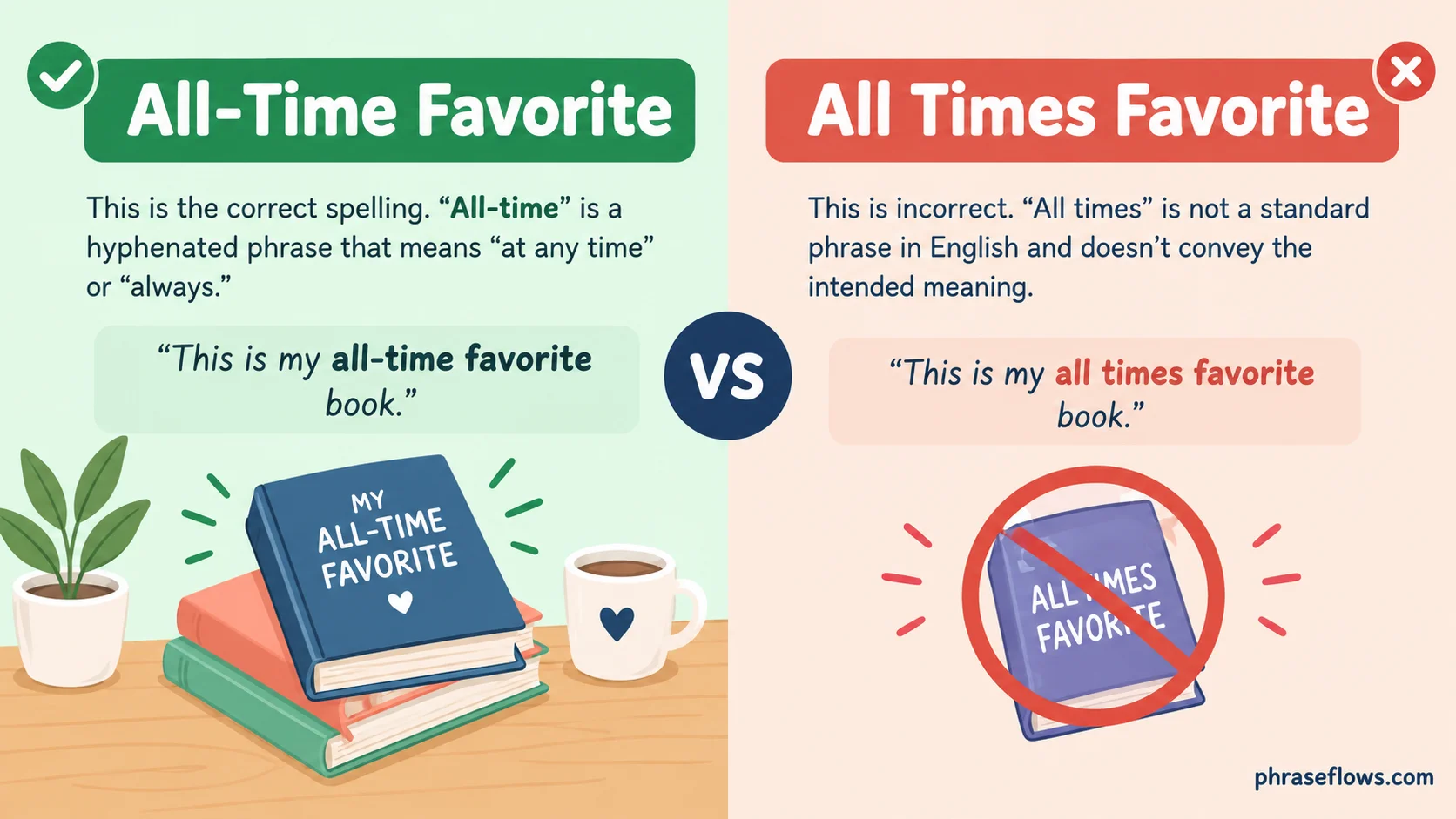

Have you ever wondered whether to write “all-time favorite” or “all times favorite”? These phrases look almost identical, so it’s easy to see why writers and English learners sometimes mix them up. However, only “all-time favorite” is correct in standard English. Knowing the difference can help you avoid common grammar mistakes and make your writing clearer, whether you’re chatting with friends or writing a professional article.
The phrase “all-time favorite” describes something you consider the best or most loved among all the things you’ve experienced. It can refer to a movie, song, book, food, or even a special memory. For example, you might say, “This is my all-time favorite movie,” when one film stands above all the others for you. The hyphen in “all-time” matters because the two words work together as a compound adjective to describe the noun that follows.
In contrast, “all times favorite” is generally considered incorrect because it doesn’t follow standard English usage. Some people add an s because they think it refers to different moments, years, or experiences. However, the established expression uses the singular word “time” with a hyphen when it appears before “favorite.” Once you understand this simple grammar rule, you can choose the correct phrase confidently and use it naturally in everyday conversations, reviews, social media posts, and other forms of writing.
All-Time Favorite vs. All Times Favorite: Which Is Correct?
“All-time favorite” is the correct standard expression. Use it when describing something you consider your favorite across a particular category or throughout your experience.
For example, if you’ve watched dozens of movies but enjoy one more than the others, you might call it your all-time favorite movie. The expression highlights its special place among your choices.
By contrast, all times favorite isn’t the standard expression for this meaning. The plural word times changes the construction without communicating the intended idea naturally.
Consider these examples:
- Correct: This is my all-time favorite movie.
- Incorrect: This is my all times favorite movie.
- Also correct: This is my favorite movie of all time.
The first and third sentences follow standard English usage. Both express a strong preference, although they use different grammatical structures.
Here’s a quick comparison:
| Expression | Correct? | Explanation |
| All-time favorite | Yes | The standard expression for a top personal choice |
| All times favorite | No, not for this meaning | The wording doesn’t follow the established expression |
| All time favorite | Not preferred in edited writing | The compound hyphen is missing |
| Favorite of all time | Yes | A correct alternative with a different structure |
| All-time favorites | Yes | The plural form for multiple favorite choices |
The easiest rule to remember is simple: Write all-time favorite when you mean favorite of all time. Keep time singular and retain the hyphen.
What Does All-Time Favorite Mean?
An all-time favorite is a person, place, object, or experience that ranks among your strongest preferences. It often describes something you like more than any other option in its category.
For example, your all-time favorite book might be a novel you enjoyed years ago and still love today. Your friend’s choice could be completely different. Both preferences are valid because the expression describes personal taste rather than a universal ranking.
You also don’t need to love something for decades before calling it your all-time favorite. You might discover a new song today and immediately decide it deserves that title. The phrase emphasizes how highly you rank it, not necessarily how long you’ve known it.
The Collins English Dictionary definition of all-time explains that the adjective compares something with others of the same type across history. In everyday conversation, however, people also use the expression to describe personal favorites within their own experience.
Collins English Dictionary
Examples of All-Time Favorite in Everyday English
You can use the phrase in many situations:
- Movies: This is my all-time favorite movie.
- Books: That novel remains my all-time favorite.
- Music: This is my all-time favorite song.
- Food: Homemade lasagna is my all-time favorite meal.
- Sports: She’s my all-time favorite basketball player.
- Travel: Kyoto is one of my all-time favorite places to visit.
- Personal experiences: That family vacation is one of my all-time favorite memories.
Each example expresses a strong preference. The phrase works whether you’re discussing entertainment, everyday choices, or meaningful experiences.
Does All-Time Favorite Mean the Best Ever?
Not necessarily. Although the expressions often overlap, they can carry slightly different meanings.
All-time favorite usually emphasizes personal preference. Best of all time often suggests a broader judgment of quality, achievement, or importance.
For example:
- This is my all-time favorite novel. — You enjoy this novel more than other novels.
- This is one of the best novels of all time. — You believe the novel ranks among the greatest ever written.
A novel can be your personal favorite without being widely regarded as the greatest literary work ever written. Likewise, a highly acclaimed book might not appeal to your personal taste.
Understanding this distinction helps you choose words that express your meaning accurately.
Why Is All-Time Favorite Hyphenated?
The hyphen in all-time favorite connects all and time into one established descriptive unit. The compound adjective all-time refers to the entire relevant period or to comparisons across history.
English uses hyphens in many compound expressions to make their structure clearer. For example, full-time employee, long-term plan, and high-speed internet each contain words that work together as a modifier.
Here are several familiar examples:
- All-time favorite: This is my all-time favorite restaurant.
- All-time record: The athlete set an all-time record.
- All-time high: The company’s sales reached an all-time high.
- All-time low: The temperature dropped to an all-time low.
- All-time great: Many fans consider her an all-time great.
In each case, all-time expresses a unified idea rather than referring to separate occasions.
How the Hyphen Improves Clarity
Consider these two sentences:
Without the standard hyphen:
This is my all time favorite book.
With the standard hyphen:
This is my all-time favorite book.
Most readers will understand both sentences. However, the second follows the preferred spelling in polished writing.
The distinction matters in blog posts, school assignments, professional emails, product reviews, and other content where consistent spelling improves readability.
Should You Always Use a Hyphen With All-Time?
Use the hyphen when writing the established compound adjective all-time, including when favorite functions as a noun.
Examples:
- My all-time favorite is a mystery novel.
- That singer is my all-time favorite.
- This remains one of my all-time favorites.
However, don’t insert a hyphen automatically whenever you see all and time together. The grammatical structure determines which form you need.
For instance, “my favorite song of all time” is correct without a hyphen in all time. The words appear in the phrase of all time, not in the compound adjective all-time.
Why Is All Times Favorite Incorrect?
The phrase all times favorite doesn’t express the intended meaning in standard English because it changes the established compound all-time into the plural phrase all times.
The word times commonly refers to repeated occasions or instances. You might say that someone called you three times or that you visited a museum several times. However, this plural construction doesn’t work as a substitute for all-time in the standard expression.
Consider these corrections:
| Incorrect sentence | Correct sentence |
| This is my all times favorite song. | This is my all-time favorite song. |
| Pizza is my all times favorite food. | Pizza is my all-time favorite food. |
| She is my all times favorite author. | She is my all-time favorite author. |
| That was my all times favorite vacation. | That was my all-time favorite vacation. |
The correction is straightforward: replace “all times favorite” with “all-time favorite.”
Can All Times Be Correct in Other Sentences?
Yes. The words all times can appear in grammatical sentences when the context calls for them. The problem isn’t that all times is always wrong. The problem is using it as a substitute for all-time in this particular expression.
For example:
- Please keep your identification with you at all times.
- The results were recorded at different times.
- The runner’s times improved throughout the season.
In the first example, at all times means continuously or whenever circumstances require it. The other examples refer to particular moments or measured durations.
These constructions have different meanings from all-time favorite. Understanding the context helps you avoid confusing them.
All-Time Favorite vs. Favorite of All Time
Here’s another useful distinction: both “all-time favorite” and “favorite of all time” are correct. They express nearly the same idea but use different grammatical structures.
The first is concise and often sounds natural in everyday conversation. The second makes the comparison across the entire relevant period explicit.
| All-Time Favorite | Favorite of All Time |
| This is my all-time favorite song. | This is my favorite song of all time. |
| She’s my all-time favorite author. | She’s my favorite author of all time. |
| That was my all-time favorite vacation. | That was my favorite vacation of all time. |
| He’s my all-time favorite athlete. | He’s my favorite athlete of all time. |
Both versions work well in standard American English.
When Should You Use All-Time Favorite?
Choose all-time favorite when you want a concise, natural expression that emphasizes a top personal choice.
For example:
This is my all-time favorite video game because I enjoy its story and characters.
The phrase fits neatly before a category such as movie, song, or game. It can also stand alone when the category is already clear.
Which dessert do you like best?
Cheesecake is my all-time favorite.
When Should You Use Favorite of All Time?
Use favorite of all time when that structure fits the rhythm of your sentence or when you want to emphasize the full comparison.
For example:
Of all the novels I’ve read, this is my favorite of all time.
You could also write:
This is my favorite novel of all time.
Both sentences are natural. The first places more emphasis on the comparison with other novels you’ve read.
Remember: Don’t write my favorite of all-time. In the standard expression of all time, the words remain separate and unhyphenated.
All-Time Favorite in Sentences
The best way to learn a phrase is to see how it works in different contexts. These examples show how to use all-time favorite naturally without changing its meaning.
All-Time Favorite in Everyday Conversation
People often use the phrase when discussing personal preferences with friends, family, or coworkers.
- Coffee is my all-time favorite morning drink.
- Spring is her all-time favorite season.
- That little Italian restaurant is our all-time favorite.
- Blue has always been my all-time favorite color.
These sentences communicate a strong preference without sounding overly formal.
All-Time Favorite in Movies, Books, and Music
Entertainment is one of the most natural contexts for this expression. You can use it to identify the film, novel, song, or performer you enjoy most.
- This is my all-time favorite movie because its story never gets old.
- That mystery novel is still my all-time favorite book.
- Their latest album might become my all-time favorite.
- She’s my all-time favorite singer because her voice feels distinctive.
Notice the difference between my all-time favorite and one of my all-time favorites. The first usually identifies a top choice in the category. The second allows for several favorites.
For example, you might have several all-time favorite songs even if you can’t choose just one.
All-Time Favorite in Food and Personal Preferences
The expression works equally well when you discuss meals, restaurants, hobbies, and other everyday interests.
- My grandmother’s apple pie is my all-time favorite dessert.
- Running outdoors is one of my all-time favorite activities.
- That café serves my all-time favorite sandwich.
- Reading historical fiction is one of my all-time favorite hobbies.
These examples also show that the phrase isn’t limited to famous or award-winning things. Your choice can be personal, ordinary, or meaningful to you.
All-Time Favorite in Sports and Entertainment
Sports fans frequently compare athletes, teams, and performances. The phrase can express personal loyalty without claiming that everyone shares the same opinion.
- She’s my all-time favorite basketball player.
- That match was one of my all-time favorite sporting events.
- He’s my all-time favorite comedian.
- That performance is one of my all-time favorites.
Be careful when discussing achievements rather than personal preferences. For example, one of the team’s best performances of all time is more natural than one of the team’s all-time favorite performances if you mean the team’s highest level of performance.
This distinction keeps your writing precise. Use favorite for preference and best for an evaluation of quality or achievement.
Common Mistakes to Avoid With All-Time Favorite
Even familiar expressions can cause spelling and grammar problems. Fortunately, a few simple rules will help you use all-time favorite correctly in almost any situation.
Leaving Out the Hyphen
Writers sometimes type all time favorite because they don’t hear the hyphen when speaking. Although readers may understand the intended meaning, all-time favorite is the preferred form in polished writing.
- Less polished: This is my all time favorite book.
- Preferred: This is my all-time favorite book.
Using Times Instead of Time
The word times doesn’t belong in this established expression.
- Incorrect: She’s my all times favorite actress.
- Correct: She’s my all-time favorite actress.
Keep time singular when using the compound expression.
Adding a Hyphen to Favorite of All Time
The opposite mistake is inserting a hyphen where it isn’t needed.
- Not preferred: This is my favorite movie of all-time.
- Correct: This is my favorite movie of all time.
The phrase of all time is a separate construction. It doesn’t require the hyphen found in all-time favorite.
Confusing Personal Preference With Universal Quality
Calling something your all-time favorite doesn’t mean it’s objectively the best option available.
For example, your all-time favorite book might be a simple story you loved growing up. Another reader might prefer a classic novel. Neither person needs to change their opinion.
Use all-time favorite when expressing personal preference. Choose best of all time when making a broader judgment about quality or achievement.
Read More: Pent vs. Pant: Meaning, Differences, Usage, and Examples Explained
All-Time Favorite vs. All Times Favorite: Quick Comparison
If you need a quick reference, the following table summarizes the main differences.
| Feature | All-Time Favorite | All Times Favorite |
| Standard English usage | Correct | Incorrect for this meaning |
| Spelling | Singular time with a hyphen | Uses plural times |
| Meaning | A top personal choice across the relevant period | Doesn’t convey the intended meaning naturally |
| Example | This is my all-time favorite song. | This is my all times favorite song. |
| Best alternative | Favorite of all time | Replace with all-time favorite |
The distinction comes down to the established compound expression. Use all-time favorite when describing something you like best, and use favorite of all time when that alternative suits your sentence.
Conclusion:
Understanding All-Time Favorite vs. All Times Favorite is simple once you learn the correct phrase and its grammatical role. All-time favorite is the standard English expression used to describe something you consider the best or most loved over your life or throughout history. The hyphen connects “all” and “time” to form a compound adjective that describes a noun. In contrast, all times favorite is generally incorrect in standard English. Whether you’re writing about your favorite movie, song, book, or food, choosing the correct phrase improves your grammar, writing clarity, and communication skills. Remember this simple rule, practice it with everyday examples, and you’ll be able to use all-time favorite confidently in both casual and professional writing.
FAQs:
Is “all-time favorite” or “all times favorite” correct?
All-time favorite is correct in standard English. The hyphen connects “all” and “time” to form a compound adjective. “All times favorite” is generally considered incorrect.
What does “all-time favorite” mean?
All-time favorite means something you consider your best or most loved choice among everything you’ve experienced. For example, “This song is my all-time favorite” means you like that song more than any other song.
Why does “all-time favorite” need a hyphen?
The hyphen joins “all” and “time” so they work together as a compound adjective before the noun “favorite.” This helps make the phrase clear and follows standard English usage.
Can I use “all-time favorite” in professional writing?
Yes. All-time favorite is appropriate in both casual and professional writing. You can use it in articles, reviews, reports, social media posts, and everyday conversations when describing a top choice.
Can “all-time favorite” describe food, movies, and songs?
Yes. You can use all-time favorite for food, movies, songs, books, people, and other things you particularly enjoy. For example, “Pizza is my all-time favorite food” identifies pizza as your most loved food choice.



1 thought on “All-Time Favorite vs. All Times Favorite: Which Is Correct?”