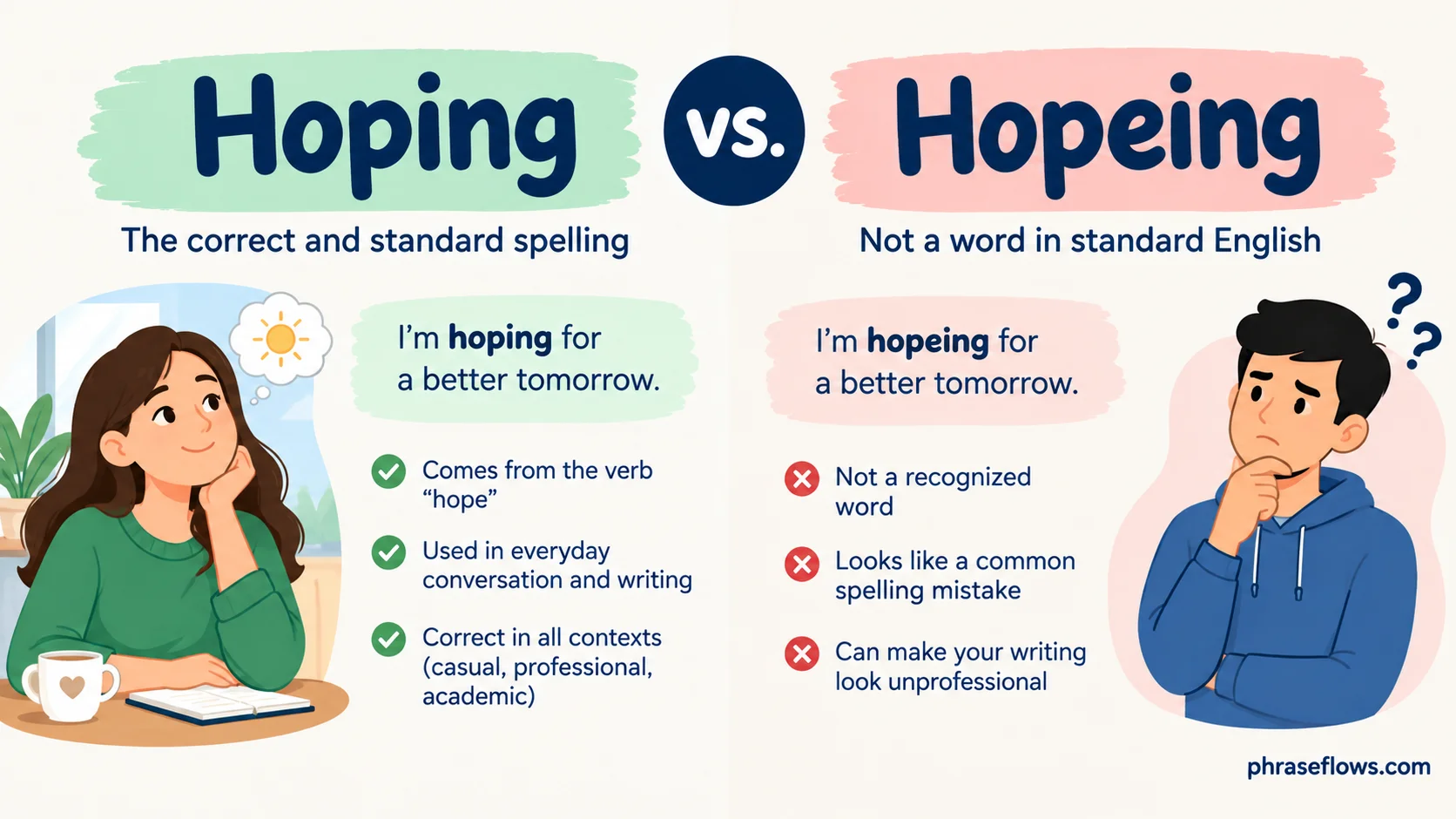

Have you ever wondered whether hoping vs. hopeing is the correct spelling? These two forms may look similar, but only one follows standard English spelling rules. Hoping is correct, while hopeing is a common spelling mistake. This confusion often occurs when writers add -ing to the verb hope and assume the final letter e should remain.
The difference between hoping vs. hopeing becomes easy to understand once you learn the silent e rule. In English, when a verb ends in a silent e, you usually drop that letter before adding -ing. For example, hope becomes hoping, just as make becomes making and take becomes taking. Remembering this simple grammar rule can help you avoid spelling errors and improve your writing accuracy.
In this guide, you’ll learn why hoping is the correct form, how the spelling rule works, and how to use the word naturally in sentences. You’ll also find practical examples and comparisons that make the difference easier to remember. Whether you’re writing a school assignment, an email, a social media post, or a professional document, understanding this rule will help you write more clearly and confidently.
Hoping vs. Hopeing: Which Spelling Is Correct?
Hoping is the correct spelling. It is the -ing form of the verb hope and describes wishing for or expecting a particular outcome. Hopeing is not the standard spelling of this word.
The confusion usually arises when writers add -ing directly to the complete spelling of hope. However, English spelling conventions call for removing the final silent e before adding this ending.
| Spelling | Correct or incorrect? | Explanation |
| Hoping | Correct | The standard -ing form of hope. |
| Hopeing | Incorrect | Keeps the final silent e when it should be dropped. |
Consider these examples:
- Correct: I’m hoping for good news.
- Incorrect: I’m hopeing for good news.
- Correct: She’s hoping to pass her exam.
- Incorrect: She’s hopeing to pass her exam.
- Correct: We’re hoping to visit next summer.
- Incorrect: We’re hopeing to visit next summer.
Notice that the meaning doesn’t change between the correct and incorrect sentences. The problem lies in the spelling, not the intended message.
If you’re writing a school assignment, professional email, application, or everyday message, choose hoping every time you mean the -ing form of hope.
Why Is Hoping Spelled Without an E?
The answer lies in the silent-e spelling rule. When a verb ends in a silent e, English generally drops that letter before adding the suffix -ing.
The word hope ends with a silent e. That final letter helps signal the vowel sound in the base word, but it doesn’t remain when you form hoping.
Here’s the change:
hope
Base verb
hop
Drop final e
hoping
Add -ing
The correct pattern is hope → hoping, not hope → hopeing.
The process is straightforward:
- Start with the base verb: hope.
- Remove the final silent e.
- Add -ing to form hoping.
This spelling pattern also appears in many familiar verbs. For example, make becomes making, write becomes writing, and drive becomes driving.
The Silent E Rule Explained
The final e often signals that a preceding vowel has a particular pronunciation. In hope, it helps distinguish the long o sound from the short vowel sound in hop.
When you add -ing, you remove that final e according to the standard spelling pattern. The resulting word, hoping, still retains the spelling needed for its familiar pronunciation.
Compare these examples:
| Base verb | Correct -ing form | Incorrect spelling |
| Hope | Hoping | Hopeing |
| Make | Making | Makeing |
| Write | Writing | Writeing |
| Take | Taking | Takeing |
| Drive | Driving | Driveing |
| Smile | Smiling | Smileing |
| Save | Saving | Saveing |
| Dance | Dancing | Danceing |
These examples show why learning a spelling pattern can be more useful than memorizing each word separately.
However, remember that English has exceptions. Verbs such as see and agree keep their final letters when adding -ing: seeing and agreeing. The silent-e rule is a reliable general pattern, not an exception-free formula.
What Does Hoping Mean?
Hoping means wishing for or expecting something to happen or be true. It usually expresses a desire for a particular outcome while recognizing that the outcome isn’t guaranteed.
For example, when someone says, “I’m hoping for a better result,” they want things to improve and believe improvement is possible.
According to the Cambridge Dictionary’s definition of hoping, hoping is the present participle of hope. The verb can describe a wish, an expectation, or a desire for something to happen.
Here are a few examples:
- I’m hoping for good news. The speaker wants to receive positive information.
- She’s hoping to get the job. She wants to succeed in her job application.
- They’re hoping the weather improves. They want the weather to become better.
- We’re hoping for a quick response. We would like someone to reply soon.
In each sentence, hoping expresses a desired outcome. The word works in everyday conversations, academic writing, professional emails, and personal messages.
Hoping as a Present Participle
A present participle is a verb form that ends in -ing. It commonly combines with a form of be to create a continuous verb phrase.
For example:
- I am hoping to hear from you soon.
- She is hoping for a promotion.
- They are hoping to finish the project today.
- He was hoping to see his friends.
- We were hoping for better weather.
In these examples, hoping forms part of the verb phrase. The accompanying form of be helps show the time and grammatical structure.
Although the word ends in -ing, it doesn’t always indicate an action that someone can physically observe. Hope describes a mental state, so hoping often expresses an ongoing wish or expectation.
You can also use it in an introductory phrase:
Hoping to avoid traffic, we left home early.
Here, the phrase explains why we left early. The spelling remains hoping, regardless of its position in the sentence.
Hoping as a Gerund
An -ing form can also function as a noun, in which case it is traditionally called a gerund.
Consider this sentence:
Hoping for a better result kept her motivated.
The phrase hoping for a better result functions as the subject of the sentence. It describes what kept her motivated.
Compare it with the following example:
She is hoping for a better result.
Here, is hoping forms the verb phrase.
Both sentences use the same spelling. The grammatical role changes, but the spelling rule doesn’t.
| Sentence | Grammatical use of hoping |
| She is hoping for good news. | Present participle in a continuous verb phrase |
| Hoping for good news kept him calm. | Gerund phrase functioning as the subject |
| They left early, hoping to arrive on time. | Participial phrase explaining their purpose |
Understanding these uses helps you recognize hoping in different sentence structures without confusing its spelling.
Hoping vs. Hope: What’s the Difference?
The words hope and hoping share the same basic meaning, but they serve different grammatical purposes.
Hope is the base form of the verb and can also function as a noun. Hoping is its -ing form, which appears in continuous verb phrases and other constructions.
| Word | Grammatical role | Example |
| Hope | Base verb | I hope everything goes well. |
| Hope | Noun | There is still hope for a solution. |
| Hopes | Third-person singular verb | She hopes to visit soon. |
| Hoped | Past-tense verb | We hoped for better results. |
| Hoping | Present participle or gerund | I’m hoping to hear from you. |
| Hopeful | Adjective | She feels hopeful about the outcome. |
| Hopeless | Adjective | The situation seemed hopeless. |
These forms belong to the same word family, but you can’t always substitute one for another.
For instance, “I hope to see you soon” is correct because hope to takes the base form of the following verb. “I’m hoping to see you soon” is also correct because am hoping forms a continuous verb phrase.
However, “I hope to seeing you soon” is incorrect in standard English. After hope to, use the base verb see, not seeing.
The key is to choose the form that fits the sentence’s grammatical structure.
Common Mistakes to Avoid When Using Hoping
Even though the difference between hoping and hopeing is small, several related mistakes can affect your writing. Learning to spot them will help you write more accurately.
Writing Hopeing Instead of Hoping
This is the most direct mistake. It happens when you add -ing without dropping the final silent e.
Incorrect: I’m hopeing everything works out.
Correct: I’m hoping everything works out.
The correction requires only one change: remove the extra e. You don’t need to change the sentence’s meaning or structure.
Confusing Hoping With Hopping
The words hoping and hopping are both correct, but they come from different base verbs and have different meanings.
- Hoping comes from hope and expresses a wish or expectation.
- Hopping comes from hop and describes jumping or moving in short leaps.
Their spelling changes follow different patterns:
- Hope → hoping: Drop the final e and add -ing.
- Hop → hopping: Double the final p and add -ing.
Examples:
- I’m hoping to visit my cousins this weekend.
- The rabbit is hopping across the garden.
The second word needs a doubled p because hop follows the consonant-doubling pattern when adding -ing. The first word drops its silent e instead.
| Base verb | Correct form | Meaning |
| Hope | Hoping | Wishing for something |
| Hop | Hopping | Jumping or moving by hops |
Mixing these words can change the meaning of a sentence entirely. If you want to express a wish, choose hoping. If you mean jumping, use hopping.
Using Hope and Hoping in the Wrong Structure
Another common mistake involves choosing the wrong verb form after certain expressions.
Consider these examples:
- Incorrect: I hope to hearing from you soon.
- Correct: I hope to hear from you soon.
- Correct: I’m hoping to hear from you soon.
The structure hope to + base verb is standard. When you use hoping to, the following verb also stays in its base form.
More examples:
- She hopes to win the competition.
- He is hoping to find a solution.
- We hoped to arrive before sunset.
In each case, win, find, and arrive follow to in their base forms.
Assuming Every Verb Follows the Same Rule
English spelling includes several patterns for adding -ing. Some verbs drop the final e, others double their final consonant, and some simply add the suffix.
Compare:
| Base verb | Spelling change | Correct form |
| Hope | Drop final e | Hoping |
| Make | Drop final e | Making |
| Run | Double final consonant | Running |
| Sit | Double final consonant | Sitting |
| Read | Add -ing | Reading |
| See | Keep the final letters | Seeing |
These differences explain why you can’t apply one spelling formula to every verb. For hope, though, the standard form remains hoping.
Hoping in Everyday Sentences
The best way to remember a word is to see how people use it in context. The following examples show how hoping fits naturally into common situations.
Examples From School and Education
- I’m hoping to improve my writing skills this semester.
- She is hoping to earn a good grade on her exam.
- We’re hoping our teacher will explain the topic again.
- He was hoping to finish his assignment before dinner.
In each example, hoping describes a desired academic outcome. It works whether the speaker refers to something happening now or something they wanted in the past.
Examples From Work and Professional Communication
- I’m hoping to hear back about the position soon.
- We’re hoping to complete the project by Friday.
- She is hoping the client approves the proposal.
- I was hoping you could share the updated report.
In professional writing, hoping can help you express a request or expectation politely. For example, “I was hoping you could share the report” often sounds softer than a direct demand.
Still, context matters. If you need to communicate a firm deadline or requirement, use direct wording rather than relying on hoping to convey urgency.
Examples From Everyday Life
- I’m hoping for sunny weather this weekend.
- They’re hoping to visit their grandparents soon.
- He is hoping his favorite team wins.
- We’re hoping the bus arrives on time.
- She’s hoping to learn a new language.
These examples demonstrate the word’s flexibility. You can use it for small daily expectations or important personal goals.
Examples With Different Sentence Structures
You can also place hoping in different parts of a sentence.
| Sentence | How hoping is used |
| I’m hoping for a reply. | Continuous verb phrase |
| Hoping for a reply, I checked my email again. | Introductory participial phrase |
| She kept hoping for a better outcome. | Following another verb |
| Their hoping for success encouraged the group. | Gerund phrase |
| We were hoping that you could join us. | Continuous verb phrase followed by a clause |
These examples show that hoping doesn’t need to appear at the beginning of a sentence or follow the same word every time. Its spelling stays the same across these constructions.
A Practical Case Study: Correcting Hoping in an Email
Imagine you’re writing a professional email to ask about an application. You type the following sentence:
I’m hopeing to receive an update about my application soon.
The reader will probably understand your meaning, but the spelling error may distract from your message.
Here’s how to correct it:
| Stage | Sentence | What changes? |
| Original | I’m hopeing to receive an update soon. | The final e is incorrectly retained. |
| Corrected | I’m hoping to receive an update soon. | The extra e is removed. |
| Polished | I’m hoping to receive an update about my application soon. | The sentence adds context and keeps the correct spelling. |
The spelling correction is simple. You don’t need to rewrite the entire sentence to fix the error.
This example also illustrates a useful editing habit: check common suffix patterns when proofreading. A quick review of words ending in -ing can catch mistakes such as hopeing, makeing, and writeing before you send or publish your work.
A Quick Trick to Remember Hoping vs. Hopeing
If you often forget which spelling is correct, use this simple reminder:
Drop the silent E before adding -ING.
Remember the pattern:
- Hope → Hoping
- Make → Making
- Write → Writing
- Take → Taking
- Drive → Driving
You can also use a short memory phrase:
Hope drops its final E before it starts hoping.
The phrase reinforces the spelling change without requiring you to memorize a complicated grammar explanation.
However, remember that some words behave differently, such as see → seeing. When you’re unsure about a less familiar verb, check a trusted dictionary rather than assuming the same pattern applies universally
Conclusion:
When comparing hoping vs. hopeing, remember that hoping is the correct spelling in standard English, while hopeing is a misspelling. The reason is simple: when you add -ing to a verb that ends in a silent e, you usually drop the final e. For example, hope becomes hoping, just as make becomes making and take becomes taking. Learning this spelling rule can help you avoid common mistakes and improve your writing accuracy. Whether you’re writing casually or professionally, using the correct form makes your message clearer and more polished.
FAQs:
Is it hoping or hopeing?
Hoping is the correct spelling. Hopeing is a misspelling because the final e in hope is dropped before adding -ing.
Why does hope become hoping?
The verb hope ends in a silent e. English spelling rules usually require you to remove this final letter before adding the -ing suffix. Therefore, hope + ing = hoping.
What does hoping mean?
Hoping means wishing for something to happen or expecting a positive result. For example, “I’m hoping for good news” expresses a wish for a favorable outcome.
What are some examples of hoping in sentences?
Here are three examples of the correct usage:
- I’m hoping to visit my friends this weekend.
- She is hoping for a positive answer.
- We are hoping to finish the project today.
What is the spelling rule for words ending in silent e?
When a verb ends in a silent e, you usually drop the e before adding -ing. For example, make becomes making, take becomes taking, and hope becomes hoping. This rule helps you recognize the correct spelling of many English words..


1 thought on “Hoping vs. Hopeing: Which Spelling Is Correct?”